







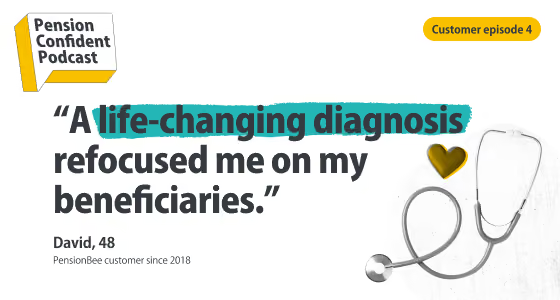
Bonus episode: “A life-changing diagnosis refocused me on my beneficiaries”



The following is a transcript of a bonus podcast episode of The Pension Confident Podcast. Listen to the episode or scroll on to read the conversation.
PHILIPPA: Hi, welcome back to another ‘Behind the Pensions’ bonus episode. This time we’re going to hear from David.
This year we’ve been enjoying hearing listeners like you tell us their pension stories. Today we’re going to hear from David and how an unexpected medical diagnosis brought his financial planning into really sharp focus.
I’m Philippa Lamb, and if you haven’t subscribed to the Pension Confident podcast yet, why not click that subscribe button right now? So you never miss an episode.
But just before we hear from David, here’s the usual disclaimer. Please do remember, anything discussed on this podcast shouldn’t be regarded as financial advice or as legal advice. And when investing, your capital is at risk.
Meet David
PHILIPPA: Now let’s meet David.
DAVID: My name’s David Barrow. I’m 48 years old. I live in the Northwest, so kind of South Manchester. And I own my own limited company. So my first time saving and thinking it was for retirement was when I was in my teenage years and my grandfather put me onto savings accounts and so on. I forget which account it was, but the ceramic pigs, if anyone remembers those. And then, yeah, so he was always very focused on future planning, my granddad. And I started off with a little pension then, but the reality is that actually I was in full-time employment, you know, employed until 10 years ago, 11 years ago now. And so I had a number of pensions that I was contributing to within the employment without really knowing what I was doing. So actually the reality is the first time I consciously started thinking about saving for my retirement and looking at what was in those pensions and then contributing towards my own, probably only about seven or eight years ago.
PHILIPPA: Now, pensions expert Dani Skerrett from PensionBee, she’s with me and she was listening along. Hi Dani, nice to see you. What struck me was that even though David learned about saving from his granddad early on, he only really started paying attention to his pensions around age 40, didn’t he?
DANI: Yeah.
PHILIPPA: Why do so many savers have this resistance around retirement planning, do you think? I mean, they’ll save for a holiday, they’ll save for a house, but not the income that’s going to keep their lifestyle up to scratch in their later years.
DANI: Yeah, we see this all the time when we hear people’s retirement planning stories, you know, that they start later in life and [it] tends to come from a conversation, maybe from an older relative. So this is a very, I think, relatable story. But we know that in the UK, people rather save than invest for various reasons. But the Financial Conduct Authority (FCA), their Financial Lives Survey shows that 90% of adults have cash savings and 35% had investments. That was in 2024.
PHILIPPA: We should just clarify, what is the difference exactly between saving and investment?
DANI: Yeah, so saving is much more straightforward to understand, which is probably why many more people have a savings account and tend to save rather than invest. So when you’re saving into a bog-standard savings account, you’re putting money away. There’s usually an interest rate attached to that. You know, that could be fixed or that could be variable. There are sort of different types, but you have this interest rate and your money’s tucked away, [it] might accrue interest over time, and then it’s there when you want to take it out and spend it.
PHILIPPA: So this is just like the bank or building society account lots of people have.
DANI: Exactly, yeah. And with investing, you’re putting, so say £100, you’re putting that same £100 into an account, but it’s not just sitting there waiting for you to withdraw it. It’s then invested into various things. So again, there’s lots of different types, but it’d likely be invested in stocks and shares, maybe bonds, maybe a bit of cash, could be property as well. So it’s sort of invested in a mix of things.
PHILIPPA: And the bottom line here is with investing, there’s going to be risk, right? I mean, you might get higher rewards, you might do, you might not, but there’s risk.
DANI: That’s what puts people off. Yeah, I think it’s that you could put your money into an investing account and the balance [goes] down, the sum [goes] down, whereas with saving, you know that you can withdraw that £100 that you stuck in when you need it.
Assessing his investments and consolidating
PHILIPPA: Let’s hear a bit more from David about exactly where he chose to put his money and why he made the choices he did.
DAVID: So I’ve definitely done plan switches, mainly based around the fact that I’d like to see my investments going into greener pots and maybe taking a little bit more risk than I would have done before. So the pensions that are with - I worked for some very large companies that invested really well. I’ve kind of left them where they are because I can see the growth. And then with the smaller companies where they weren’t working too well, I’ve taken control of them and put them into PensionBee. I like to have a little bit of risk or pseudo-risk, and then just a little bit of hands-off, it’ll look after itself. So that’s kind of my theory now on pensions and savings. But then my granddad’s thoughts come back for the other. Which is [to] keep it safe and let it grow on its own.
PHILIPPA: So, David, he’s thought about this quite hard, hasn’t he? He’s got these little pot sickles over his career, and he has consolidated some of them, he said. So just explain for us, what exactly does that mean?
DANI: Yeah, so consolidating or combining your pensions is basically just pulling them into one pot with one provider. So like David mentioned, he’s had multiple different jobs for, you know, different lengths of time and has accrued these small pots. Loads of people will have this, especially when they get to David’s age, because you’ve naturally -
PHILIPPA: different jobs, different pensions?
DANI: Yeah, had lots of different jobs, probably with different providers. So consolidating is just transferring those, bringing them all into one place. The benefits of that are you can see all of your savings in one place. You can keep track of them much easier. You can potentially save on fees you might be paying across, you know, having five different pots.
PHILIPPA: And paying fees on each of them.
DANI: Exactly and paying different fees. I think the benefit is you’re better able to manage from, from sort of one place. And people tend to do that at David’s age because you’re thinking about it a lot more. So when you’re in your 20s and 30s, maybe you’re thinking, I’ve got two or three pensions, but don’t really mind what’s in them, don’t really need to know where they are. But when you’re in your 40s or 50s, you might be thinking, well, actually, how much is that all together? So it’s just far easier to see in one place. With that, I’d say that it’s not always best to combine.
PHILIPPA: And he’s done both, hasn’t he?
DANI: He’s left some of them where they are, like he mentioned, having bigger pots with providers where he’s left where they are. That’s probably because, you know, there could be benefits tied to it, special benefits. There might be exit fees.
PHILIPPA: So you need to do your homework before you do that.
DANI: Yeah, definitely. You know, you carefully check with the provider what the terms would be around transferring, but it’s something to consider, especially if you’ve got lots of small pots.
PHILIPPA: Yes, got it. Now, David has also rethought where he wants to invest his money and how much risk he’s prepared to take with it. These are obviously important things to think about.
DANI: Yeah, so like we said earlier, investing always involves risk. There’s going to be higher-risk investment accounts and higher-risk pension plans that you can be in and lower-risk risk. The higher risk ones essentially mean that your money will be more invested in the stock market, and a lower risk pension plan or investment account could mean that you’re more invested in cash and bonds, which are less volatile.
PHILIPPA: Yeah.
DANI: So throughout your life, you’re going to be comfortable with different levels of risk. At David’s age, you know, you’re approaching retirement or you’re thinking about retirement a bit more, so you might want to change your risk profile and move away from higher risk investments. When you’re younger, you might want to be exposed to higher-risk investments because you have much longer to save and for your investments to ride out the ups and downs of the stock market.
PHILIPPA: Got it.
DANI: So age is definitely a consideration, but I’d also say that, you know, it’s not just age because what are you doing with your life? You might be starting a family, you might be changing careers. All of these things are going to factor into risk too. So it’s not just age. You need to consider the stage you’re at, your dependents, how much you’re earning, all these things.
PHILIPPA: There’re all sorts of plans for all sorts of risk levels.
DANI: Yeah, there is. So with your pension provider, you should be able to see clearly the level of risk attached to the plan that you’re in. With PensionBee, our default plans are tailored to ages. So we have a default plan for customers under 50, and we have a default plan for customers 50 and over. So the under-50s, the Global Leaders plan, is invested more in the stock market.
PHILIPPA: So higher risk?
DANI: Higher risk because people have longer to save and to ride out the ups and downs. And then the over-50s plan is slightly more lower risk because we’re assuming that people are going to be coming to access those savings soon, and so they don’t want to be exposed to as much risk.
PHILIPPA: And people can move between them?
DANI: Exactly, yeah. You can switch plans as you like. And like I said, your provider should be making it very clear what you’re invested in whatever plan you’re in.
PHILIPPA: That’s the key thing, isn’t it? It’s knowing where your money is.
DANI: Yeah, exactly.
PHILIPPA: Now, David also, he said he does wish that he’d understood his workplace pension better when he was working, you know, when he was an employee. And of course, at that time, his company was contributing regularly into his pension, which is great. Yeah, I think a lot of us feel that way.
Hindsight on workplace pension contributions
PHILIPPA: Let’s hear exactly how he explained that.
DAVID: So I think with those pensions that I mentioned that were with the large organisations, I wish I’d have understood and acted more around the contributions. So as an employee [my] contribution and it being matched by the employer, I didn’t grasp, understand, or choose to understand that, I guess. I chose to spend the money. And whilst I don’t regret spending the money, going back, I’d probably say to myself, maybe just take an extra percent or 2% and add it on to your employer pension because that’s going to help you so much going forward.
PHILIPPA: This makes me smile because I think the truth is, you know, lots of us know almost nothing about our workplace pension schemes. How do you actually go about finding out about it?
DANI: Yeah, agree, this is very relatable, and not understanding terms like matched by employer and things like that.
PHILIPPA: Yeah, and drawdown and all the kind of jargon around pensions.
DANI: Yeah, so with most workplace pensions, you should be able to just ask your HR department or your employer to share those details. You’ll likely be enrolled in a workplace pension if you work full-time or part-time, you’re over 22 years old but you’re not yet at State Pension age, you’re not already enrolled in a different workplace scheme, and there’s an eligibility criteria around how much you need to earn.
PHILIPPA: OK.
DANI: So if you earn, it’s just over £10,000 and under £50,000, that’s the bracket.
PHILIPPA: So if you don’t know if you’re actually, you know, enrolled in your company pension scheme, ask.
DANI: Yeah, definitely ask. And the thing is, you likely are, because there was something called Auto-Enrolment which came into play, I think, in 2012 that kind of made sure that a lot of people were enrolled in that workplace pension. I think the key thing to understand is, if you know that you’re auto-enrolled, that means some of your salary is going into the workplace scheme via your own contribution, and some of it’s going in from your employer. That should amount to 8% - that’s the minimum that your workplace should be paying in for you.
PHILIPPA: So this really matters, doesn’t it? Because, you know, it’s your hard-earned cash going in every month and it gets taken out before your money arrives, you know, in your monthly salary. Your employer’s paying into it, so that’s free money. And if you don’t know how it’s working, well, they should explain it to you, right?
DANI: Exactly. And like I said, your employer has to contribute that 8%. So it’s 3% from them, 5% as a personal contribution from your salary, and that just comes out to 8% together, but ask them. This is what David mentioned, employer-matched contributions. So if you say, I’m willing to put in 6% of my salary, can you also increase the employer percentage by 1%, they might do that.
PHILIPPA: Yeah, because some are really generous, aren’t they? And that is a thing worth looking at before you take a job, I’d think?
DANI: Yeah, definitely. Not just about holiday entitlement and salary.
PHILIPPA: Another question I never asked when I was job hunting when I was younger. Yeah. Now, you’re talking about 1%. you know, maybe 2% contribution, does it really make a big difference financially?
DANI: Yeah, we have done a study on increasing pension contributions. This was a report called the Cost of Disengagement Report. So 8% is the auto-enrolment minimum.
PHILIPPA: So your employer has to be paying that much for you?
DANI: Yes, exactly. To just get a few caveats out of the way, we’re assuming you’re on a starting salary of £25,000 at 21 years old, the average annual salary increases are 2% of the pension contributions, and that’s from age 21 to 54.
PHILIPPA: OK.
DANI: We’re talking about 3% annual investment growth and a 0.7% fee that your provider’s going to take, and you’re not withdrawing over this time between 21 and 54, which is -
PHILIPPA: OK, so that’s the scenario.
DANI: Yeah, so the 8% contributions, your pot size by the time you get to retire at 68 would be just under £195,000.
PHILIPPA: OK.
DANI: If you increased by 2%, so the total percentage contribution is 10%, you would get just over £240,000.
PHILIPPA: OK.
DANI: So the difference in the pot size over that lifetime is £48,500.
PHILIPPA: So serious money. Yeah. And if you pushed your contributions even higher?
DANI: Yeah, you can increase again to 13%, and your pot size at 68 would be £315,000, and the difference between that and the original 8% is over £120,000.
PHILIPPA: So that is a radical improvement.
DANI: Really, really stark.
PHILIPPA: It lays it out, doesn’t it?
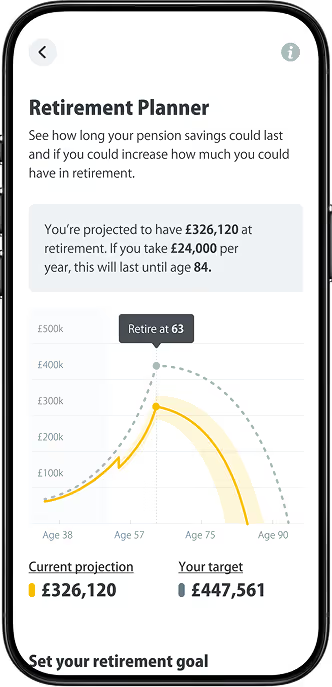
DANI: And I think, you know, sometimes these numbers can just sound quite abstract, and it’s quite hard to put your own circumstances into it. But there’s lots of tools online where you can use calculators and forecasting and stuff like that. So I’d encourage people to go and do that for themselves. Put in what you’re starting with, put in your age, put in your contributions and see that projection. And we’ve got one on the, on the PensionBee website, our Pension Calculator.
PHILIPPA: And then you can play with pushing the numbers up and down and see what the difference would be when you actually retire?
DANI: Yeah, exactly.
PHILIPPA: Yeah, OK.
The diagnosis that changed everything
PHILIPPA: Now, getting back to David, for him, he had this diagnosis and that changed his whole outlook.
DAVID: I had a life-changing diagnosis a couple of years ago around a cancer. Which I’ve come out the other end of, but that really refocused me on my beneficiaries and understanding that if I wasn’t going to be around, would they be looked after? So again, when you’re 21, you’re not thinking about that, but I’d probably say to myself, think about not just your future, but the future of those that depend upon you and contribute a bit more now, and they’ll be in a better position if or when you’re not around in the future.
PHILIPPA: So, David’s talking about pension beneficiaries. These are the people who benefit from the pension if you’re not there to enjoy it yourself. Just explain how all that works.
DANI: Yeah, so your pension beneficiaries are exactly like you said, Philippa. It’s who’s going to get that pension money if you pass away, either before you’ve even accessed it or after you’ve accessed it and there’s still some money in the pot. You know, people don’t like talking about death and people don’t like talking about pensions, and this is a topic that combines the two. So it’s really difficult to kind of have that front of mind. People don’t want to have these conversations with family, but you need to. People are a bit more used to maybe talking about wills and things like that, but pension beneficiaries are maybe slightly forgotten about. So you could also write in your will who you want to receive your pension, but for the vast majority of providers, you need to specify the beneficiary with them.
PHILIPPA: OK, so you actually need to formally tell them who you want your beneficiaries to be.
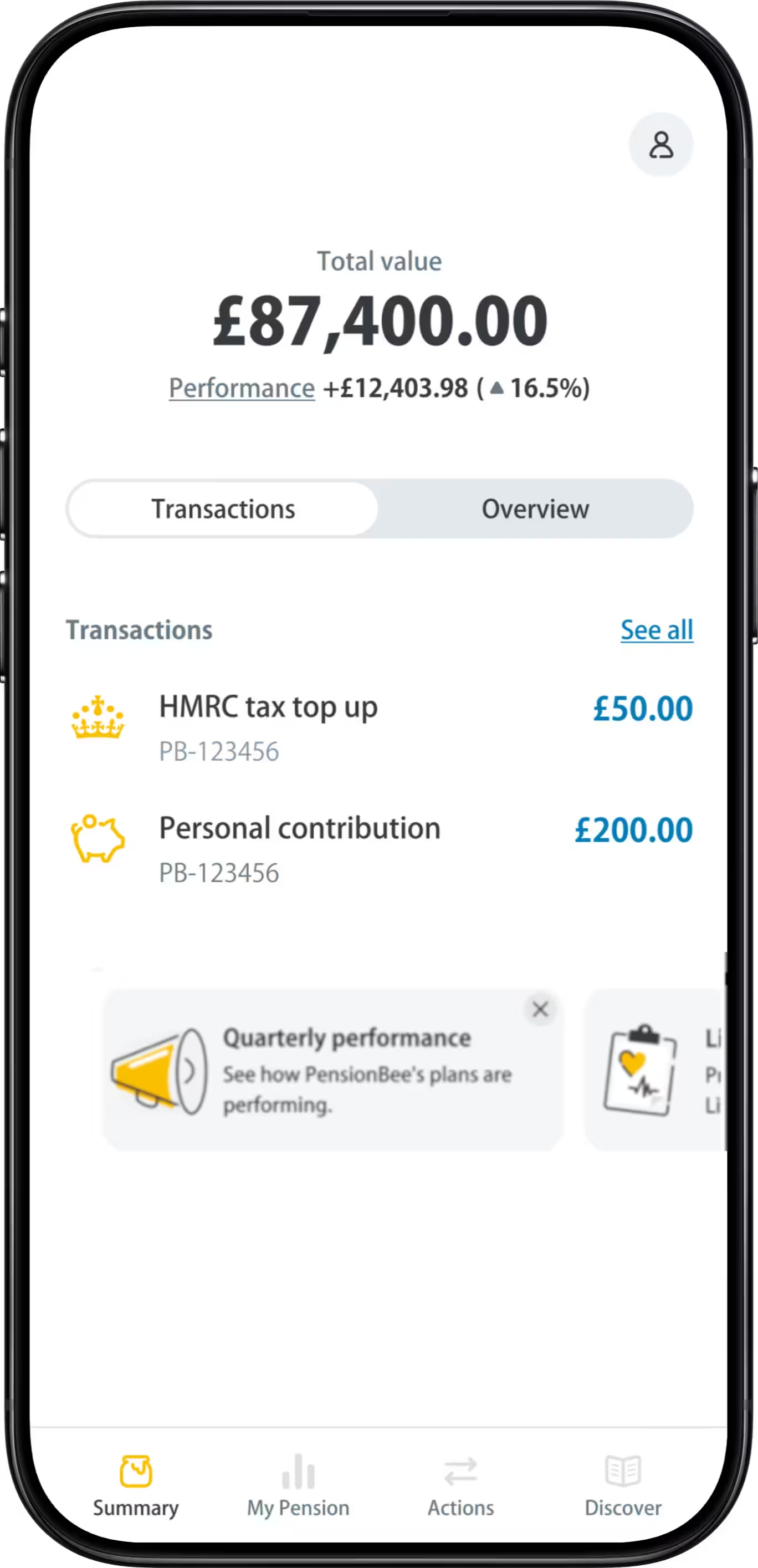
DANI: And certainly with PensionBee, and I think that it will one, make the process much easier should that happen. It will, it will make your life easier, your family’s life easier. And if you’re with a provider that has an app or an online dashboard, it should be very obvious where you can just jot those names down. With PensionBee, you can just do it on the app. So it’s super, super easy, and we always encourage people to think about it quite frequently as well. So it’s not something at 30 years old that you put someone’s name in as your beneficiary and you don’t look at it again.
PHILIPPA: Well, yeah, life happens, doesn’t it? I mean, relationships, you know, unfortunately break down. You know, you may still have a former partner as a beneficiary and have forgotten all about it.
DANI: Yeah, and then you might expand your family and have children, they might have children.
Preparing his family for the worst
PHILIPPA: Yes, so as well as thinking about beneficiaries, David started overhauling the financial admin that his family would have to manage if he didn’t get through that cancer.
DAVID: That was the first thing that struck me actually when I had the diagnosis was what is the future for those that are going to be around when I’m not. Before my diagnosis, they were, here’s a folder, go and look in this if I get run over tomorrow, and you’ll find everything you need for all my savings and all my pensions. Then with that diagnosis, it was much more, we’ve got to sit down and go through this, so you understand who to contact, how, and all the addresses that come with it and the amounts that sit there. Yeah, sat down with my wife and gone, this is what you need to do. If I’m not about.
PHILIPPA: So, Dani, it’s like he said, isn’t it? It’s not the most joyous conversation, but he’s making a really important point here, isn’t he, about record keeping and keeping your loved ones in the loop about your arrangements. They need to know, don’t they?
DANI: Yeah, definitely. I’d say David is the A-star student in this. The Excel spreadsheet is impressive.
PHILIPPA: Yes, I’ve got to say, I don’t have one of those.
DANI: With all the passwords and what you need to know. So that is ideal, but at the very least, you need to be just having conversations. If you don’t have the Excel spreadsheet, I think it doesn’t mean that you’re sort of disorganised, but, you know, do your - does your partner, do your children even know where your pensions are, the providers that they’re with, your bank details? So as much as you can, [keep] it really clear. And I guess that supports the point of combining, if that’s right for you, combining your pensions, because then there’s only one lot to remember. There’s only one provider you need to contact. There’s only one provider you need to keep up to date with your details and your beneficiaries’ details. So yeah, I think the message there is around open conversations with your family, even if you’re in perfect health. What an important conversation to have with your spouse.
PHILIPPA: Yeah, food for thought.
David’s dream retirement
PHILIPPA: So happily, David gets through that cancer. So what about his retirement plans now?
DAVID: My retirement in the perfect world looks at me being 55, wherever I want to be in the world, with people who need me to do a bit of work for them. For half a day or a day or a week or a month only means saying, can you be somewhere at this time or can you jump on a call? And me having the choice as to whether to say yes or no. And that choice might be, I just want to do ceramics, throwing pottery and stuff, and that’s my retirement. So I don’t ever want to be fully retired, but I want to be in the game, so to speak, on my very own terms and having obviously you need finance to have that. So I’ve got money tied up in pensions, property, a few shares, and I’m just hoping that, you know, at some point they give me that ability to work at my own pace wherever I want to work.
PHILIPPA: So David is looking at a future where he’s in control of his own time and he’s throwing pots. It sounds good, doesn’t it?
DANI: Yeah, definitely. It’s lovely to hear about what people aspire to be doing in their retirement. I know. The hobbies that they want to continue that they might not have time for at the moment. So I think semi-retirement is something he’s sort of referring to. And we hear that so much from people now, especially people that work for themselves or work more on their own terms. So whether you’re consulting or you’re a freelancer, because you’ve already got that flexibility in your working life, so no wonder you want that to continue into your retirement years.
PHILIPPA: Yeah.
DANI: And less and less people are seeing it as a hard stop.
PHILIPPA: I mean, obviously there’s the money, which is helpful, but it’s just like, you know, using your skills and keeping in touch and just, yeah. I mean, I wouldn’t want to do a hard stop. I think you’re right, a lot of people really like the idea of a bit of both.
DANI: I think the bottom line here as well is you can only have that flexibility and carry on a bit of work and doing the things you love if, if you’ve planned definitely properly, because you’re still going to need the money, right?
PHILIPPA: So yeah, exactly.
DANI: Yeah, the pot throwing sounds lovely if you’ve got the retirement fund to fund it.
PHILIPPA: Possibly not going to pay all the bills with the ceramic pots. Yeah, I mean, it’s like you say, Dani, I always think it’s so interesting hearing people talk about this because even though everyone’s circumstances, they’re different, lots of the issues and the questions and the decisions that David talked about, they’re going to be on the table for lots of other listeners, aren’t they?
DANI: Everybody’s trying to find that balance of having a nice life and also make sure they have enough later in life.
PHILIPPA: Thanks, Dani, and thanks too to David for sharing his story with us. We really loved hearing it. If you’d like to find out more about pensions and retirement planning, just head to the show notes on this episode. We’ve shared a tonne of resources there for you to explore and use for yourself. Now, here’s a final reminder just before we go that anything discussed on the podcast shouldn’t be regarded as financial advice or legal advice, and when investing, of course, your capital is at risk. Thanks for being with us. We’ll see you next time.
Risk warning
As always with investments, your capital is at risk. The value of your investment can go down as well as up, and you may get back less than you invest. This information should not be regarded as financial advice.
Period | Market Event | FTSE World TR GBP (%) | 4Plus Plan (%) |
|---|---|---|---|
4Plus Plan’s inception – 6 Sept 2013 | QE Tapering, China Interbank Crisis and its aftermath | -5.44 | -2.41 |
3 Oct 2014 – 15 May 2015 | Oil price drop, Eurozone deflation fears & Greek election outcome | -5.87 | -1.77 |
7 Jan 2016 – 14 Mar 2016 | China’s currency policy turmoil, collapse in oil prices and weak US activity | -7.26 | -1.54 |
15 June 2016 – 30 June 2016 | BREXIT referendum | -2.05 | -1.07 |











%201.png)