







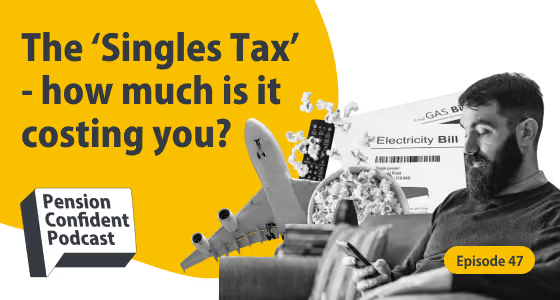
E47: The ‘Singles Tax’ - how much is it costing you? With Bobby Seagull MBE, Emma Barnes, and Valentina Adaldo



The following is a transcript of our monthly podcast, The Pension Confident Podcast. Listen to episode 47, watch on YouTube or scroll on to read the conversation.
Takeaways from this episode
- The ‘Singles Tax’ is real - single-occupancy living can cost over £10,000 more a year than shared households. In London the premium can reach around £20,000 extra.
- Single incomes face tighter mortgage affordability - the average deposit (around £40,000) can take couples six years to save; whereas for singles, with less disposable income, this could take a staggering 26 years.
- The ‘single supplement’ isn’t just a household cost - everything from the cost of hotels and travel insurance, to gym memberships and art passes.
- Retirement costs singles 44% more than those coupled up - a ‘moderate’ retirement lifestyle costs singles around £31,000 year, compared to £43,000 a year for couples.
PHILIPPA: Welcome back. Now, I know this is a bit of a personal question, but are you single? One in every three households in the UK right now is single occupancy. And here’s the kicker: being single is actually costing you. The so-called ‘Singles Tax’, it’s real. Couples pay less per person on everything, from energy bills to hotel rooms. So if you happen to be single, exactly how much is your relationship status costing you every year? And how can you keep that cost down? That’s what we’re talking about today.
I’m Philippa Lamb. And if you haven’t subscribed to The Pension Confident Podcast yet, click right now and catch every single episode in 2026.
Here to crunch those ‘Singles Tax’ numbers for us, we have Bobby Seagull [MBE], Britain’s favourite Maths Teacher-turned-Broadcaster. He’s written for the [Financial Times] (FT), and you may have seen him on University Challenge, or pursuing love on the Netflix hit series, Indian Matchmaking. He’s also the host of FUBAR Radio’s new money podcast, Broke and How to Fix It.
Emma Barnes, she’s a self-styled real-life Bridget Jones. She’s a former Sales Manager-turned-Content Creator since she became a breakout star of Married at First Sight in 2024. You may have seen her recently in a certain big brand’s Valentine’s ad.
And from PensionBee this time, we’re joined by Valentina Adaldo. She’s a Senior Manager in the Marketing team. She knows all about the added costs of not being coupled up right now.
Welcome, everyone.
EMMA: Thanks for having us.
VALENTINA: Hello!
BOBBY: Hi.
PHILIPPA: Here’s the usual disclaimer. Just before we start, please do remember, anything discussed on the podcast shouldn’t be regarded as financial advice or as legal advice. And when investing, your capital is at risk.
Now look, the thing I want to ask you right now, and I know it’s a bit personal, but who’s single right now?
VALENTINA: I am.
BOBBY: Mine is complicated. In physics, there’s something known as Schrödinger’s cat in a box. So the cat is both dead and alive at the same time. So I’m dating someone, so we’ll see where it progresses.
PHILIPPA: OK, but everyone’s living alone?
EMMA: Living alone.
VALENTINA: No, I live with flatmates.
PHILIPPA: OK, but in charge of your own finances?
VALENTINA: Yeah, that’s correct.
PHILIPPA: OK. You know, it’s amazing, we were looking at the numbers on this. Single people can expect to pay over £10,000 more on average every year compared to those who are in shared households. So Bobby, where does that £10,000 come from? How does that break down?
BOBBY: So the ‘Singles Tax’ isn’t actually a government official, like you check your pay slip and “there’s the ‘Singles Tax’, we know you’re not dating anyone, we’re getting back £10,000”. All it is, is like the small penalties of your housing, your bills, your travel. All these are there’s a premium if you live by yourself and you’re not having to share with someone. But again, if you live in the big cities like London, you think about your housing and your travel, they’ll be more expensive. So in London, it’s actually £20,000 additional per year on living and lifestyle costs.
PHILIPPA: Bobby, do we know how much extra single people are paying each year on things like rent and bills?
BOBBY: So in the UK, in 2025, I think unattached Brits - or single people, as I’d like to call them.
EMMA: Yes! Singletons!
PHILIPPA: We need a shorthand, don’t we?
BOBBY: Shall we call them single, singleton?
EMMA: Which is a growing number in itself, right? More and more people are single nowadays. That number is growing.
BOBBY: Yes, it’s a sad state for people’s hearts - and their finances.
PHILIPPA: This is true, but you’re singles, yes.
BOBBY: I think it’s just under £4,000 (£3,844 a year) more on average than couples for household expenses. That’s a huge whack.
PHILIPPA: So you’ve experienced this yourself, haven’t you? I mean, were you aware of it at the time?
EMMA: I used to live in Bristol with a £2,000-a-month property. It was £1,500 a month plus bills, so about £500 a month on bills. That’s £2,000 a month. If I had a partner living with me in that property, it’d half the rent, it’d half the bills, it’d be £1,000 a month of bills. So that’s £12,000 a [year] just in that flat alone before you even start taking into account all your fun stuff, you’re going out, you’re dating, the gender pay gap and things like that. So I can totally see how those numbers are being brought out.
BOBBY: By yourself.
EMMA: Yeah.
PHILIPPA: And as Valentina says, that’s why you’re house sharing, right? Would you rather be living on your own?
VALENTINA: Probably, yes, I’d love to, but location is actually much more important for me right now because I really love London, so you have to compromise in a way.
PHILIPPA: Yeah, and you’re looking at travel costs if you live outside and work in London anyway, aren’t you?
VALENTINA: Yeah, absolutely.
PHILIPPA: But bills are the thing, aren’t they? Because I remember this, and when I had a flat by myself, you’re paying all the bills, at least if you’re sharing. So have you ever done the maths on that? Because you use almost as much by yourself, don’t you, in terms of utilities when it comes to it? Whereas if there’s three or four of you?
VALENTINA: It’s three of us. Actually, it works out quite well when it comes to electricity and internet. However, you’re still in charge of your own grocery shopping or small appliances because, for instance, as your average Millennial, I wanted an air fryer, and they didn’t want that. I had to buy my own air fryer!
PHILIPPA: And do they use it?
EMMA: I bet they use it!
VALENTINA: No, they don’t!
The trade-offs of flatmates vs living alone
EMMA: I’ve lived on my own for about five years now. I’ve recently moved to London, well towards London and Kent, to be in London where my work is now because my role’s changed, my job’s changed since I’m not in a corporate job anymore, and I couldn’t afford to live in London on my own. And the challenge then from going from a place in Bristol where I had a two-bed apartment to then facing a house share in London. I pulled my hair out, so I had to go further outside of London.
BOBBY: You still have good hair.
PHILIPPA: Great hair.
EMMA: Thank you!
PHILIPPA: If you’re not watching this on YouTube, you’re going to have to take our word for it. So have you really noticed it then, even so, moving closer to town because closer to London, everything’s more expensive anyway, isn’t it?
EMMA: Exactly. And really, as a single person, like a couple, a one-bed isn’t really big enough. You kind of need a two-bed because you want someone to be able to come down and stay because I’m single and I have people over all the time and I have friends come down to stay because my social life’s buzzing. I’d like a spare bedroom because that’s what I’ve been used to. But with household costs going up, it’s kind of become unaffordable for me now.
PHILIPPA: So do we have numbers then, Bobby, on the specifics on singletons and bills?
BOBBY: Yes, so across the board, singletons are being penalised. So for rent, it’s 44% more. And Valentina, again, the fact that you’re living with others, you clearly benefit from that. For broadband, it’s 29% more, and even for energy bills, still 15% more. So across the board, being that single person in a household, you’re getting absolutely like...
EMMA: And there’s Council Tax discounts.
PHILIPPA: Is it 25%?
EMMA: 25%, it’s not 50%, is it?
BOBBY: I know, they can’t do the maths in local councils, can they?
PHILIPPA: I know, that does seem a bit mean, doesn’t it? I mean, there’s one of you. So it seems fair enough. The other thought I had was car ownership. I’m guessing in London, you don’t have a car, right?
VALENTINA: No, I don’t, no.
PHILIPPA: Do you have a car?
EMMA: I actually don’t have a car, I just rent one when I need to. But if I had a partner, I’d share a car because it halves the price.
PHILIPPA: But there’s insurance as well, isn’t there? You can end up paying more, bizarrely, if you don’t have so many people on your policy.
EMMA: Oh, really?
PHILIPPA: I discovered this. When I did my own car insurance, which was an absolute mystery to me, but when I put my husband on my car insurance, it went down.
BOBBY: The sneaky tip that some people do is add their parents onto there.
PHILIPPA: Can you legitimately do that?
BOBBY: You can, because in theory, as long as they use it occasionally, it’s a legitimate... So obviously, I’m not encouraging people to do anything dodgy, but get Mum and Dad to drive your car occasionally. Maybe you could do some shopping for them, and then therefore, they’ll bring down your insurance premium.
PHILIPPA: This assumes they live locally to you.
PHILIPPA: Thinking about how single people could save in these specific areas, what are we thinking? I mean, I’m intrigued about your streaming services. Should you not all be pooling your streaming services?
VALENTINA: That would make sense.
PHILIPPA: Because I have a bunch of these. We all have a... Well, they’ll have a bunch of these. It’s a lot of money.
EMMA: Sometimes £12.99 now. They’re going up, aren’t they?
PHILIPPA: And you can’t part with them, can you? Once you’ve got them, they’re really hard to give up, aren’t they?
EMMA: So I’ve got them all.
PHILIPPA: OK. So if we think then, we’ve talked about renting, what about home ownership? Is it better if you’re buying? But it seems to me that single people are probably at a disadvantage trying to get onto the property ladder, aren’t they? Because just in terms of getting a deposit together?
BOBBY: It’s just the basics of economies of scale because you got two incomes versus one income. And then if you look at how mortgage lenders, their affordability ratio is obviously, let’s say it’s four times your average income with two people. They may not give four, but it might be three and a half or 3.2 [times]. So again, having one person applying for a mortgage makes it much more tricky.
PHILIPPA: Yeah. And I’m wondering whether women aren’t at a specific disadvantage there because women are often earning less.
EMMA: Yeah, the gender pay gap.
‘Houses before spouses’ movement
VALENTINA: Have you heard about this new movement called ‘Mortgage Mates’, so like ‘Houses before Spouses’?
BOBBY: No.
EMMA: No.
PHILIPPA: Oh, yes!
VALENTINA: Yeah, because it’s pretty much impossible to afford to buy property by yourself, and especially if you’re single. Lots of people are actually pooling resources with friends or siblings. [51%] of Millennials and [84%] of Gen Z are predicting to do so in the future.
EMMA: Wow.
VALENTINA: So that they can buy a property. But that comes with its own set of difficulties.
PHILIPPA: It does.
VALENTINA: Because you have to have a very strict and clear agreement in place with your friends.
EMMA: Of course.
PHILIPPA: As in legal agreement?
VALENTINA: Legal agreement.
PHILIPPA: At some point, that arrangement is going to break up.
EMMA: That causes friction.
PHILIPPA: Then what happens? Because you have to buy out if someone couples up and wants to go, you’re going to have to buy them out.
VALENTINA: Or if they move to a different country maybe, like different paths.
EMMA: Life moves on.
PHILIPPA: You’d really need to like these people.
VALENTINA: Yeah.
PHILIPPA: We have numbers on this, don’t we? So a couple could say for the average house deposit of... I think the average house deposit is about just over £40,000. So it’s going to take them six years, assuming that each person is putting in half and they’re in full-time employment, they’re on the average salary, so that. But, if you’re single, 26 years! It’s just insane.
BOBBY: I know. Essentially, that’s not going to happen.
EMMA: It’s not happening.
BOBBY: To be honest, if you look at the globe in terms of our demographic crisis, as it were, especially in the West, 2.1 children per family is mathematically meant to be the stable population. But in the UK, we’re 1.4 [children]. That means every generation, we lose a third of the number of people. And that’s partly because 26 years to save for a property. People just, again, that houses before spouses.
PHILIPPA: When we were talking about this episode in advance, we were thinking about who’s most to be living on their own. And you think of young people, don’t you? Largely. Actually, it’s middle-aged and older people are more likely to live alone. And that’s a whole raft of other issues, isn’t it? Because if you did have a partner and they’re gone- relationship break, or died even - that’s a massive financial pivot, isn’t it? Because then you’ve got all the costs based on you did have two and now you have one.
EMMA: And then if you’ve retired, if you don’t have money in your pension that covers both of you or both the housing properties, you’ll have to downsize.
PHILIPPA: I’m thinking lodgers, flatmates, that sort of thing. There’s quite a movement, isn’t there? Particularly with elderly people of getting younger people to move in, which I always thought was a lovely idea.
BOBBY: Yeah, young people, especially in the big cities, they need somewhere to live. Cross-generations, they have company. I think, again, for [having] lodgers, there’s a certain amount that you can claim tax-free. It’ll be the first around £5,000 [Correction: £7,500].
PHILIPPA: It’s a nice idea, isn’t it? On all sorts of levels.
Redundancy when single hits harder
PHILIPPA: We did an episode about redundancy last time around and the shock of losing your job. It’s the same thing again, isn’t it?
VALENTINA: Absolutely, yeah.
PHILIPPA: If you’re on your own.
VALENTINA: I have a personal experience in that.
PHILIPPA: Do you?
VALENTINA: Yeah, because I was made redundant five years ago. And obviously, because you have to rely on your own finances.
PHILIPPA: How did you manage?
VALENTINA: Yeah, it was quite tricky because you don’t have the luxury to pursue your dream job. You have to rush into finding any job in order to survive, whereas couples have income diversification. So if you lose a job or you take a pay cut, your partner can support you with rent and bills. But when you’re on your own, you must have a much larger emergency fund because you need to think about the unexpected.
PHILIPPA: And it’s harder to get that emergency fund together because you’re a single person.
VALENTINA: Yeah, exactly.
PHILIPPA: So you get caught in this doom loop, don’t you?
BOBBY: But there’s also the psychological impact of having to make these big career choices without a sounding board.
PHILIPPA: Absolutely.
BOBBY: If you’re, again, with me, I’ve been living by myself for many years, my parents, bless them, on WhatsApp, Zoom, anything, I need to learn to be more independent as I go on now. But every day is like, “Mum, Dad, there’s this podcast coming up on Tuesday, and then the afternoon, should I do it?” Whereas with a partner, you can casually have these conversations.
PHILIPPA: You do. It’s like self-employment. I did this myself. That moment when you think, actually, I’m going to stop taking a paycheck. I’m going to be self-employed. That isn’t easy.
EMMA: It’s a leap of faith.
PHILIPPA: It’s a leap of faith. You know about this. You’ve done it yourself, haven’t you? Emma, what do you reckon?
EMMA: Yeah, absolutely.
PHILIPPA: How did you feel about doing that?
EMMA: I had an awesome corporate career. I absolutely loved my job, and I’d still be working there now if it wasn’t for this sideways move. They didn’t allow me a sabbatical, I had to leave the business.
BOBBY: Their loss.
EMMA: I still have a great relationship with my ex-employer!
PHILIPPA: Shame, though.
EMMA: But my parents, that was one of the biggest things. “What are you going to do? You’re going to come out, you’re going to have no job. There’s going to be no...”. I ended up having to get a lodger, actually.
PHILIPPA: Did you?
EMMA: When I came out of the show, I didn’t have a job for a couple of months. I was still paying my rent, still paying it. So I ended up... It was only for summer, only for six weeks, but I needed that income. Otherwise, it was [the] Bank of Mum and Dad because I didn’t have a partner to turn around and be like, “oh, can you sort out the food shop?”. You still have to pay for it yourself.
Building your own financial safety net
PHILIPPA: Do we have numbers on financial resilience, Bobby?
BOBBY: Yes, we do. And again, this is lower as you’d expect. But again, 29% of single people aged 18 to 40, so the Millennials and the Gen Z, they’ve got no emergency fund. So the rainy day fund when you lost your job and you need cash to keep you tiding [you] over, compared to 16% of those in relationships. So that’s almost a double ratio.
PHILIPPA: Because the other numbers we’ve got here, and they made me frown and worry, was about single people relying on credit cards for household bills. One-in-ten relying on credit cards for household bills. So what would we suggest they do instead? Certainly not [a] credit card if you can possibly avoid it, right?
EMMA: Get an Excel spreadsheet and start budgeting.
PHILIPPA: Yeah. Talk to your utility company if you’re struggling to pay all those things, rather than racking up credit card debt.
Holidays and fun budgets for single people
PHILIPPA: More happily, the fun stuff. Holidays, travel. Mind you, having said that, solo travellers, this is the one everyone knows about, isn’t it? The single room, the dreaded single room tax or the single supplement. Have you experienced this?
EMMA: Of course, absolutely. I think naturally me and my friendship group, we tend to book Airbnbs and big houses when we go away, which makes it a little bit cheaper. But for hotels, if you look at a hotel room in London, if you wanted, say, I was still living in Bristol, coming up to London for the night, £120 minimum, probably, for a hotel room?
PHILIPPA: You’d be lucky.
EMMA: Exactly. If it was last minute, it’d probably be towards £200, right? If you think of half that, £60 pounds versus £120, it leans with you with booking a hotel versus not, right?
PHILIPPA: Yeah, it really does. And transport is the other thing, isn’t it?
VALENTINA: Yeah, absolutely. And it feels like life is buy one, get one half price for couples, but then full price for singles, right? Even when it comes to travel insurance, for instance, you pay more if you’re travelling by yourself. You have a supplement on singles, yeah.
PHILIPPA: That’s so ridiculous. Because I’m thinking about things like train journeys.
BOBBY: Yes.
PHILIPPA: Because you can do this like two people travelling, and it doesn’t need to be a romantic relationship. I did it with a colleague when we were doing a lot of work in Manchester. And you have to travel - or at least you did then, I don’t know what the rules are now - you had to travel with that person.
BOBBY: From that terminus station to the - Yeah.
PHILIPPA: So there had to be two of you.
BOBBY: If you have a quarrel in the middle of the journey.
PHILIPPA: That’s a problem.
EMMA: So if they check the ticket they’re like, “where’s your other person?”.
PHILIPPA: Yes, they actually do. But it can be anyone. And so if you do end up doing regular stuff together, or you can pair up if you know that you’re doing trips, regular trips.
VALENTINA: That’s actually very useful. But for instance, I’m really big into art. I love museums.
BOBBY: Me too.
VALENTINA: If you want to buy the National Art Pass, it’s much more expensive as a single person. However, if you buy the couple one, it’s like 30% off, but they must be at the same address. I can’t force one of my flatmates to go to random museums with me, can I, right?
EMMA: It used to be with the gym, but they didn’t necessarily check you’re at the same address. So at my old gym, it was quite a fancy gym.
BOBBY: The fancy gyms, yeah.
PHILIPPA: I was going to say, my gym doesn’t do that!
EMMA: It was saving about £50 a month off the membership.
PHILIPPA: Really?
EMMA: Between two. So there were many non-committal relationships that I knew of. I went on a funny date once. I actually - It was a no-go after that. But he messaged me saying, “do you fancy coupling up on the David Lloyd membership?”.
PHILIPPA: Really?
EMMA: And what can you say? I didn’t want to go on another date with them. I don’t want to be in this non-committal relationship either.
PHILIPPA: On the museums and galleries thing, I’m thinking about this because I’ve just renewed a couple of London museum memberships. And the ones where you can take a friend [for] free, strike me as a possible thing for single folk, because if you basically have someone who does like doing that stuff, you could split the cost, couldn’t you? Of one of those because it’s cheaper than you both joining.
VALENTINA: Yeah, for sure.
PHILIPPA: And do that thing where someone goes in with you free. But you obviously have to go on the same day. So it’s a bit limited, but it’s cheaper. They’re quite pricey now. They’ve already gone up lately, all those memberships, haven’t they? So you have to think about those quite hard.
VALENTINA: Because obviously, marketing optimises towards couples because they’re chasing the dual income.
EMMA: Two people who buy two coffees.
VALENTINA: So the best product, the best deals, they’re always built for pairs.
PHILIPPA: You’d think that marketing teams would be wising to this, wouldn’t you? With the way the demographics are.
BOBBY: Was it 8.4 million people live in a single household? So there’s a big market.
PHILIPPA: How are you not marketing to them?
BOBBY: Yeah, hopefully, they’ll listen to this and go like, “we’ll start!”.
PHILIPPA: It’s amazing. Because I was thinking even about Ubers - well Ubers, other cab companies are available - taxis. Night out, if you get one home, you’re paying the whole bill yourself, aren’t you? Which can be pricey if it’s late.
VALENTINA: [In] some countries, you can buy a seat in the car.
BOBBY: In London, you can do that as well. Ride shares. It just takes a bit longer.
VALENTINA: Let’s say you’re going to the airport. That’s a massive cost for yourself.
EMMA: Yes, that’s good.
VALENTINA: Can you split that?
PHILIPPA: Yes.
Wedding season costs, pooling gifts, and the cost of dating
PHILIPPA: OK, I’m going to talk about weddings and events because I think we all know that people’s weddings are getting ritzier and ritzier, and abroad, and the money is big and on your own, of course, even more. Tell me your horror stories. I know you’ve all got them.
EMMA: I had six last year, seven the year before, including my own. And we’ve got another five this year. So it’s a serious thought about going.
VALENTINA: For your single friends it’s a lot of money and time. Weddings, baby showers, hen dos, probably second wedding, because I’m at the stage of my life where I’m going to second weddings, even, or divorce parties.
PHILIPPA: Absolutely, I’m on my second now. Are you pooling on gifts, at least with friends?
EMMA: We have an amazing pool available. All of our 30th birthdays, all weddings, babies, we all pool. When there’s about 30 of us in our school friendship group, everyone always gets a really good sizable chunk of money when you only have to stick in a tenner or something, I think £15 or £20, if they’re one of your best friends.
PHILIPPA: The other thing I was thinking [about], when I think about the times I’ve been single myself, because I was married, then I had a long period when I was single and then married again. So it’s not that long ago that I remember having all this stuff to deal with. And I was a single mother at the time, too. But there’s a pressure to go out more as a single person because otherwise, you’re isolated, aren’t you? Because you don’t go home to a loved one.
EMMA: Dating is pretty expensive.
BOBBY: Being the mathematical nerd I am, for my eyes only, I have a spreadsheet of all my first dates.
EMMA: No!
PHILIPPA: You don’t!
VALENTINA: Spreadsheet?
BOBBY: Yes, and after 10 first dates, I’m like, I’m a mathematician. There’s great data here. I know it’s not very sexy.
PHILIPPA: Are you ranking these women?
BOBBY: Well, if you’ve got data there, you can choose to rank them if you want. Again, it sounds like a lot, but over 14 years, 158 first dates.
VALENTINA: Did you pay for all of them?
BOBBY: So pretty much 99% of first dates. Again, as a guy, you always insist. I always think there’s this charade. If I always want to pay for date one, if they like, “Oh, no, I’d like to pay”, I’d love to see them pretend to pay. But if they don’t even flinch, I see it as a bad sign.
PHILIPPA: It’s a bad sign. What do you two do on dates? Do you offer to split?
VALENTINA: Yes, I’ll say, yeah.
EMMA: I always choose to go to a pub for the first date. They buy the first round, I buy the second round. And if we stay for a third, they can buy the third.
BOBBY: Excellent.
EMMA: That’s a kind of rule.
PHILIPPA: That’s it. That avoiding meals, I think, is an excellent plan. Actually, I went with coffees. You can leave quite rapidly, if you want to.
VALENTINA: I love park dates as well.
EMMA: A dog walk or a park date, that’s good.
VALENTINA: It doesn’t have to be a meal because what if you don’t like them? You’re stuck with them for two hours.
BOBBY: One pro tip is, you know that a lot of London museums have London Lates? So National Gallery, Tate Modern, Tate Britain, and they’re free to enter, and you can buy drinks, but that’s a cheap, great date.
PHILIPPA: That’s an excellent idea.
BOBBY: It’s my number one choice. Of my 158, a lot of them, a sizable minority of them would’ve had that.
PHILIPPA: Dating profiles, some of them, you pay for these dating sites, don’t you? They’re not all free.
EMMA: Oh, my gosh, some of them are about £40 a month. I’m not paying £40 to find a boyfriend. I’m not. It’s crazy.
BOBBY: At one stage, I think a few years ago, I paid £500 for dating apps in a year. Time is money, because obviously, if you have the freemium version of these apps, you would get X now, you get maybe 10 profiles a day, maybe five swipes. Whereas if you pay for the premium, your 15 minutes of swiping, you can be efficient because you can do the filtering for whatever things that you want to filter on.
PHILIPPA: For dating, efficiency is key.
BOBBY: Otherwise, I find like -
EMMA: - let’s not call it too transactional.
PHILIPPA: Because just looping back to the actual cost of dates, I saw a NatWest survey recently, the numbers are high. 43% of people in the UK, so heading for half, spending between £50 and £100 on a date. Now, obviously, it can be more. It’s not going to be less, is it? Even if you go to the pub for two or three rounds of drinks, it’s going to cost you.
BOBBY: I’ve consulted my spreadsheet. I’ve tracked my average price. It’s gone down early.
PHILIPPA: Is there a graph?
BOBBY: Yeah, there’s lots of data. This is a rich set of data. Over time, it has ticked down. So in the early days, I’d say £60 to £70 per date.
EMMA: Wow.
BOBBY: So it’d probably go for dinner. Now it’s probably come down to an average of £50. But overall, over the course of the 158 dates, about £56 a date. That’s like £10,000 on first dates, and it adds up.
PHILIPPA: That’s quite an investment, isn’t it?
BOBBY: Again, the way I see it, as long as you’re enjoying the process, having a good time, and eventually you’re hoping it’ll lead to the right person and you’ll feel worth it. But it can feel a bit thankless if you’re going just first date after first date.
EMMA: And you just don’t like them and you just think, “well, if I just spent £30, I could have stayed at home watching TV”.
Saving for retirement while single
PHILIPPA: OK, I’m now going to loop as many years forward and we’re going to talk about retirement. So look, Valentina, you’re the pensions queen. Tell us, single people, we’re going to be at a disadvantage, right, when it comes to saving for retirement.
VALENTINA: Yes, absolutely. A single person spends 50-60% of their income on bills and rent, whereas a couple 30-40% combined. And that’s money that could have gone to your pension fund, right?
PHILIPPA: OK.
VALENTINA: And as mentioned before, you need a much larger emergency fund if you’re a single person. Once again, you could’ve contributed to your pension instead. So that’s why this is where the ‘Singles Tax’ might become much more obvious.
PHILIPPA: OK.
EMMA: I wonder whether that crosses over with the investment gap, gender gap as well?
PHILIPPA: Savers not investors, women, without wishing to generalise, but that does seem to be what the data says, doesn’t it? And I think it’s that about anxiety, particularly if you’re a single person or a single woman, that risk, your appetite for risk, it’s going to be less, isn’t it? Because it’s that thing we’ve talked about that you haven’t got anyone to catch you.
EMMA: Yeah.
BOBBY: And again, that compounding, if you’re in your 20s and 30s, you’re not saving, you’re not investing. You think, “oh, it’s only a small amount now”. But over the course of 20, 30, 40 years, that compounding impact of being single becomes huge by the time you retire.
PHILIPPA: And when you’re retired, because I’m thinking even then, you’re at a disadvantage, aren’t you? Because the State Pension disadvantages single people.
VALENTINA: Yes, it does. According to the Retirement Living Standards, which show you how life could look like at different price points when you retire, if you want to live a moderate lifestyle, which is basically one trip per year, a couple of dining out per month or one takeaway, actually, per week, you’ll need as a single person [£31,700]. So you’d expect that in a relationship, you’ll need £62,000, right? But it’s actually [£43,900]. The bottom line is, life in retirement is [around] 44% more expensive if you’re a single person.
PHILIPPA: Wow. This litany of disasters we’re talking about for single people .
EMMA: The world’s against us!
PHILIPPA: I can think of lots of good things about being single. I mean I enjoyed being single. I know you don’t want to be single all the time. People don’t necessarily want to be single all the time, but I enjoyed a lot of the years.
EMMA: I don’t want to live with a boy.
BOBBY: They smell and they don’t tidy up. They watch really rubbish programmes.
Money tips for savvy singletons
PHILIPPA: So do we have other useful tips then? As a kind of rounding off of this podcast, of things single people should be thinking about doing money-wise.
BOBBY: Find a buddy. In life, get a travel buddy, a holiday buddy, a wedding buddy, a close friend of yours that you can double up with. They probably will be single because if they have a partner, I don’t think they’ll be too keen on sharing with you.
EMMA: But great for your TV subscriptions. Beg, borrow, and steal. You can always add an extra account on your TV subscriptions.
PHILIPPA: I’m wondering, really, if it shouldn’t be more about what people in couples should do and the way they should think about dealing with their single friends, because choosing venues, holidays, outings on the basis of double-income friends, it’s really inconsiderate, isn’t it? I mean, there probably should be more consideration given by those who are coupled up for the people who aren’t, who are just paying all these bills by themselves. Don’t you think?
EMMA: Yeah, absolutely. Look after us. We’re poor.
BOBBY: And we’re a growing army, 8.4 million of us and every year we’re recruiting more members.
PHILIPPA: I’m not sure if that sounds like a good thing.
EMMA: But be aware, I think budgeting is like, I’ve certainly seen it in the past couple of years. Budgeting is so important when you have a variable income, when you’re single, when you could face singledom, dooming around the corner if you’re reaching the end of a relationship and actually that could come crashing down on you. Make sure that you’ve got a plan for that because it’s visible, the difference.
PHILIPPA: Well you’re right, maybe being a financially savvy singleton is a bit of a superpower.
VALENTINA: Yeah, it is.
EMMA: Absolutely.
PHILIPPA: Because if you can manage on your own, if you can make it all stack up on your own, if you do couple up, it’s all going to be good. You’re not going to be frightened of it coming to an end, are you? Because you know that you can hack it by yourself. Which I think is a rather nice idea.
EMMA: Yeah, that’s great.
PHILIPPA: If you’re enjoying the series, please do rate and review it so other listeners like you can find us. If you’ve missed an episode, don’t worry. You can catch up anytime on your favourite podcast app or watch on YouTube.
Next month, we’re discussing the ‘Great Wealth Transfer’ from Boomers to their Millennial children that economists have been predicting and what you can do about it.
And just a final reminder, anything discussed on the podcast shouldn’t be regarded as financial advice or as legal advice. When investing, your capital is at risk. Thanks for being with us. We’ll see you next time.
Risk warning
As always with investments, your capital is at risk. The value of your investment can go down as well as up, and you may get back less than you invest. This information should not be regarded as financial advice.
Period | Market Event | FTSE World TR GBP (%) | 4Plus Plan (%) |
|---|---|---|---|
4Plus Plan’s inception – 6 Sept 2013 | QE Tapering, China Interbank Crisis and its aftermath | -5.44 | -2.41 |
3 Oct 2014 – 15 May 2015 | Oil price drop, Eurozone deflation fears & Greek election outcome | -5.87 | -1.77 |
7 Jan 2016 – 14 Mar 2016 | China’s currency policy turmoil, collapse in oil prices and weak US activity | -7.26 | -1.54 |
15 June 2016 – 30 June 2016 | BREXIT referendum | -2.05 | -1.07 |











%201.png)