







Your pension has its own inheritance rules - and many people don't know them




Your pension doesn’t work like the rest of your estate when you die. Unlike your property, savings, and other assets, it won’t automatically go to whoever inherits everything else. It isn’t covered by your will, which comes as a surprise to a lot of people.
Here’s what actually happens, and why it’s worth a few minutes of your time to check who’s going to inherit your retirement savings.
Your pension isn’t currently part of your estate
When you die, nearly all your assets and possessions - collectively known as your ‘estate’ - are dealt with according to your will.
If you don’t have one, the person who’s most ‘entitled’ to a share of your wealth would have to apply to become your estate’s administrator. Find out more about what happens if you die intestate on the MoneyHelper website.
The rules of intestacy would then apply. In this case, your estate goes to your spouse and children first, then other family members, and finally to the Crown if you have no living relatives.
With pensions, the picture’s slightly more complicated. There are two types of pension scheme, and the type you have will determine what happens to your savings when you die:
- Discretionary - your pension savings are held in trust and managed by your scheme’s trustees. That sees your fund sit outside your estate and not covered by your will. That also means these pensions don’t attract Inheritance Tax (IHT). However, it’s worth noting that this is set to change from April 2027 (more on this below). Even once this change comes into place, your pension still won’t be covered by your will.
- Non-discretionary - also known as ‘direction-based’, you nominate who you’d like to receive the funds and your pension scheme will pay out exactly in line with your request. As you’re directing where those funds go, HMRC treats it as your money. As a result, it can be brought into your estate and subject to IHT.
Most modern personal pensions, like PensionBee’s, are discretionary.
In this case, the pension trustees will decide who receives your funds when you pass away. They base that decision on who you’ve nominated in an ‘expression of wishes’. That person is known as your ‘beneficiary’, or ‘beneficiaries’ if you choose more than one person.
It’s worth noting that, unlike a will, an expression of wishes isn’t legally binding. Your pension scheme’s trustees will take your choice into account, but they have the final decision.
You may have chosen your beneficiaries when you first set up your pension. Or you may never have done so at all.
I checked my own pension recently and discovered I hadn’t nominated anyone - the trustees would’ve been completely unaware of my wishes. If that sounds familiar, you’re not alone.
{{main-cta}}
Who inherits your pension?
Your pension beneficiaries don’t update automatically. So, depending on your age and the type of pension you have, you could be leaving a significant sum, or a long-term income, to whoever you initially chose.
As a result, it’s worth revisiting your choices after any major life event, such as:
- marriage;
- divorce;
- estrangement;
- bereavement; or
- the birth of a child.
It’s also worth doing this after making key financial decisions with your pension, such as if you start drawing down. Likewise, it’s sensible to do so if your chosen beneficiary’s financial situation changes - that might impact who you’d most like to receive any money.
The good news is it usually takes minutes to do and you should be able to do this online.
With PensionBee, you can do this via your online account - your ‘BeeHive’ - in just a few clicks.
If you have several pension pots, you’ll need to do this for each of them. While you’re at it, you may want to use the government’s free Pension Tracing Service to make sure you haven’t lost track of any retirement savings from previous jobs.
Pensions and Inheritance Tax
Because pensions sit outside of your estate, they’re currently exempt from Inheritance Tax (IHT).
If there’s money left in your pot when you die, your beneficiaries can inherit it without an IHT bill. They may still pay Income Tax on withdrawals, depending on your age at death. But the pension itself won’t be subject to IHT.
That changes from April 2027, when unused pension pots will be brought into your estate for IHT purposes. For some people, adding the value of their pension to their property and other assets could push their estate over the £325,000 nil-rate band.
As a result, it’s worth thinking carefully about who you nominate as your beneficiary.
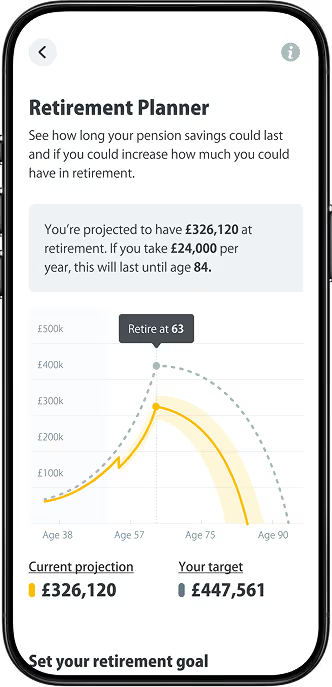
Not sure how much your pension could be worth by the time you retire? Use PensionBee’s Pension Calculator to get an estimate.
Should you change your nomination before April 2027?
If your estate’s likely to be affected by the IHT changes, it’s worth understanding how your beneficiaries fit into the picture. In particular, you may want to think about whether it’d be more tax-efficient to leave your pension to your spouse or civil partner, or your children.
Your spouse or civil partner can inherit your entire estate IHT-free. So, if they inherit your pension, they’d receive it free from IHT. That won’t change after April 2027.
But once the new rules come in, your pension will count as part of their estate when they die. Married couples and civil partners can combine their IHT allowances, potentially passing on up to £1 million free from IHT. But a large pension pot could use up a chunk of that.
Note that this only applies to married and civilly partnered couples. It doesn’t apply to other relationships, even if you’ve been with your partner for a significant amount of time.
Meanwhile, if you were to die before April 2027, nominating your children instead could mean your pension passes to them IHT-free.
They may still pay Income Tax on withdrawals, depending on your age at death. But there’d be no IHT charge.
After April 2027, the picture changes. Your spouse or civil partner can inherit your pension free from IHT, thanks to the spousal exemption. So, nominating them again at that point could make more sense. Remember: the exemption only applies to spouses or civil partners, not children or any other family members.
You could consider changing your nomination to your children now, then switching it back after April 2027. It’s a straightforward thing to do - but whether it’s the right move depends on your estate and your family circumstances. It won’t be right for everyone.
Summary
Think the IHT changes could affect your estate? Speaking to an Independent Financial Adviser (IFA) could help you make decisions around who inherits your pension.
In the meantime, checking and updating your beneficiaries could help make sure your pension ends up where you want it.
Ruth Jackson-Kirby is a Financial Journalist passionate about making money matters clear and accessible. She’s written for The Mail on Sunday, MoneyWeek, The Sun, and Good Housekeeping, helping readers navigate pensions and personal finance with confidence. She believes everyone deserves financial security and is on a mission to cut through jargon and make finance relatable.
Risk warning
As always with investments, your capital is at risk. The value of your investment can go down as well as up, and you may get back less than you invest. This information should not be regarded as financial advice.
Please note that tax rules change regularly, and the actual tax benefits you receive will depend on your individual circumstances. If you’re not sure, please seek professional advice.
Period | Market Event | FTSE World TR GBP (%) | 4Plus Plan (%) |
|---|---|---|---|
4Plus Plan’s inception – 6 Sept 2013 | QE Tapering, China Interbank Crisis and its aftermath | -5.44 | -2.41 |
3 Oct 2014 – 15 May 2015 | Oil price drop, Eurozone deflation fears & Greek election outcome | -5.87 | -1.77 |
7 Jan 2016 – 14 Mar 2016 | China’s currency policy turmoil, collapse in oil prices and weak US activity | -7.26 | -1.54 |
15 June 2016 – 30 June 2016 | BREXIT referendum | -2.05 | -1.07 |











%201.png)