



Handling debts before retirement
From mortgages to credit cards, taking debt into retirement can strain your later-life income. Find out how you could handle debt before you retire in this guide.
What to think about with debt and retirement
As you start planning for retirement and thinking about your income for life after work, you might consider how to manage debt.
Debt isn’t necessarily bad. If you manage it well, it can help you achieve your financial goals. You can use it to afford more expensive items, rather than having to wait and save up. That might be a mortgage for a home or a loan on a car.
You might have also used shorter-term debt throughout your working life, such as on a credit card.
However, debt also comes with risk. It can be expensive, especially if you allow it to build up. Likewise, being unable to pay your debts can lead to difficulties, and could affect your credit score.
That can feel even more important in retirement when you no longer have your income from work and you start drawing from your pension (from 55, rising to 57 from 2028).
In this guide, find out what to think about when handling debts ahead of retirement.
{{main-cta}}
Can you retire when you’re in debt?
You can retire with outstanding debts. But you’re still responsible for paying them off. So, if you retire with debt, you’ll need a plan for clearing your borrowing during your retirement.
You could consider clearing it before you stop working instead. Doing so could give you the peace of mind that you’ll be able to use your savings to reach your retirement goals, rather than to pay off debt.
What debt should I pay off before I retire?
Here are a few types of debt you could have and what to consider before paying them off ahead of retirement.
Mortgages
It’s becoming more common for borrowers to take out mortgages lasting into their later years. In fact, two-in-five new mortgages in 2024 had terms that would take borrowers past State Pension age (_state_pension_age, rising to _pension_age_from_2028 by 2028).
However, retiring with an outstanding mortgage can put pressure on your pension.
As an example, repayments of £1,000 a month might be manageable during your working life. But imagine that you retire with one year left on your mortgage term. In that case, you'd need an extra £12,000 in pension savings to cover that cost.
If you’re set to be paying off your mortgage in retirement, you could consider:
- making overpayments (if you’re able to) to clear the debt sooner;
- reducing your mortgage term with your current lender or remortgaging on a shorter term, making higher repayments over a shorter period; or
- dedicating funds within your pension for paying off your mortgage, or even drawing a lump sum to clear the rest of the loan (from 55, rising to 57 from 2028).
It’s sensible to speak to an Independent Financial Adviser (IFA) before making changes to your mortgage or accessing your pension and using it to clear your home loan.
Personal loans
You may have also borrowed money for other expensive purchases. These might be necessary costs, especially ahead of retirement.
Having a reliable car in later life, for example, could be important for your independence. Similarly, you may need to make adjustments to your home so that it’s suitable as you get older.
These loans tend to be more expensive than mortgages, with a higher interest rate. So, although the amount you borrow is generally lower, you’ll pay more interest on it.
As a result, it could be more pressing to clear than your mortgage.
Credit card debt
Credit cards can be helpful for various things. You might use them to tide you over in expensive months, or cover larger one-off expenses, such as holidays.
You can also get more protection from faulty goods and fraud thanks to the Consumer Credit Act. You might benefit from 0% interest for a period, too.
However, beyond introductory offers, credit cards tend to have higher interest rates than other debts. So, if you’re not paying it off every month and it’s accumulating interest, it might be sensible to clear this ahead of retirement.
Just as pensions can grow thanks to the power of compounding, debt can also snowball as a result of compounding. If you don’t clear it each month, your lender will add interest, which then has interest added to it in the next month, and so on. Because credit card interest rates tend to be higher, this can quickly grow your debt.
Consider this example:
- you borrow £2,000 with an interest rate of 26%;
- you only make the minimum payment of 1% of the balance (and fees), starting at £59 a month and falling as you clear the balance;
- this will take 25 years and three months to pay off in full; and
- you’ll pay £3,670 in interest - almost twice as much as you borrowed in the first place.
While the small repayments are manageable, this debt can end up costing you a lot more in the long term. If you take it into retirement, it could eat into your pension savings, too. So, it can be sensible to prioritise clearing this type of debt first.
You could also explore transferring the balance to a card with a 0% rate. This can stop interest building up while you look at clearing it.
Should I pay off debt before I start saving for retirement?
You don’t need to choose between managing debt and saving for retirement. Instead, if you can, it’s sensible to design a budget that ensures you’re hitting both goals at the same time.
With debt, it can make sense to clear the most expensive, high-interest borrowing first. While longer-term debts such as mortgages might be larger, they usually attract a lower interest rate. So, it’s generally more efficient to prioritise the debts with the highest rates.
At the same time, look at how much you can afford to pay into your pension. Even small, regular contributions can add up over time to give you a healthy pot in later life.
Budgeting this way can help to ensure that you don’t retire either with excessive debt, or without enough savings to reach your later-life goals.
Planning for the long term
Here are a few options you could consider for handling debt ahead of retirement.
- Delay retirement until you’ve cleared your debt - by working for longer, you could earn enough to entirely clear your borrowing, allowing you to live debt-free once you give up work. You could even consider semi-retiring, earning enough to cover your debt payments while being able to start enjoying your pension savings (from 55, rising to 57 from 2028).
- Look at ways to clear your mortgage sooner - you could make overpayments (if possible), shorten your mortgage term and make higher repayments, or even downsize to a less expensive property and use the freed-up funds to clear the outstanding loan.
- Save more into your pension to cover the costs - if you plan to retire with debt, ensure that you have enough saved so you can afford it. You could contribute more to your pension now to cover those costs later.
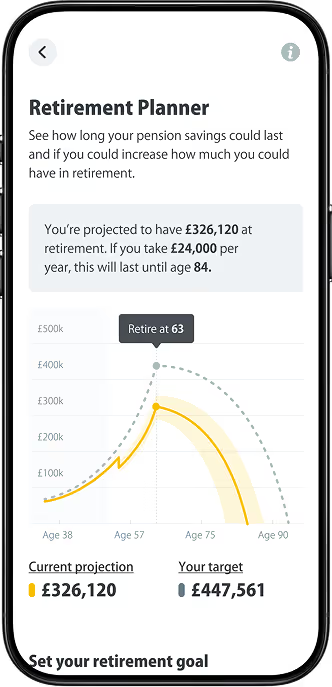
- Work out how much you need for retirement - by knowing how much you need in your pension, you could then calculate what you’d need to contribute to create a pot of that size. Use the PensionBee Pension Calculator to see what you could have at different ages, depending on what you pay in.
Summary
Debt can be a useful tool for managing your wealth, provided you do so carefully. If you don’t, it could end up costing more than you think.
That becomes even more important when you retire and no longer have your working income. Taking debt into later life could force you to use your pension savings to cover it, which could affect the lifestyle you’re able to enjoy.
By planning ahead, you can ensure that your debt is well-managed and under control, so you can retire with confidence.
Risk warning
As always with investments, your capital is at risk. The value of your investment can go down as well as up, and you may get back less than you invest. This information should not be regarded as financial advice.
Last edited: 23-03-2026
.webp)