



Blog
What do rising university tuition fees mean for families?
You don’t need a Maths degree to know that going to university is an expensive business - and student debts are only set to grow under new rules.

You don’t need a Maths degree to know that going to university is an expensive business - and student debts are only set to grow under new rules. The government has announced that university tuition fees in England will increase every year in line with inflation from 2026 onwards.

This means that the current £9,535 tuition fee cap could increase by hundreds of pounds a year, while student living costs continue to climb too. As a result, many families will be looking to save and invest early to help their children avoid leaving university with excessive debt.

How much will tuition fees rise by?

Communications Director at Save the Student, Tom Allingham says: “90% of eligible students take out a loan. But, whereas a tuition fee loan covers the cost of tuition in full, a Maintenance Loan won’t cover, in most cases, your living costs in full.

The government’s yet to confirm which measure of inflation will be used to calculate the tuition fee increases, but it’s likely to be the RPI All Items Index Excluding Mortgage Interest (RPIX). If so, the maximum tuition fee could rise by around £420 a year to around £9,955.

When fees rise each year with inflation, the cost of university doesn’t just increase once - it compounds over time. For example, if inflation averages 3% annually, a £9,500 university course today could cost nearly £11,000 a year in five years’ time. Parents planning to help with tuition costs may find the total bill far higher by the time their child turns 18 years old, especially for those with young children.

Maximum Maintenance Loans will also increase yearly in line with inflation - although critics have warned that this isn’t enough. Maintenance Loans are designed to pay for students’ living costs, so higher loans help students keep up with the cost of living. But tuition fees are paid directly to the university, so any fee increase simply makes higher education more expensive.

What can parents do to help with rising university costs?

Founder of Pennies to Pounds, Kia Commodore says: “I think I’m close to £90,000 [in debt]. Because I did a four-year degree and I had a lot in Maintenance Loan. It’s a big chunk of money.

According to Save the Student, in 2025 parents typically give each child an average of £146 a month while they are at university, the lowest figure since 2021. For parents, it often makes more financial sense to focus on reducing the amount of debt their children take on rather than trying to help repay it later.

Once a student graduates from university, their loan repayments are linked to their income, not the size of the debt. This often means that parental lump sum gifts after graduation rarely make a meaningful difference to their child’s monthly outgoings (unless the total debt is wiped out).

Under current rules student debt is written off by the government 40 years post-graduation (previously 30 years). This means a narrow majority (52%) of new graduates are predicted to repay their full student loan, plus any accrued interest, during their working lives.

Many parents are increasingly concerned about their children leaving university saddled with debt before their career has even started. If parents contribute earlier - for example, by helping with living costs during university - this can directly lower the amount borrowed and reduce the long-term interest that builds up.

Don’t neglect your own finances

Start making regular contributions today to ensure you’re on track for retirement. When your pension is in a good place, you’re in a good place.

{{main-cta}}

1. Start when your kids are young

Engineering Manager at PensionBee, Stewart Tywnham says: “We saved for both our eldest, basically from when they were born. We were putting something like £25 a month into an Individual Savings Account (ISA), the price of a takeaway pizza.

Finding spare cash out of your income once your child, or children, goes to university can be difficult. You might be overpaying on your mortgage to become debt-free faster, or catching up on pension contributions ahead of your planned retirement. So, if you want to help them, the key is to start investing when your child is younger - preferably soon after they’re born.

One of the most effective ways is investing through a Junior Stocks and Shares ISA (JISA). Parents (and other family members) can save up to £9,000 a year per child and the growth is completely tax-free (2025/26). The account belongs to the child and becomes accessible to them when they turn 18 years old - just when they might need money for living costs at university.

If you were to contribute £750 a month (which equals £9,000 a year) from your child’s birth until they turned 18 years old, the total contributions would amount to £162,000. Assuming an annual growth rate of 5%, and paying 1% annual charges, the pot could grow to £235,211 over 18 years. Such a sum could potentially cover both university and a house deposit for your child.

Even if you managed to contribute a more modest £100 a month, the pot could grow to £31,362 over 18 years (assuming a growth rate of 5% and 1% annual charges). That’s enough to give your child over £10,000 a year for the duration of a three-year university course.

2. Take advantage of Premium Bonds

Premium Bonds can be a useful way for parents to save for their children’s university costs. Instead of earning interest, each bond is entered into a monthly prize draw for tax-free prizes of up to £1 million. This offers savers the chance of higher returns than a typical savings account while protecting the capital.

Each individual in the UK - both adults and children - can hold up to £50,000 in Premium Bonds. You can buy Premium Bonds in your child’s name, but you’ll need to oversee the bonds until your child reaches the age of 16, when ownership of the account’s transferred to them.

One key advantage of Premium Bonds is flexibility. Money can be withdrawn at any time, making them handy for covering university expenses such as accommodation, travel, or course study materials.

While the initial deposit is backed by HM Treasury and the prizes are tax-free, Premium Bonds don’t guarantee growth. Any returns depend entirely on winning prizes and it’s possible to win nothing. For this reason, they’re best used alongside other savings or investment options, such as ISAs, to balance capital preservation, accessibility, and potential growth.

3. Consider other tax efficient investments

Beyond Junior ISAs and Premium Bonds, parents can consider several other investment options to save for their child’s university costs. A Stocks and Shares ISA allows you to invest £20,000 a year and any growth in the account’s tax-free (2025/26). Through this account you can invest directly in:

  • company shares;
  • exchange traded funds (ETFs);
  • government bonds;
  • index funds; and
  • many other types of investments.

One advantage of using an ISA in a parent’s name is that the parent retains full control of the account, even after the child turns 18. Unlike a Junior ISA, which automatically transfers ownership to the child at adulthood, an adult ISA allows parents to decide when and how to withdraw funds to pay for university costs.

Investing doesn’t have to be expensive or complicated. Parents can make contributions into a low-cost global index fund and benefit from diversification across a spread of countries and industries. Through the power of compound interest, even a lump sum contribution when they’re first born could snowball into a sizable gift by the time they reach university age.

General investment accounts (GIA) are another option, especially if you’ve already used up your ISA allowance and have money spare to invest. Parents can invest in the same range of assets as commonly available in ISAs. The key difference is that investment gains above your allowance are subject to Capital Gains Tax (CGT).

Summary

With tuition fees and the cost of living continuing to rise, planning ahead isn’t just sensible - it’s essential. But saving for your child’s education doesn’t have to come at the expense of your own financial goals. By getting started early and making the most of government allowances, even small, regular contributions can grow into a substantial fund over time.

Listen to episode 42 of The Pension Confident Podcast where our expert guests debate whether parents should pay for their children to go to university. You can also watch on YouTube or read the full transcript.

Emma Lunn is a multi-award winning Freelance Journalist. She’s written about personal finance for 20 years, with a career spanning several recessions and their consequences. Her work has appeared in The Guardian, The Mirror, The Telegraph and MoneyWeek. Emma enjoys helping people learn to manage their money well, in both the short and long term.

Risk warning

As always with investments, your capital is at risk. The value of your investment can go down as well as up, and you may get back less than you invest. This information should not be regarded as financial advice.

E44: Buy Now, Pay More? With Alice Tapper, Tim Hogg, and Dani Skerrett
From Buy Now, Pay Later plans to click-to-buy product tags on Instagram and TikTok, technology makes it super easy for us to shop 24/7.

The following is a transcript of our monthly podcast, The Pension Confident Podcast. Listen to episode 44 or scroll on to read the conversation.

Takeaways from this episode

PHILIPPA: Welcome back. Today, we’re looking at the cost of convenience. From Buy Now, Pay Later plans to click-to-buy product tags on Instagram and TikTok, technology makes it super easy for us to shop 24/7.

More than a third of us have used Buy Now, Pay Later, but 41% of those shoppers reported late payment in the last year alone. And what about the long-term debt that you can stack up?

Some experts think all this convenience is blinding us to the psychological and financial consequences of click-to-buy. Today, we’re going to talk about that, and we’re going to share some steps you can take to protect yourself.

Alice Tapper is here with me. She’s the Founder of life and money platform, GoFundYourself, which is also the title of her book. She’s a determined campaign for stronger regulation in the Buy Now, Pay Later industry.

To shed light on the psychology of retail and spending, Tim Hogg is back with us. He’s a Behavioural Economist and Director at research and ratings agency, Fairer Finance.

And from PensionBee, Head of Content Marketing, Dani Skerrett. Hello, everyone.

ALL: Hello.

PHILIPPA: Here’s the usual disclaimer before we start, please remember that anything discussed on this podcast shouldn’t be regarded as financial advice or legal advice. When investing, your capital is at risk.

Now look, I know you’re all financially savvy people, but I’m going to ask you: have you ever used Buy Now, Pay Later?

DANI: Yeah.

PHILIPPA: You have?

DANI: Yeah.

PHILIPPA: Often?

DANI: I went through a few years of using it quite often, yeah. I think I started in a similar way to most people by buying a big high-value item -

PHILIPPA: OK.

DANI: - a piece of furniture. Then I found myself using it quite a lot for silly things, really.

PHILIPPA: How did that go? Did you manage to make the payments?

DANI: Yes, I’d say on the late payment thing you mentioned, I think a lot of people fall into that without realising. I think with the app that I was using, when you pay in three instalments, it automatically comes out. If you pay in 30 days, it doesn’t automatically - you have to physically go on and make the payment.

PHILIPPA: So you don’t necessarily know -

DANI: - so that tripped me up -

PHILIPPA: - do you?

DANI: Yeah, exactly.

TIM: That was my recent experience as well. I use it occasionally. I was setting up with a new retailer, clicked the ‘buy in three’ [option], went through the whole thing, getting approved, clicking all the forms, saying I’d read stuff that maybe I probably hadn’t read in great detail. Yes, yes, yes, put in my address, it gets delivered.

Then I realised I’d never actually set up the repayment plan, and it never told me to do that in that journey. I had to re-log into the app, which is a bit of a faff, and then find out how to put my Direct Debit details in and everything like that. That was a real faff, and I thought, “actually, this is why loads of people end up missing their payments. It’s not because they can’t afford it, it’s just because it’s a bit more friction”.

ALICE: It’s also new. I think so many of us - It’s a relatively new credit product, and there are lots of different providers that do things slightly differently. I’ve used it. I used it when I just bought a house. Life was very expensive, and it’s incredibly useful for those large purchases that you’re going to make one-off, and cash flow is a bit tight for a few months, and it’s actually a really good way of spreading the cost. I’m sure we’ll talk about the pros and cons of it, but I think it can be really useful.

Spending season is here

PHILIPPA: Of course, the timing of this episode, it isn’t any coincidence, Black Friday sales going on right now. Next month, there’s Christmas. Then there’s the January sales. Should we just get a sense of the impact that seasonal spending can have on us? I mean, Alice, how much more do we tend to spend at this time of the year?

ALICE: On average, if you look at the average person, we’re spending about £700 more in December, which is about 30% for most people. It’s a huge increase in the average spend. I think there’s also a huge amount of pressure that lots of us feel to make, particularly with people with kids, to make it this magical time.

PHILIPPA: That probably underrates it, doesn’t it? Because it’s not like we do all our Christmas spending in December.

ALICE: No, exactly.

PHILIPPA: People shop earlier and earlier, don’t they? There’s a long lead up to Christmas now, isn’t it? When you’re probably spending more in the few months in the run up.

ALICE: Well, I think ideally we probably should think about budgeting for Christmas over the year. I think the reality is actually it’s quite difficult to do. The research finds, I think it’s around 50% of people who say that they’re going to use a Buy Now, Pay Later product are probably going to spend the next six months actually paying it off, if not even more than six months.

Actually, it’s July before maybe you’ve paid off your Christmas debt. We’re then even thinking about saving up for Christmas. It’s caught in this cycle. I think it can be really difficult to manage the pressures of Christmas.

PHILIPPA: Yeah, and by that time you’re managing summer holidays. Before you know it, you’re looking at the next Christmas, aren’t you? But the pressure, you may talk about the pressure to make Christmas special. I mean, that’s a big deal, isn’t it? Particularly for families with kids. But generally, the marketing hype around it, I mean, everything urges you to treat yourself, doesn’t it?

DANI: You’re going out to eat more, you’re spending more on drinks, you’re catching up with friends and family, and you want to let people know during that time of year that they’re valued and that you want to spend time with them -

PHILIPPA: It’s true!

DANI: - That’s a pressure, too. It’s not actually just buying presents.

TIM: The other thing about Buy Now, Pay Later is that many more people are Googling the Buy Now, Pay Later providers at the start of December. You see it in the data. It’s like, as Christmas approaches, we know what’s going to happen. We know we’re going to spend more money than maybe we do on another month, or maybe that we can afford. We start Googling how we’re going to be borrowing the money pretty early on.

ALICE: I think something as well is worth noting, and I’ve just really noticed this change, even in just the last six months, that Buy Now, Pay Later providers are working hand in hand with retailers to market products. Even on the Tube, on the way here, I see adverts from one Buy Now, Pay Later provider basically saying, “you can buy everything through us”.

It’s priming us to make all of our shopping choices through Buy Now, Pay Later providers. Because they’re not Buy Now, Pay Later providers are also just payment platforms. You can also pay immediately and pay upfront through them. It becomes this really neat way to make it seem like it’s an innocent payment choice.

PHILIPPA: It’s convenience again, isn’t it? It’s that thing we’re talking about. It’s just seamless. It’s easy. We’re busy. Let’s do that. As you say, particularly if you’re confronted with the advertising the way to work, it feels like a problem solved, doesn’t it?

ALICE: Absolutely. It’s so integrated into the shopping experience in a way that credit cards aren’t necessarily.

£30 bill, or pay £10 today?

PHILIPPA: Do we know how many of us will get into debt to cover the spending that we choose to make over this season?

ALICE: Of those who are actually intending to use credit, 40% are going to use Buy Now, Pay Later. But I think it’s about 50% of us on average that will put some cost of Christmas on a form of credit. It’s just become so incredibly normalised. I started campaigning for more regulation around Buy Now, Pay Later about five years ago. At that point, it was only one-in-five of us that would probably be using Buy Now, Pay Later to pay for Christmas. It’s become massively normalised just over the last five years.

PHILIPPA: That’s interesting, isn’t it? Presumably, thanks in major part to those marketing campaigns we’ve just been talking about.

ALICE: Absolutely. There’s been so much talk about regulation, but at the same time, that hasn’t come into place yet. But they’ve done a fantastic job of capitalising on the moment of relatively limited regulation around marketing and things like that to make us so aware of these providers.

PHILIPPA: And the cycle is, Tim, that whole post-pandemic, it’s five years ago now, but that whole, “you deserve it, cost of living crisis, special times need to be special”. I mean, these firms have leveraged all that, haven’t they? Or it feels that way to me.

TIM: Yeah, there’s a couple of key behavioural things going on with Buy Now, Pay Later. So firstly, it’s free, right? And we just know that that’s going to be impactful in terms of what we choose to buy and how we choose to buy things, right? So the fact that you don’t pay any more if you pay back on time is really important.

The other thing is that because it splits up a big cost into smaller costs, like research shows that just psychologically, we just feel like it’s less expensive. It seems really daft, doesn’t it? I’m looking at a £30 pair of shoes or whatever. If it says first payment’s £10, even though I know [this], I’m an Economist, I should know this, right? I know that I’ll pay three times £10. That’s £30 in total. Research shows that I just feel that that’s actually cheaper.

PHILIPPA: It’s not now, is it? You’re paying £10 now.

TIM: I’m paying later and it’s just £10 now.

DANI: I completely agree with that because in [preparation] for this podcast, I looked at my Buy Now, Pay Later app on the last purchase. It was a £30 product from Boots and I paid [for] it over three months. Why did I do that?

It’s free for you, but someone’s paying

ALICE: Just to say, it’s actually not free. I think we think it’s free -

PHILIPPA: I wanted to ask you that because ‘it’s free’.

ALICE: - but it isn’t.

PHILIPPA: It can’t be free, surely. How do these companies make money?

ALICE: No. Two ways that it’s essentially paying for itself. One is that Buy Now, Pay Later providers are charging the retailers a percentage on what you’re spending, between 2% and 5%, which is quite -

PHILIPPA: From your point of view, do you care if the retailer is paying? Except that -

ALICE: But that cost is obviously being passed to the consumer. Then the other way in which it’s paying for itself is that we know that Buy Now, Pay Later gets people to spend more money. There’s a study from Harvard in 2022 that found that on average, it’s about $60 more per week, a permanent increase in spending, predominantly on retail for people that are using Buy Now, Pay Later. We know it gets you to spend more money.

PHILIPPA: That’s a lot, isn’t it?

ALICE: That’s covering the cost of it. Otherwise, retailers wouldn’t use it. It’s huge. It’s a massive, massive increase. From a behavioural science perspective, I think it’s also worth just noting that it’s effectively decoupling the pain of paying. When you pay for something with cash, if you hand over a £20 note, it effectively triggers the pain receptors in your brain. It feels painful. When you use Buy Now, Pay Later, you’re deferring that payment, so you’re just getting the pleasure of spending the money. It’s a really, really clever way of manipulating your brain into thinking that this is a totally, well, cost-free way of having something now.

TIM: Which is why some debt advice charities advise people to pay in cash wherever possible. That’s increasingly becoming less possible. But if you can pay in cash, you feel the pain more and you end up spending less.

The evolution of frictionless spending

PHILIPPA: It’s interesting because obviously, we’re under this constant temptation to spend. It seems to me in a way that we weren’t even 10 years ago because it’s so easy, isn’t it? Smartphones, it’s smartphones, isn’t it? Because I often just walk out of the house with nothing except keys and a smartphone. I pay for pretty well everything on my phone, and I’m guessing most people do.

ALICE: Yeah, I do. I never use cash, I have to say. I think also what’s changed is just the retail environment. Obviously, online shopping has been around for ages now, but it’s now not only going onto a website to spend money, it’s within your social media apps, it’s on TikTok. Everything is just so, so integrated and jumbled up into this online shopping mess. It’s so easy to be able to just click a button and split a payment. I think it’s no wonder that we’re all struggling with this sense of impulse control in a way to money.

PHILIPPA: Even if you’re physically shopping in a shop, you’re wandering around, you see stuff, you buy. If you’re just waving your phone at the till, that doesn’t feel like spending in the same way, does it? It’s a really different - Even handing over a credit card or a debit card, a bit of plastic, somehow to me, it’s a different psychological contract.

TIM: It’s less friction if you’re not having to put in a pin number as well. The whole process has become lower friction. You’re not forced to feel the pain, as you were saying, and you’re not forced to reflect so much on exactly what you’re doing with your cash.

DANI: It’s a different shopping experience. When you’re on Instagram, they’re completely tailored to what you’ve looked at before - the people you follow, the style. If you get a Marks and Spencers advert, it’s a coat that you probably - That’s your style. You’ve liked a different image before. Because when you walk into a shop, it’s not tailored to you. You have to search. You have to go and find what you like.

PHILIPPA: I’m really interested in exactly how we got here because it does feel to me like this has really ramped up in very recent years. But Alice, give us a bit of history on it, because credit cards, I was interested, 1966 was the first time we had them in the UK. Which obviously it was a long time ago. We didn’t get debit cards until 1987.

ALICE: Yeah, the concept of borrowing has obviously been around for ages. But in terms of [how] we’re looking at frictionless spending and how that’s evolved, it really is only in the last 70 years. So as you said, we’ve had credit cards launched in the UK in 1966. Then online shopping and retail and the ability to check out online seamlessly, well, Shopify in 2006. Apple Pay, which obviously many of us are so familiar with, as you were saying Philippa, the ability to just tap and go.

Also, what’s worth noting is the contactless amounts we’ve seen massively increase. It’s possible to spend thousands now just with a tap. So yeah, Apple Pay came in 2015. Snapchat introduced the ability to make purchases in 2018. Instagram integrated payments in 2019.

In the last five or six years, we’ve seen Amazon Live. So live streaming, a bit like TikTok Shop, selling as they - reminds me a bit of QVC. It’s the new QVC, I guess, on TikTok. But you can pay on your phone while you’re watching it, as opposed to having to send a mail order form off. And YouTube shopping more recently. TikTok Shop has exploded, I think, in the last year.

Where’s the regulation?

PHILIPPA: It’s rolling at an extraordinary pace, isn’t it? You’re talking about Apple Pay. Apple Pay, the start of all this in a way, that’s only 10 years ago. So you wonder where it’ll go. Talk to me about regulation? Because I’m guessing regulation hasn’t caught up.

ALICE: It’s really interesting. The Consumer Credit Act, which forms the foundation of a lot of the way in which credit products are regulated, was put together in the 1970s. It served us well up until more recently, and up until the existence of Buy Now, Pay Later. It’s what means, for example, that when you see an advert for a credit card, it tells you what the Annual Percentage Rate (APR) is going to be and things like that.

It also means you’re protected. If things go wrong, there’s the consumer ombudsman and so forth. With Buy Now, Pay Later, there’s a sneaky little loophole that means that because it’s 0% or free, and because they’re relatively short-term, it doesn’t fall under the regulator’s remit, so it’s unregulated.

PHILIPPA: Completely unregulated?

ALICE: It is. If it’s 0% and if it’s short term, it’s unregulated. That’s changing. As of next year in July, that’ll be regulation day, and Buy Now Pay Later providers will have to stick to certain rules. I’ll say I started talking about the regulation of Buy Now, Pay Later about five years ago, and it was a Wild West. It’s changed significantly since then. Buy Now Pay Later providers are acting responsibly on the whole -

PHILIPPA: So they’re self-regulating to a degree?

ALICE: They are. Absolutely. It’s improved.

PHILIPPA: Presumably because they saw this coming down the road.

ALICE: Completely, yeah. I saw anecdotally some horror stories of teenagers getting debt collection letters five years ago. That obviously wouldn’t happen now.

PHILIPPA: Horrifying.

ALICE: But we’re seeing better protection in the form of affordability checks, which is obviously super important. Protection from the Consumer Ombudsman should come into play in my view, and also reporting to credit reference agencies. Because one of the risks of Buy Now, Pay Later is that there are so many providers out there. It’s very possible to rack up debt across different providers.

PHILIPPA: Yeah.

ALICE: And there’s no communication behind the scenes between different providers to check if you can actually afford it, or maybe you’ve got £1,000 of Klarna debt, but ClearPay are saying, “oh, go for it”. That’s the risk, and we want to see regulation that means it’s treated like any other credit product. There’s affordability checks, and so on.

PHILIPPA: Do we know how much that’s happening? I’m guessing there are people who’ve racked up vast amounts of debt, a lot of people.

ALICE: I’ve gathered about 200 personal experiences from people who had actually got into really, really difficult situations, either 18 year olds who had received a debt collection letter for a scrunchy, they’d forgot to pay back from an online retailer -

PHILIPPA: Wow!

ALICE: - all the way through to people, as you described, who hadn’t really realised that they needed to set up maybe a Direct Debit or made the payment on time. They then had their mortgage application and things like that.

I think an important point, if I can just add, is that the way that these Buy Now, Pay Later products have been packaged doesn’t really feel like debt. It doesn’t feel like credit. They feel like vehicles to purchase things or payment providers. I think that makes people feel a little bit more at ease with using them, but maybe actually it’s worth being aware that it’s a form of credit.

PHILIPPA: Yeah, Tim, that must be a big part of it.

TIM: Yeah, definitely. I mean, even on the details of it as well, there was one survey earlier this year that showed that one-in-two people who used Buy Now, Pay Later, didn’t know that there would be late fees if they missed a payment. This is the key ‘got you’ moment that people have got to watch out for, and maybe half of people aren’t aware.

There’s a lot in terms of awareness and in terms of providers sending better and better communications to people just before a payment is due. Then if you miss one, immediately telling them. Do you want to do something about that? Pretty quickly so they don’t miss another one and so on. There’s a lot that needs to be done on that.

Don’t let technology push you into high spending

PHILIPPA: Because there’s so much regulation can do, it seems to me, to separate us from this convenience. But then the technology doesn’t let you go, does it? Off the back of one of the podcasts we did earlier in the year, we had a fantastic guest who said, “look, if you want to rein in your spending, put stuff in the basket, don’t buy it. Wait 24 hours or whatever, and then consider, do you really want this stuff or not?”

It’s remarkably effective, I think. I was doing that. Then, of course, what you get is you get basket reminders, don’t you, in your email? “Items in your basket”. I mean, it’s amazing. They hunt you down, don’t they?

TIM: Yeah. In general, we want to make good decisions easier for ourselves and bad decisions harder. We’re probably in a really good place to judge what is going to be a good decision for ourselves if you step back and think about it. Maybe a good decision is spending less on online retail and maybe using less Buy Now, Pay Later.

How do we make those decisions to delay easier? It could be through setting things up on your phone, so it’s harder to spend money on your phone, so you have to go back and use a laptop or whatever. That’s quite a big friction moment. It could be imposing those delays on yourself, but also just talking to people as well, that mutual accountability, it can be really important for people.

PHILIPPA: I was going to say, I think there’s quite a lot you can do with settings, aren’t there? Which I am all over on everything. The whole absolutely not to cookies, the whole making sure that trackers are stripped off all your devices, all those things that make it harder.

ALICE: Unsubscribing, from marketing emails.

PHILIPPA: Unsubscribing from marketing emails. Don’t you get a real dopamine hit when you unsubscribe? When I unsubscribe from things, when they rain me with stuff I don’t want, and then you unsubscribe and you get this lovely clean inbox with all this stuff.

ALICE: It doesn’t last long, that’s the crazy thing. Then you sign up for a 10% off and you’re getting more. I think also it’s important to note that there are obviously lots of things we can do to help ourselves manage our spending. But we often forget that this isn’t just about us vs. our impulse control. Behind the scenes, when you’re hovering over the ‘Pay Now’ button, billions has been invested in trying to get you over the line.

It reminds me of, I always think about in the Devil Wears Prada, she’s talking about the cerulean blue lumpy jumper, and she’s like “what you don’t realise is that this jumper has been chosen for you by this whole invisible machine”. It feels similar to that where billions has been spent in precision engineering and data science and behavioural science to get you to spend money. It’s not as simple as just saying, “have better impulse control”.

Masterclass on proper usage

TIM: All that being said, Buy Now, Pay Later does serve a real purpose. I think it does help a lot of people make those bigger purchases. Also, if your income isn’t constant. One of my friends is a top lawyer, she’s self-employed. She’s probably very well-paid. Actually, because she’s self-employed, her income is very lumpy. She might not get anything one month, then an absolute tonne the next month. Being able to use things to smooth those purchases is really helpful for her.

PHILIPPA: That must be true. I’m wondering whether we shouldn’t have a little masterclass on how to use it properly then.

DANI: Well, I wouldn’t use it as a shopping app because I’ve noticed on Klarna that it’s like Amazon. There’s categories, you can shop through it. So don’t use it like that.

ALICE: Delete the app, I’d say -

DANI: - Not if you have payments on it that you need to repay. But if your balance is clear -

PHILIPPA: - It’s really important not to do that.

ALICE: You don’t have to be constantly bombarded with notifications. Even just doing it analogue and keeping reminders and putting them in your calendar as to when payments are due, I think is essential.

PHILIPPA: Because both of you said that you tripped up over when payments should be made. It’s so easily done. You’re really savvy people. What hope is there for the rest of us?

DANI: Also, maybe set yourself a limit. Everybody’s circumstances are going to be different. But if it’s £500, OK, if an item is over £500, then I can spread the payment. Maybe think of it like that.

PHILIPPA: I like two-factor authentication on payments, which is annoying. This way, you have to do the two steps thing and they WhatsApp you, or they text you, or you have to use an authenticator on your phone. But it does put that hiccup in, doesn’t it? Before you just click and go.

TIM: Yeah, I do, I’m most tempted to make irrational purchases of books on Amazon. I have to factor it, stay logged out. That friction forces me to delay a bit. I mean, I probably do still do the occasional impulse purchase, but it’s going to be much less than one-click buy.

DANI: One step before putting it in your basket on most shopping apps, ASOS Boots, things like that, you can favourite stuff. Maybe that’s a step before putting it in your basket and having a think, just favourite the item. You’ll still get a notification saying, “remember you favourited this”, or “now it’s on sale”. But maybe that’s a nice way of going, “OK, here’s my shopping list. These are the things I like”. A week later, come back and be like, “I don’t need any of these things”, or “I just need that one thing”.

ALICE: Oh, I know. They’re so clever with then sending - I need to turn them off, actually. This is a good reminder. In app notifications, just saying, oh, I got one the other day. It was like, “we really think that you’d like a hot tub”. I was like, “I don’t know how big you think my garden is”.

PHILIPPA: Why would they say that to you?

ALICE: Maybe that’s less effective marketing, but there have been somewhere, it’s like, “oh, you’re absolutely right. I did need that thing”. They’re just so clever. I think I like to try and bring things back as analogue as possible and use wish lists for keeping track of things I want to spend money on. I think also giving yourself permission to have guilt-free spending. I think things like that can help free you a little bit to splurge when you want to rather than controlling all of your spending. I think it would be quite helpful.

PHILIPPA: What do you reckon, Tim?

TIM: Keeping a budget is done by a lot of people and it can be really helpful. That’s one of the things that debt advice charities would advise as well. I think it’s also worth pointing people to free debt advice as well, because often through using Buy Now, Pay Later or credit cards or whatever else, we can end up in a situation where we’re in financial difficulty.

The research shows that when we’re in that situation, we feel things like anxiety and depression. We might even feel embarrassed or even worthless. So there’s some really heavy emotions going on.

Actually, it’s important to realise that actually, that’s entirely normal in that situation, you’re not alone and that you can go and get free help which will help you become debt-free and take control of your finances. There are free charities out there like StepChange, which are really familiar with helping people out of these traps.

ALICE: Can I just mention something else as well? Because I touched on being really analogue. There are also really positive technologies that can steer your decision making in the right direction.

I’m a huge fan of Open Banking apps and lots of banking apps themselves now integrate features that nudge you into automating your savings, for example, or even saying, “oh, you spend a little bit more this month”, or actually turning on the notification so that when you’ve made a purchase through Monzo, so or whatever it is, it actually says you’ve made the purchase. It just gets you more familiar with where your money’s actually going.

TIM: These digital tools are fantastic. I’ve got a budgeting app, and I got one that didn’t allow me to make payments anywhere else. When I go on it, it just helps me budget. It’s not there for me to make payments or to look at things. It’s just there to help me understand what I’ve spent on different things over the course of -

ALICE: - Which one that’s really asking?

TIM: I’ve got Snoop.

ALICE: Oh, yeah, I love Snoop. It’s great. Snoop and Emma are the two I know of. Others are available.

Dopamine hit of saving money

DANI: I think as well with the dopamine hit you get from buying something, you get that from saving.

PHILIPPA: Yes!

DANI: I started a challenge in January on Monzo. Other banks are available. It was a one-penny-a-day savings challenge. I’m thrilled -

PHILIPPA: - Oh yeah?

DANI: - When I look at that pot now. By the end of the year, you’re supposed to have, I think, £648. At this point in the year, I’ve got hundreds of pounds. It started a penny on 1 January, two pennies on 2 January, and it goes up like that -

PHILIPPA: Oh, OK.

DANI: - Now the daily payments are £3, something.

PHILIPPA: It’s a coffee.

DANI: Less than a coffee.

ALICE: It’s so clever.

DANI: It’s completely changed my mindset in terms of saving up for stuff.

ALICE: There’s one with Monzo. For anyone that enjoys the gamification of money, you can use a tool called ‘If This, Then That‘. For example, you can set it so that if it’s raining outside, you automatically save £10 and things like that, which is just - If you find money managing it quite boring and tedious, I think finding ways to actually make it fun. Yeah, why not?

PHILIPPA: But you’re right about the dopamine hit of saving, which I know sounds so hilarious, because how can that compare to going out and buying a handbag or something?

DANI: It really does.

PHILIPPA: But actually, it really does. It’s so weird. I get a sad little hit every month when I see my pension contribution land in the account. It’s really fascinating. It’s just that - Because I’m not one of those people who lives all over my pension balance. I don’t live on the app looking to see what it is. I know some people do and find it very rewarding.

But that, I do. I get a little warm glow. It’s safely gone and stashed. As you say, the saving thing, when you look at those little automated savings pots, I’ve got them set up to small amounts going in and it’s amazing how they rack up.

DANI: Yeah, it is.

PHILIPPA: Then if you don’t look very often, when you do look -

DANI: - it’s a nice treat -

PHILIPPA: - It’s like a lovely win.

DANI: It’s that consistency. We say it all the time about pension contributions, but the same for saving. Consistency and automation are the two biggest things. If you’re listening and thinking, “oh, I want to start saving”, or “I want to start paying off this debt”. If you just start with £10 or whatever, it’s a very small amount, you won’t notice it’ll just start rolling. I think the main thing is [to] just start now.

ALICE: I think also - Sorry.

PHILIPPA: If you don’t see it, you don’t miss it, do you?

ALICE: I think translating because with Buy Now, Buy Later, it’s very obvious what the tangible win of using it is. You’re seeing, “oh, I’m going to get that new top”. Now, I think, if you can also translate the opportunity cost. We’ve said the average increase in spending for the average person that’s using Buy Now, Pay Later, it’s $60 extra per week that the research has shown.

PHILIPPA: I’m still amazed by this.

ALICE: I know.

PHILIPPA: It’s a lot.

ALICE: It’s a lot of money.

PHILIPPA: It’s so much.

ALICE: It’s so much money. That’s three - quick maths, but £3,000-ish a year. I think translating into the opportunity cost of what that means over the course of a year, maybe even over the course of 10 years, it starts to actually look quite scary, which you don’t want to scare yourself into saving. But I think having a more tangible connection to what you could have otherwise can be really helpful.

PHILIPPA: What that money could’ve done for you.

ALICE: Exactly.

PHILIPPA: I’m going to say, I know we’re a pension podcast, I’m going to say, if you’d invest in that way, it would’ve been sitting there rolling for you. So there’ll be even more of it.

Tips for managing seasonal spending

PHILIPPA: I’m just going to wrap this up with [the] best tips. The tip that you’d have for this season right now, reining in your spending.

DANI: Mine’s maybe a bit basic, but Secret Santa. I think, don’t feel like you have to buy a gift for everybody. If you have a big family, Secret Santa’s fantastic. If you have a small family, it’s even better because you can get a really nice gift.

PHILIPPA: Yes. Excellent advice.

ALICE: My mum actually messaged me yesterday, the best message ever, which was, “we’re doing Secret Santa this year”. I was thrilled. I think that’s a massive one. I think also, it sounds really boring, but just planning. Actually sitting down and writing a list of what you’ve got to spend money on, who you’ve got to buy a present for, and thinking really carefully about what the budget is, and then going out and making purchases. I think it’s boring, but really, really important.

PHILIPPA: Yeah. Go on then, Tim.

TIM: Definitely agree with all those. I guess one other thing is if you think it’s going to be really problematic, speak to someone and get help. It’s better to do that now before Christmas rather than wait until January.

PHILIPPA: Yeah, definitely. Thank you all very much indeed. Such a great discussion. I really enjoyed it. I learned loads, as I always seem to do.

If you enjoy these podcasts, we’d love to hear from you. You can contact us on social media @PensionBee or email us at podcast@pensionbee.com with your thoughts and questions! We would really like to hear your thoughts and questions.

If you’re new to the podcast, you can find all the back catalogue episodes on YouTube. They’re in the PensionBee app too, or whatever app you prefer. While you’re there, you could always leave us a review and a rating.

Next week, we’ll have a special episode all about - what else? The Autumn Budget. What does the Chancellor have in store for us? In December, we’ll be rounding off the year with an episode about micro-retirements, and we’ll be looking back at everything we’ve learned this year with a special bonus episode, keeping your finances and your retirement savings on track. Don’t miss those.

A final reminder, anything discussed on the podcast shouldn’t be regarded as financial advice or as legal advice. When investing, your capital is at risk. Thanks for being with us. We’ll see you next time.

Risk warning

As always with investments, your capital is at risk. The value of your investment can go down as well as up, and you may get back less than you invest. This information should not be regarded as financial advice.

How to stay in control when using Buy Now, Pay Later

Technology has made shopping easier than ever. With just a few taps on your phone, Buy Now, Pay Later (BNPL) lets you split any purchase into smaller instalments - no interest, no fuss, no pain.

But this convenience comes at a cost. One-in-five of UK shoppers have used BNPL, and 41% of them reported a late payment in the past year. Some experts believe the ease of click-to-buy can make it harder to notice how it affects your mindset and your money. BNPL can feel free at first, even though you’re still borrowing.

Before you buy something next time, it’s worth taking a moment to understand what really happens when you click that ‘pay in three’ button.

Tim Hogg, Behavioural Economist and Director at Fairer Finance, says: “Psychologically, we feel like it’s less expensive. When I’m looking at a £30 pair of shoes, if it says the first payment is £10, even though I know that I’ll pay £10 three times, research shows that I feel like it’s actually cheaper.”

What is BNPL?

BNPL lets you spread the cost of something into smaller payments over a few weeks or months. Unlike credit cards, BNPL is interest-free if you pay on time - which is part of what makes it so appealing.

The BNPL sector has grown rapidly in recent years. What started as a way to spread the cost of big purchases, like furniture, is now often used for smaller everyday buys - from £30 beauty products to clothes and gadgets.

But there’s a catch. BNPL isn’t fully covered by the usual credit rules yet. Because it’s short-term and 0% interest, it’s not covered by the Consumer Credit Act that governs other borrowing. That means fewer protections for shoppers and fewer checks on how BNPL companies operate. New rules are due to start in July 2026, and they should bring BNPL under closer supervision.

How much do we spend at Christmas?

The pressure to spend during the festive season is real. On average, people in the UK spend around £700 more in December than in other months - roughly 30% more. And each year, the shopping season starts earlier, stretching that financial strain across several months.

Research shows around half of us will use some form of credit to pay for Christmas, and 40% will specifically turn to BNPL. Many will still be paying off their festive spending in July - just in time to start planning for the next one.

Why BNPL isn’t really ‘free’

It might feel free, but BNPL has hidden costs. Providers charge retailers between 2-5% per transaction, and those costs are usually passed on to shoppers through higher prices.

More importantly, BNPL can quietly change how we spend. Research from Harvard in 2022 found that people using BNPL spent an average of £50 more per week - a permanent increase in spending, mostly on retail. That’s roughly £2,600 a year.

When you use BNPL, you separate the ‘pain of paying’ from the pleasure of buying. You get the dopamine hit now and defer the discomfort until later. It’s why it’s so effective at encouraging extra spending.

{{main-cta}}

Seven ways to protect yourself from overspending

BNPL can be handy for spreading the cost of bigger things, but it’s important to use it mindfully. Here are seven steps to help you stay in control.

1. Avoid using BNPL apps as shopping platforms

Many BNPL apps now look more like online stores, filled with offers and recommendations designed to tempt you.

If you have a BNPL app, avoid browsing it. Only use it at checkout when you’ve already decided to buy something.

2. Set a personal spending threshold

Set your own BNPL boundary. For example, you might decide to only use it for things that cost more than £500, or another amount that feels right for you.

This creates a natural pause between impulse and decision. If you wouldn’t normally split a £30 spend into instalments, don’t let the app persuade you.

Alice Tapper, Founder of GoFundYourself, says: “I’m a huge fan of open banking apps that nudge you into automating your savings, or that say you’ve spent a little more this month.”

3. Keep track of payment dates

Even savvy spenders can miss a BNPL payment. Don’t rely on app notifications. Add reminders to your calendar and set up a Direct Debit as soon as you buy.

4. Add friction to the buying process

Enable two-factor authentication (2FA) on shopping and payment apps. Stay logged out so you have to sign in each time. Those few extra seconds of friction are often enough to stop late-night impulse buys.

5. Try the ‘favourite’ strategy

Instead of adding items straight to your basket, save them to your favourites or wishlist. Revisit them a week later - you’ll often find the urge has passed, or that you’re more selective about what you really want.

6. Use open banking apps to stay informed

Budgeting tools can show you where your money’s going and alert you when your spending spikes. Many also let you automate savings, so you’re building financial security as easily as you’re spending.

7. Make a realistic budget

Before the festive rush begins, plan what you’ll spend and how you’ll fund it. Consider Secret Santa arrangements or spending caps. And give yourself permission for some guilt-free spending. Setting aside a small ‘fun’ budget makes your plan more sustainable.

Summary

BNPL can be a helpful way to spread the cost of bigger purchases, but the convenience often leads to overspending. Research shows BNPL users spend an average of £3,000 more per year. To protect yourself and stay in control:

  • Don’t browse BNPL apps - checkout only, not a shopping destination.
  • Set a spending threshold - only use BNPL for purchases above a certain amount.
  • Mark payment dates manually - don’t rely on app notifications.
  • Enable two-factor authentication - add friction to impulse purchases.
  • Use wishlists first - wait a week before buying.
  • Try open banking tools - track spending and automate savings.
  • Budget with wiggle room - include some guilt-free spending money.

Listen to episode 44 of The Pension Confident Podcast, where our expert guests unpack the psychology of spending and share practical ways to protect your finances this festive season. You can also read the full transcript.

Risk warning

As always with investments, your capital is at risk. The value of your investment can go down as well as up, and you may get back less than you invest. This information should not be regarded as financial advice.

When the State Pension meets the tax threshold and what it means for you
One of the key announcements from the government’s Autumn Budget was that Income Tax thresholds will remain frozen until at least 2031.

One of the key announcements from the government’s Autumn Budget was that Income Tax thresholds will remain frozen until at least 2031. This means the State Pension is on course to meet, and potentially exceed, the Personal Allowance.

For many people, the State Pension makes up a large part of their retirement income. As it rises, understanding how tax works in retirement becomes more important.

The Personal Allowance, which is how much you can earn annually before paying Income Tax, has been frozen at £12,570 since 2021. In 2021/22, the full new State Pension was £9,339.20 per year. Today, it’s £11,973 per year (2025/26).

The State Pension increases each year under the triple lock. This guarantees a rise based on whichever is highest of:

  • inflation;
  • average wage growth; and
  • 2.5%.

Even if the State Pension only rises by the minimum 2.5% each year, it’s expected to exceed the Personal Allowance by April 2027.

Who will this affect?

Chancellor Rachel Reeves said she doesn’t intend for people to pay Income Tax if their only income is the State Pension. However, this would apply to a relatively small number of people.

In reality, many people have other sources of income in retirement, such as:

  • a workplace or private pension;
  • a part-time job;
  • interest on savings; and
  • investments.

As the State Pension gets closer to the Personal Allowance, even a small amount of extra income could mean you start paying Income Tax.

From April 2026, the full new State Pension is expected to be £12,548. If you’re eligible for the full amount, you’d only need £32 a year of extra income to become a basic rate taxpayer.

There are around 13 million people receiving the State Pension across the UK. The Department for Work and Pensions (DWP) estimates that 8.51 million already pay Income Tax. This includes around 2.5 million people on the pre-2016 State Pension system, who receive both a basic pension and additional State Second Pension (SERPS) income, which can take their total income over the tax threshold.

With the Personal Allowance frozen, millions more people could start paying Income Tax in the years ahead.

{{main-cta}}

How do you pay tax in retirement?

If your total income goes above the Personal Allowance, you pay Income Tax on the amount above it. How that tax is collected depends on where your income comes from.

If your State Pension on its own takes you over the Personal Allowance, HMRC will usually collect any Income Tax through a Simple Assessment after the tax year has ended. This sets out how much tax you owe and when it needs to be paid.

The Chancellor said that people whose only income is the State Pension shouldn’t pay Income Tax in future. However, the government hasn’t yet confirmed how this would work in practice.

If you receive income from a workplace or private pension, Income Tax is usually deducted automatically by your pension provider under PAYE (Pay As You Earn). This is done through your tax code, which is why it’s important to check your tax code is correct.

If you receive income from other sources and also have PAYE income, HMRC will usually collect all the tax you owe through your tax code.

You will usually need to complete a Self-Assessment tax return if you have:

How can I reduce my tax bill in retirement?

There are a few general ways to manage your income in retirement that may help reduce how much tax you pay:

  • understanding how much State Pension you’re likely to receive;
  • making use of tax-free income sources;
  • pacing your pension withdrawals once you can access your pension (normally from age 55, rising to 57 from 2028); and
  • using your ISA allowance where possible.

Check your State Pension

A good starting point is to get a State Pension forecast on GOV.UK. This shows how many years of National Insurance (NI) contributions you have made and how much State Pension you’re on track to receive.

You usually need 35 qualifying years of NI contributions to receive the full new State Pension.

Look at other income

It can also help to review your other sources of income, such as workplace and private pensions, savings, investments, or part-time work.

Many people have higher income in the early years of retirement, especially if they’re still working or using savings. This can often be a useful time to draw on tax-free income sources.

Use your tax-free pension lump sum

One option is to take small, regular amounts from your tax-free pension lump sum.

You can usually access your pension from age 55, rising to 57 from 2028. Most people can take up to 25% of their pension savings tax-free.

For example, if you have £500,000 in pension savings, you could access up to £125,000 tax-free - either as a lump sum or in portions. Using our Drawdown Calculator can help you understand how much you could take tax-free and how much tax might apply to further withdrawals.

Make the most of ISAs

Any income you receive from ISAs is tax-free. This includes:

  • interest;
  • dividends; and
  • investment gains.

Using ISA savings to top up your income can reduce the amount of taxable income you need to take from your pensions. If you aren’t using your full £20,000 annual ISA allowance (2025/26), you may wish to consider doing so, depending on your circumstances.

The bottom line

Whether you’re in, or approaching, retirement, it’s worth keeping an eye on the impact of the rising State Pension. While frozen tax thresholds may mean more people pay Income Tax over time, planning ahead can help you manage your income more effectively.

Understanding how much State Pension you’re likely to receive is a good first step. Pacing withdrawals and making use of tax-free income sources can also help you keep more of your money over the long term.

Want to explore how your pension could grow? Pensionbee’s Pension Calculator can help you see how adjusting contributions could impact your retirement income.

Ruth Jackson-Kirby is a Financial Journalist passionate about making money matters clear and accessible. She’s written for The Mail on Sunday, MoneyWeek, The Sun, and Good Housekeeping, helping readers navigate pensions and personal finance with confidence. She believes everyone deserves financial security and is on a mission to cut through jargon and make finance relatable.

Risk warning

As always with investments, your capital is at risk. The value of your investment can go down as well as up, and you may get back less than you invest. This information should not be regarded as financial advice.

Your January 2026 market update: gold reached an all-time high and Trump tariffs briefly spooked investors
Here's a recap of how the markets moved in January and some of the big investment stories, including gold, Trump’s tariff announcements, and the current state of the AI bubble.

This is part of our monthly series. Catch up on last month’s summary here: What happened to global investment markets in December 2025?

With 2025 delivering such positive returns, you’d be forgiven for going into 2026 with just a touch of pessimism.

2025 was a strong year for stock markets. Key indices such as the FTSE 100 and S&P 500 both finished the year at or close to all-time highs, and many investors around the world saw strong returns.

The current bull market - in which shares are rising - started in late 2022. Since then, Yahoo! Finance reported the S&P 500 is up 92%.

However, history tells us that this can’t continue indefinitely. Although the wider pattern of stock markets is to rise over time, this has previously not been completely smooth. Instead, increases in stock values are punctuated by peaks and troughs.

So, you might’ve thought we’d see the start of the dip last month.

Yet, January 2026 delivered no such return to form. In fact, many market indices continued to rise, with the FTSE 100 hitting (another) record.

Let’s take a look at how the markets moved, and some of the big investment stories, including gold’s impressive rally, the market reaction to President Trump’s tariff announcements, and the current state of the AI bubble.

The headlines: January sees developed markets make modest gains

Looking at indices tracking the biggest companies in the world, these trended upwards in January. Across the US, UK, Europe, Hong Kong, and Japan, all indices made gains. That’s despite small dips in late January after President Trump’s tariff threats.

Asian indices, including Hong Kong’s Hang Seng and Japan’s Nikkei 225, performed particularly well. These outpaced the MSCI World Index, which tracks more than 1,000 of the biggest companies in the world.

A modern-day gold rush

As stock markets performed well throughout 2025 and the first month of this year, another set of assets did too - gold and precious metals.

Gold and silver prices reached all-time highs in January, rising to almost $5,600 and $120 per ounce, respectively.

Investors often see gold and silver as ‘safe-haven’ assets. So, they tend to perform well during periods of high inflation and market volatility.

Prices softened as the month came to a close, with gold falling 9% and silver by 27% on 30 January. But that still leaves both assets considerably up year-on-year.

PensionBee’s 4Plus Plan (our default pension plan for customers aged 50 and over) invests in gold through exchange-traded commodities (ETCs).

Markets respond to President Trump’s tariff news, but barely

President Trump kicked off 2026 saying he wanted to take Greenland for the US, including the possibility of using military force to do so. In response, nations including the UK, France, and Canada asked him to reconsider. The President then announced that he’d put tariffs on those countries if they didn’t align with him.

Initially, markets reacted to this news. Wall Street had its worst day since October 2025 and the dollar slid by 0.9% in late January.

However, what looked like it could make waves across the markets ended up as more of a storm in a teacup.

Just two days after the dip, European and US stocks had risen again. That came after the President’s speech at the World Economic Forum, where he backed down from military action in Greenland and the tariffs.

Many analysts and traders had predicted that these events would calm down and the tariffs wouldn’t come to pass. As a result, the market reaction was far more muted than when President Trump last announced tariffs on ‘Liberation Day’ in April 2025.

This serves as another reminder that staying patient during periods of market volatility can be a sensible course of action.

The AI bubble is intact (for now)

A key development that didn’t take place in January was the predicted bursting of the Artificial Intelligence (AI) bubble.

AI companies surged in value throughout 2025, with 80% of stock gains in the year coming from the big US tech companies, known as the ‘Magnificent Seven‘. However, while these returns are most welcome, it could mean that the AI companies are overvalued.

What’s concerning many investors and analysts are the similarities between this and the dot-com bubble. In the early 2000s, a host of internet-based companies collapsed after they were overvalued without a sustainable business model to keep them viable.

Of course, the difference this time is that the AI technology is seemingly here to stay. But right now, with so many companies competing in the same market, it seems all-but-impossible for every AI producer to survive. And if funding tightens from investors, it could squeeze the smaller players out of the market.

It’s still to be seen whether the AI bubble will finally pop in 2026. But as for January, it’s business as usual for the AI companies and their products.

Risk warning

As always with investments, your capital is at risk. The value of your investment can go down as well as up, and you may get back less than you invest. This information should not be regarded as financial advice.

Updating your PensionBee app - what’s changing and what you need to know
We've started rolling out a refreshed PensionBee account, the ‘BeeHive’. Learn what's happening and why.

We’ve taken the first step in refreshing your PensionBee app, known as your ‘BeeHive’. For a short period, you may notice features continue to change, and we’ll be rapidly rolling out new features to improve your experience over 2026.

At this stage, most of the changes are ‘under the hood’, and although it’ll look and work a little differently from what you’re used to, they’ll enable us to deliver exciting new improvements that’ll make managing your pension online even easier in the near future. These include:

  • unified experience: a more seamless cross-device experience with the same features and layout across your app and our website;
  • more transfer transparency: better visibility over what’s happening with your pension transfers that will help you complete your transfers more seamlessly;
  • enhanced investment insights: providing a more detailed breakdown of how and where your money’s invested; and
  • withdrawal improvements: enhanced ways to withdraw from your pension, (withdrawals can be made from the age of 55, rising to 57 from 2028).

What’s changed so far?

As you navigate the app, you may notice some differences between how the old and updated apps look and work. You’ll see a few parts of the app open in a secure in-app page instead of the usual built-in screens, but we’ll be introducing new built-in screens over the year.

Here’s a little guide to the current changes and where you can find some of the features you’re used to.

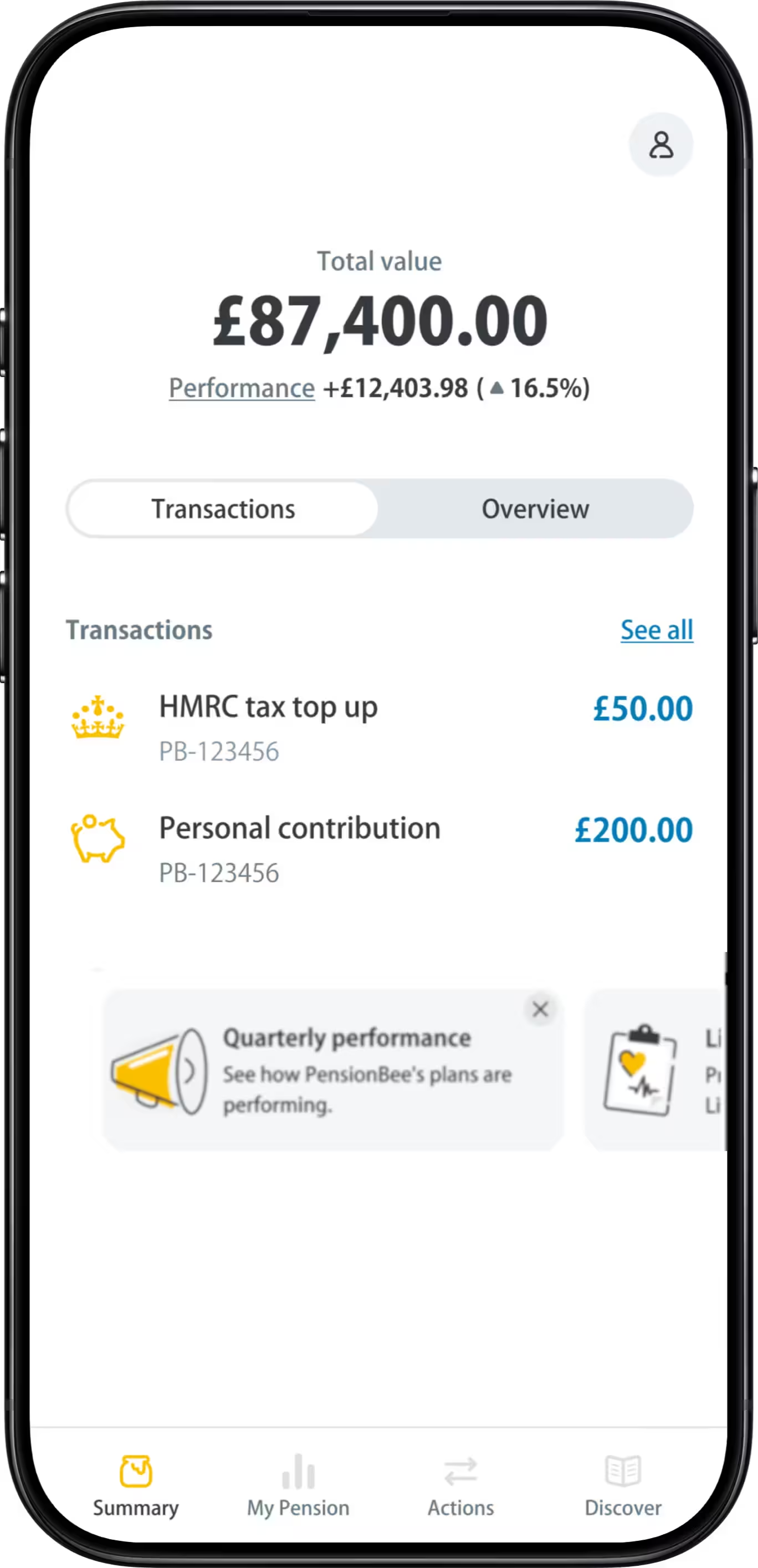
Summary (previously, the ‘Balance’ tab).

To keep the most important information accessible at a glance, we now show only your two most recent transactions here. This leaves room for us to bring new features that make your ‘Summary’ tab and managing your pension even more helpful. To see your full transaction history, simply tap or click ‘See all’.

My Pension (previously, the ‘Analytics’ tab)

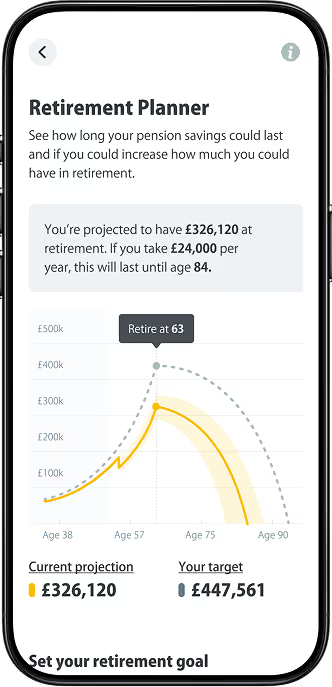
Here you’ll find information related to your pension plan. Most notably, we’ve moved your plan information out of your ‘Account’ tab to here under ‘View plan information’. Other than that, you’ll continue to see your ‘Retirement planner’, ‘Transfer and contribution breakdown’ and ‘Past performance’ chart. We’ve got some great updates planned here, too, like more information about where and what your plan invests in and how your plan’s performing.

Actions (previously, the ‘Funds’ tab)

This is where you’ll go to transfer your old pensions, track and manage your transfers’ progress and top up your PensionBee pension. For now, the biggest change here is moving our ‘Refer a friend’ feature from your ‘Account’ tab. But there’s much more to come, including offering better visibility over what’s happening with your pension’s transfers.

Account

This sees some of the biggest changes. Perhaps, most importantly, this is where you’ll find our help and support information. If you need to contact your BeeKeeper, you can now find their email address under the ‘Support’ section, along with access to your FAQs.

For the time being, you can also access our content from here. These include blog articles, the Pension Confident Podcast and our Pension Academy video series. However, we’re looking forward to offering a refreshed version of our content soon.

The Account tab is where you’ll continue to manage personal details, like updating your phone number or address and your beneficiaries. You’ll also find your pension’s Annual Statements and other key documents under ‘Documents and resources’.

Let us know what you think

We’re always looking for ways to improve your experience as a PensionBee customer. If you have feedback about the changes or any other part of your PensionBee experience, email us at feedback@pensionbee.com.

Thank you for your patience as we navigate to a new and improved way to support you throughout your retirement journey.

E46: How to bounce back from redundancy with Jimmy McLoughlin OBE, Eleanor Mills, and Emma Ferenc-Bachelor
Where do you see yourself in five years? In a rapidly changing world of work, that’s becoming harder to answer. If you find yourself looking for work after redundancy, our panel has expert tips for how to bounce back.

The following is a transcript of our monthly podcast, The Pension Confident Podcast. Listen to episode 46 or scroll on to read the conversation.

Takeaways from this episode

PHILIPPA: Welcome back. Today we have a question for you: where do you see yourself working in five years’ time? In a rapidly changing world, that question is becoming harder to answer. The World Economic Forum predicts that by 2030, so not long, we’ll have 170 million new jobs, but nearly 92 million existing jobs, they’ll have gone.

And that’s not all. The new Employment Rights Act came into law here in December. Over the next two years, phase changes will affect many workers’ rights, including: parental leave, unfair dismissal, and redundancy. Now, these changes, they’re mostly good news for workers, but some experts say they could also make employers more cautious about hiring. Some might even lay people off before the new rules take effect.

So what could this mean for you? Well, if you’re job hunting, expect more competition. If you’re working, but your job feels at risk, now’s the time to prepare so you can bounce back if redundancy does happen to you. That’s what we’re talking about today.

I’m Philippa Lamb. If you haven’t subscribed to The Pension Confident Podcast yet. Why not click right now, you’ll never miss an episode and catch every single new episode in 2026.

With me to talk about redundancy, I have Jimmy McLoughlin. He’s a former Downing Street Adviser. He’s Chief Podcaster at Jimmy’s Jobs of the Future, the UK’s most trusted careers podcast. Is that right? Did you just say that? Is it true?

JIMMY: I’m not sure where that’s come from. It is now.

PHILIPPA: It says so on your website, so I’m reading it out. Impressive guest list I have to say, you’ve had some heavy hitters, including the Prime Minister.

JIMMY: Yes, which is very interesting, in terms of job security.

PHILIPPA: Eleanor Mills, she’s a former Editorial Director of the Sunday Times. She’s Founder of Noon, which is a platform which helps women find a new path through midlife and beyond. She’s also the Author of the bestseller, ‘Much More to Come‘.

From PensionBee this time, we’re joined by Training and Culture Manager, Emma Ferenc-Batchelor.

Hello, everyone.

ALL: Hi.

PHILIPPA: Thanks for coming in. Here’s the usual disclaimer before we start. Please do remember, anything discussed on the podcast shouldn’t be regarded as financial advice or as legal advice, and when investing, your capital is at risk.

How it feels being made redundant

PHILIPPA: Now, I’m going to ask you all the obvious first question. Have any of you ever been made redundant?

ELEANOR: Yes.

PHILIPPA: OK. What happened?

ELEANOR: It was horrible. It was really, really grim. I’d been at my old newspaper for 23 years. I was the Editorial Director, I was the Editor of the Sunday Times magazine. I got a call asking me to go up and see the new Editor. I went up with all my stuff for the six months, all my jolly things.

PHILIPPA: The things you were going to be talking about.

ELEANOR: I just interviewed Sheryl Sandberg. It was all good, world exclusive. [I] walked in, the tissues were on the table, the Head of [Human Resources] (HR) was there with the new boss, and I was out. It was a truly horrible, surreal moment. A bit like being in a car crash. When you get that real dissociation.

I was sitting in that office and watching the tugboats chug up the Thames and the seagulls flying around the Southwark Cathedral. Just knowing in that moment that my life was never going to be the same again. It’d been my life from when I was 21 to when I was 50 [years old], and I suddenly realised that I was going to have to start again.

PHILIPPA: Horrifying. You’ve had this, too, Jimmy?

JIMMY: Well, yes -

PHILIPPA: - in a sense -

JIMMY: - in a sense, slightly different. But it’s quite interesting, because people are probably quite interested in what happens when a Prime Minister changes. I was a Special Adviser to Theresa May, and I was there for the entire three years. But people will remember that Theresa May’s premiership wasn’t the most stable of times. So you were constantly aware that this may all come to an end this week.

What happens when a Prime Minister leaves is [that] all the political appointees, which [are] Special Advisers, all leave. You are - you literally wave the Prime Minister, who goes and gives the speech outside Number 10, you wave them out in the corridor, at the front, and then you’re ushered out the back door.

PHILIPPA: Literally that?

JIMMY: Literally, that’s what happens. And then the new Prime Minister, Boris Johnson, had asked me to stay on for a little while. So one of just a couple that had happened to. And after a few weeks, we were about to have our first baby and whatever, and it was really time for me to do something else. So I took almost voluntary redundancy, I suppose you might say.

So that was 2019, and I thought, well, I just needed a bit of head space to work out what I was going to do in my life next and so on. If I’d known there was going to be a pandemic coming six months later, I might’ve taken one of the jobs that was offered to me as I left. But then I had an enforced period of thinking about it.

PHILIPPA: I’m going to say you two are complete outliers here. Most people, when they get made redundant, they don’t have jobs like yours. They’re just people who have that meeting, the meeting you described, a shorter version usually, with a HR person there and a box of tissues - if that! They’re out the door thinking, “how do I pay the mortgage next month?”.

EMMA: I think it’s quite interesting, because I haven’t personally gone through redundancy, but I’ve experienced it vicariously through my mum. She was a single parent. We were just at the age we were becoming quite independent - so [the] end of primary school, start of secondary school. I think at the time, it was very scary, but she looked at it as like, “well, actually, this opens so many more doors”.

She went back to university and finished a degree. She’d gone from [Transport for London] (TFL) driving a tube. She was like, “maybe this is the time to put into gear the things I do want to do”. Then she got a degree and then went to actually work for [University and College Union] (UCU). It was a fresh start. For me, it’s like, redundancy doesn’t always seem like a negative.

PHILIPPA: She sounds so impressive. I mean, I’ve got to say, having been a single parent myself, that wouldn’t have been my first thought. If I’d lost work and I was looking at paying all the bills by myself, I’m not sure I would’ve been as positive as your mum.

EMMA: At the start, she was like, “how are we going to do this?” But I think because we were at that age, we were becoming independent and we were - somewhat became like latchkey kids and me and my sister kicked into gear, I was like, “maybe we should actually learn how to cook now”.

The triple whammy hitting employers

PHILIPPA: There are positives if you can get there. But Emma, I do want to ask you about the nitty-gritty of this, because there’s talk of job cuts. It’s a tight labour market right now. It’s fair to say, employers are under pressure. We’ve got National Insurance contributions (NICs) going up. We’ve got wage pressure. I did mention the Employment Rights Act, and it kicks in this year and next year.

Do you want to just run us through [it]? This is a big piece of legislation. There’s a lot to it. One of the things that struck my mind was that we’ve got ordinary parental leave and paternity leave. They’re going to become ‘day one’ rights. Is that right?

EMMA: Yes. That’ll be parental leave and unpaid parental leave, also with sick pay - that’s the Statutory Sick Pay (SSP). That’d be from the first day of employment.

PHILIPPA: OK. And protection from unfair dismissal. Well, that becomes a right, I think it was going to be a ‘day one’ right, wasn’t it? But now it’s going to be, what, six months in?

EMMA: Yes. That was originally that would’ve been in play from two years [in].

PHILIPPA: OK, so that’s a big change that employers need to take on board, obviously, helpful for workers.

EMMA: Yeah.

PHILIPPA: OK. So helpful for working people. But obviously, I mean, Jimmy, from an employer’s point of view, if we look at it in the round, that’s going to make some employers think twice about hiring, isn’t it?

JIMMY: I mean, there’s a huge amount with this at the moment for businesses, because as you mentioned at the top, you’ve got the National Minimum Wage going up, you’ve got the NICs going up, you’ve got the Employment Rights [Act]. You’ve also got geopolitics and the tariffs happening, and you’ve also got the rise of AI as well. So the first three of those things are all government interventions, and it’s a lot for business to ask to do all at once. Any one of them, they’d probably complain about, to be fair, but it’s a lot all at once.

If you’re an employer, and I’ve now got access to all these amazing AI tools and so on, it does end up forcing you to think about that more. Because actually, and this has happened now for 15 years or so, the National Minimum Wage has gone up a huge amount. Basically, now, if you work full-time, you’re pretty much on £30,000. It’s gone up exponentially. Of course, for an employer, they’ve got NICs on top of that as well. It’s been one of these things that’s happened.

PHILIPPA: Yeah. So understandably, employers are going to be cautious. Obviously, they’re always cautious about hiring. They’re going to be potentially more cautious. And there’s some talk of potential redundancies ahead of some of this legislation kicking in next year. So would it be fair to say that obviously, jobs, it’s a tight market already. It could be tighter soon?

JIMMY: I think that’s true. I think we’ll get into the position where we’ll see the likes of Amazon hiring more robots and so on. It’s pretty extraordinary.

Where new jobs will come from

PHILIPPA: Where are the new jobs going to come from then? Because if we hear all these numbers [are] up, millions of existing jobs disappearing and all these new roles coming, what are they going to be?

JIMMY: Well, of course. This used to be my job in Number 10.

PHILIPPA: Yeah.

JIMMY: I’d get a phone call at 07:55 from Wilkinson’s or Debenhams saying, “we’re about to go into administration. We’re going to make 10,000 people redundant”. I’d go in and tell the PM this ‘joyous news’ to which she’d react with, “Jimmy, all you ever tell me about is job losses”.

But there are lots of interesting roles that are out there. I think actually, if you’re building or switching careers at the moment, arguably, there’s never been a more exciting time to do it. I think there’s more opportunity out there. There’s more jobs being created, but they’re not the jobs that you grew up knowing.

PHILIPPA: Thinking about what people might do in that situation, if you’re thinking about if your job’s looking at risk, and you’re not in a very ritzy job and you do need to pay the bills, where should you be aiming if you’re thinking about what sectors are actually going to be flourishing for me?

JIMMY: You’ve got the obvious ones like AI, technology, creator economy, etc. What I think could be interesting is the human face-to-face jobs. I look at elderly care being a primary one of this. Having done 250 episodes of Jimmy’s Jobs of the Future, people always ask me what the future looks like. I don’t know anything about the future. You can’t predict with certainty at all. But the one thing you can predict is demographics.

PHILIPPA: Sure.

JIMMY: We’re going to have lots of old people.

PHILIPPA: Ageing society.

JIMMY: I think that’s a big thing. I think the hope with AI is that it’ll be able to automate a lot of the admin work that people have and people are actually able to do the job of caring for people.

EMMA: I think there’s a bit of scaremongering in regards to what jobs will exist and how the employment industry will look. But I think technology-related jobs are the fastest growing in percentage terms. I think people need to be looking at stuff around data, AI. It’s looking at the language, fintech engineer or machine learning specialist. I think it seems like jobs are shrinking or maybe disappearing, but I think it’s more just pivoting.

JIMMY: I think people have to think of themselves as a T-shape. You want to have a deep skill in something, but then you want to be trying to add these bits onto the side as well. One of the interesting jobs that I think isn’t that academic necessarily, it’s like community managers. All these companies now are like, they talk about community, and I’m sure PensionBee does do this a lot. It’s part of this podcast, right?

PHILIPPA: Sure.

JIMMY: It’s building that out. I think that’s a more interesting area as well for people that they can get involved with, learn how to build and be involved in the community.

Reskilling in midlife

ELEANOR: What I also see amongst my midlife women is that they’re actually radically reskilling, and they’re taking up things like being an electrician or plumber or carpenter or becoming therapists or coaches or doing things which the AI won’t be able to do. We’re always going to need people to decorate our homes. That’s not something that AI can do. Being a therapist, actually, it’s quite important to speak to a real person. We were talking about caring roles earlier. I think it’s also, or gardening, it’s thinking about the things that the AI is never going to be able to do.

I see some really exciting midlife women taking up really new skills, setting up their own building companies, that kind of thing. I think it’s also worth, yes, the T thing, adding some things onto what you already do. But I think if you’re made redundant, particularly at midlife, thinking that we’re going to be here for the 100-year life, many of us, we’re all going to live a lot longer than we think, is A, where lots of us are going to be made redundant and have to start again and reskill, and that B, at 50 [years old], if you’re actually going to have another working life of 25, 30 years, it’s worth reskilling. It’s actually worth maybe learning something new.

PHILIPPA: Can we just look back to who’s most at risk of job loss here? Because I know, Eleanor, middle-aged women, you’re high risk, right?

ELEANOR: Well, there’s a lot of gendered ageism in the culture, and certainly what I’ve seen within my community, so we now have a community which is 100,000 strong of women in midlife. We call them ‘Queenagers’. We see that a lot of women, as they hit 50 [years old], hitting ‘gendered ageism’ - which is where ageism hits sexism.

I think that certainly within the corporate world, [the] corporate world likes women to be pleasing - physically pleasing, and also emotionally pleasing. I think younger women are much more likely to tick both of those boxes. As you get a bit older, a bit more experienced, a bit more bolshie, you’ve been around the block a few times, it’s not your first rodeo, you’re much more likely to go, “well, don’t think that’s going to work? We did that five years ago”, or “no, actually, I think we should do this”.

I think that less pleasing-ness in [older] women is still a bit of a challenge. I was talking to the Head of SmartWorks the other day, who try and get women back into careers, and they say that they see it takes twice as long for a woman over 50 [years old] to get a job as it does for the younger women.

PHILIPPA: OK.

ELEANOR: This is a very, very real thing. The Menopause Society also says that one-inten women are leaving jobs, or being pushed out of jobs, as they hit this age.

PHILIPPA: Those of us who’ve had kids know how hard it was to get decent work, part-time, when you were trying to combine it with childcare. Well, certainly that was my experience [and] most of my friends, real struggle there. A lot of women end up taking quite low-grade jobs to make that work. So all this stuff might make people more vulnerable to job loss.

ELEANOR: I think for redundancy in midlife, what I see with a lot of the women, is a lot of them had a very what people now call a ‘squiggly career‘. If you haven’t had a very linear career progression, and that’s true for a lot of women because they’ve taken time out for caring, they are quite often find it difficult to tell a coherent, succinct narrative about exactly who they are and what they’ve done.

So one of the things that we do at Noon is we do this rebrand course where we help people with what their story is. And if you can get your own story right, which takes in some of the setbacks as well as the triumphs, then you create a very cogent and human story to help people with. So I find that that’s something that’s really useful for people when they’re restarting.

Your redundancy rights

PHILIPPA: I want to loop back further to the point at which you lose your job. Emma, are you able to talk to this? What are your rights? What notice period? What consultation?

EMMA: In regards to notice period, it’s about a week for every year that you work. That’s up to 12 weeks’ notice period. You should also get a consultation with your employer. So essentially, that’s an opportunity for them to speak with you, to inform you why you’re being made redundant, if there’s any alternatives to redundancy, and if your employer is making up to 19 redundancies, there’s no rules about how they should carry out the consultation.

PHILIPPA: Not that helpful, to be honest.

EMMA: But in regards to pay -

PHILIPPA: - [there’s] statutory redundancy pay, isn’t there?

EMMA: So you need to be there for two years, and you need to be an employer, so it can’t be [a] contractor or freelancer.

PHILIPPA: So this is a really key thing to know, isn’t it? If you’re listening to this right now and you’re on contract, and of course, millions of people are, let alone gig work. Or you haven’t been there, even if you’re an employee, for two years - nothing. They’re not required to give you a single penny. This really speaks to the need for pre-planning, doesn’t it?

ELEANOR: We see a lot of people being made redundant just as their two-year contract comes up. Just at the point where they’re beginning to get employment rights, they get whacked. We see that a lot.

PHILIPPA: That’s the key thing for everyone to understand. But if you’ve been there for two years, it’s about your age?

EMMA: Yes. If you’ll get half a week’s pay for each full year, if you’re under 22. It’s one week’s pay for each full year if you’re 22 and older, but under 41. And one and a half weeks pay for each year if you’re 41 and older.

An example of that would be if you’re made redundant on 1 January this year, you’re 42 years old and you’ve been working for about five years and earning about, let’s say, £767 a week, so that’s just under £40,000 [a year].

PHILIPPA: OK.

EMMA: Your statutory redundancy payment could be just under £4,000.

PHILIPPA: I’m going to say that’s not a lot of money, is it, in today’s world? It’s not going to take you very far, is it?

Cutting spending and saving tips

PHILIPPA: That takes me to my next question then, which is about preparing for this horrible reality. We’re a personal finance podcast. In many ways, let’s talk about what you should do, because you’re going to need a cash cushion to at least tide you over. Presumably, we haven’t talked, Emma, about this six-month cash cushion, but it’s hard to get six months’ money together, isn’t it? Of six months of your outgoings.

EMMA: Yes, that’s definitely something that I’m doing. I know that, especially living in London, it can sometimes feel quite impossible. But I think as cliché as it is, every little helps. I think starting with a - I think that’s one of the things I actually learnt in university. It’s like a small nest egg can keep rolling, keep going. I think that, yes, trying to get that six months fund is a good starting point.

PHILIPPA: I must say, if I was employed right now and I was thinking my job was fragile, I’d probably be cutting out any unnecessary expenditure, wouldn’t you? Just be thinking about, do you really need whatever it is you got your eye on in the sales right now?

EMMA: Funnily enough, one of the things I always say to myself in regards to saving is, “if you can’t afford to buy it twice, then you can’t afford it”. If I can’t afford to replace it, then I can’t afford it. That’s my way of trying to reign my spending back in.

PHILIPPA: You two have experienced jobs. Obviously, you worked a long time for your employer, so I’m assuming they had to pay you a big fat redundancy check for you to go.

ELEANOR: I’ve been there nearly 25 years. I had a cushion. But what I see with many women within my community is this, and we really encourage it, is that idea of having a walk away fund so that you do have some choices or if the worst thing happens, you have a nest egg.

Everyday networking

ELEANOR: I also think that in today’s world, it’s always good to have a bit of a side hustle. Actually, what saved me was that I did have a side hustle. I’d been Chair of Women in Journalism for the last seven years. When I lost my job at the Sunday Times, I had a whole network of people, and I stood for something which wasn’t just me and the job that I had.

Because I think too many of us, and particularly women, put a lot of effort into networking within their own company or chatting people up in their company, but they’re not thinking of that more broad network. I think that what saves you when you get made redundant, and there’s a lot of evidence of this, [is] that you’re five times more likely to get a job through someone in your network than you are from just applying cold. I think it’s really thinking about enriching all those ties that might help you if you suddenly lost your job tomorrow.

EMMA: In regards to networking, I think sometimes people can get a little bit caught up in that networking needs to be specifically with employment. You don’t realise, I don’t know, just doing social activities, they might start a conversation with someone, “oh, you’re working in the field that I want to work in. Let’s swap numbers. Let’s have a chat. What do I need to do to get into that?”.

People don’t realise that it could just be a question away or it could be a meeting away. It doesn’t always have to be in a massive hotel - I think, champagne dinner thing, you might just be sitting next to someone on the bus and start a conversation. You’re like, “actually, great contact. Let’s keep in touch”.

ELEANOR: It’s those loose connections.

JIMMY: I also think the key thing to do is go out to your friends and to people that you’ve worked with before and say, what do you think I’m good at?

ELEANOR: Yes.

JIMMY: Because actually -

PHILIPPA: - that’s a really interesting idea. Your own skills audit.

JIMMY: It’s really hard sometimes to be self-analytical of your own skillsets. And also you have a tendency to think of the stuff that you’re good at, is that everyone’s good at and they enjoy as well. And that’s actually not true. We’ve all got different makeups and different brains and so on. So I think that’s my tip to try and do that. You go for lots of coffees with people and try [to] get feedback on yourself.

PHILIPPA: When it happened to you, though, I know you knew at some point it was going to come because of the nature of the work you were in. But when it was that day.

JIMMY: Yes.

PHILIPPA: How did it feel? I bet it was still somehow a shocking experience.

JIMMY: Yeah, it felt very - that has been my life and that has defined me.

PHILIPPA: Now what?

JIMMY: Jimmy from Number 10, right? And now you’re just Jimmy.

ELEANOR: It’s really hard when a big plank of your life is suddenly ripped out from under you. And the first thing to do is just to pause and to be kind to yourself. So I started swimming in the pond on Hampstead Heath every day when I was made redundant. That shot of joy kept me going.

Reframing the shame around redundancy

PHILIPPA: It’s true, though. It’s an injury, isn’t it?

ELEANOR: It’s a wound!

PHILIPPA: It’s an injury that’s inflicted on you. Personal, professional, financial.

ELEANOR: And shame! There’s a big amount of shame in this. When I first left the Sunday Times, I wrote about how it felt to be made redundant in The Telegraph. I had about 10,000 people get in touch with me saying, “it’s a bit like death. Nobody wants to talk about it. Nobody wants to come near you; feel a bit like you’re contaminated”.

PHILIPPA: Still?

ELEANOR: Yes.

PHILIPPA: It’s such a common thing.

ELEANOR: No, but the shame around redundancy is huge. That’s why, and it’s partly why I wanted to come on this podcast to talk about it, because people don’t talk about how awful it feels. What I’d say to people is, take a breath, remember that you were only able to do that thing because you have some innate qualities.

PHILIPPA: Well, that brings us to support, doesn’t it? Because as you say, there’s a lot of support out there, and you don’t necessarily have to pay for an expensive career coach to get it, do you? There’s lots online, of high-calibre support, career coaching. No, you’re looking dubious.

JIMMY: No, do you want to know something that I did the other day with ChatGPT?

PHILIPPA: Oh, yeah.

JIMMY: I said, take everything you know about Jimmy McLoughlin and everything that I’ve spoken to you about -

PHILIPPA: - that was bold.

JIMMY: - and predict my career for the next 30 years.

PHILIPPA: That’s such an interesting thing.

ELEANOR: What did it say?

JIMMY: Well, it was fascinating, because it was like reading potentially the future and all the different paths you could do. Also what it made me think afterwards, was actually it’s not that impressive what it did, because it knows I’m interested in media and politics and entrepreneurship. So actually -

PHILIPPA: - you’d told it everything about yourself?

JIMMY: Well, I talk to it semi-regularly and whatever. It knows who I am. It knows I do the podcast.

PHILIPPA: But if it didn’t, if you came to this new, you just sit down and tell it everything about you.

JIMMY: But I think it’d just be like, “act as a careers coach for me. Ask me 10 questions”, and it’ll be amazing the prompts that it comes out with and so on.

PHILIPPA: Because we talk about this because we use AI, but lots of people don’t ever use it. So you can do this, it’s free?

JIMMY: You can do it, yeah. Or you pay for a premium account, £15 a month or whatever it is. You have access to quite a good careers coach there for quite a, at least to get -

PHILIPPA: - a starter.

JIMMY: A starter. It’s a good place to start.

PHILIPPA: Obviously, there are lots of caveats around the accuracy of stuff that you might get back from AI. But I think it is good on that practical front, isn’t it, Emma?

EMMA: Yeah.

PHILIPPA: Getting your ducks in a row.

EMMA: Yes. I think it’s a good place to start with the research and then go from there. It helps you. I think it makes it a little bit less scary because I know when you type things into Google, it’s like thousands of pages. It can be overwhelming.

PHILIPPA: OK. I’m getting a strong feeling that we’re going to talk about this for a whole other hour. So thank you very much, everyone. It’s great having you with us.

EMMA: Thank you for having us.

ELEANOR: Yeah, it’s been great. We’re going to talk about it all day.

JIMMY: Really, really enjoyed this.

PHILIPPA: If you’re enjoying this series, please do rate and review us so other listeners, just like you, can find us. If you’ve missed an episode, don’t worry about it. You can catch up anytime on your favourite app. We’re on YouTube, we’re in the PensionBee app, too, if you’re a PensionBee customer.

Next month, we’re going to be discussing the single tax. How much is it costing you not being coupled up? Just a final reminder, anything discussed on the podcast shouldn’t be regarded as financial advice or as legal advice. When investing, of course, your capital is at risk. Thanks for joining us. I’ll see you next time.

Risk warning

As always with investments, your capital is at risk. The value of your investment can go down as well as up, and you may get back less than you invest. This information should not be regarded as financial advice.

3 pension saving tips from Warren Buffett
Warren Buffett is undoubtedly one of the most successful investors of all time. And in his final letter to his shareholders, he shared some savvy tips for pension savers.

Warren Buffett is undoubtedly one of the most successful investors of all time.

Known as the ‘Sage of Omaha’, Buffett bought his first shares as an 11-year-old in 1942. Then, throughout a 60-year career at Berkshire Hathaway, he turned the former textile producer into a world-renowned investment conglomerate. As of 2026, it’s worth more than $1 trillion.

Throughout his time in charge, Buffett became known for his long-term and patient approach. This strategy proved very effective across more than half a century of moving through the markets.

He also gained fame for his annual letter to shareholders, where he’d provide insights and wisdom that have become standard investment practice for many people. This includes:

  • “If you aren’t willing to own a stock for 10 years, don’t even think about owning it for 10 minutes.”
  • “It’s far better to buy a wonderful company at a fair price, than a fair company at a wonderful price.”
  • “Someone’s sitting in the shade today because someone planted a tree a long time ago.”
  • “Be fearful when others are greedy, and greedy when others are fearful.”

Buffett stepped down from his role as CEO at Berkshire Hathaway at the end of 2025, aged 95. And, his final letter as CEO to shareholders contains even more wisdom that may help you manage your own wealth, especially your pension.

With this in mind, take a look at three tips from his final letter to shareholders.

1. It’s important to plan for a long life

Having reached the ripe old age of 95, Buffett noted in his letter that he’s set the new bar for longevity in his family.

“Now let’s move on to my advanced age,” he wrote. “My genes haven’t been particularly helpful - the family’s all-time record for longevity (admittedly family records get fuzzy as you work backwards) was 92 until I came along”.

Buffett thanked his impressive age to the medical staff who’ve kept him healthy. But crucially, he also gave thanks to “Lady Luck”, noting that “those who reach old age need a huge dose of good luck”.

This is of course very true. Longevity depends on many factors, from genetics and luck, to lifestyle choices and access to medical care.

Regardless, the odds of living a long life are increasing. Data shows that:

  • 65-year-old men today have an average life expectancy of 85, with a one-in-ten chance of living to 96;
  • for 65-year-old women, that rises to an average of 88, and a one-in-ten chance of living to 98;
  • one-year-old boys today have a one-in-ten chance of living to 101; and
  • one-year-old girls have a one-in-ten chance of living to 102.

Source: Figures generated using the Office for National Statistics (ONS) life expectancy calculator. Projections may vary based on cohort and methodology

As you can see, many people have a one-in-ten chance of being close to or reaching a centenary. So, it’s important to plan for the potential of a 100-year-life - and that means preparing financially.

You might plan to retire when you reach State Pension age (66 in 2026, rising to 67 by 2028). In that case, your savings might need to last for 30 years or potentially even more after you finish working.

As a result, having enough in your pension to ensure you can reach this target is key. By making regular contributions now, you could build a fund that better prepares you to enjoy your lifestyle in retirement.

Plus, most UK taxpayers get tax relief on their pension contributions, which means that the government effectively adds money to your pension pot. Usually, basic rate taxpayers get a 25% tax top up, seeing HMRC add £25 for every £100 you pay into your pension making it £125. Higher and additional rate taxpayers can claim further tax relief via Self-Assessment.

So, a pension can be a tax-efficient way to save for the future, too.

Note that you can usually contribute into your pension each tax year up to the annual allowance (£60,000 in 2025/26). This includes personal, employer and any third party contributions. There’s a separate limit on how much you can receive tax relief on, which is up to 100% of your relevant earnings, capped at £60,000 (2025/26).

{{main-cta}}

2. Stay invested for the long term

When you put money into a pension, you aren’t just saving it in a separate pot, your contributions are usually invested to help them generate growth over time. As a result, if you have any pension savings, you’re likely an investor.

Buffett is a very successful investor, largely because he’s followed a strategy built around long-term growth and patience.

Throughout the 60 years Buffett was CEO of Berkshire Hathaway, he saw some sizable investment market dips. From Black Monday in 1987, when quoted shares in London fell by £50 billion, to the infamous 2008 financial crash that saw $1.64 trillion global losses, Buffett saw markets fall significantly.

Yet, as he pointed out in his letter, these fluctuations - while alarming - are just what markets do.

“Our stock price will move capriciously, occasionally falling 50% or so as has happened three times in 60 years under present management,” he wrote.

But he also followed up with the reassuring message of “don’t despair; America will come back and so will Berkshire shares”.

The lesson here is that staying invested when markets fluctuate can mean you benefit when they recover. As Buffett says, this is part of investing and, over the long term, history has shown that investment values do bounce back over time. While past performance isn’t an indicator of future results, historical perspective is important.

If you start saving from the beginning of your career, your pension will be invested for perhaps 40 years or even more. This longer time frame could allow markets to recover from dips and generate greater returns.

Additionally, you could also benefit more from compounding interest and returns. When you receive interest or dividends on your pension savings, these then generate growth next time, and so on, creating a cycle of growth.

Think of it as a snowball effect - the snowball continues to grow in size as it rolls down the hill and picks up more snow.

By staying invested for the long term, you give yourself a good chance of benefiting from compounding.

3. Think about what you want to happen with your pension when you’re gone

Alongside thinking about how you’ll manage your wealth during retirement, it’s worth considering what will happen when you die.

This is a point that Buffett made in his letter, noting how important it is to make decisions now:

“Ruling from the grave doesn’t have a great record, and I’ve never had an urge to do so,” he said.

For your pension, you might want to consider your preferred beneficiaries. It’s usually sensible to nominate them with an expression of wishes form, which you fill in with your pension provider and is separate to your will.

This isn’t legally binding like a will. But, your provider will usually take it into account when deciding how to administer your funds on your death.

As part of this, you might also want to think about intergenerational planning and how you can pass on wealth to your loved ones tax-efficiently.

That might involve gifting wealth to reduce the Inheritance Tax (IHT) bill charged on your estate when you die. Although note that IHT rules are complex and mistakes can be costly. If you’re unsure, it’s best to speak to an Independent Financial Adviser (IFA) for support and guidance.

Whatever you decide, Buffett’s wise words show the value of early estate planning, guided by trust and good intention.

That way, you can be sure that your wealth will be divided as you wish and your family will be as financially secure as you can make them.

If you’re a PensionBee customer, you can nominate your beneficiaries in your online account (your ‘BeeHive). Watch our video explainer for more information.

Summary

Warren Buffett built an investment empire on patience, prudence, and a long-term outlook.

By applying these principles to your pension savings, you could set yourself on the road towards financial freedom and security in later life.

The key is in consistency and sticking with your long-term plan. With regular contributions and reviews, you could build a fund that lets you live the retirement lifestyle you want.

Risk warning

As always with investments, your capital is at risk. The value of your investment can go down as well as up, and you may get back less than you invest. Please note that tax rules change regularly, and the actual tax benefits you receive will depend on your individual circumstances. This information should not be regarded as financial advice.

Money milestones: what women should check at 25, 35, 45, and 55
Money milestones look different at each life stage. Here's what women should check as they move through their career, family life, and retirement.

Your priorities shift as you move through life. What matters at 25 years old can look very different at 35, 45 or 55. Many women also face challenges such as lower average pay, career breaks and caring responsibilities. These can affect financial confidence and long-term plans.

A simple checklist at each stage can help. It breaks big goals into smaller steps and shows you where to focus your efforts. Whether you’re building savings, balancing family life or preparing for retirement, small actions taken today can make a real difference for your future.

If you’re unsure where to start, here’s a clear guide for each decade.

Age 25: Building strong foundations

Your mid-20s can be a time of change and uncertainty. You might be starting a career or living independently for the first time. It’s also a stage when many women start out on lower pay, with the gender pay gap at 12.8% in 2025. This can affect saving habits and long-term confidence.

These early years can be a good time to build habits that may support your financial confidence in the future.

What you can do

  • Start a pension - if you’re employed and earning over £10,000 a year, you could be eligible for Auto-Enrolment. This is where your employer sets up, and enrols you into, a workplace pension. If you’re self-employed, you could consider starting a personal pension.
  • Build an emergency fund - setting money aside each month to cover at least three-to-six months’ of living costs can be a good place to start. This may help reduce the need to take on debt to cover emergency expenses.
  • Consider a Stocks and Shares ISA - this lets you invest in funds, bonds and company shares in a tax-efficient way. While past performance isn’t a guide to future returns, investments in stocks have historically tended to outperform cash savings over the long term.
  • Look at a Lifetime ISA - this is a government-backed savings account designed to help people aged 18-39 save for their first home or retirement.
  • Check your pay - look at how your salary compares with similar roles in the industry. Understanding your earning potential early on may mean you’re less likely to be underpaid.

{{main-cta}}

Age 35: Balancing career, family and growing responsibilities

Your mid-30s can bring a mix of progress and pressure. Many women see their careers develop, but it could also be a time when caring responsibilities increase. A PensionBee report found that 65% of women aged 35-44 provide unpaid childcare.

It’s easy to lose financial confidence during this time, but there are some things you could consider to stay on track.

What you can do

  • Review your pension - many women see their pension savings drop in their mid-30s due to parental leave or reduced hours from part-time work. If you have multiple pensions from old jobs, combining them may make them easier to manage.
  • Explore ways to diversify income - freelancing, tutoring or selling skills online can offer flexibility and help manage rising costs.
  • Map out your financial goals - think about what you want to achieve and how you’ll get there.
  • Create a will - it’s a simple way to protect your family. You can do this online or through a solicitor.
  • Think about life insurance - it may give your family financial security if something unexpected happens.

Age 45: Midlife reset

This stage can be a turning point. Many are part of the ‘sandwich generation’ - caring for both children and ageing parents. Earnings typically peak between ages 40-49, making this a crucial window to boost pension contributions if you can. The gender pay gap also widens significantly for women over 40, which means salary reviews are particularly important.

These years can be a useful moment to pause, check in and adjust your plans for the decades ahead.

What you can do

  • Check your pension forecast - take a look at how your savings are building. Use PensionBee’s Pension Calculator to see if you’re on track and consider adjusting contributions if your circumstances have changed.
  • Review your investments - check your investments still suit your goals and risk tolerance. As you get closer to retirement, you might want to adjust your approach.
  • Look at protection cover - review any health and income protection you have. These may support future stability.
  • Check your pay against industry averages - this can make salary negotiations easier. Use tools like Glassdoor or PayScale to compare salaries.
  • Reduce high-interest debt - paying down expensive debt helps to free up money for other goals.

Age 55: Preparing for retirement

Your mid-50s are often when retirement starts to feel real. From age 55 (rising to 57 in 2028), you may be able to access your pension. This brings new options, but also new decisions. It can feel daunting, especially if you’re managing savings gaps from earlier in life.

This stage is about understanding what you have, what you want, and what steps could help you get there.

What you can do

  • Understand your pension options - from age 55 (rising to 57 from 2028), you might be able to take a tax-free lump sum, start withdrawing (pension drawdown), or buy an annuity which may provide a regular income, depending on your circumstances. What’s right for you will depend on your personal situation.
  • Check your State Pension - look at your State Pension forecast and see if you have any National Insurance (NI) gaps which you might be able to top up.
  • Work out your retirement budget - think about your expected spending over the next decade. This may give you a sense of what a realistic retirement age could be. The Retirement Living Standards from Pensions UK can help as a guide.
  • Get free guidance - if this feels overwhelming, Pension Wise offers free impartial guidance. They can help you explore your options if you’re over 50 years old. Remember, guidance can help you understand your options, but it isn’t the same as financial advice.

The key takeaway

Taking small steps can help you feel more in control of your money, whatever life brings. These milestones are a starting point to help you plan with confidence at every stage.

Katie Sims is a Freelance Journalist with over three years’ writing experience. She has a keen interest in financial wellness for women, and hopes to make money topics simple and accessible. Holding an MA in Media and Journalism, her work has been featured in Marie Claire, Woman & Home, Liz Earle Wellbeing, Tom’s Guide, and many more.

Risk warning

As always with investments, your capital is at risk. The value of your investment can go down as well as up, and you may get back less than you invest. This information should not be regarded as financial advice.

What should you do with a redundancy lump sum?
Redundancy can be a turning point, and a lump sum can offer a vital financial cushion. Learn how it’s taxed and the key ways to use it wisely - from paying off debt to boosting savings or your pension.

Redundancy in middle age can feel like a major turning point - bringing uncertainty about whether to return to work, retrain, or ease into retirement, often with financial pressure alongside it.

Figures from the Office for National Statistics (ONS) show there were 4.5 redundancies per 1,000 employees from July to September 2025, equivalent to 124,000 people losing their jobs. According to the Centre for Ageing Better, those over 50 are twice as likely to struggle to find a new job after redundancy than younger colleagues.

One of the few positives is the lump sum payment you might be eligible to receive, which can provide a valuable financial cushion during a period of change.

So what should you do with the cash?

How much is redundancy pay?

Redundancy is a form of dismissal which happens when an employer no longer needs a role, rather than because an employee has done anything wrong. Redundancy pay is designed to help cover the gap while someone looks for their next job or considers their options.

In the UK, statutory redundancy pay depends on your age, how long you’ve worked for your employer, and your weekly pay, up to a set cap. The maximum statutory redundancy pay you can receive is £21,570 (2025/26).

You can calculate your statutory redundancy pay GOV.UK.

Many employers also offer enhanced or contractual redundancy packages. These can be significantly higher than the statutory amount. For example, a company might offer:

  • one month’s salary for every year of employment;
  • a multiple of statutory redundancy pay; or
  • a flat-rate lump sum paid on top of statutory pay.

When you might not get redundancy pay

You usually won’t qualify if you’ve worked for your employer for less than two years, if you turn down a suitable alternative role, or if you’re dismissed for misconduct.

Even if that is the case, your employer could still offer:

  • an enhanced redundancy package, if it’s in your contract;
  • an ex-gratia payment as a goodwill gesture; or
  • notice pay, which you’re entitled to even without two years’ service.

This is general information only. What you receive can vary, so it’s worth checking your contract or speaking to HR.

How is redundancy pay taxed?

In the UK, up to £30,000 of redundancy pay is tax-free. Any amount above this is usually taxed as income.

Other parts of your redundancy package are taxed in the usual way, including:

  • pay in lieu of notice (this means your employer pays you for your notice period instead of asking you to work it);
  • holiday pay; and
  • bonuses.

Understanding what is tax-free, what is taxable, and whether the payment could push you into a higher tax band for the year can help you avoid surprises later on.

{{main-cta}}

Taking time before deciding

Redundancy can be an emotional experience. In the early days, it can be tempting to make quick decisions about money without fully thinking through the long-term impact. Giving yourself some breathing space can help.

Before doing anything, it may be worth considering:

  • what your essential expenses look like over the next 6-12 months;
  • how long job-hunting might take in your sector if you plan to return to work; and
  • setting aside at least six months of essential spending before allocating the rest.

This kind of approach can help provide peace of mind while things feel uncertain.

Paying off debts

Using a redundancy payment to clear debts can often be an effective way to improve your financial position.

Paying off high-interest borrowing, such as credit cards, overdrafts, or personal loans, can immediately reduce the amount you lose to interest each month. It may also free up more of your income for future goals.

That said, it can be worth pausing before overpaying low-interest debts, such as a mortgage. In an uncertain period, having accessible cash can be just as important as reducing long-term borrowing.

Boosting savings and investments

Once you have a plan for debts and short-term spending, you can start thinking about saving and investing. A helpful first step is to separate money you may need soon from money you’re setting aside for the longer term.

ISAs for tax-free growth

Cash ISAs and Stocks and Shares ISAs both allow your money to grow tax-free, up to £20,000 a year (2025/26). Any withdrawals are also tax-free, which makes taking money from your ISAs a more flexible option.

  • Cash ISA - can be a suitable place for emergency savings or short-term goals.
  • Stocks and Shares ISA - may be more appropriate for longer-term plans if you don’t need quick access to the money.

Longer-term investing

Investing can help your money grow over time, rather than losing value to inflation. The key is to think about your goals, how long you plan to invest for, and how much ups and downs you’re comfortable with.

Some people prefer low-cost funds with a clear investment approach. Others may choose a broader mix of investments. What matters most is that the approach matches your timeframe and tolerance for risk.

Retraining and studying

For some people, redundancy can be a chance to change direction. Investing in retraining or new qualifications may open up opportunities in growing industries, or support a move into consultancy or self-employment.

Others may choose to take a career break before returning to work. This can be a valid option, but it’s important to plan how long the money needs to last and how it fits into your wider retirement plans.

Paying into your pension

A redundancy lump sum can also be used to boost pension contributions. This can be tax efficient, as most pension contributions usually benefit from tax relief. This means the government effectively adds money to your pension pot. Basic rate taxpayers usually get a 20% top up - HMRC adds £20 for every £80 you pay in.

If you’re still part of a workplace scheme, it may be worth checking whether you can make additional voluntary contributions before leaving. It’s also important to be aware of the annual allowance - the total amount that can be paid into your pension each tax year without triggering extra tax charges. The current standard annual allowance is £60,000 (2025/26), and this includes personal, employer, and any third party contributions (for example, from a partner or family member).

There’s also a separate limit on tax relief. You can receive tax relief on personal and third party contributions up to 100% of your relevant earnings, capped £60,000 per year (2025/26).

If you’ve already accessed your pension flexibly (from age 55, rising to 57 from 2028), the Money Purchase Annual Allowance (MPAA) applies. This reduces the amount you can pay into your pension to £10,000 per year (2025/26) and still receive tax relief.

Options to consider

A redundancy lump sum could be used to:

  • pay off high-interest debt, such as credit cards or personal loans;
  • build or top up an emergency fund covering around six months of essential expenses;
  • contribute to a Cash or Stocks and Shares ISA for tax-free growth;
  • make pension contributions to benefit from tax relief; and
  • invest in retraining, qualifications, or a planned career break.

Not all of these options will suit everyone. Thinking through your priorities before acting can help you make more confident choices.

Pitfalls to watch for

It’s important not to rush into investing or making large pension contributions without understanding the risks.

You may want to avoid:

  • locking too much of your lump sum into long-term products when you still need easy access to cash; and
  • missing contribution limits or tax deadlines for ISAs, pensions, or other allowances.

For major investment decisions or large pension transfers, seeking regulated financial advice is strongly recommended.

Taking things step-by-step can help you make the most of your redundancy payment while keeping a longer-term view of your finances.

In episode 46 of the Pension Confident Podcast, Philippa and a panel of expert guests discuss how to bounce back from redundancy. Listen to the episode or read the transcript.

Emma Lunn is a multi-award winning Freelance Journalist. She’s written about personal finance for 20 years, with a career spanning several recessions and their consequences. Her work has appeared in The Guardian, The Mirror, The Telegraph and MoneyWeek. Emma enjoys helping people learn to manage their money well, in both the short and long term.

Risk warning

As always with investments, your capital is at risk. The value of your investment can go down as well as up, and you may get back less than you invest. This information should not be regarded as financial advice.

Why pensions deserve your attention during divorce
Divorce often centres on the family home and immediate costs, so pensions can be overlooked. Yet they’re often one of the most valuable assets and can shape your financial security for years to come.

Divorce can be a deeply personal and emotional experience. It also brings a series of practical steps that can affect future financial security.

During a separation, it’s natural to focus on the family home and the day-to-day costs of moving forward. Long-term savings, including pensions, can feel less urgent and are often left out of the conversation. The financial strain of divorce itself, from legal fees to setting up a new household, can add another layer of stress at a time that already feels overwhelming.

Yet after property, pensions are often one of the most valuable assets a couple has built together. When they aren’t fully considered during a settlement, the impact may not be obvious straight away, but it can shape financial security later in life. This can affect women in particular, especially where career breaks or caring responsibilities have meant limited pension saving over time.

Understanding why pensions are often missed during a separation is key. This awareness can help support fairer and more sustainable outcomes, especially for women.

Pensions are marital assets

It’s completely normal for pensions to feel personal, and that’s why many women hesitate to raise them during a separation. When contributions haven’t been equal, it can feel like the money built up in a pension belongs more to one partner.

Having a clear understanding of how pensions are treated in divorce can help women approach this part of the process with more confidence.

Many people aren’t aware that pensions are considered marital assets, in the same way as property or savings. They form part of the overall financial picture of a relationship.

In many homes, one person’s pension savings increase while the other handles unpaid care or spends time away from work. By taking on this unpaid work, they often make it possible for their partner to continue working and saving into a pension.

These contributions are important. That’s why pensions should be included when reaching a fair financial settlement, and why it’s reasonable to ask for them to be considered.

Divorce can widen the pension gap

Women in the UK already retire with smaller pension pots than men. This is known as the gender pension gap, and it often builds up gradually over time. PensionBee’s Pension Landscape Data shows that, on average, women over 50 have around £30,644 in their pension. Men of the same age have £54,512, leaving a 44% gap.

Pension saving differences reflect broader trends in people’s working lives. Women often earn less, take more time out of paid work, and are more likely to work part-time, which can reduce how much they’re able to save over time.

PensionBee’s research shows that in the first half of 2025, men contributed an average of £1,845 per quarter to their pensions, compared with £1,347 for women. That’s a difference of 27%.

Divorce isn’t the reason the gender pension gap exists. However, it can make it harder to close if pensions are missed or undervalued during a settlement.

Research from the UK Parliament House of Commons Library shows that divorced women aged 45-54 hold just 38% of the pension wealth of divorced men. On average, divorced women in this age group have pension savings of £16,000, compared with £42,000 for divorced men.

These figures reflect long-standing inequalities, which can worsen if pensions aren’t properly considered during divorce proceedings.

Why pensions are often overlooked

Pensions can be missed because divorce brings pressure, uncertainty, and urgent decisions.

Housing usually feels like the most immediate concern - especially for divorcing parents. Decisions about where you and your children will live and whether someone can afford the family home often come first.

Pensions, by contrast, relate to the future. When emotions are high and decisions feel pressing, retirement can seem a long way off. This can create informal trade-offs. For example, one person might keep the home while the other keeps the pension. However, a trade-off like this lacks a clear view of the long-term impact.

Pensions can also be difficult to compare. Many people have several pension pots built up over time, often with different employers.

Some pensions, particularly defined benefit pensions in the public sector, can be more valuable than they appear on paper. A single valuation figure may not reflect the income they could provide over a lifetime.

For some women, divorce might be the first time they’ve needed to engage with pensions at all. That can make the process feel overwhelming, especially when quick decisions are needed.

Keeping pensions part of the conversation

Raising pensions during divorce can feel uncomfortable. However, it’s not about asking for more than your share. It’s about understanding what financial security looks like for you later in life.

Pensions are designed to provide long-term income. For many women, they play a key role in maintaining independence and flexibility in retirement.

Including pensions in the conversation helps keep future needs in mind, not just today’s pressures.

Understanding your options

In the UK, pensions can usually be dealt with in several ways during divorce. The rules depend on where you live.

In England, Wales, and Northern Ireland, the total value of both partners’ pensions is taken into account. This includes any savings accumulated before the marriage.

Pension Sharing Orders

A Pension Sharing Order (PSO) transfers a percentage of one partner’s pension to the other. Each person then holds their own pension savings.

This option is often seen as one of the clearest ways to support long-term independence, as it creates a clean financial break.

It’s important to know that if you receive a pension share, it must be paid into a pension in your own name. If you don’t already have a pension, you’ll need to open one before the PSO can be completed. Opening a pension is usually straightforward and doesn’t mean you have to start making ongoing contributions.

With PensionBee, you can receive or send a pension share from a divorce settlement in England, Wales or Northern Ireland at no charge. If you don’t already have an account, you can sign up and choose from a range of pension plans.

Pension offsetting

Pension Offsetting involves balancing pensions against other assets, such as property. For example, one person may keep a larger share of the home while the other keeps more of the pension.

This approach relies on accurate valuations and a clear understanding of future income, not just today’s asset values. A home may offer stability, but it doesn’t provide retirement income in the same way a pension does.

Pension Attachment Orders

A Pension Attachment Order pays part of one person’s pension income to their former partner when the pension is accessed (usually from age 55, rising to 57 from 2028).

This option is less common. It keeps both people financially linked because one person’s income relies on the other’s retirement choices.

Practical steps to take

You don’t need to understand everything or deal with everything at once. Small steps can still make a meaningful difference. Divorce can be emotionally demanding, so it helps to have a clear list to focus on when things feel uncertain.

  • Start with one clear question - do either of you have a pension, and if so, what type. This includes workplace pensions, personal pensions and any pensions from previous jobs.
  • Get up-to-date valuations - pension providers can share a current valuation and basic information about how the pension works. If this feels unclear, a solicitor or Independent Financial Adviser (IFA) can help explain what the figures mean in plain terms.
  • Understand how pensions can be shared - pensions can usually be divided in different ways during divorce. Knowing the options can help you understand what a fair outcome might look like.
  • Think about future income, not just today’s value - consider what each option could provide later in life, including income in retirement.
  • Get expert help - a qualified IFA who knows about divorce can show you how different choices might impact your long-term finances.

Looking ahead

Divorce is a time that can bring uncertainty and a lot of competing needs, particularly if you’re parenting through the process. It’s not always clear what to tackle first.

That’s why it can help to slow things down and take a step-by-step approach, with outside help if needed. Clear information and the right support can reduce the pressure and help you avoid decisions made in haste.

As part of that wider picture, including pensions in the conversation can help protect your future. It also helps recognise the full contribution made during a relationship, including both paid work and unpaid care.

Taking things step-by-step now can help you feel more protected in the years ahead.

Risk warning

As always with investments, your capital is at risk. The value of your investment can go down as well as up, and you may get back less than you invest. This information should not be regarded as financial advice.

What happened to global investment markets in December 2025?
How did stock markets perform in December 2025 and how does that impact your pension plan? Find out all this and more.

This is part of our monthly series. Catch up on last month’s summary here: What happened to global investment markets in November 2025?

After a year of tariff shocks, government shutdowns, central bank uncertainty, and ongoing wars in Ukraine and Gaza, global markets finished 2025 on a remarkably calm note.

December itself saw little drama. Most major stock indices either posted modest gains or remained flat. But look at the full year, and 2025 delivered strong returns almost everywhere.

The S&P 500 posted double-digit gains for the third consecutive year, rising close to 17%. Asian markets had one of their best years in recent memory.

And in a surprise to many, the FTSE 100 delivered its strongest annual performance since 2009, rising over 21%.

The most notable moves came in the final days. On 30 December, the FTSE 100 closed at a record high of 9,940 points.

This marked a significant milestone for UK shares and capped off a year where the FTSE 100 beat both the S&P 500 and major European indices.

Keep reading to find out what happened to markets in December, why UK shares hit record highs, and what this means for your PensionBee plan.

What happened to stock markets?

In North America, the S&P 500 Index remained flat in December. This brings the 2025 performance close to +16%.

In Europe (excluding the UK), the EuroStoxx 50 Index rose by over 2% in December. This brings the 2025 performance close to +19%.

In Asia Pacific (excluding Japan), the Hang Seng Index fell by over 1% in December. This brings the 2025 performance close to +28%.

In Japan, the Nikkei 225 Index rose by over 2% in December. This brings the 2025 performance close to +26%.

In the UK, the FTSE 250 Index rose by over 2% in December. This brings the 2025 performance close to +9%.

UK shares and the record-breaking year

The FTSE 100 had a record-breaking year in 2025, rising over 21%. This beat the S&P 500, which gained close to 17%.

It’s often seen as a quieter index, especially next to the fast-growing US tech market.

But in 2025, this proved to be a strength rather than a weakness. What drove this strong performance? The FTSE 100’s mix of different sectors played a key role.

Banks staged a recovery

UK banks continued their strong performance from 2024, with shares rising sharply for a second consecutive year.

Interest rates fell gradually through 2025 after years of increases. This gave banks more certainty to plan and improve their profitability.

As their earnings grew, investors became more confident in the sector. The recovery showed how quickly sentiment can shift when fundamentals improve.

Energy and mining stocks drew cautious investors

The FTSE 100 includes many large mining and energy companies. In an uncertain year, these sectors appealed to investors looking for stability.

Most of these firms are globally diversified. They produce a wide mix of commodities, such as copper, iron ore, gold and natural gas, not just oil. That spread can help cushion returns when individual prices move around.

Gold and silver both reached record highs in December 2025. Gold rose by almost 65% over the year, while silver climbed by more than 140%. These gains supported companies focused on precious metals.

Many of these firms also pay regular dividends. For some investors, reliable income mattered more than rapid share price growth.

Defence spending boosted aerospace companies

Defence and aerospace stocks also saw an impressive year. Some companies such as Babcock International and Rolls-Royce nearly doubled in value.

Western governments increased defence spending significantly in 2025 in response to geopolitical tensions, including conflicts in Ukraine and the Middle East. This created strong demand for UK defence contractors and aerospace companies.

What does this mean for pension savers?

The FTSE 100’s strong performance shows why diversification matters. At the start of 2025, many investors were cautious about UK shares.

The US market looked more attractive, driven by technology and artificial intelligence (AI).

By the end of the year, the picture had changed.

PensionBee customers hold globally diversified pension plans. These can include UK shares alongside US, European, and Asian markets.

When one market has a quieter year, another may perform more strongly. That’s what happened in 2025.

For pension savers, this meant benefiting from:

  • strong US technology earnings;
  • a recovery in UK banking and defence stocks; and
  • continued growth in Asian markets.

No single region led throughout the year. Instead, different areas contributed at different times. That’s diversification working as it should.

For pension savers, this reinforces a simple principle. Short-term headlines don’t drive long-term outcomes. Over time, markets reflect the value companies create, not the worries of individual weeks or months.

The long-term perspective

December was a quiet month. But quiet months still matter. Markets don’t move in straight lines. Some months deliver strong gains, others see little change, and some fall. Over time, these ups and downs combine to shape long-term returns.

Technology cycles, economic shifts and policy changes can all add to market ups and downs. Over longer periods, markets have often moved in line with how businesses grow and adapt.

As we move into 2026, new questions will emerge:

  • technology valuations will come under scrutiny;
  • trade policy may shift again; and
  • central bank decisions will drive headlines at times.

Markets may be volatile. But the principles that supported pension savers in 2025 remain the same. Diversification across regions and sectors helps smooth returns.

Staying invested through uncertainty matters as pensions are intended to remain invested for the long term.

2025 ended quietly. But it delivered strong results for diversified, long-term investors. That’s worth remembering as a new year begins.

Have a question? Get in touch!

Do you want to know more about your pension plan with PensionBee? You can check out our Plans page to learn how your money is invested in different assets and locations, or log in to your BeeHive to see your specific plan. You can always send comments and questions to our team via engagement@pensionbee.com.

Risk warning

As always with investments, your capital is at risk. The value of your investment can go down as well as up, and you may get back less than you invest. This information should not be regarded as financial advice.

E45: The rise of micro-retirements with Ola Majekodunmi, Lauren Spearman, and Tom Carter
Imagine hitting pause on your career, not decades from now, but far sooner. What would you do with all that freedom? We’re talking about the rise of micro-retirements in this episode.

The following is a transcript of our monthly podcast, The Pension Confident Podcast. Listen to episode 45 or scroll on to read the conversation.

Takeaways from this episode

PHILIPPA: Hi, welcome back. Now look, imagine hitting pause on your career, not decades from now, but far, far sooner. What would you do with all that freedom? We’re talking today about the rise of micro-retirements, or sabbaticals, as maybe they’re better known. Gen Z are big fans, but it’s a big thing with mid-career workers, too. A rejuvenating break, meaningful time for non-work projects, maybe travel or even education. So unlike traditional retirement, micro-retirements offer that chance to hit pause more than once. So if you’ve ever wondered whether taking a break mid-career might boost your happiness and productivity, you’re in the right place.

Now, just before we begin, if you haven’t subscribed to The Pension Confident Podcast yet, why not click right now so you never miss an episode?

We’re talking about the rise of micro-retirements. Here with me, I have Ola Majekodunmi. She’s the Founder of financial literacy platform, All Things Money. And when she’s not inspiring the next generation of savvy savers, she’s off travelling the world. Lauren Spearman is with us, too. She’s become a bit of a TikTok sensation, championing pay transparency and urging employers to treat their people better. From PensionBee, we’re joined by Tom Carter. He’s already taken a sabbatical. Last year, he took three months out from his Senior Performance Marketing Manager job at PensionBee and backpacked through South America.

Hello, everyone.

ALL: Hello.

OLA: What an intro!

PHILIPPA: Here’s the usual disclaimer, just before we start, please do remember anything discussed on the podcast shouldn’t be regarded as financial advice or legal advice. When investing, of course, your capital is at risk.

Tom, I’m so envious. How was it?

TOM: It was fantastic. It was, I think, a once-in-a-lifetime experience. Yeah, it was fantastic. Nice to get away and to see something that you don’t see all the time.

PHILIPPA: Where did you go?

TOM: I was in South America, I flew out to Brazil, and then I horseshoed down and around. Brazil, Argentina, Chile, Bolivia, and Peru.

PHILIPPA: Have you guys done this?

LAUREN: I haven’t been travelling on a sabbatical, but I did take three months off to renovate a flat. In between jobs, I was very fortunate that I had a new job offer and said, “look, can I delay the start by three months because I’m going to throw my all into a flat renovation?” And I loved it. I absolutely love it. I just learnt so many new skills about project management, about managing my patience with builders, all sorts of lovely stuff. Yeah, I’m really grateful to have that time to give it the headspace.

PHILIPPA: That’s a hard deadline. Did you get it done in time?

LAUREN: I did, and I started the job two days after I moved in.

OLA: Wow.

PHILIPPA: Ola, you’ve done lots of little trips, haven’t you?

OLA: Yes, I’m big on taking mini career breaks throughout the year. So I haven’t, as such, done a traditional sabbatical - but I do love taking breaks in the form of travelling whenever I can.

PHILIPPA: So how long do you go for?

OLA: Anywhere between 2-3 weeks, but I did do a month working abroad in Bali at the beginning of this year as well.

PHILIPPA: OK, that sounds all right.

OLA: Yeah, not too bad.

How popular are micro-retirements?

PHILIPPA: So, Tom, is there actually any hard data on how big this is?

TOM: Yeah, it’s definitely becoming more mainstream. There was a study just about the general workforce, I think. I think it’s one-in-three are now considering a mini retirement for about one-to-three months.

OLA: Wow.

PHILIPPA: That’s very high. Do we know about the number of people who’ve already done it?

TOM: 26% of people have taken a sabbatical, and I can imagine that number for both of those is only going to increase further.

PHILIPPA: It’s not always travel, though, is it?

LAUREN: No. Interestingly, I was chatting to a friend about this recently, and she was saying she actually took a sabbatical because she was going through IVF, and actually she took it as a ‘fertility break’. I think having that time to almost give herself the headspace and looking after herself physically and mentally, and then go, “actually, what do I want to do and how do I want to live my life? Can I set myself up for the best fertility journey I may have going through IVF?”.

PHILIPPA: I mean, this all sounds great, but do you tend to get paid, do companies usually offer to pay?

LAUREN: As part of my portfolio career, I’m a Marketing Consultant. I have a client at the moment that offers sabbaticals after five years, I believe it is. And generally, I’m not seeing people that are getting paid for those sabbaticals.

PHILIPPA: So they say you can take the time -

LAUREN: - yes -

PHILIPPA: - but you’re on your own. How long can you take?

LAUREN: Anywhere up to three months.

PHILIPPA: OK.

LAUREN: Yeah. So most people tend to take one [month] just because it feels like it’s a manageable amount to take off given that you’re not going to be earning in that time.

PHILIPPA: Yeah. Tom, what was your experience of that?

TOM: Yeah, I think just adding, I think one month, I feel like it’s quite common. I think it’s also a way of not using all your annual leave, especially if you take it earlier in the year. I think it can be a bit scary if you’re fully employed that you might use a big chunk of your annual leave. So I think the sabbatical is a good option to give you a bit more flexibility. In terms of my experience, the PensionBee policy is you get three months after three years of service with them. And I actually took the full three months and then added on a bit of annual leave for a week -

OLA: Wow!

TOM: - I think, when I was enjoying myself a little bit, so I took a bit longer.

PHILIPPA: I can see why you would.

Making the most of our health capital

PHILIPPA: Maybe you want to do that stuff sooner. And also there’s always that thing that if you do wait right until you’re properly older, you might not be in good shape to do it. You never know, do you?

TOM: Yeah, I completely agree. I think as well as me having that more financial stability, the job security, it gave me the opportunity, for example, in mine - I don’t want to talk too much about it - but I could hike up Machu Picchu. That was a five-day trip. I went into the Amazon. It just gave me the opportunity to really go on maybe some of these longer trips -

OLA: Yeah.

TOM: - that I wouldn’t be doing in 20, 30, 40 years.

PHILIPPA: So physical hardship trips.

OLA: Yeah, it’s so true. Even when I went to Japan, we were doing 25,000 steps a day. It’s a lot, and I, in my 20s, I was struggling. And so, yeah, I think maybe that’s something that people are considering as well.

PHILIPPA: I think we’re all thinking we’re going to work longer, aren’t we? Do you think it’s stemming from that, Lauren? This whole idea that our attitude to work, it’s different now. It’s probably going to be longer.

LAUREN: Yeah, I think so. And if you think about the traditional working pattern of a 9-to-5 with a two-day weekend, that’s been in place for 100 years and it hasn’t evolved since then. The thought of, I’m 41 now, but the thought of working for another almost 30 years at the rate I am with no pause, where’s the fun in that?

Actually, I’ve got a lot of friends in their 60s and 70s that retired, and I see how much fun they’re having. I’m like, “I don’t want to wait until I’m that age to have that fun. How can I have those micro moments and intentional pauses?”, which I think is really motivating.

PHILIPPA: Yeah, because it’s that thing, isn’t it? Particularly if you’re thinking about doing something maybe educative or skills based or something. I mean, later, fine. I’m not saying [you can’t do] lifelong learning. That’s great. But quite handy to do that sooner rather than later.

TOM: Yeah, adding on to that. I think when I was younger, I was always envisioning the ‘FIRE movement’: work hard, finish early, and then go and do this travelling. But I think [I] got to a situation where after being in the career for, I suppose, around 10 years working, it gave me [the] opportunity where I had that financial stability. I didn’t have any family commitments, I had the job security as well. I could spend a bit more money, a bit more comfortable, and then come back to a job as well and not have to then be struggling to find a job as well.

PHILIPPA: Yeah, that FIRE movement you talked about, it was a thing, wasn’t it? It was a big thing. This was Financial Independence, Retire Early, which sounds great and obviously nothing wrong with it. But this sounds like a new iteration of it.

TOM: Yeah, I agree. And I think, I mean, partly it’s probably down to the sacrifices you need to make for that. I think [for] myself, I live in London, it’s getting more and more expensive. And I think I wasn’t ready to commit to that, I suppose.

PHILIPPA: Yeah. I mean, I’m wondering, because obviously first-time buying, people are buying their own homes, that’s getting later and later. 35, I think, is the average age now, isn’t it? Some people are just taking - they aren’t going to do it because they know they’re not going to be able to amass enough deposit to even think about that. And we had talked on a podcast before about what are they doing with that money, that otherwise they’d be stashing for a deposit. Do you think maybe that’s playing into this, too? That thinking, “OK, well, I want to save for that instead?”.

OLA: I think it’s about balance for a lot of people I’ve met and I work with. I think it’s about being in a process of being really witty and smart with your money, but also enjoying the little wins as well. And if that little win means you can save an extra £3,000 just to go away travelling for two weeks, then I think a lot of people will like to go down that route, as well as also still saving for their property and saving for retirement. I think a lot of young people, especially in the era of social media, where we’re constantly being told to save and save and invest and retire soon.

PHILIPPA: It’s you telling them to do that, Ola.

OLA: Yeah, it’s me. I’m not going to lie to you on that. But I think it’s also about making that process enjoyable, and that process becomes enjoyable because you can enjoy those little wins along the way. And I think some people are in a privileged position where they can do a little bit of both.

Tips for saving towards two retirements

PHILIPPA: Did you have rent then?

TOM: Yeah.

PHILIPPA: What did you do?

TOM: I think it’s a big burden. One of the little things I deliberately made a point of - so PensionBee, it’s three months unpaid - but I deliberately made a point of going mid-month. So what it meant is I got half a paycheck in August, then half a paycheck in November.

PHILIPPA: That was smart.

TOM: So that was a little bit. I was able to find someone to come in and sublet as well, which definitely helped.

PHILIPPA: Did you come back with a big debt?

TOM: It wasn’t too bad, no. I had my pot that I’d saved up for as well. So I wasn’t completely walking home. There was a bit of money left, which was good.

OLA: I think that’s what we’re finding. Well, that’s what I’m seeing as well, in terms of young adults that are like, “I’ve been saving for five, six years, but actually, is homeownership my immediate goal? No, it’s not”. And I think that’s what a lot of people are realising. So I think a lot of people are sitting there thinking, “OK, where do I actually want to go in life? Is it retiring early? Is it just making sure I’ve got just some investments, but I can still live in the now?”. I think a lot of people are really reassessing those societal norms.

TOM: I’m probably guilty of that. You look on social media, I was comparing [myself] to my friends. I think relationships plays a part, one of my friends at home, growing up outside of London, they were all in longer term relationships. They’re going to be buying together. So where you’ve got that aspect, I wasn’t.

PHILIPPA: Different life stage?

TOM: Exactly. You moved to London, house prices suddenly were a lot higher. I was saving for my first house. And then after a while, it was a bit like, “hang on, let’s step back a minute here”.

PHILIPPA: And having done that, that still feels like a good choice to you now?

TOM: Completely. Yeah, 100%. I think it was nice to have that break. And I think the stat is that 96% of people who take a sabbatical or a mini-retirement come back feeling more refreshed. I think it can give them some fresh ideas. So I definitely felt like I did. Came back and was ready to then jump back into work and really push on with that. I think it gave me that nice reset as well.

LAUREN: Do you think that that stat, do you think that’s related to people that leave a job where they feel valued, they feel like they matter, they feel like they’re connected to the purpose? Or actually, I wonder if you don’t feel any of that. You actually do come back rejuvenated, but rejuvenated to leave!

PHILIPPA: I think there’s probably quite a lot of that, don’t you? Because whenever you travel, don’t you find this? You come back and you’re just full of ideas. Because you’ve got out of that grind. And other times you think, “I hate this job”.

LAUREN: I’ve definitely had jobs where if I had taken a sabbatical, I would’ve loved to have come back because I loved the job. And then other places that would’ve made me go, “actually, what am I doing?”.

Are sabbaticals the cure for burnout?

PHILIPPA: You see, that brings me very neatly to my next question, because I’m going to throw a little bit of shade at this and say, what do employers make of it? Because I’m thinking, is there that thing where they’re thinking, “you want three months off? I mean, maybe we offer it, maybe we don’t. But what does that say about your commitment?”.

LAUREN: I think good employers are actually starting to bring that in as part of the benefits package, because I think they know that if their staff are treated well, they feel like they matter, they’ve autonomy over the work they do, all of that, they feel valued.

PHILIPPA: So I guess my thought might be then what would be the best way to frame it on your CV? So if you’re thinking about future employers, that gap.

OLA: If it’s a sabbatical in the workplace, where you’re in a place where it’s been offered as a benefits package -

PHILIPPA: That’s all good.

OLA: - I don’t think it necessarily needs to be disclosed on your CV. I also don’t think there’s necessarily an issue in terms of taking career breaks in between jobs where you’ve just decided to go travelling. Because I think people often overlook the skills and how much you develop travelling. I don’t know about you, Tom, when you went backpacking, but I always come back learning something new, and some, when I’ve gone backpacking. I think there’s so many things you can bring into that when you’re in the interview process.

LAUREN: As someone that’s hired plenty of times before, I would’ve been really interested to be like, “what did you do? What did you learn in that time? What did you take away from it?” I think it can be a real positive thing if you’re an employer that wants to hire ambitious, driven people.

TOM: I agree. I think it’s becoming very mainstream. I think there’s probably less questions asked.

LAUREN: I was actually in a meeting yesterday, and there were some stats around the more autonomy someone has over their work, the more engaged they’re as an employee. So actually being able to make that choice is a net positive.

PHILIPPA: It’s very empowering. Yeah. I’m going to play devil’s advocate here and say, if you’re an employer, particularly a small employer, this isn’t an easy thing to give, is it?

OLA: No.

PHILIPPA: Because if you’ve got a small team and someone disappears, even for a month, that’s quite tricky, isn’t it?

LAUREN: Yeah. I think sometimes that’ll be based on [the] duration of how long you’ve been in the business, right? Five years is a long time to work in a business to have a month off. Actually, the reality is that month will go incredibly quickly, but it also allows the employer to plan for that as well. How would they cover that? How would they make that work? So again, I think the success comes in the planning.

PHILIPPA: There’s quite a lot of planning, isn’t it? Because I’m thinking if you’re a small to medium-sized company, obviously, most employers are in this country, and this happens, and then the person comes back and they say, “it was so great”, and then everyone wants to do it. And then you’ve got this repeating pattern of short absences, which could be quite tricky to handle for a business.

TOM: I think one way to look at it is, I also think there’s that retention element -

PHILIPPA: Yes.

OLA: Yes.

TOM: - where I think someone may look at taking that mini-retirement, whereas if you switch it to a sabbatical. I think the cost there’s to train or hire a new person could be quite high; whereas if you know the original person is coming back, I think that can be beneficial.

So they’re not having to put a job advert up, hire someone probably on a higher salary, potentially, and then train them up to know about the company and the role, specifically. If you’re getting the original candidate back, then I think that can help. I guess you could potentially flip it as well and think it’s an opportunity for other people in the company to learn new skills and more about that individual’s role.

PHILIPPA: Or cover a more senior role, briefly.

TOM: So I think that was an element of mine, I guess.

PHILIPPA: Was it?

TOM: Yeah, I suppose one worrying aspect for mine was I thought I was going to come back and then potentially them say they don’t need me anymore, because they would’ve been able to cope without me.

PHILIPPA: Oooh, that would’ve been bad. I hadn’t thought about that.

TOM: It was a bit comforting.

OLA: You’re still here.

TOM: I’m still here.

PHILIPPA: Particularly if you’re on contract, that would be a thought in your head, wouldn’t it? Short contract work, like “do they really need me? They’ve discovered, actually, I’m an expensive luxury and they don’t need me”.

TOM: Exactly. So thankfully, that didn’t happen.

Switching off during your sabbatical

PHILIPPA: OK, I’m going to say, self-employed, because you’re self-employed, right?

OLA: Yes.

PHILIPPA: So this is obviously a different ball game, isn’t it? No employer to fall back on.

OLA: No.

PHILIPPA: Tell me about organising work and how it works for scheduling work for when you come back, and all those things that you need to think about.

OLA: Yes. So when you’re self-employed, I feel like it can be very easy to start the year in January, get to December, and never have taken a day of annual leave. And so whilst everyone is always down my neck about the fact that I’m always travelling, I do feel like that’s the most efficient way for me to actually take a break, because I work from home.

If I’m ill or I want a day off, I’m still at home with my laptop where I can still see all my social media notifications. I can see all my LinkedIn messages. I can see all my emails. And so I do need to take a step back. So when it comes to planning that, I do need to plan months ahead. One, just from a financial standpoint, because I’m just like, “OK, this is at least two weeks where I’m not earning any money”. Also to just let my clients know that I’m actually going away.

PHILIPPA: How do they tend to take to that?

OLA: Absolutely fine. And I think the more notice you give them, sometimes it can be good, because they at least know. But sometimes it can be bad, because then they’re like, “OK, can you get all of this done before we go?”.

PHILIPPA: A mountain of work before you go.

OLA: In the new year, I want to go travelling in February, go to Sri Lanka. But I have to plan, “OK, what does that look like in terms of social media content, the podcast? Do I have episodes going live there? Do I need to let clients know in terms of any brand work, coaching?”. So I started planning that in November, but I’m not planning on going away until February. So, yeah, there’s a lot of planning that goes into it.

PHILIPPA: Yeah, this sounds familiar to me because I’m self-employed, too. I’ve been self-employed for years. And as you said, I first took time out, I took about three months out of my 20s and went to China and Southeast Asia. And it was great. But at that stage, being young and not so smart, I really hadn’t thought very hard about what I was doing when I came back. So I came back to a really ‘no work, no money’ [situation]. Taught me a valuable lesson. Didn’t do that again. But it’s lovely, isn’t it? To be able to schedule. But I think more planning for the self-employed, obviously.

OLA: Definitely.

PHILIPPA: That’s the thing you have to do.

TOM: Just on that as well Ola, sorry. So I found when I was away, I was fully switched off, deleted all the work, emails, apps, everything from my phone, which was fine. I’d said if there’s an emergency, then they can contact me, but we’re very good. With yourself, with your clients, like you were saying, you can plan ahead. Did you find yourself wanting to check messages and emails and stuff?

PHILIPPA: Or did they send you stuff regardless?

OLA: I’m very strict. I have my ‘Out Of Office’ on, and then I delete the Mail app, delete LinkedIn. Instagram is really hard, because I use Instagram for work and pleasure. So Instagram is always on, but I share more of the highlights of my holiday and what I’m getting up to. But everything else is just incognito, which is sometimes really needed because you don’t realise how much your brain is always on when you’re self-employed.

PHILIPPA: OK, you’re bolder than I am. I always have my stuff just like ticking away. Just in the corner of my eye.

OLA: Sometimes I’m like, “oh, should I download it?” But I’m like, “nah”.

LAUREN: I need to take a leaf out of your book, because I’m self employed and I’m about to take my first period of a month off. And similar to you, this has been a long, probably about three months in the making. And I’ve been working ridiculous hours, which isn’t something I glamourise. I always say I don’t have a dream job, I have a dream lifestyle and work can facilitate it. And that’s really motivating for me.

But I’m quite nervous about taking that time off. I think I won’t necessarily do any client-facing work, but there’s still business admin, lots of bits and pieces. I brought in a Virtual Assistant and I’ve said, “if there’s money on the table, an email comes in, there’s money on the table, obviously, let’s talk”. But there’s a lot of guilt of “well, I might still work, and is that OK?”. Actually, maybe that does calm my nervous system to go, “I’m going to spend 15 minutes just reading my emails in the morning, so then I can switch off”. But it’s that mental preparation is almost just as tough as the financial preparation, too.

OLA: Yeah, always. I think you’re always thinking, “oh, my gosh, the business is going to burn to the ground when you come back”. But then I feel like if you never take that break, when will you?

Financial planning for your micro-retirement

PHILIPPA: You’re right. Ideally, you should definitely step away. I want to talk about financial planning, so you’re about to do this. So tell us how you’ve set about that.

LAUREN: I’m not sure if this is the smartest advice, but what I have done is say “yes” to a lot. Say yes to pretty much everything that’s come my way over the last few months.

PHILIPPA: So you’re stashing the cash.

LAUREN: Yeah, but I have also moved things back so that I know when I come back in February, March, there’s things lined up -

OLA: Yes!

LAUREN: - which makes me feel, I feel much more secure. I have a runway. If I came back and nothing else comes in for the next couple of months, that’s fine.

PHILIPPA: That’ll be so stressful, otherwise not knowing you had and who to come back to.

LAUREN: That’s giving me peace of mind.

PHILIPPA: And your clients and the people you work with?

LAUREN: Yeah, I have. Some clients I’ve worked with extended contracts. I’m like, “just so you know, these are the dates I’m away”.

PHILIPPA: And they’re OK with this?

LAUREN: Yeah. I think I was expecting their panic. I’m like, “oh, actually, they’ll be fine without me”.

PHILIPPA: Like you said, I’m not sure that’s really very good news. It’s swings and roundabouts.

OLA: Having that financial cushion. So God forbid, if you didn’t have any work for a month when you came back, you don’t have to stress. And so, yeah, I always make sure I have at least ‘X’ amount of months runway. So even if I wasn’t going on holiday, I’ll always have that to fall back on.

PHILIPPA: That’s a good tip. Maybe the trick would be to add at least another month or two in your mind to your financial planning. And that either leaves you gloriously well off when you come back or not frightened, at least, of the debt.

LAUREN: Yeah, it’s like with any big project, you’d always add a contingency. It’s almost the equivalent, why not do the same with the sabbatical, too?

TOM: Yeah, exactly that. I think in terms of the savings, I deliberately made a conscious effort for that. The pension, I’ve always made an effort to up a couple of percentages on how much I’m contributing to that. So yes, like I said, “I’d love to retire at 40 or whatever“, but it’s not going to happen for me. But I’d always make an effort to still be thinking about that whilst I’m doing it and you’re not giving up on retiring at any point. We’re all still living for longer and need to still think about that, even with these micro-retirements.

PHILIPPA: I’m just going to ask about our future selves, we’ve been talking about throwing - looking at the now. But we’re a savings and investments podcast here. So I’m going to say, this is all great, but we do really want to keep those rolling. Did you bring down your pensions and savings contributions when you went away or did you just ditch them?

TOM: When we were away, they stopped. So I wasn’t earning any salary or anything into my pension. But it was, like I said, in terms of the planning for it in advance, I was saving more into my pension and still do that now to help for that in the future.

PHILIPPA: So you front loaded it?

TOM: Yeah, front loaded it. Still do that now. I think like you were saying in terms of I’m always saving for that. Yes, you’ve got your emergency pot, but also for these experiences. And we’ve spoken a lot, I think, about travelling, but I think it’s more about whether it’s self-development. Do you just want time off? Do you want to renovate your house? Maybe spend time with your family, depending where you’re at.

PHILIPPA: It might be a year to do a Masters or something. Exactly.

TOM: So I think for me, it’s being intentional about my savings now. I think it’s taught me it’s saving for experiences as opposed to just that traditional retirement of 60, 65, 70 [years old].

PHILIPPA: What’s your plan on - You’re about to do this? On the ongoing saving front.

LAUREN: I’ll still continue to save while I’m having time off, but I’ll reduce it. The reason I’m able to do that’s because the nature of invoices getting paid, even though I’m not technically working that period, there’ll still be invoices coming in.

PHILIPPA: Trickling in.

LAUREN: It’ll still allow me to contribute just at a slightly reduced rate.

PHILIPPA: Obviously, the trick there’s to make sure you kick it back up again -

LAUREN: Yes.

PHILIPPA: - when you come back. Because it’s very easy to get used to contributing or saving less.

OLA: Yes.

LAUREN: Very easy.

PHILIPPA: Yeah. I’m going to wrap this up by asking you if your number one tip people think about it. So go on, tell me yours.

LAUREN: I guess my biggest tip is you often regret the things you don’t do, not the things you do. So go for it.

PHILIPPA: Tom?

TOM: I think save early. And then when you’ve got a figure in mind of what you want to save, save a lot more on top of that.

OLA: Yeah, that’s a good one, isn’t it?

PHILIPPA: OK, more on saving.

OLA: Just have that goal in mind and have set a financial goal towards that and save accordingly. I think it’s all good and well said, “I want to take a sabbatical, I want to take an early retirement”, but not actually know how much you’re going to need for that financially. So yeah, set a goal.

PHILIPPA: So you’re going to Sri Lanka next. Where would it be after?

OLA: Maybe Australia. We’ll see.

TOM: I think Central America.

LAUREN: Yeah, I’m off to the Caribbean in January.

OLA: Oh!

PHILIPPA: OK. I’m not liking Lauren as much as I did. We’re all very jealous. Thanks, everyone. That was so interesting!

TOM: Thank you.

OLA: Thanks for having us.

LAUREN: That was a great conversation.

PHILIPPA: If you’re enjoying the series. Give us a rating and a review. It really helps us reach more listeners like you. And if you’ve missed an episode, don’t worry. You can catch up any time on your favourite podcast app or YouTube, or if you’re a PensionBee customer in the PensionBee app, too.

We’ll be back in January. In the meantime, we’ll be sharing a special bonus episode featuring the best bits from Series 4 over the Christmas break. So stay tuned for that. Just a final reminder that anything discussed on the podcast shouldn’t be regarded as financial advice or legal advice, and when investing, your capital is at risk. Thanks for being with us this year. We’ll see you next time.

Risk warning

As always with investments, your capital is at risk. The value of your investment can go down as well as up, and you may get back less than you invest. This information should not be regarded as financial advice.

A milestone moment for pension switching and why the work isn’t done yet
Thousands backed PensionBee’s call for change, triggering government action on faster, safer pension transfers.

When we launched our petition calling on the government to make pension transfers quicker and simpler, we set ourselves an ambitious goal - 10,000 signatures. What happened next exceeded even our expectations.

During the six months that the petition was live, more than 16,500 people from across the UK - from Land’s End to John O’Groats - added their names. That collective voice has now triggered a formal government response.

While a petition response may sound procedural, it isn’t. This moment matters.

It represents thousands of savers speaking up about a system that too often fails them at the moment they’re trying to take control of their financial future.

At PensionBee, we see the reality of pension transfers every day. For many savers, bringing pensions together is first and foremost about clarity, confidence and feeling in control. They may also be looking for more suitable investment options which yield better returns, to manage fees, or to be served by superior technology and personalised customer service - all valid reasons. Yet transfers can still take weeks or even months, creating unnecessary stress, uncertainty and disengagement. In a world where we can switch banks or mobile providers in days, the pension transfer disconnect feels increasingly out of step with modern life.

The government’s response acknowledges this frustration. It acknowledges the importance of efficiency in the pension transfers system and accepts that delays can occur under the current framework. Crucially, it also highlights that the practical application of existing regulations - particularly those introduced in 2021 to combat pension scams - may have contributed to some of those delays.

This is an important admission.

Protecting savers from scams is non-negotiable. Pension fraud can be devastating, and robust safeguards must remain at the heart of the system. But protection and efficiency shouldn’t be competing objectives. Savers shouldn’t be forced to trade speed for safety, or vice versa. A well-designed system must be capable of delivering both.

The government has committed to working with the pensions industry to explore operational improvements, including greater use of electronic processes, and has confirmed that the Department for Work and Pensions (DWP) plans to consult on potential changes in the coming months. That consultation will be a critical opportunity to get this right.

However, it’s also clear from the response that meaningful, market-wide change may require primary legislation. That makes progress slower - but it also makes public pressure more important than ever. The fact that this petition reached the threshold to trigger a government response sends a powerful signal - savers care deeply about how their pensions work, and they expect the system to evolve with them.

This is about more than just pension transfers. When pensions are difficult to move, they’re easier to ignore. Small pots get left behind, engagement drops, and people lose sight of what they’re saving for. A smoother transfer process supports better retirement outcomes by helping savers see their pensions as something active and accessible, not distant and complicated. It allows them to engage. And engagement leads to better outcomes.

What encouraged me most about our petition’s success was the breadth of support. It wasn’t just industry voices or policy specialists signing. It was everyday savers who want pensions to work in a way that reflects how people live and work today - with multiple jobs, career breaks and changing circumstances over a lifetime.

So while we welcome the government’s response, this can’t be the end of the conversation. Consultation must lead to action, and action must lead to tangible improvements that savers can feel. Faster, safer transfers are not a ‘nice to have’; they’re a fundamental part of a pension system that supports confidence, trust and long-term financial wellbeing.

To everyone who signed, shared or supported the petition - thank you! You’ve helped move this important issue forward. Now we need to make sure that momentum isn’t lost - because the pension system should be built around the needs of the people who rely on them, not the processes that slow them down. We must tear down the barriers that prevent people from taking control of their retirement.

Risk warning

As always with investments, your capital is at risk. The value of your investment can go down as well as up, and you may get back less than you invest. This information should not be regarded as financial advice.

How PensionBee's plans are performing in 2025 (as at Q4)
Find out how PensionBee’s plans performed over Q4 2025, and what drove the performance across different regions.

This blog is part of our quarterly plan performance series. Catch up on last quarter’s summary here: How PensionBee’s plans are performing as at Q3 2025.

2025 was a busy, noisy and, at times, exhausting year for investors. But it was not without opportunity, as the US trade war, booming AI investments and changing central bank rate cut expectations repeatedly moved markets.

The final quarter of 2025 delivered steady gains across global equity markets, led primarily by Asia and Europe, including strong performances in Japan, South Korea and the UK, while US markets posted more modest gains. In fixed income, UK government bonds stood out with a strong quarter, outperforming US bonds and many global peers. They also delivered better returns than corporate bonds for the first time since the 2009 global financial crisis.

The performance data covers both Q4 (1 October to 31 December 2025) and year-to-date (1 January - 31 December 2025) and is sourced from our money managers. Figures are before fees and past performance is not a guarantee of future performance.

Keep reading this article for the Q4 market update and performance in your PensionBee Plan and its key asset classes. For the December market update, see our latest blog.

PensionBee’s default plans

4Plus Plan

The 4Plus Plan is managed by State Street with an equity proportion of 81.7%^. It’s the default plan for our customers over 50 years of age. The plan is actively managed for volatility in times of market turbulence, whilst targeting an annualised 4% return above the Bank of England base rate over a minimum five-year period. It aims to balance certainty with stability for those approaching retirement or making regular withdrawals.

Global Leaders Plan

The Global Leaders Plan is managed by BlackRock with an equity proportion of 100%. It’s the default plan for our customers aged under 50. The plan invests in around 1,000 of the largest public companies globally. It aims to maximise the growth of pension savings in the years before retirement.

PensionBee’s specialist plans

Climate Plan

The Climate Plan is managed by State Street with an equity proportion of 100%. The plan follows a Paris-Aligned Benchmark and aims to reduce the total carbon emissions produced by the plan’s companies by at least 10% each year.

Shariah Plan

The Shariah Plan is managed by HSBC and traded by State Street with an equity proportion of 100%. The plan invests in the 100 largest stocks traded globally that also comply with Shariah investment guidelines, as set by an independent Shariah Committee.

PensionBee’s other plans

Tracker Plan

The Tracker Plan is managed by State Street with an equity proportion of 80%. The remaining 20% is allocated to fixed income. The plan offers a cost effective way to follow global markets as they move.

Preserve Plan

The Preserve Plan is a money market fund managed by State Street. The plan makes short-term investments in highly creditworthy companies to preserve money.

Learn more about how your pension is invested

Your pension is invested in a range of assets like company shares (equities), bonds, property and cash. Your pension balance fluctuates depending on how these assets perform. See below for a summary of global markets and the performance of key asset classes in Q4 2025.

Global market summary in Q4 2025

The final quarter of 2025 saw mixed investor sentiments, with strong corporate earnings in November offset by growing scepticism and fear around the AI bubble. Despite this, global markets continued to rise, though at a slower pace than earlier in the year.

October began with a record 43-day US government shutdown, halting key economic data releases such as jobs and CPI reports (which are key indicators of US economic health). Despite heightened uncertainty, market impact was limited, with US equities posting modest gains as investors looked past short-term disruption and focused on long-term economic fundamentals.

Meanwhile, Japanese equities surged to record highs in 2025 following the appointment of the country’s first female Prime Minister, Sanae Takaichi of the Liberal Democratic Party. Her pro-growth agenda includes fiscal policy, higher defence spending, energy stability and keeping the Bank of Japan (‘BoJ’) rate at 0.50%, significantly fueling optimism towards international investors.

In the UK, following Chancellor Rachel Reeves’ Autumn Budget, the FTSE 100 closed higher as improved fiscal forecasts for 2026 and the Budget report showed that Reeves was meeting her main fiscal target with some headroom, supporting investor sentiment.

How did global stock markets perform in Q4 2025?

Japanese equities led the quarter, with the Nikkei 225 rising 12.2%, attracting renewed interest from global investors. The rally was driven by a combination of Prime Minister Takaichi’s pro-growth agenda, supportive fiscal policy and corporate governance push. At the same time, growing caution around potential bubbles in the US tech sector encouraged investors to shift away from US equities in search of alternative growth opportunities.

This shift in sentiment also boosted South Korean markets, where the KOSPI (an index that tracks South Korea’s large to mid cap companies) surged at 21.9% in the final quarter. Gains were driven by major semiconductor companies, alongside strong performances from defence and nuclear firms. Power transformer manufacturers further benefited from rising investment in AI infrastructure, reinforcing the market’s momentum.

The UK also enjoyed a strong quarter, with the FTSE 350 (an index that tracks the UK’s 350 large to mid cap companies) gaining 6.4%. The UK equity market rallied as banks and other financial institutions benefited from elevated interest rates and solid capital positions. Mining stocks also surged, supported by higher commodity prices, including precious metals such as gold and silver.

The US market slowed down during the quarter, with the S&P 500 (an index that tracks the US 500 large cap companies) posting 2.7%, a rare muted performance amongst major global stock indices. Slower momentum reflected a late November pullback linked to the government shutdown and delayed economic data. Concerns about a potential market bubble also cooled enthusiasm for AI and tech stocks. Despite these challenges, the outlook remained positive, supported by strong corporate results in Q3, with 81% of S&P 500 companies beating earnings expectations in November, and renewed confidence following the Federal Reserve’s December rate cuts.

Please note that the performance figures above are reported in local currencies, except for the MSCI Asia ex-Japan, which is reported in USD due to the use of multiple currencies among its constituents.

Short-term fluctuations don’t reflect the full picture of overall performance

The graph below shows the monthly performance of major global stock indices, including those of the US, UK, Japan, Europe, and Asia, throughout 2025. When viewed on a monthly basis, performance appears volatile, reflecting the impact of short-term factors like global political events and changes in central bank interest rate policies.

However, when viewed over the full year (shown in the second bar chart), all indices are posting robust positive year-to-date returns with broad-based strength.

As of 31 December 2025, the geographic allocation for PensionBee equity and multi-asset funds is as follows. Global Leaders: (US: 67%, UK: 3%. Japan: 4%); 4Plus: (US: 52%, UK: 4%, Japan: 5%); Tracker: (US: 49%, UK: 28%, Japan: 5%); and Climate: (US: 66%, UK: 2%, Japan: 3%); Shariah: (US: 82%, UK: 2%, Japan: 3%).

This highlights one of the most important lessons for retirement investing: short-term market movements shouldn’t influence long-term decisions. For retirement portfolios, which are designed for growth over decades, staying focused on long-term goals and maintaining a diversified portfolio is far more effective than reacting to monthly performance swings.

How did UK bond markets perform in Q4 2025?

UK bonds ended Q4 2025 strongly, with both government bonds (gilts) and high-quality corporate bonds posting solid gains. Gilts returned around 3.3%, as markets grew more confident that inflation was easing, interest rates had likely peaked (and expected further cuts), and the government’s Autumn Budget held in November showed a larger-than-expected fiscal headroom, which helped ease concerns about the UK’s financial stability. Additionally, the Bank of England’s (BoE) decision to cut interest rates by 0.25% in December also boosted market confidence.

High-quality corporate bonds also rose by 2.7%, as gilt yields declined and investor confidence in UK companies and the economy was restored, leading to narrower gaps between government and corporate bond yields.

Source: MSCI and Bloomberg

How the BoE policy change influenced 10-year UK gilt yields

The chart below shows the monthly changes in UK 10-year gilt yields and BoE rate movements in 2025. As UK inflation dropped, investors began to expect that the BoE would halt rate hikes and might even cut rates. This led to a gradual decline in gilt yields throughout the year, as optimism about the UK economy grew.

The expectation of rate cuts helped push UK government bond prices up in September and October, resulting in strong returns. In December, the BoE’s 0.25% rate cut, as anticipated, strengthened market confidence and reaffirmed that inflation was slowing.

As of December 31, 2025, PensionBee’s Tracker Plan allocates 5% of its funds to 10-year gilts and 5% to 10-year index linked gilts.

Conclusion: Staying the course for stable growth

Overall, 2025 was full of political events and surprises for both equity and bond investors. Yet, despite all the volatility, markets still found a way to deliver strong returns. Central banks played their part with rate cuts, and global equities, especially in Asia, powered ahead. It wasn’t just the tech sector leading the charge either. Financials, defence, energy and commodities (including precious metals) all had their gains, and in some cases, all-time highs.

The UK bond market also saw strong returns, buoyed by investor optimism following the UK Autumn Budget. Increased fiscal headroom, along with the BoE’s easing monetary policy, helped to support UK bond prices and further delivered the return to investors.

2025 served as a reminder that while markets may be shaped by uncertainty and short-term volatility, maintaining a disciplined, long-term approach and staying the course remains important for stable and longer term returns.

Have a question? Get in touch!

Do you want to know more about your pension plan with PensionBee? Learn more about the top 10 holdings in your pension fund on our blog, which is regularly updated. You can also look at our Plans page to learn how your money is invested in different assets and locations, or log in to your BeeHive to see your specific plan. You can always send comments and questions to our team via engagement@pensionbee.com.

Risk warning

As always with investments, your capital is at risk. The value of your investment can go down as well as up, and you may get back less than you invested. This information should not be regarded as financial advice.

Bonus episode: “I stopped paying into my pension for 20 years”
In this bonus episode, we hear from PensionBee customer, Tara-Jane, as she tells us her pension story - from starting early at 17 years old, to the impact of ignoring her pension for 20 years.

The following is a transcript of a bonus podcast episode of The Pension Confident Podcast. Listen to the episode or scroll on to read the conversation.

PHILIPPA: Hi. Today, we’re doing something new. We’re going to hear from Tara-Jane.

TARA-JANE: The scary thing is, I could’ve retired at 44, and I would’ve had a seven figure sum in my bank account.

PHILIPPA: Like you, she listens to the podcast, and for this bonus episode, she’s going to tell us all about her own journey with pensions and what she’s learned so far.

I’m Philippa Lamb, and if you haven’t got around to subscribing to the podcast yet, you can do it right now by clicking on the link. That way, you’ll never miss an episode.

Now, like many of us, Tara-Jane has faced her share of financial challenges over the years, so her savings have gone up and down, and there was a long spell when she didn’t manage to pay into her pension at all. But she’s got herself in a good place now, and today, she’s going to tell us how she managed that, and crucially, what she learned along the way. There are good lessons for every saver in this, young and old. And I’ve got a PensionBee expert with me, Rachael Oku, who’s VP Brand and Communications. She’s going to help me pull out all the tips you might want to take from Tara-Jane’s story.

Just before we get into it, here’s the usual disclaimer. Please do remember, anything discussed on this podcast shouldn’t be regarded as financial advice or legal advice, and when investing your capital is at risk.

PHILIPPA: Here’s Tara-Jane talking about how she started her first pension.

Starting a pension at 17 years old

TARA-JANE: Hello, my name is Tara-Jane Sloan. I’m 53 years of age, and I’m a Founder and Managing Director of my own company.

I was actually 17 years old, so relatively young. My father was the one who drove the decision to pay into a pension scheme, and that was because I come from a very working-class background. My mother was a nurse for the NHS, and my father worked for the majority of his life in the steelworks in the heart of the Black Country. So for us, money wasn’t plentiful. They really considered every purchase they made, making sure that it was budgeted for properly.

And so my father just wanted to make sure that I was already starting to plan for my later years from the point in which I was starting to earn a salary. So we took advice, and before we knew it, the three of us had signed into a private pension scheme. So I paid into that pension scheme from the age of 17 to the age of 21. And at 21 years old, I’d already been three years at my employer at the time, and I got given the opportunity to opt into a pretty lucrative company pension scheme.

So I stopped paying into my private pension and started paying into the company pension. And I did that from the age of 21 to 27. Continually, every single month, increasing my contributions. At this point, I haven’t got a house, I wasn’t married. Actually, financially, I was able to commit extra to my pension every single year.

PHILIPPA: So, Rachael, Tara-Jane, it seems to me she got off to a great start, didn’t she? She opened a private pension. She was only 17 [years old]. There are a lot of benefits starting that young, right?

RACHAEL: Yeah, absolutely. I mean, kudos to Tara-Jane’s parents. What a great job they did introducing her to pensions at such a young age. I wish I’d had that experience.

PHILIPPA: Yeah, because then you get the long-term benefit of compounding your money, compound interest on your savings.

RACHAEL: Well, exactly. Compound growth does the heavy lifting for you. Just for people that aren’t familiar with the term, it’s basically when your investment earnings generate their own earnings. You’re making money on your money, plus all the money that you’ve already made.

PHILIPPA: When she was able to join a workplace scheme, she did, which is obviously a great idea, she did then stop paying into that private pension, didn’t she? She could’ve continued and paid into both, couldn’t she? Assuming she could’ve afforded to do so. I’m guessing that’s a mistake people make, they’re thinking they can only have one pension open at a time.

RACHAEL: Yeah, absolutely. I think the thing to remember is that you can have as many pensions as you want. You just have to be mindful of the contributions that you’re making. The annual contribution allowance is either 100% of your salary or £60,000, whichever is lower (2025/26). You just need to make sure that however many pensions you have, your contributions don’t exceed that amount.

PHILIPPA: OK. Now, she’s 53. Obviously, this was before Auto-Enrolment. She didn’t miss out on employer contributions. And today, it wouldn’t be such a great idea to have opted out, would it? Because it’s free money from your employer.

RACHAEL: It’s free money from your employer. If you work in the UK, are at least 22 years or older, up to State Pension age, which is currently 66 (rising to 67 from 2028), you earn more £10,000, and are a member of a suitable workplace scheme, your employer is obliged to enrol you. If you were to opt out of your workplace scheme now, you’d be losing that free money from your employer, which over time could add up to be quite a lot.

PHILIPPA: She was also really sensible in that she adjusted her contributions as she went, which is a great strategy, isn’t it?

RACHAEL: Yeah, absolutely. I think you can either do it manually, so when you get a pay rise, you can calculate how much extra you might want to put into your pension, or other savings vehicles. But perhaps the easiest way to do it’s to just pay a flat percentage into your pension. So the more your salary increases, the percentage automatically increases as well.

PHILIPPA: Right. So if you get a 5% [pay] rise, you pay in another 5%?

RACHAEL: Yeah.

PHILIPPA: Or as you say, just pick a number, but as long as it continues to go up, as long as you earn more.

RACHAEL: Yeah.

PHILIPPA: OK. You can use the PensionBeee Pension Calculator for that, can’t you? To see what impact that will have. It’s quite encouraging.

RACHAEL: Yes! So you can use PensionBee’s Pension Calculator to see the impact of adjusting your contributions. And it really helps you visualise the impact that making small changes now can impact your eventual retirement pot.

PHILIPPA: OK, let’s hear a bit more from Tara-Jane.

Spending on the present, without saving for the future

TARA-JANE: At the age of 27, I left the job that I was in, relocated to the Midlands. At that point, I was no longer then paying into a company pension scheme. At no point did I ever stop to think about picking up the payments into my private pension scheme. The thought never even crossed my mind. Instead, money was spent on renovating a house, going on holidays, and starting to build my married life.

Then fast forward to my early 30s, that marriage broke down. I found myself having to pay myself out of a very hefty divorce settlement and then having to resurrect my single life by buying another house. So all of this time, all of my money was going into other areas of my life. I wish I’d known then what I know now, which is for all of the years that I didn’t pay into my pension, what impact that would have on the trajectory moving forward. So I actually found myself in a position where I actually didn’t have any pension investments for nearly 20 years.

PHILIPPA: No pension investments for nearly 20 years. Ouch! Let’s start with when she left that job, she’s no longer paying into the workplace scheme. What happens to that pension?

RACHAEL: So when you stop paying into the pension, it stays where it is. It doesn’t automatically follow you anywhere. It stays with that pension provider, and typically, you’ll be paying an annual management fee. If you’re not getting any new contributions into that pension from either yourself or your employer, you just have a fixed sum, and every year that’s being eroded by pension charges. Depending on how big the pot is, you could find that when you come closer to retirement, that there’s very little and sometimes nothing left in that small pot.

PHILIPPA: Yeah, it’s not great, is it? It’s so easy to forget about workplace pensions, particularly if they’re just little ones.

RACHAEL: Yeah, we did some analysis with the Centre for Economics and Business Research that found that over £50 billion is thought to be at risk of being lost and left behind by savers who’ve just simply forgotten about old workplace pensions.

PHILIPPA: At this moment, she isn’t paying into a workplace scheme. She doesn’t restart the private pension payments. Lots of listeners are going to be in that same situation. Life takes over, stuff happens. Other priorities take precedence, particularly if you’re starting a family or you’re buying property. What advice do we have for people to balance these things out and not neglect their retirement savings?

RACHAEL: There are a few things that you can do. You can, of course, set it and forget about it, automating your savings, so you don’t have to think too much about it. But as I said earlier, it’s a habit. If you have more disposable income, you don’t necessarily notice it coming out. But when you need to pay for other things, there are more pressing expenses. It makes sense to consider reducing it, rather than stopping altogether, if that’s a possibility. But then if you do have to stop, to give yourself some grace, just commit to restarting it as soon as you can. Whether that’s setting a reminder to check in three-to-six months or a bit further down the line, the thing to avoid, if possible, is to forget to set it back up again.

PHILIPPA: Tara-Jane, she goes on, she divorces her partner, and of course, she has to refocus on building her life. Thinking about pension savings and divorce, can you just remind us about the options for splitting pension assets when you get divorced?

RACHAEL: There are a few different options for splitting a pension when you’re going through a divorce, but the most common one here in the UK is a Pension Sharing Order (PSO). Essentially, that means that you take a percentage share of your former partner’s pension by either joining their scheme or having it transferred into a scheme in your name. You have to have a pension in order to do this or set one up.

PHILIPPA: Or of course, it may be they take a bit of your pension.

RACHAEL: Absolutely, [it] works both ways.

PHILIPPA: Yeah, OK. But the key thing isn’t to forget about pensions when you’re going through a divorce.

RACHAEL: Yeah. If anybody finds themselves in a similar situation to Tara-Jane, contemplating or going through a divorce, they should absolutely consider their pension within that. It’s not just about the marital home or cash savings. Pensions can be really valuable as well.

PHILIPPA: OK, let’s get back to Tara-Jane’s story.

Frustrations with rising State Pension age

TARA-JANE: One of the biggest frustrations that I have, it sits around the constant changes to the State Pension age, so what the government are doing. We all know we can’t hide away from the fact that the State Pension age is being increased, and I think it’s moving up to 67 [years old] shortly. So for me, I’ve been planning and investing and trying to pay into my scheme so that I can plan for a specific age that I can retire.

So I’ve built supplementary strategies around the State Pension. And then, lo and behold, that age limit stretches again. So it means that whatever structural plan that I’ve built to support the State Pension age means nothing. I’ve got to go back to the drawing board, and I’ve got to look at how much more I’ve got to reinvest so that I can support getting me to the State Pension age. So it just feels like the goalposts are constantly moving.

PHILIPPA: I think a lot of people will be sharing Tara-Jane’s frustration around this, the changing State Pension age. It makes it so difficult to plan, doesn’t it?

RACHAEL: It does. This is a really tricky one because no one really knows what’s going to happen in the future, especially the politicians. To be fair to them, it’s hard to predict. When we look at it today, it’s really expensive. We have an ageing population. It’s going to become even more unsustainable in the future. So something’s going to have to change. But the fundamentals of what and when, who knows?

PHILIPPA: It’s a bit of a tanker, isn’t it? You can’t turn it around at the last minute. So even if we get decent amounts of warning about the changes in the State Pension age, but even with a good few years warning, it’s hard to make up the difference, isn’t it?

RACHAEL: Yeah, especially when we’re talking about the amount of money over a period of years. It’s a lot of money to have to come up with yourself or via other means.

PHILIPPA: Let’s just talk about the State Pension. We haven’t really talked much about that. Eligibility, how much you get, where are we right now?

RACHAEL: Sure. I think the main thing to point out here is that not everybody is automatically entitled to the State Pension. You have to work for and pay in National Insurance Contributions (NICs) for a minimum of 10 years to qualify for the basic amount. Then it’s 35 years for the full [new] State Pension, which is currently worth £230.25 a week, which works out It’s about £12,000 a year (2025/26).

PHILIPPA: OK. You can go online, can’t you, and check how many years you’ve got?

RACHAEL: Yeah, you can go on GOV.UK and have a look.

PHILIPPA: If you’ve got gaps, maybe you’ve taken time out to raise kids or look after other people, or you weren’t working, whatever it might be, you might have gaps in your contributions. You can buy back some of the years you didn’t pay. Is that right?

RACHAEL: You can, yeah. It’s possible to buy back some of the years. There are certain criteria around when and how, but you can definitely look into that.

PHILIPPA: OK. So the State Pension currently is just shy of £12,000 a year (2025/26). A lot of people are going to need to supplement that with all the savings.

RACHAEL: Yes, definitely. I mean, £12,000 might be enough to scrape by depending on where you live in the country, but it’s definitely not enough for a happy retirement. So Pensions UK have published what’s called the Retirement Living Standards. They update every year. For the minimum level of retirement, there are three levels. There’s minimum, moderate, and comfortable. For the minimum, they’re saying that one person needs £13,400, and it goes up to a bit more, it’s £21,600 for a couple. So even for a basic minimum level of living, you need a grand and a half more than the State Pension. So it’s not going to get you all the way there.

PHILIPPA: And that’s absolutely at the bottom end.

RACHAEL: Yeah. And if you want something that’s moderate for one person, it’s £31,700. And if you’re going for something more comfortable, which is holidays, new cars, that thing, every so often, for one person, it’s £43,900. So the State Pension is really not getting you there at all on its own.

PHILIPPA: So let’s hear more from Tara-Jane.

When was the last time you did a pension review?

TARA-JANE: When my mum said to me, “you really need to think about getting all of your ducks in a row, getting all of your financial situation into a very clear, structured place. When was the last time you did a pension review? When was the last time you looked at maybe your ISAs or where your money is sitting? And is it working hard enough for you?”.

And it really took me aback that it took my very sick mother to make me sit down and think, I’ve never, ever thought about what’s fast approaching, and that’s my retirement. Now, the scary thing is I could’ve retired at 44, and I would’ve had a seven figure sum in my bank account. Now, that gives me chills when I actually stop and think about how by not investing into a pension for 20 years, it’s meant that I’m now going to be working till probably early to mid-60s, which is going to be like a lot of the people out there, and probably later.

PHILIPPA: I’m going to say I think that Tara-Jane’s mum sounds like a fantastic woman, giving her that heads up on, you need to start saving again, because we can really see the impact of that, can’t we? Of that 20-year break.

RACHAEL: Yeah, it’s really painful, but I guess it does illustrate the power of pensions, but also why it’s never too late to start, especially not at 53 [years old].

PHILIPPA: So all hope isn’t lost. It doesn’t matter how old you are. It’s always worth looking at this, not burying your head in the sand. What can people do if they have had to take a break from making contributions then? We’ve talked about topping up the State Pension.

RACHAEL: Yeah, you can also top up your personal, private [and] workplace pensions. If you have a workplace pension and your employer is particularly generous, you might want to increase your payments into that so they’ll potentially match them. Tracking down your pots is probably the biggest thing. As we said earlier, with Auto-Enrolment, now in particular, people have so many pots and they don’t move with you. The onus is on you as the saver to do something with them once you change jobs.

PHILIPPA: Yeah, because these little stubborn pensions that so many of us have, aren’t they? You can end up with loads of them by the time you’re later in life. Of course, as you say, you’re paying charges on all of them, even if no one’s contributing into them.

RACHAEL: Exactly. For most people, it makes sense to try and bring them all together so you can see how much you’re paying in fees, what your balance is, and how your investments are performing. But then also there are strategies when you get to a point in life where you can access your pension. At the moment, you can access your pension (personal, workplace) from the age of 55, and that’s rising to 57 in 2028. At 55, you can get 25% tax-free. You can withdraw that.

PHILIPPA: A lump sum.

RACHAEL: A lump sum. I think if you’re wondering if you’ll have enough later in life, one option could be to consider not taking up that 25% at 55 [years old] and leaving that invested so that it has longer to grow.

PHILIPPA: Yeah, because by that stage, it might be quite a substantial amount of money. As we say, even later on in life, those contributions, if you’re able to put them in, that’s great. If you’re to leave them in, that’s great, because it’s never too late to be doing this. We say this every time, but there’s no point at which you think, “you know what? I’ve missed the boat. There’s no point saving”.

RACHAEL: Totally, yeah. I mean, yesterday is the best time to have started saving, but today works as well. It really is never too late. We’re actually finding that PensionBee customers in their 70s are contributing more than I would’ve expected. It’s surprising, but the theory is that they’re not thinking about themselves anymore. They’re thinking about their families and how they can maybe pass on their wealth.

PHILIPPA: Or maybe they’re just thinking, “I feel great. I’m going to be needing money for years to come”.

RACHAEL: Well, when we do talk about projecting how much you’ll need, particularly for people who are at the younger end of their working lives at the moment, we say that they should plan to live to 100 [years old].

PHILIPPA: People in their 70s, they’re just spring chickens, right?

RACHAEL: Yeah, lots of fun to be had.

PHILIPPA: That’s great. Rachael, thanks so much.

RACHAEL: Thank you for having me.

PHILIPPA: We hope that’s been a helpful episode. A huge thanks to Tara-Jane for sharing her story with us, and of course, to Rachael for being here today. We’re going to be hearing more listeners’ pension stories in the coming months. If you subscribe to the podcast, we’ll send you a notification whenever a new one drops.

If you’d like to find out more about the points that came out of Tara-Jane’s story, head to the show notes on this episode. You can find them on your app or on the website. We shared a tonne of resources there for you to look through. Here’s a final reminder before we go, that anything discussed on the podcast shouldn’t be regarded as financial advice or legal investing, your capital is at risk. Thanks for being with us.

Risk warning

As always with investments, your capital is at risk. The value of your investment can go down as well as up, and you may get back less than you invest. This information should not be regarded as financial advice.

Greenland and market volatility: what’s happening and what it means for your pension
President Trump’s desire to take control of Greenland for the US - willingly or otherwise - has dominated the news so far this year. Here's what it means for your investments.

President Trump’s desire to take control of Greenland for the US - willingly or otherwise - has dominated the news so far this year. His repeated demands have been rejected by Greenland’s leadership, and by NATO member Denmark, of which the island is a semi-autonomous territory.

This development has seen markets react with increased volatility, given the uncertainty as to how events will play out. You might have seen some of this volatility impacting your pension balance too.

But before you consider making any changes to your investments, it’s important to understand what’s happening, what it means, and what to think about before you act.

Trump, tariffs, and another market reaction: haven’t we been here before?

The latest US tariff announcement and subsequent market reaction is by no means an unprecedented event. In April 2025, President Trump’s ‘Liberation Day’ tariffs caused market volatility and pension balances fluctuated as a result.

This time, the reasons are different.

President Trump has long wanted to secure Greenland for the US, stating his intentions and making an offer to buy Greenland during his first presidency in 2019. In recent years, there has been increased interest in Greenland’s natural resources, including rare earth minerals, uranium, iron, and potentially significant oil and gas reserves.

Earlier in January, President Trump stepped up these ambitions, and now claims to have agreed a deal with NATO that will see the US take control of the island in some respect.

Here’s a brief summary of what’s happened so far:

  • President Trump asserts that Russia and China are a threat to Greenland, and that only the US could protect, develop, and improve the island, even confirming that military force is on the table.
  • Nations including the UK, France, Germany, and Canada condemn the US threats and show support for Greenland and Denmark in deciding the territory’s future.
  • President Trump threatens to impose new trade tariffs on goods sent to the US from eight European countries: Denmark, Norway, Sweden, France, Germany, the UK, the Netherlands, and Finland. He proposes levies of 10% from 1 February, rising to 25% from 1 June if they don’t support his plans.
  • The European Parliament suspends work on the EU-US trade deal - which would’ve promised 0% tariffs on many American industrial exports - until the threats to Greenland end.
  • In a speech to world leaders at the World Economic Forum in Davos, President Trump confirms that he won’t use force in Greenland, but says that he’s seeking “immediate negotiations” to acquire it from Denmark.
  • Following talks with NATO’s Secretary General, President Trump claims that he’s “formed the framework of a future deal with respect to Greenland, and in fact, the entire Arctic region”, and drops plans to impose tariffs on the European countries.

This de-escalation in tensions is welcome news, with the immediate threat of tariffs and military action in Greenland seemingly lessened for now. That said, the Prime Minister of Denmark, Mette Frederiksen, has said that her country “cannot negotiate on our sovereignty”, so it remains to be seen how this will end.

However, this shows that markets are generally reactive to this kind of geopolitical news, especially when events are changing quickly.

Investors - and stock markets by extension - dislike uncertainty, especially when it involves decisions that could harm businesses and drive up costs.

So, when tariffs and military action are threatened, investors often react and pull their money from the market. As investors sell assets at once, it creates more supply and lowers prices.

This is what leads to market fluctuations, which can in turn affect your pension savings. However, this may not be the most sensible course of action, as volatility like this can be short-lived.

Volatility is common and typically short-lived

Market volatility is a normal part of investing, but how you respond to it matters most. It may be disconcerting, and you may’ve noticed your pension balance fluctuate. You might feel that you want to take action, to try to protect your savings, but it’s important to remain patient during times of volatility.

History shows us that when the markets drop, they can often then rally. Therefore, withdrawing or changing your investment strategy can see you miss out on the eventual recovery that follows the drops.

This is what happened last time President Trump used tariffs as a bargaining chip. The S&P 500 fell by 12% in the six days after the Liberation Day announcement on 2 April 2025. Yet by May, the index had recovered and was already up by 3% from before the tariffs had even been announced.

This is just one recent example and it doesn’t necessarily indicate what will happen this time. However, it highlights how short-lived volatility can sometimes be.

What this volatility means for you and your pension savings

Most stock market indices have fallen to some extent over the past week or so - and may continue to fluctuate as geopolitical events continue to unfold. As a result, it’s likely that you’ll see some impact reflected in the value of your pension savings.

However, how you choose to respond to this will depend on your personal circumstances and whether you need, want, or even can access the money in your pension.

If you’re under 50

Unless you’re in poor health, you can’t usually access your pension savings before 55 (rising to 57 in 2028). So, if you’re under 50 now, you’ll have at least five years before you can access your pension. You may also choose to stay invested for many more years beyond the point of access.

In this case, you should have a long enough investment time frame that means staying invested could give your pension savings the chance to recover from any volatility and continue to grow until you access your pot or retire.

In fact, periods of volatility can present opportunities to buy at lower prices. Continuing to make regular contributions can be beneficial for the long-term value of your pension.

If you’re a PensionBee customer, our default investment plan for under 50s is the Global Leaders Plan. This equity-based plan invests in approximately 1,000 of the world’s largest and most recognised public companies, aiming to generate growth on your savings.

If you’re over 50

For those considering retiring soon or already in retirement, who need or want to access their pension in the near to medium term, the current volatility might feel more unsettling.

If you’re a PensionBee customer over 50, you’re likely invested in our 4Plus Plan - our default fund for customers aged 50 and over. This plan aims to grow pension savings by 4% per year above the Bank of England’s base rate, over a minimum five-year time period. It invests in equities, bonds, cash, and other assets, seeking to balance growth and stability.

Crucially, this plan is built to reduce the impact of market volatility, protecting balances and targeting growth, smoothing returns and bringing more certainty in retirement years. It has historically fared well during market movements.

The plan is actively-managed by experts who have the flexibility to adjust its holdings - sometimes weekly - depending on market conditions. For example, as markets move, they might increase how much you have in cash-like holdings. That way, you might be better insulated from volatility, helping to preserve your pot and reducing the need to withdraw more of your funds when the market is low.

So, if you’re at, approaching, or already in retirement, this plan may be suitable, especially when markets are volatile and you’re concerned about your savings falling in value.

Summary

Market volatility is a normal part of investing. While it can be unsettling, learning how it works and understanding how your pension is invested can help you navigate it. You can check where your money’s invested on our Plans page or log in to your online account (your ‘BeeHive’) to see your specific plan.

Risk warning

As always with investments, your capital is at risk. The value of your investment can go down as well as up, and you may get back less than you invest. This information should not be regarded as financial advice.

Reimagining your PensionBee account, the ‘BeeHive’
We're reimagining your PensionBee account, the ‘BeeHive’. Learn about what's happening and why.

We’ve started rolling out some changes to your online account (your ‘BeeHive’) to help you manage your pension more easily. This is the first step in rebuilding your BeeHive. While it may look and feel slightly different, most of the changes are happening behind the scenes and lay the groundwork for exciting updates coming in 2026.

We’ll be releasing improvements gradually, including:

  • a more seamless cross-device experience;
  • enhanced investment information providing a more detailed breakdown of how your money is invested;
  • more transparent and efficient pension transfers;
  • and improvements to withdrawals (withdrawals can be made from the age of 55, rising to 57 from 2028).

For now, if you log in via our website, you may notice some layout changes, but you’ll find your pension balance, plan information, and any transfers in progress are all still accessible.

These updates are currently available on the website only, with app changes coming early next year. We’ll keep you updated and share a sneak peek of what’s coming soon!

Let us know what you think

We’re always looking for ways to improve your experience as a PensionBee customer. If you have feedback about the BeeHive or any other part of your PensionBee journey, we’d love to hear from you at feedback@pensionbee.com.

Bonus episode: What does the Autumn Budget 2025 mean for your finances?
Read the transcript from our bonus podcast episode on how the Autumn Budget 2025 may impact your finances.

The following is a transcript of a bonus podcast episode of The Pension Confident Podcast. Listen to the episode or scroll on to read the conversation.

PHILIPPA: Hi, welcome back to The Pension Confident Podcast. Today, we’re unpacking the Autumn Budget and what it means for your finances. Labour told us this year’s Autumn Budget aimed to address an economy that’s “not working well enough for working people“. But will the changes they’ve announced leave you better off, or worse off?

To unpack exactly what the Chancellor said, I grabbed a few minutes with the very busy Holly Mackay. She’s Founder and CEO of Boring Money, an independent business designed to help normal people cut through jargon and better understand their savings, investments, and pensions.

Here’s the usual disclaimer before we start. Please do remember, anything discussed on the podcast shouldn’t be regarded as financial advice or as legal advice, and when investing, your capital is at risk.

Now, before Budget day, analysts were estimating that the government was facing a £30 billion shortfall. The challenge for the Chancellor, well, that was to fill that hole while balancing economic growth and fairness. So the first question I put to Holly was, how much pressure was the Chancellor under?

HOLLY: When she got to her feet, I think it’s fair to say that Rachel Reeves was under a huge amount of pressure from all sides. She was under pressure from the Labour backbenchers, who were really keen to see the two-child benefit cap [removed].

She was under pressure from financial markets. If you think back to Liz Truss’s disastrous Mini-Budget, financial markets went into turmoil after that. So, she had to present a clear, stable view for the economy moving forward.

Last but not least, she was under pressure from us. She spoke to consumers that morning and said, “I know you guys are angry”. So there was a lot of pressure under her, lots of people with lots of demands.

And not only that, but when the Chancellor finally got to her feet to speak, an hour before there had been a leak from the Office for Budget Responsibility (OBR). And so when she got to her feet, she was not only under a lot of pressure from all sides, she was also visibly furious.

Changes to take-home pay and cost of living

PHILIPPA: So what exactly did Rachel Reeves announce that matters to ordinary people, in terms of take home pay and the cost of living? What does Holly think?

HOLLY: For me, the single biggest thing that came out of the Budget is this ‘freeze’ we hear so much about on tax thresholds. For me, this is an enormous change. Now, that’s a freeze that’s going to be in place now [until] 2031. The problem with this is it sounds almost innocuous because they’re not doing anything - they’re not putting any percentage rates up. But they’re freezing the thresholds at which we move from, say, [being a] basic rate to [a] higher rate taxpayer.

Now, freezing tax thresholds is going to hurt all of us. I think we can get a handle on how much, by the fact that by 2030 one-in-four of us will be a higher rate taxpayer. So next time you’re on a train or in a supermarket or down the pub, look around and think one-in-four of these people is going to be a higher rate taxpayer. That’s the impact of freezing tax thresholds.

Another way I can give an example is imagine saying to a seven year old boy, “how much food do you eat today? We’re going to freeze that amount, and you can only eat that same amount in six years time, when you’re 13 years old.” That’s going to hurt, right? So it’s a similar impact by freezing these tax thresholds. So more and more people are going to be dragged into higher rates of tax.

This doesn’t just impact Income Tax either. It changes how much we pay on Capital Gains Tax. For some of us, it might change our Child Benefit. So we really have to think about “how is this going to impact me over the next six years?” It’s a long time. And therefore, “what can I do to plan and mitigate around that?”

I think another key announcement she made, which will impact many of us, is ‘salary sacrifice‘. Again, this sounds very technical, but it’s something used by millions of British people. And effectively, it means you can pay a bit of money, your employer can pay some of your salary, into a pension before that’s taxed, before that has National Insurance paid on it. So it’s a very tax-efficient way for lots of people to try and ratchet up more in their pension. Now, the cap was announced yesterday in the Budget on that of £2,000 [from April 2029]. That’s the maximum amount [before National Insurance applies]. That’s going to hurt a lot of people who’re using salary sacrifice today to save into a pension.

Impact of raised National Insurance and Minimum Wage for employers

PHILIPPA: Last year, the Chancellor announced a substantial National Insurance hike for business - and it hit hard. Profits were down for many, and so were plans to invest and to hire new people. In the run up to this Budget, business loudly urged Rachel Reeves to leave them alone. But did she listen? Here’s Holly.

HOLLY: I think the environment’s really hard out there for employers at the moment. I mean, as you say, employers - and I’m one of them, I employ about 30 people - we’re still getting used to that 15% National Insurance rate that we have to pay. That was announced, of course, last year. That hit hard. And so I think businesses are still feeling the impact of that.

Now, there’s also been announced an increase in the [National] Minimum Wage, which sounds like good news, right? For people over 21, the [National] Minimum Wage will go up to £12.71. But of course, this has to be funded by employers, who are still struggling to digest the impact of those higher National Insurance rates.

So you think about small businesses, for example, in the hospitality sector, you think about care homes, you think about businesses like that. And increasing the National [Minimum] Wage is going to be another blow for them. I think as a result of it, we might see a freeze on further employment, because someone’s got to stomach those costs. So I think that was difficult.

Also, I’ve talked about salary sacrifice. Now, if you’re an employer and you’re using salary sacrifice with your staff, you don’t pay the 15% National Insurance on those contributions that get made into a pension via salary sacrifice. So with that being removed [for contributions over the £2,000 cap], now, granted, that’s from 2029, there’s time to plan. But it’s another thing on the horizon that could see National Insurance costs going up for them.

There were a few glimmers of better news out there. For companies looking to list their shares on the London Stock Exchange, there’s been announced a three year holiday on Stamp Duty. What this means is when we buy shares in the UK, we have to pay a fee of 0.5% on the shares that we buy on the London Stock Exchange. Now, if we waive that, as the Chancellor has done, for firms who list on the London Stock Exchange for the first three years, it means those shares are more attractive for people to buy. So it’s a little sweetener for firms that might be looking to list here.

Another change she announced was to something called an ‘EMI Scheme‘. That stands for Enterprise Management Initiative Scheme. It’s basically a way where smaller businesses that are starting up, that want to really incentivise and find the best talent out there, can give staff a little share in the business. And there were announcements in the Budget yesterday which make it easier for more firms to participate in that.

There were some good news comments coming out of the Budget, but generally, I think the environment remains really very hard for a lot of employers out there.

How will homeowners and landlords be hit by the Budget

PHILIPPA: Did you know more than half of us now own our own homes? So was there any good news for homeowners in the Budget? Here’s Holly’s take on that.

HOLLY: Well, it was certainly not good news for people who own more expensive properties. So the so-called ‘Mansion Tax’ was announced yesterday. This will be the form of a Council Tax Levy for people who own properties valued at £2 million or above. Now, this will be done via a revaluation of properties currently in Council Tax Bands F, G, and H [from April 2028]. If your home is valued at £2 million and above, you’ll pay £2,500 extra a year. If your home is valued at £5 million and above, arguably a nice problem to have, you’ll pay an extra £7,500 a year. So not great news for people sitting on expensive properties.

The other thing that came out, that I think will impact property markets, is for landlords. Now, landlords do pay tax on their rental income. That was increased by 2% yesterday. So moving forward, landlords will actually pay, if they’re a basic rate taxpayer, 22% tax on income from rental properties. If they’re higher rate taxpayers, they’ll pay, just check my notes here, 42% [and] additional rate, 47%. But actually, it’s been getting tougher and tougher out there for landlords.

What this might mean, we’ll have to wait and see, is that more landlords throw in the towel and say, “do you know what? This has just got too difficult. Progressively each year, it’s been getting harder and harder, so I’m going to sell up”. So there might be more properties coming onto the market which might impact housing valuations.

A final glimmer of good news. Now, not directly influenced by the Chancellor, of course, it was interest rates. The Budget was well received by financial markets, so markets were calm. There was nothing there to spook people that might impact the Bank of England when they’re looking at what to do with interest rates. So we’re on a downward trajectory, so I’d still hope that people might see a little cut in interest rates before the end of this year.

What’s been announced about savings, investments and pensions?

PHILIPPA: This podcast is all about making the most of your money, so we were listening hard for any announcement that might impact savings, investments, and of course, pensions. Here’s Holly with everything we need to know about that.

HOLLY: So there were lots of little tax changes that were announced yesterday that will impact money we make from rental income, money we make from interest we might make on cash accounts, and money we might make on dividends. Now, these changes will come in from April 2027.

But by way of an example: if you make interest on cash at the moment, and you’re a basic rate taxpayer, you can make £1,000 of interest and not pay tax on it - you have your Personal Savings Allowance. However, as soon as you earn any interest over that, you pay tax on it. No such thing as any tax-free income anymore. So from April 2027, that rate will go up to 22%, and it goes up even higher for higher rate and additional rate taxpayers.

We’ve also talked before about property income, so rental income for landlords. Tax on that has gone up by another 2%. So from April 2027, landlords will pay more on tax on the interest they make from rental properties.

Also, dividends. Now, dividends impact people. Some business owners pay themselves using dividends. Also, people who invest in UK shares, for example. A lot of companies listed on the UK Stock Exchange pay relatively high rates of dividends. So a lot of investors use these dividends to make extra income. Now, [the] tax rate on dividends will go up again from April 2027. And it’s quite a significant amount for basic rate taxpayers, they’ll pay 10.75% on that. For higher rate taxpayers, they’ll pay tax on dividends of 35.75%.

Now, the key takeout for me on all of this because it can all sound quite academic and granular. But if we look at it in the round, the big takeout is we’re all paying more tax for pretty much everything we do. So we have to learn to love our ISAs and our pensions, because these tax quarantined accounts will be a real weapons for all of us in retaining as much of our income as money in our pockets at the end of the day as we can. So it’s really vital that we really maximise the £20,000 ISA limit we all have today and also pay as much as we possibly can afford into a pension.

Now, on that point, the Chancellor did also announce changes to Cash ISAs. That’ll be coming in from April 2027 as well [for the under 65s]. Now, at the moment, we all have £20,000 a year that we can invest into a Cash or a Stocks and Shares ISA, as long as the total doesn’t go above £20,000. The Chancellor is really keen to get more of us buying British, I guess, if you will, with our investments, investing money into the stock market, into the UK stock market.

To attempt to do this, she’s now limiting the amount we can pay into Cash ISAs to £12,000 a year in the hope that with that extra £8,000 - for anyone that can afford to save a lot into ISAs - that extra money will be diverted instead into a Stocks and Shares ISA. So Cash ISA levels [are] coming down for people under the age of 65 from 2027.

With Christmas around the corner, any good news for families?

PHILIPPA: What about families? With Christmas around the corner, finances can be pretty stretched right now. So, I asked Holly if there was any good news.

HOLLY: It’s not a Budget that’s overflowing with good news, but I’ve had a look and tried to pull out a few things. From April next year, energy bills should come down by about £150 per household. Also rail fares, such a huge expense for all of us that commute. They’ll be frozen next year, so good news there.

Also, and if you dig into the fine print of the Budget, if you like Bingo, there’s good news because the Bingo Levy has been abolished. If you’re prone to a flutter on the horses, the taxes there will be frozen, and they won’t be rising along with other changes to the Gambling Tax. If you like Bingo, if you like horse racing, if you’re a commuter, and if you’re fed up of high energy bills, there are a few glimmers of hope in the Budget.

PHILIPPA: That’s a wrap for Holly’s hot take on the Budget. We’ll be back with our final episode of the year in December. And in January, we’ll be kicking off 2026 with a whole new series.

Here’s our final reminder, nothing in the podcast should be considered financial or legal advice, and of course, when investing in capital is at risk. See you next time.

Risk warning

As always with investments, your capital is at risk. The value of your investment can go down as well as up, and you may get back less than you invest. This information should not be regarded as financial advice.

Love, family and future plans: how your life shapes the way you save
New research shows that while gay and straight men often have similar pension savings, what motivates them to save can be quite different.

When we think about pensions, we often focus on the numbers. We look at what we save, what we might receive, and whether it’ll be enough. But we rarely stop to ask: why are we saving in the first place?

New research from PensionBee and The Open University suggests that this question matters more than we think.

Jonathan Lister Parsons, Chief Technology Officer of PensionBee, says: Financial planning is influenced not only by income or opportunity, but by the families we imagine for ourselves. Straight men often plan as if they’ll have children one day, while gay men are less likely to build that assumption into their saving goals.”

It found a clear pattern: gay men and straight men hold pension pots of similar size, yet their motives for saving differ in meaningful ways.

When savings goals differ

Straight men were far more likely to say they save so they can leave money to future dependents - even when they didn’t have children. Meanwhile, gay men tended to focus on securing their own financial independence.

Once men become parents or caregivers, the gap disappears. Both groups become equally motivated to provide for dependents.

The study also found that sexual orientation didn’t predict saving motives among women. This suggests that other factors, such as the gender pension gap, may play a larger role.

Why financial planning is not one-size-fits-all

What drives people to save varies widely - and that’s perfectly normal. Some save with:

  • children or grandchildren in mind;
  • a partner they plan to grow old with;
  • ageing parents they want to support;
  • chosen family rather than biological relatives; or
  • their own independence as the priority.

These priorities reflect our lives and the people we care about. Social expectations about family life can shape how we plan for the future, often long before our lives take that shape.

Understanding the LGBTQ+ pensions gap

These findings sit within a wider conversation about pension inequalities that affect LGBTQ+ people.

Understanding why people save is crucial, but it’s not the only factor shaping LGBTQ+ retirement outcomes. While the study found that gay and straight men save comparable amounts, broader research points to other unique challenges:

  • Life expectancy assumptions - Barnett Waddingham found that 38% of transgender respondents didn’t expect to live beyond age 67. Only 5% of cisgender respondents felt the same. Many transgender respondents reported long-term health conditions.
  • Social isolation - LGBTQ+ people are more likely to be single, childfree or estranged from family. Almost three-quarters (73%) say they’d find a community space run by their pension provider helpful.
  • Confidence in care services - Stonewall research shows that three-in-five lesbian, gay and bisexual people aren’t confident that care services would meet their needs later in life.

These factors can shape how people save and plan. When pension messages focus on leaving money to kids or helping a nuclear family, it makes sense that some people feel the system isn’t designed for them.

{{main-cta}}

What you can do now

Whether you’re saving for yourself, for others or for a mix of reasons, here are some steps that may help.

Check what you already have

If you’ve changed jobs, you may hold old pension pots. Bringing them together can make your savings easier to manage and may help reduce fees. You can transfer and combine your pensions with PensionBee easily online.

Jasper Martens, Chief Marketing Officer at PensionBee, says: Financial messaging that focuses on ‘leaving a legacy for the kids’ might resonate with straight savers but risks missing others entirely. True inclusion means recognising that not everyone saves for the same reasons.”

Review your State Pension forecast

Visit GOV.UK to see what you are on track to receive. This is the base for many people’s retirement income. Not sure how? Read our guide on how to check your State Pension forecast.

Name your beneficiaries

If leaving a legacy matters to you, check that your pension beneficiaries are up to date. It’s a simple step that helps make sure your savings go where you intend. Want to know more? Learn what happens to your pension when you die.

Think about your income needs

Tools like PensionBee’s Pension Calculator can help you estimate future income. Think about the lifestyle you want and whether you plan on supporting others.

Consider increasing contributions

If you can, even a small increase may make a real difference over time through compound interest, potential investment growth and tax relief.

Make sure your pension plan matches your goals

Different plans suit different needs. Review your investments to make sure they still reflect your time horizon and how you feel about risk.

Building a more inclusive pension system

Dr Peter Hegarty, Lead Author of the study, points out that social expectations about family formation influence how people think about their financial futures - often well before they become parents. The findings highlight why inclusive financial education and communication matter.

The industry has work to do. Providers need to recognise diverse family structures and goals. They also need to train professionals to help them understand these differences. It ensures that communication engages all savers.

At PensionBee, we think it’s just as important to know why people save as it is to know how much they save. When the financial system reflects people’s real lives, everyone benefits.

Your future, your way

Retirement planning is personal. Your goals may differ from those of your friends, colleagues or family members - and that’s how it should be.

What matters is that you know your priorities and build a pension that supports them. No matter if you’re saving for independence, a legacy, security, or all three, taking control today can help you create the future you desire.

Risk warning

As always with investments, your capital is at risk. The value of your investment can go down as well as up, and you may get back less than you invest. This information should not be regarded as financial advice.

Thank you! Your submission has been received!
Oops! Something went wrong while submitting the form.

How PensionBee customers' voices are changing the world of pensions

10
Dec 2020

I feel blessed as I’m able to spend time speaking to our customers and learning about their rich and unique lives. These conversations help to uncover insights about pensions, more specifically what works for people, and what stands in their way and prevents them from enjoying the journey to a comfortable retirement.

At PensionBee, we think it’s important to amplify our customers’ voices, whether through the national media, industry press, or internally, so that we can help all of our customers achieve better pension experiences.

Looking back over 2020, I feel excited about how our customers have spoken out to a wide audience.

Here are three examples:

28-year-old Sarah is from Stockport and self-employed

The Financial Times recently featured our customer, Sarah, in an article about how pension savers are responding to the pandemic.

The pandemic motivated Sarah to save more. She saw friends being put on furlough and being made redundant, and felt that she should take advantage of the fortunate position she was in, as her company was doing well. “I decided that while I can, I should really pay more money into my pension,” The FT article reports.

Sarah talked to us about the role her family has played in inspiring her to save. She has selected her nephew, who was born last year, as a beneficiary, and her brother initially introduced her to PensionBee.

Her mother also plays a strong role, and has been encouraging Sarah to save into a pension since she was a teenager. Seeing how her mother’s saving decisions had impacted her also highlighted the importance of her pension, “She has to adjust to a lower standard of living in retirement. She didn’t think about her pension until her late thirties,” Sarah told me.

Sarah also described her experiences of increasing her contributions at PensionBee, “When I want to up the payments with PensionBee it’s straightforward. My short-term goal in the next 12-18 months is to up my contributions again. I put it to £280 a month, but my target is £300, because when I was playing around with the tools, that kind of seems like the best amount to be paying in, because that’s what I can afford. If I can do that, it seems like a good outlook for when I come to retirement age”.

Sarah’s story shows that pension providers can support customers by making it easy for them to contribute, and to update their contribution levels as their financial situation changes. Additionally, digital planning tools are effective in helping customers take control of their savings and better plan for retirement

Sarah is one of our many self-employed customers. Our analysis shows that the gender pension gap is least pronounced amongst self-employed customers, at 33%, compared to 38% for employed customers. This grows to 56% for employed women aged over 50, and only 35% for self-employed women in the same age bracket. The self-employed are completely responsible for their finances, and this insight suggests that empowering them with tools that make managing their pensions easy, can help to close the gender pensions gap.

_pension_age_from_2028-year-old Frank is from Hampshire and retired

I spoke to Frank earlier this year, and he told me about his difficulties being able to access his money when he retired, and before he joined PensionBee, “I found it very difficult to get clear information, particularly on charges. Charges are often very complex. Investment charges, fund charges, charges every time you drawdown, and they seem to mount up. My providers insisted that you spoke to what they called their advisors, but when you spoke to them it turned out that they were Independent Financial Advisers. I was not interested in that. I was a chartered accountant by profession and I didn’t feel I needed to speak to them about how to budget and how much money I could spend.”

He also talked about the challenges he faced when trying to understand how much he had already saved, and generally interacting with his pension. “Their systems are just old fashioned. The presentation of it and the amount of information that is available. It is online but looks like something out of the 1980s. It’s on a PC, not an app or a phone. Normally with pension money you don’t look at it that often, so it wasn’t a problem not having it on a phone. Coming up to drawdown I was looking at it more frequently. That’s where PensionBee scores highly, the simplicity of it. The capability to just go ahead and put the funds across and get to drawdown, and the simplicity of the funding charges.”

This experience was shared nationally, in the Sunday Express, in a piece about how pensions are not serving the over-55s well, and Frank was quoted extensively, which helped to bring attention to this issue, and highlight what consumers need.

Findings from our survey of consumers earlier this year echoes the need for simplicity and a sense of control, and indicates that this encourages people to keep more of their money invested, with almost 6_personal_allowance_rate of those who have considered taking their money out agreeing that if they knew they could access their pension easily, they would be more likely to leave it where it was. Almost 5_personal_allowance_rate of those who have considered accessing their pensions say that having a phone app to see their balance and pay in would encourage them to keep their pension invested. Similarly, about 5_personal_allowance_rate of those who considered accessing their pensions feel that taking money out means they would feel more in control of it.

Over 2020 we’ve seen customers respond to the pandemic by keeping more of their money invested. Only _basic_rate of our customers aged over 55 took money out in Q2 2020, compared to 33% during the same period last year. Similarly, only 24% took money out in Q3 2020, compared to 29% at the same time last year. This indicates that giving customers control of their money helps them to respond to changing financial circumstances, and make decisions that are better for them.

49-year-old Lester is from London and employed

Lester is switching into our new Fossil Fuel Free Plan, and recently shared his motivations for doing so. He is being driven by ethical as well as financial concerns, “The idea that I may be inadvertently funding companies that are not investing for the planet concerns me. Secondly, some of the environmentally sustainable funds could actually be good financial investments - some studies are showing that investing ethically could be a good move. I know that there are regulatory changes happening in that space, I know the market, in terms of consumers, is going to vote with its feet in terms of moving more towards these kinds of investments.”

It’s customers like Lester, speaking to us about their concerns with investing in fossil fuel producers, through phone calls and surveys, that gave us clear evidence of customer demand for a new mainstream Fossil Fuel Free Fund, which we’ve created in partnership with Legal & General. We found that a quarter of customers in our existing climate focused, Future World Plan, would prefer to divest from fossil fuel producers at the outset, rather than engaging with companies to drive more sustainable business practices through their existing plan.

We were given a customer mandate to act. We searched the market, and found a dearth of existing options, and that’s why we took our customer feedback to our money managers, who have now produced a new fund. This new plan will exclude companies that own proven or probable reserves of oil, gas or coal, as well as tobacco companies, manufacturers of controversial weapons and persistent violators of the UN Global Compact.

The asset management industry didn’t think there was demand for this type of investment product. Our customers have since shattered this belief by sharing their views on what kind of companies their money should be invested in, and choosing to drive positive environmental change with their pension.

Period
Market Event
FTSE World TR GBP (%)
4Plus Plan (%)
4Plus Plan’s inception – 6 Sept 2013
QE Tapering, China Interbank Crisis and its aftermath
-5.44
-2.41
3 Oct 2014 – 15 May 2015
Oil price drop, Eurozone deflation fears & Greek election outcome
-5.87
-1.77
7 Jan 2016 – 14 Mar 2016
China’s currency policy turmoil, collapse in oil prices and weak US activity
-7.26
-1.54
15 June 2016 – 30 June 2016
BREXIT referendum
-2.05
-1.07
Period
Market Event
FTSE World TR GBP (%)
4Plus Plan (%)
4Plus Plan’s inception – 6 Sept 2013
QE Tapering, China Interbank Crisis and its aftermath
-5.44
-2.41
3 Oct 2014 – 15 May 2015
Oil price drop, Eurozone deflation fears & Greek election outcome
-5.87
-1.77
7 Jan 2016 – 14 Mar 2016
China’s currency policy turmoil, collapse in oil prices and weak US activity
-7.26
-1.54
15 June 2016 – 30 June 2016
BREXIT referendum
-2.05
-1.07
Popular

Ready to boost your retirement savings?

Ready to boost your retirement savings?

Every contribution counts towards a more comfortable retirement. When your pension is in a good place, you’re in a good place.
Combine your old pensions into one simple plan
Invest with one of the world’s largest money managers
Make paper-free online withdrawals from the age of 55
Pay just one simple annual fee
  • Sign up in minutes
  • Transfer your old pensions into one new online plan
  • Invest with one of the world’s largest money managers
  • Pay just one simple annual fee
Capital at risk
Button with Google Play logo and text 'Get it on Google Play' on a black background.
No items found.
Capital at risk

Choose a self-employed pension that puts you in the driving seat

Sign up to our flexible pension plan for the self-employed and contribute as much or as little as you like, as often as you like.
Get started
When investing, your capital is at risk