Blog
How the 2022 Spring Budget impacts your pension
Find out what was (and wasn’t) covered during the 23 March Spring Budget announcement, and what it could mean for your pension.

It’s been a tough few years for the UK economy. Living costs are rising, disruption continues as a result of the pandemic, and now there’s a war raging in Europe. So all eyes were on Westminster today as the Chancellor, Rishi Sunak, announced an especially important Spring Budget that many hoped would help ease household finances.

We’d hoped for some announcements directly aimed at assisting the many pension savers and retirees currently feeling the squeeze, but this year’s Budget turned out to be light on pensions. However, there were announcements that could indirectly affect your pension.

Here’s what was (and wasn’t) covered during the 23 March Spring Budget announcement, and what it could mean for your pension.

The National Insurance income threshold will rise

The income threshold where you’ll start to pay National Insurance is set to rise from £9,568 to £12,570 this spring, which Rishi Sunak says will result in 30 million people paying less tax. However, some of this saving will be cancelled out by the confirmed 1._corporation_tax rise in the rate of National Insurance.

While raising the threshold will help some of the lowest earners, it won’t help the majority. We think the rise in National Insurance is poorly timed and will hit people at the least opportune moment. The threshold rise doesn’t go far enough to help ordinary people who will be feeling the squeeze.

What it means for your pension…

We’ve calculated that this approximately £300 a year saving could enable you to top up your pension contributions by an extra £25 a month. Over time, an additional monthly contribution of this magnitude could help put another £15,000 in your pension.

Income tax will fall (in 2024)

Although it won’t help you now, The Chancellor said that the government would reduce the rate of income tax from _basic_rate to _corporation_tax_small_profits - the first fall in 16 years.

What it means for your pension…

For every _money_purchase_annual_allowance you earn, the 1% cut to income tax could leave you £100 better off each year. It’s a small saving, but if you earned £30,000 you could put away another £25 a month into your pension.

What wasn’t covered

The State Pension is rising with the rate of inflation. But it’s based on last year’s inflation figures. So this April, it’s rising by just 3.1% - while the Office for Budget Responsibility expects inflation to peak at 8.7% by the end of 2022. We think this shortfall should have been addressed to limit the impact of higher living costs and prevent the real problem of pension poverty in the UK.

There were rumours that tax relief on pension contributions could be lowered or scrapped altogether. Thankfully, this didn’t end up in the Spring Budget. Pension tax relief is a vital incentive that encourages people to save efficiently towards their retirement - boosting pension personal contributions by _corporation_tax - and we’re pleased it’s been left untouched.

We’d also have liked to see tax relief on pension contributions shifted to a flat rate. The tax relief system we have today is complicated and results in too many people continuing to miss out on this crucial benefit as they aren’t aware that the government offers tax benefits for saving into a pension. We think The Chancellor could have delivered a clear and simple message when it comes to pension saving by offering a flat rate of tax relief, leaving behind an incredibly costly and complicated system, in favour of one that truly rewards everyone for putting money away for their retirement.

**The Pension Lifetime Allowance remains frozen at _lump_sum_death_benefits_allowance for another four years, meaning up to two million savers will pay a _pension_release_tax_amount tax charge. While there are already sensible limits on how much an individual can pay into their pension each year, the current Lifetime Allowance limit punishes those who have saved diligently throughout their working life and contradicts the government’s message that everyone should be saving for retirement. We’d have liked to have seen this increase.

The minimum age of Auto-Enrolment remained untouched at 22. We’d hoped this might be lowered to 18 years of age to encourage as many people as possible to begin putting money away for their future, due to the benefits of compounding returns.

In summary

Changes to the National Insurance rate and threshold could see someone on a £30,000 salary put away an extra £50 a month into their pension.That’s welcome news. But we think The Chancellor left plenty of options on the table that could have really made a positive impact on people’s pension savings during such a challenging time for household finances.

To learn more about how to boost your pension, read our article: How to make the most of your pension

Risk warning As always with investments, your capital is at risk. The value of your investment can go down as well as up, and you may get back less than you invest. This information should not be regarded as financial advice.


What happened to pensions in June 2022?
Find out how the performance of your pension plan is directly impacted by the performance of its investments.

This is part of our monthly pension update series. Catch up on last month’s summary here: What happened to pensions in May 2022?

Pension balances across the UK are still grappling with market volatility. And on the surface it may feel like your retirement savings hit the brakes and began reversing. We know that global investments have dropped in 2022 - but what are our investments (including our pensions) made up of?

Asset classes are ways of grouping investments: bonds, cash, companies shares, amongst others. Most investment products (like pensions) are diversified, meaning they contain a range of different asset classes to spread the level of risk and reward.

Company shares and bonds are often compared to the tortoise and the hare. Company shares are typically seen as faster growing investments at the risk of occasionally stalling, whereas bonds are usually considered to be a stable investment that plods along in line with inflation. In this current economic climate company shares are suffering, however more surprisingly bonds are too.

Keep reading to learn what bonds are and why they’re in decline this year.

What happened to the markets in June?

June began a sharper global market downturn as we officially entered into a ‘bear market‘.

In the US, the S&P 500 fell by a further 5% in June, bringing year to date losses to -20.33%.

US

Source: Google

In the UK, the FTSE 250 fell by a further 7% in June, bringing year to date losses to -20.27%.

UK

Source: Google

As of writing, the S&P Global International Bond Index is reporting 23._higher_rate losses this year alone.

What are bonds?

Bonds are basically loans given by investors to companies. In exchange for their funding, the company usually pays investors fixed interest on the bond amount before repaying it in full. Bonds have different characteristics (like mortgages) from their interest rates to their term length.

There are two types of bonds: corporate and government. Corporate bonds are taxable investments, whereas government bonds are tax-exempt. On the other hand, corporate bonds usually pay investors a higher interest rate than government bonds.

Historically bonds have been seen as ‘safe assets‘. As such they’re often included in pensions to balance portfolios from the volatility of higher risk investments like company shares - especially for people approaching or in retirement.

How big is the bond decline?

Bonds thrive on market stability as they aim to provide moderate growth for investors. Recent surges in inflation and rising interest rates have pushed bonds between the proverbial rock and a hard place - leaving investors understandably concerned.

In 2022, the Scottish Widows Four Series Pension Fund, which is 58% bonds, dropped by over 12%.

Scottish Widows

Source: Morningstar

And the Aviva My Future Focus Annuity Pension, which is _rate bonds, dropped by over _corporation_tax_small_profits.

Aviva

Source: Morningstar

While asset classes such as company shares are used to the ups and downs, bonds have been relatively sheltered from volatility until this point. To understand why this drop in bond prices is so surprising, all we need to do is look back at their last significant fall in value.

Bond performance of the past

This year, global government bonds are on track for an approximate annualised loss of 29%. The last time bonds were this bad, the UK’s monarch was Queen Victoria and US President Abraham Lincolm was succeeded by Andrew Johnson, and that was back in 1865. Since then bond markets have seen steady growth of approximately 5% each year, overtaking inflation by a slim margin.

The downside is obvious; bonds and investments that are bond-heavy have seen dramatic losses this year. The upside is that hopefully we’ll recover some or all of these falls in the medium term, and not see double digit losses for another two hundred years, give or take.

What should you do if you’re invested in bonds?

There are multiple ways in which your pension can grow over time, based on the type of assets in your pension plan. The growth of each asset depends on a number of factors which influence how much they grow in value. It might be tempting to switch to a different pension plan when you see your balance falter.

However, pensions are long-term investments and have historically weathered all short-term financial storms that have been thrown at them. It’s impossible to completely isolate your retirement savings from the wider economy - even investing in cash means you could lose value due to inflation.

It is also important to bear in mind that many pension funds will be diversified, including investments in bonds and shares. It is possible that shares will recover at a different pace, perhaps more quickly than bonds. Read our article on bear markets to learn more.

Key takeaways

  • Market volatility is a widespread, international issue
  • Switching plans or providers isn’t likely to change your situation
  • Withdrawing large sums locks in your losses

As a general rule of thumb, when markets are down company shares become more affordable to investors. For example, if you buy company shares during a downward trend at £1 per share, then during a market recovery they increase to £1.50 you’ll have seen a 5_personal_allowance_rate increase on your initial investment. Of course, there is no guarantee that this will happen, but if you’re able to, then adding to your pension pot could allow you to effectively grow your pension in the long-term.

This is part of our monthly pension update series. Check out the next month’s summary here: What happened to pensions in July 2022?

Have a question? Get in touch!

You can check out our Plans page to learn how your money is invested in different assets and locations. You can always send comments and questions to our team via engagement@pensionbee.com.

Risk warning

As always with investments, your capital is at risk. The value of your investment can go down as well as up, and you may get back less than you invest. This information should not be regarded as financial advice.

E7: The rising tide of financial scams - with Michelle Cracknell CBE, Lisa Markey, and Jonathan Lister Parsons
In this episode Michelle Cracknell CBE; former chief executive of The Pensions Advisory Service, and an Independent Non-Executive Director at PensionBee, Lisa Markey; Head of Security and Counter Fraud at the OBIE, and Jonathan Lister Parsons; Chief Technology Officer at PensionBee, discuss the threat of financial scams.

The following is a transcript of our monthly podcast, The Pension Confident Podcast. Listen to Episode seven here, watch on YouTube here or scroll on to read the conversation.

PHILIPPA: Welcome back to the Pension Confident Podcast. I’m Philippa Lamb. On the podcast this month, how the pandemic provided rich pickings for financial fraudsters.

Music starts

Last year saw a 30% hike in swindlers profits compared to the year before. Now you might think you’re too savvy to be caught out. Are you really sure you know how to spot a scam? Did you know, for example, fraud creates almost as many victims as violent crime and theft put together? In the year to March 2021, there were more than 4 million fraud offences. And how much did the swindlers walk off with? Well, more than £2.3 billion. So what can you do to protect yourself? Stay with us to find out. We’ve got three experts here today to answer that question, Michelle Cracknell CBE is the former chief executive of The Pensions Advisory Service, and an Independent Non-Executive Director at PensionBee. Hello, Michelle, thanks for coming in.

MICHELLE: Happy to be here.

PHILIPPA: Lisa Markey is Head of Security and Counter Fraud at the OBIE. Now, that is the Open Banking Implementation Entity. It’s great to have you with us, Lisa. We were talking about Open Banking and the OBIE before we started recording. Now, it’s complex, but we need to just iron out what it is. As I understand it, this is all the tech that helps banks talk to each other and makes transactions easier for consumers. Is that about right?

LISA: That’s about it. It can be quite complex. There are lots of concepts in it but actually it’s quite simple at the core of it. It’s about trust, it’s about consumers having access to their data from the banks, the banks being able to trust other banks. You know, all of those fabulous applications we have on our phones these days. A lot of them can work on Open Banking, and really Open Banking was aimed to create competition and opportunity within the financial markets and that’s what we’re doing. We’re excited to be leading the charge on that globally.

PHILIPPA: Guest number three is our in-house expert, PensionBee’s own Chief Technology Officer, Jonathan Lister Parsons, who’s going to give us his take on the fraud landscape and tell us about PensionBee’s own initiatives to combat financial scams. Hi, Jonathan.

JONATHAN: Hi, Philippa. Good to be here.

PHILIPPA: Now it is great to have you all here. Before we start, just the usual reminder that anything discussed on the podcast should not be regarded as financial advice and when investing, your capital is at risk. Last June, Citizens Advice Bureau reported that more than two thirds of British adults have been targeted by a scammer in the past six months. So I’m guessing chances are, you know, we have all sitting around the table been targeted by fraudsters at some point. Have any of you ever actually fallen victim to a financial scam?

MICHELLE: I was a victim to one of those people that hang around on the street and say, they’ve got one last offer and they’re just about to go home for the day and they’re doing this amazing discount from £150 to £75, if I just gave them their credit card details. And I did fall for that. And to this day, I’m embarrassed that I did fall for it. I did eventually unwind it but it took a lot of perseverance. But it was just that moment, he got me with a product that I was quite interested in at the right time and I was slightly time pushed and I didn’t give it enough thought.

PHILIPPA: That’s often the way, isn’t it? They grab you just at the moment when you’re jumping on a train or in a rush. And before you know, you’ve fallen for it.

MICHELLE: Exactly right. You think, “Yes, maybe they are right. Maybe this is an offer that I can’t refuse.

PHILIPPA: Lisa?

LISA: Oh, that’s always what they go for. So the thing that popped out to me there, that was in the street with a credit card. There’s nothing new about that. We’ve had streets and credit cards for a long time. The fraudsters just move along any avenue and that’s what we’re focusing on at Open Banking, we’re not seeing anything new. We’re seeing exactly the same thing as what you described. However, this is just another avenue, the fraudsters are going to try and find their way through it.

PHILIPPA: But you’re a security expert. Have you ever fallen victim?

LISA: I actually have not. But these things are so clever that sometimes I will see something and I will literally send it to my tech guys to unravel and tell me, “Is this one okay?”.

PHILIPPA: Yeah. Jonathan?

JONATHAN: Well, I can’t pass up the opportunity to talk to you about an experience that my brother had recently. So he crossed the Dartford Crossing, the bridge where you have to pay a small toll.

PHILIPPA: Yeah.

JONATHAN: And he got a text message saying, “You’ve crossed the Dartford Crossing, please pay this £4 or £6”, whatever it was. And you know, he had done that and it was to his phone. So he clicked on the link and went through the process paying no attention, you know, what the website looked like.

PHILIPPA: Yeah, well, you would, wouldn’t you? Yeah.

JONATHAN: Why would you think it was anything other than real? And then within 24 hours, he got a phone call from the real Dartford Crossing people saying, “You haven’t paid your toll. Can you pay your toll now, please?” That really amazes me because to have somebody’s telephone number and know that they’d crossed the bridge. Yeah, that’s a strange combination, you’ve really got to have done a lot of work.

Identifying scams and fraud and the impact they have

PHILIPPA: I mean, personally, I am a massive online shopper, I always was even before the pandemic. And I’m careful, because you know, we all know there are risks. But I’m wondering if I’m really careful enough, because over 4 million offences in a single year, it makes you think, doesn’t it? The numbers are eye watering. Before we can identify a scam, and work out what to do, obviously, we need to have some sense of what a financial scam might be. So, Lisa so just slightly, what sort of thing are we talking about when we talk about a financial scam?

LISA: It’s a very broad base. But at the end of the day, at some point, there is a money transfer. And, you know, I think what you experienced, Jonathan might have been a drive by. Somebody sitting close by with something scanning and I would like to know how that works. That’s a new one for me. And the fact that it is a new one for me just shows, they’re so numerous, you can’t even hear about all of them.

PHILIPPA: I mean, I think we’re all familiar with that idea of maybe being scammed by a text or an SMS, or an email. But there’s purchase scams too, aren’t there? You know, where you buy something online…

LISA: Oh when you’re actually buying? Yeah, when you’re buying something online, I think it’s not necessarily the item that you’re buying. But the methods, you know, always look for HTTPS, which is the secure version, to make sure that your data is encrypted. There are a lot of accreditation schemes out there, like Trustpilot, that sort of thing. If you see a blank sort of bare website, then that’s a cause for concern. I’m always wary. I know people use it all the time but I’m wary of eBay, and tickets; I would be very very wary of buying tickets online.

PHILIPPA: We saw that recently with the Liverpool fans at the Champions League final. 70% of the tickets presented were fake.

LISA: I would say that clicking on links, versus just writing in the web address you want to go to, make sure you are in charge. Don’t reply if somebody sends you an email, don’t expect that that’s a real email address. Give the person a call, you know?

PHILIPPA: Impersonation scams, isn’t it? They can be online or that old fashioned scam someone on your doorstep still.

LISA: It does, it absolutely still happens, and especially with vulnerable people.

PHILIPPA: Well, yeah, exactly that. I was going to ask you about that, Michelle, because I mean, I don’t want to get into victim blaming here. But are there some sorts of people who are more likely to become victims than others? Can you profile likely victims?

MICHELLE: Well, I think there’s quite a common myth that scams affect vulnerable people. And certainly, there are some terrible stories of people that are lonely, and therefore are profiled and pulled into certain scams. But in the pensions area, certainly, the experience that I’ve had is that actually, level of knowledge and financial expertise is not a barrier. In fact, in a way, because the individual is always looking to improve on the investment performance or some other angle of their pension scheme, then they are prime people to be targeted to go into some things that’s offering a better investment possibility. And in fact, just an anecdote from me is that when I was Head of the Pensions Advisory Service (now the Money and Pensions Service), I was blogging about pensions all the time and I was getting scams about three or four times a day because my social media profile was picking up that I was talking about pensions, so they were thinking, “She must have pensions, and she must be obsessed by pensions, which I am”.

PHILIPPA: Citizens Advice, they say people over the age of 55 are most likely to be targets of fraud. That seems relatively young, when you think of elderly people, but middle-aged people, and those under the age of 34 are five times more likely to fall victim to a scam. I was surprised by that.

LISA: They’re just so much more prolific out there. They’re doing everything there is, there has to be an exposure sort of as we call in security, “the attack surface,” probably a numbers game as much as anything. Plus, you know, they’ve grown up. Those people have always had smartphones. The thought process is very different. So you’ve got this little secure group of people between 35 and 55, who have like not grown up with that much technology.

PHILIPPA: They’re not digital natives.

LISA: But they’ve grown up with enough to have enough about them and to not be lonely, invulnerable as well, but really, I think that’s tech savvy. I think that’s a really interesting concept.

JONATHAN: There’s also that little cut off around 55 screams to me, pension withdrawal age. It is not the case necessarily that the middle group are much more savvy than the older group. I think it’s just that they can’t access those pension benefits.

PHILIPPA: Right? Because that’s the age at which you can release your pension into cash. So they basically have more money for fraudsters to play with, is that what you’re saying? Yeah. But I mean, as you’re saying, education doesn’t necessarily save you, does it? People with a university degree, 40% more likely to accept a free pension review from a company they did not know. I mean, and 21% more likely to accept an offer of early access to the pension. So just what you were talking about. So is that about overconfidence, you think you know a bit, and you’re not as cautious as you should be?

MICHELLE: I’m not sure whether it’s over-confidence. But I think the offer for the pension, to let me review your pensions, which is the common starting point of a lot of scams, is that people know they’ve got a pension, they know it’s important, but it’s in this black box that they don’t understand. So they don’t know whether they should pay for advice. They don’t even know where to go for advice. So the idea, I think, of somebody offering a free review, you think, “Well, that can’t do any harm, can it?” but of course, as soon as you get sucked into the process, then they will start finding little nuggets of things that are important to you and all of a sudden you find that you are buying into their scam.

PHILIPPA: Yeah, I mean, the impact can be terrible. And it’s not just money is it? I mean, the emotional impact of being scammed like that, particularly with pensions.

MICHELLE: Terrible. I mean, some of the stories that we used to hear about people that had lost their pension to scammers, it was the entire pension.

JONATHAN: The other thing that really scares me about these reviews is if you’re trusting the person who’s giving that review to you, you’re going to disclose who knows how much personal information and financial information. So that particular experience doesn’t need to directly lead to apension scam, because they’re going to find out all about your assets, they might find out about your accounts. You know, if somebody you thought was a financial adviser gave you a form and said, “Please fill in your account details”. People will.

PHILIPPA: You might do, mightn’t you?

MICHELLE: And a lot of the people that are phoning up and contacting you over the pensions review are the same people that were contacting you over PPI reviews, EasyJet plane refunds. So it’s the same people that are doing that.

PHILIPPA: That point you make about fraudsters responding to what’s going on in the world right now. I mean, I was looking at the crime survey for England and Wales, about the pandemic, in the year to March 2021 incidents of fraud shot up by nearly a quarter, 24% COVID related scams, they played a really significant part in that and they got their own name, didn’t they? The scamdemic you know, just goes to show you what a huge problem it was. And that was completely opportunistic, wasn’t it?

MICHELLE: The one thing you can say about scammers is they are very quick, very quick on the uptake, consistent, and also their customer service is unbelievable. I mean, you may spend hours on the phone trying to get through to your bank, but I promise you, your scammers will be phoning you on a regular basis.

LISA: Very true. Absolutely.

JONATHAN: You know, when everybody got locked up in March 2020, it wasn’t very long before we started getting text messages from Hermes and other couriers. You know, there’s postage to pay on your Amazon parcel. And of course, most people would just look at that and go, “Yes, I absolutely ordered some, you know, some tablets or clothes” because there was no other way to get products. And with COVID vaccines as well, you know, people sending text messages saying, “get an early vaccine”, and of course, it’s all fake, but it’s just preying on people’s insecurities.

PHILIPPA: Crypto is another one, isn’t it?

JONATHAN: Crypto is terrifying. And I say that as a technologist, crypto is terrifying. I would estimate probably 90 to 95% of everything that’s going on in crypto has at the heart of it some sort of scam. Whether that’s a pyramid scheme, or an actual criminal intent. There’s very little that I can see that’s legitimate in terms of consumer accessible activities. I mean, a lot of people are kind of gambling around buying crypto and that’s not really a scam, but it’s more of a sort of embezzlement in a way?

PHILIPPA: Yeah. I mean, would you agree with that, Lisa?

LISA: I would. I think it’s interesting too, because there’s a couple of types of crypto to my mind. There’s currencies and scams around that. But I’m also thinking of CryptoLocker, which is the encryption malware that we get in. And I think both of them are terrifying. I would absolutely agree with everything you just said. And there is a subsection of society that will always look to profit from human misery, and it’s just a fact of life.

PHILIPPA: Who are these people? I mean, they’re not necessarily in this country, obviously.

LISA: They’re very unlikely to be in this country, because there are consequences for doing this in this country. They hide behind borders where there are no consequences. The nation state concept is something we’ve been dealing with for a long time.

JONATHAN: Yeah I mean, just to pick up on the point about who these people are. I mean, I think the idea of people in a far-flung country, sort of, you know, scamming you from afar, taking your money over the internet. Yes, those are there. But they’re also sort of curious teenagers in Oxfordshire, because of the technology that we have these days, you can route your traffic through the internet, through many different countries and servers and VPNs and firewalls. And by the time that it’s sort of, you know, at the website, and the consumers, you know, entering the details on the fraudulent website, there’s no real way to track that back to the owner of the website. It’s completely anonymous. And we’ve seen, you know, big international hacking groups, you know, coming out of the West Coast of America, middle England, it’s not just nation states and far-flung groups who need to be worried about.

PHILIPPA: And this is consequence-free for them by the sound of it?

JONATHAN: Well, it is until they get arrested.

LISA: Yes. Well, that’s the thing. Because, you know, we’re talking about people that got caught here, that we know about and so there were consequences for them. But this is an industry in these countries. These people get up in the morning, they go to an office, they work, they go home. They’re not in some bunker somewhere, or wearing hoodies, you know, this is not Mr. Robot. This is a job, it is very, very big business.

JONATHAN: Also, just from the pension side, I think something which is sad, and tragic, but true is a lot of fraud comes from within the family. And that’s something that we see. You know, so people who are trying to act on an impulse to maybe access the money that they think that they are due, you know, that sort of situation where maybe a family relationship has broken down, and they have all of the personal information, you know, if they’re a legitimate customer, so I think that’s a real problem. And that’s very, very hard to put walls in front of.

PHILIPPA: A very depressing thought, isn’t it? Michelle, I mean, as we said earlier, pensions, it’s a particularly vulnerable area, because the numbers are so big. It’s a huge pot of cash for most people. Presumably that is why it’s particularly, you know, attractive to fraudsters, but are there any specific pension related scams that we should be looking out for?

MICHELLE: Yes, I think there are. It is a large pot of money. And it’s also an asset that you didn’t, in most instances, didn’t set up yourself, it was set up for you by your employer. So your level of understanding of what you’ve got, and how it works is incredibly low, in a lot of instances. And that makes it a very, very attractive target. Big pot of money, low levels of understanding. And the sorts of scams that certainly, I’ve seen in my career, have mainly been associated with investments. And I think, again, people don’t really understand that their pension is invested. And if they do know it’s invested, they don’t really know how you pick, you know, a good fund to be in and where to go. So when somebody makes an offer, to invest their pension fund in a truffle farm in France, shares in a hotel, or buying a car park, for an individual on the street that seems like a very legitimate investment, because it’s bricks and mortar. And some of the red flags in the pension scams are where they are promising - and quite often they use the word ‘guaranteeing’ investment returns of in excess of 8%, 9%, 10%.

PHILIPPA: Completely unrealistic but tempting and as you say, are kind of at particular points in your life. So pension release, pension liberation. Jonathan, you mentioned that it’s, you know, 55 you should be wary of any scheme that says, “Oh, you can have that money before 55”.

JONATHAN: Absolutely. That’s a big no-no, there’s a lot of tax to pay if you accidentally take money out.

PHILIPPA: But people don’t know this, do they? It sounds good.

MICHELLE: Absolutely. Yes. We all know that because we work in the pensions industry or the financial industry. I’ve seen less of that at the moment. And quite often now, a lot of people are saying, “take your money out at the age of 55 from this pension fund that you don’t really understand and invest it in some other vehicle”. Quite often offshore, quite often unprotected, so that you’ve got no compensation if it goes wrong, so that if the shares and the company goes bust, you get nothing back. Actually, if you went to court are not illegal. They’re just very bad for you.

PHILIPPA: It’s a terrible thought. So that’s pension liberation, pension release. We’ve talked about pension review, people phoning you up, contacting you saying, you know, “You could have a better pension than this”. Annuity scams, how do they work?

MICHELLE: The scams I’ve seen related to annuity have been playing on people’s thoughts that annuities are of poor value, and what happens if I die, that I’ll get nothing back. And so as soon as somebody mentions annuities, we used to hear this all the time at the Pensions Advisory Service. Most people say, “Well, how can I avoid having an annuity?” So people will then try and say, “Well, here’s an alternative where if you give me all your money, like, which is what happens with an annuity, will pay you an income, which is better and higher, and therefore you’re not trapped in and will also, if you did die would give your money back”. So they touch on all of the issues that people don’t like about annuities. But the one thing that they’re doing that is exactly the same as an annuity is they’re getting all of your money in one go, upfront.

What to look out for in a scam and how can we protect ourselves?

PHILIPPA: Make me feel better tell me, how do I spot these things? Are there particular red flags I should be watching out for?

JONATHAN: I mean, I don’t know if I can make you feel better. But for me, scams are one of three things. They’re either good to be true, too quick or too weird. So, returns that are too good to be true.

PHILIPPA: Unrealistic.

JONATHAN: They’ll solve all your money problems – something about it just seems wrong, there’s a lot of those sorts of scams. And then with the speed, you’ve got either the pressure to act now, or you know, this deal will be off the table or you know, like you said, the world will come crashing down. Or they don’t do enough due diligence. So they’re being really, really fast about things. They’re not bothered about whether you submit scans of your passports. They just want your account details, they want you to send them the money. And then too weird, is those esoteric investments that we were talking about. Or maybe there’s something about it, like you have to pay the funds over through a strange payment channel or move it into crypto, for example.

MICHELLE: One of the signals that we used to hear from people who phoned us at the Pensions Advisory Service was where the individuals used to come round to pick up, you know, “You don’t have to worry about photocopying your passport, you know, we’ll come and pick it up and we can take the photograph for you”. And there was just one gentleman I remember vividly who phoned us up and said, “I’m phoning from the kitchen because he’s still in the living room”.

PHILIPPA: So the checklist of things we’re thinking about is: do not be rushed or pressured into making a decision. Reject unexpected offers, cold calling, and those sorts of things. Check who you’re dealing with by using the FCA register? Tell me about that Michelle, how does that work?

MICHELLE: Yes, so the FCA have got a lot of information on their website about scams, and they’ve also got a list of all regulated firms and also regulated advisors, and also if you go into the details, you can actually see whether they are authorised to do pension transfer activity. So it can be incredibly helpful. However, and this is where people really need to be incredibly alert is that the advisor could be registered, but the person who is then giving the investment advice on top of the regulated pension product may not be and so it is definitely not a failsafe that if they are a regulated advisor that everything is okay with the proposal that they’re pushing to you.

What’s being done to help combat fraud?

PHILIPPA: Okay, shall we take a quick look at what to do if the worst happens and you do fall victim to a scam? What can you do?

MICHELLE: If you are still in the process of the transaction, stop. It is just to stop what you’re doing. Also notify, for example, if you’re transferring from one pension fund to another pension fund, notify the original pension scheme. The second thing is to phone Action Fraud, and they will ask for the details. They’ve got specific details relative to pensions, which they’ll ask you for.

PHILIPPA: And they are the national reporting organisation?

MICHELLE: They are, I’m afraid to say that definitely, in the case of pension scams, the probability, you know, they’ll give you a crime number, but the probability of you getting your money back is incredibly slow.

PHILIPPA: Lisa, what do you reckon?

LISA: Moving out further towards the rest of the financial services industry, it depends on the nature of what has happened. But with other transactions, you can get the money back sometimes as long as you do contact the organisation quickly enough, that is absolutely of the essence.

PHILIPPA: So Jonathan, pension scams, it’s obviously something PensionBee takes very seriously. Tell us about what the organisation does to stand in the way of these fraudsters, specifically about pensions.

JONATHAN: Even since the beginning of the company, we’ve had a really strong Information Security programme. So always looking at what we can do to improve our controls. We’re externally kind of audited by independent experts who look at our controls, test our systems and help us find areas where we can improve, you know, where it’s not 100% yet. We discuss it at the board level. It’s a really, really top-level area.

PHILIPPA: Raising awareness is a big one, isn’t it?

JONATHAN: Raising awareness is probably the most important thing. I mean, there’s a big – there’s a sort of, you know, saying in security that the weakest link is the human. So it’s really about awareness and helping people to make them a harder target than somebody else. I mean, I know that’s a little bit, kind of –

LISA: Actually, I think there’s a lot of truth in that. It’s the old story of outrunning a lion and I don’t have to outrun the lion, I have to outrun you. You know, on a street, the burglar will go into the house with the window open. You know, hackers are no different.

PHILIPPA: Yeah, I’ve learned a lot. It’s been really useful. Thanks so much everyone. I think we’re going to leave it there. But we could go on and on. Thank you.

JONATHAN: Thank you.

LISA: Our pleasure. Thank you so much.

Music starts

PHILIPPA: If you’ve enjoyed this podcast, please rate, review and share it and of course, subscribe to the series on your app so you never miss an episode. If you’d like to find out more about how to be scam aware, there is loads more information in the show notes. And if you’d like to get in touch with any feedback or questions, you can do that too. Email us podcast@pensionbee.com or tweet using the handle @PensionBee. And finally, please do remember that anything discussed in the podcast should not be regarded as financial advice. And as with all investments, your capital is at risk. Next month we’ll be back to unpack the world of kids’ finances. So if you’re a parent, a future parent, or even uncle, aunt or grandparent, this one’s for you. Thanks for listening.

Catch up on episode 6 and listen, watch on YouTube or read the transcript.

Risk warning

As always with investments, your capital is at risk. The value of your investment can go down as well as up, and you may get back less than you invest. This information should not be regarded as financial advice.

Is it time to delay your retirement?
Choosing whether to retire later or not isn’t a decision that can be made easily. What should you think about before you decide to delay taking your pension?

The last few years in the UK have come with a series of unexpected events which have not only had an impact on the way we go about our everyday lives, but also the way we look at our finances.

The pandemic has been an unprecedented unknown which nobody; professional or otherwise, would have realistically been able to factor in when it came to planning their retirement. Top that off with uncertainty over Brexit and now a cost of living crisis, is there any wonder that many may be thinking that they simply can’t afford to retire?

Are people retiring later?

Since March 2020, it appears that the trend has been quite the opposite. According to the Financial Times, the number of people aged 50 - 64 who are not in work has risen by almost 250,000 since March 2020. This unsurprisingly appears to have been mainly pandemic driven and includes those who were forced out of work due to job cuts as companies struggled with the pressures from a downturn in business. However, for some it was an unexpected opportunity to live a more frugal lifestyle, with expenses such as commuting and eating out no longer being a necessity, they found that saving for the future was a lot easier and so opted to take early retirement.

There is of course the possibility that this trend will reverse and start to head in the opposite direction with people choosing to retire later, especially given the current challenging climate. Data from the Institute for Fiscal Studies (IFS) suggests that up until COVID-19 hit, the amount of people working in the UK at age 65 had actually increased as a result of concerns over the rise in State Pension age, currently _state_pension_age but rising to _pension_age_from_2028 by 2028. However, with restrictions now lifted, we’re able to go out and spend again, but this new sense of freedom is against a backdrop of a nationwide cost of living crisis. With an increase in energy bills, a rise in inflation and a war raging in Ukraine, there are so many unknowns influencing the current cost of living. It will likely be a factor in why many people will start to consider when they may retire.

The rising cost of living may not only affect your everyday income and outgoings, but could also affect your pension savings. The combination of the above factors is driving down market prices, which you’ve probably seen reflected in the value of your pension pot. If your investments aren’t performing so well, then naturally you may want to wait until the situation improves which may mean delaying your retirement.

What should you consider when it comes to delaying your retirement?

For most people, choosing whether to retire later or not isn’t a decision that can be made easily. There are many things to consider before making such a life altering change. On average, people in the UK are estimated to spend 39 years of their life in work so it might be daunting to think that you’d need to spend even longer at work. However, if staying as a part of the workforce is the difference between enjoying a more comfortable retirement and not, then it may be something you would want to seriously consider.

Let’s take a look at some of the things you may need to think about before making a decision.

{{main-cta}}

1. Will retiring later make me any better off financially?

Without future planning, it’s difficult to calculate how far your pension will go, which is why it’s important to start this as early as possible so that you are aware of what you can expect to receive if you retire at a certain age and can plan accordingly.

On top of the specific age you want to retire at, there are also options with how you want to take your savings, whether you take it all as a lump sum when you retire or spread payments out over the remainder of your life as a regular income.

You may find that if you plan to retire at your normal State Pension age, that your pension doesn’t stretch as far as you had hoped. The amounts you receive will be affected greatly by how long you or your employer have been contributing, so the first thing you may want to take a look at is if you feel you have enough put away (or not) to enjoy the kind of retirement you want. If you’re a PensionBee customer, you can use our retirement planner by logging in to your BeeHive to help you estimate how long your current savings might last.

It’s important to remember that a pension is a long-term investment that can see peaks and troughs throughout its lifetime. In the short term, values can drop, but the longer you’re able to leave it invested, the better chance you are giving your pot to recover as markets improve. Although the current outlook may continue to be rocky for the near term, there’s also reason to be hopeful that pension balances will rise again.

If you have multiple pots from several different employers, then it might make it easier to see exactly how much you’ve accumulated in total by consolidating your pensions with a provider such as PensionBee. If your savings are spread out in various pots of smaller amounts, it can be tricky to work out how long that particular pension will last. If you’ve got one pot with all of your pension savings together, you could find it easier to calculate whether you have enough to retire at your desired age and will benefit from the effects of compounding.

2. How long do I delay my retirement for?

This is something only you can decide and it may depend on how long it could take to see an increase in your savings that aligns with your retirement goals, as well as how much longer you realistically see yourself working for. These decisions are personal and will entirely depend on your individual circumstances. Whether it be one year, five years or even longer; each year that you delay withdrawing from your pension, could make a difference to what’s saved up in your pension pot. For example, if you are 65 years old and delay until you are 70, you might see a fairly decent return depending on your contributions and if there is an uptick in market performance, but you’ll need to weigh up if you are happy to wait as well as be aware that market conditions can change - for better and for worse.

Of course, if you feel that your pots just need a small boost to get you over the line to retirement, you could opt to just push back for a year or so, or even a few months. This can also be the case for your State Pension; though it is important to remember the way you contribute to this is entirely different from your personal and workplace pensions and is based on your National Insurance contributions. For every year you delay your State Pension, there’s the possibility that you’ll receive up to 5.8% extra, or 1% for every nine weeks that you hold off from claiming.

3. Should I be budgeting elsewhere?

Delaying your retirement isn’t the only option out there and it won’t be something that’s possible for everyone. So it’s good to consider the alternatives available before you make the decision to keep working a little longer.

Scott Moxbray, Co-founder and Chief Communications Officer of Snoop says: “I think we worked out at Snoop that people spend £640 a year on subscriptions. And you just know that some of those are going unused.”.

As a result of the cost of living crisis, a lot of people are starting to look at where they can trim their expenses such as by cancelling unused subscription services and gym memberships. PensionBee’s Pension Confident Podcast recently discussed whether people actually need to keep hold of all their subscriptions.

Depending on your pension provider, you may have the option of taking a drawdown pension. This means that you can begin taking money from your pot as and when you need it, while it still remains invested. So if you aren’t quite ready to retire fully, you could take a part-time working arrangement which would allow you to continue contributing to your pension, with the security of being able to take some cash whenever you feel it’s required.

It’s also worth reminding yourself that if you do wish to take full retirement, that doesn’t mean you have to immediately withdraw your pension. If you feel like you can afford to leave your money invested for a bit longer after you’ve retired, there’s no obligation to take that money from your provider the moment that you leave the workforce.

4. What type of pension do I have?

As with all contracts you sign, pensions come with a small print. So it’s important to know what the rules are surrounding the age you can retire and also to make sure that you aren’t missing out on any benefits by moving your retirement date.

Many pensions do make allowances for both early and late retirement. However, there are often limits to this, which are important to check in your policy details. The earliest age is normally 55, which will rise to 57 by 2028 although some have a Protected Retirement Age which allows you to take your pension even earlier than this. It’s also relatively common to see a late retirement limit of 75 which may hinder your plans if you’re looking to delay your pension quite significantly.

There are a number of special benefits that have the potential to be lost if you decide to take your pension later which are worth checking for too. You might have a guaranteed annuity rate or have a guaranteed growth rate. It is also handy to know if your pension is either defined contribution or defined benefit which affects the way in which your savings are accumulated.

Still unsure of what to do?

Ultimately only you will know whether delaying your retirement is the right course of action for you and for many this won’t be solely a financial decision. It can be easy to forget that your health and happiness should also play a role in making these important life choices. It may be that the type of work you do is too physically demanding to continue past your desired retirement age or that the stress that comes naturally with some work isn’t good for your mental wellbeing. People with chronic health conditions may not have the luxury of being able to make the choice of which age to retire at, if this is the case for you then it’s always advisable to speak to an appropriate health professional.

Making decisions around taking your pension can be overwhelming and if you feel unsure about what to do as you are nearing retirement, the government offers a free appointment with their Pension Wise service to those over 50 to discuss your options. Taking independent financial advice can be a good way to provide clarity on how far your savings will go, and help you to decide how you can retire as comfortably as possible.

Risk warning

As always with investments, your capital is at risk. The value of your investment can go down as well as up, and you may get back less than you invest. This information should not be regarded as financial advice.

How to avoid a pension scam
Last year 4.6 million cases of fraud were reported. With scammers getting smarter, we need to stay one step ahead to keep our money (and our pensions) safe.

This article was last updated on 01/10/2024

In the year to March 2024, 3.2 million cases of fraud and approximately 2.4 million fraud incidents involved a loss (of money or property).

Online scams can vary from clicking links which download viruses that lock or steal your information, to an elaborate online dating manipulation to scam you out of thousands. One common misconception is that scammers are only attempting to access your bank account.

Pensions are often people’s second largest financial asset, aside from their home, which means they are also targeted. Some of these fraudsters impersonate pensioners to access their account, or pressure them to transfer to an unregulated scheme where the money can be stolen from.

Beyond the risk to your wealth, there’s also the damage scams pose to your mental health. A recent report impact of fraud on victims’ wellbeing found 6_personal_allowance_rate of reporting a negative impact on their mental health. Keep reading to find out what some of these scams look like and how best to avoid them and stay safe from fraud.

What’s a scam?

Scams are an illegal and dishonest plot to steal from, or commit fraud against, the victim. Anyone could become the target of a scammer. In fact it’s quite likely you’ve evaded several attempts already - perhaps by hanging up on a cold call or ignoring a scammer’s text or suspicious email.

A common method that scammers use is ‘phishing’. This is a cybercrime which targets people by calling, emailing, or texting them posing as an organisation - often a financial institution. In answering their questions you may reveal your personal details. With this information scammers can attempt to access your accounts and commit fraud.

Who are the victims of scams?

In short, everyone is a potential victim. Different fraudsters will take various approaches to persuade victims to part with their money. Data from Action Fraud found that as age increases so to does the amount of loss. Those between 55-64 were the highest affected age range.

Polling by Citizens Advice found 73% of over 55s compared to 57% of under 34s were contacted by a scammer in 2021.

Some scams, such as texts are low effort and are often mass sent. However, many sophisticated scams target victims that are perceived to be more susceptible to deception (those less technology confident) or have more available money (retired people).

What types of scams are there?

Claire Webb, acting director of Action Fraud “People should avoid pension opportunities that come out the blue and not let anybody rush them into a decision”.

Most scams begin with an out of the blue communication: an email, a letter, a phone call, a text message. As we learn to protect ourselves from scams, these criminals become more sophisticated in their efforts to dodge our security measures.

What do pension scams look like?

There are three common types of pension scams to watch out for:

1. Annuity scams

Annuities are products that pay you a guaranteed income for a fixed period or life. Scammers may target those looking to buy an annuity and try to convince them to buy products at an inflated cost or that aren’t suitable for them. Sometimes annuity scammers might promise a cash incentive or signing bonus to try and convince you to sign.

2. Liberation scams

Pension liberation (also called ‘pension freedom’) is normally linked to fraud and accessing pension benefits early. Scammers may promise to help you ‘liberate’ your pension without penalty using tax loopholes. They’re lying! You’ll be charged a substantial amount of tax (up to _pension_release_tax_amount) if you make an unauthorised early withdrawal from your pension.

Scammers may try to transfer your pension to an unregulated scheme. In exchange for this alleged ‘early release’ they’ll likely charge an extortionate commision, perhaps as much as 3_personal_allowance_rate of your pension. Pension liberation risks you losing all of your savings through commissions for fraudulent investment products and tax penalties.

3. Review scams

Free pension reviews are available from Pension Wise if you’re over 50 years old. Scammers may claim to be from an authorised agency offering a free pension review. Often these plots are designed to trick those approaching retirement to transfer their money into a high-risk scheme. Sometimes they’re advertised as unusual investments that could yield above average returns, but without proper diversification and regulation they often fail.

How to spot a scam

If it sounds too good to be true, it probably is. Familiarising yourself with what scams look like may stop you falling for one. Knowledge is power, and learning about a scammer’s tactics is one of the best ways to protect yourself. Here’s some useful tips for what to look out for:

Suspicious messages

Often these fraudulent messages come out of the blue and our first instinct is to open and reply to them. In doing this we play right into the scammer’s hands. The most dangerous thing we can do is to act before we think.

If you receive a suspicious text you can forward it to Ofcom (7726) to report it as spam. You can select suspicious emails (without opening them) and report them as phishing in your email settings. And by not continuing to engage in suspicious calls or disposing of suspicious letters you can improve your chances of evading even a sophisticated scam.

Payment methods you’ve not heard of

As fraud is a criminal activity, scammers may ask you to pay them through unusual methods. This is because your bank or building society have systems designed to spot suspicious activity. Methods vary from victims buying gift cards that scammers can redeem to paying in cryptocurrencies that are hard to trace back to the culprit.

When you’re being asked to make payments and it’s not a legitimate method, think twice. If your bank account is hacked then by making a claim you may be able to retrieve some or all of your stolen money. However, making cash withdrawals and paying through these unusual methods makes it harder to find the culprit and recover your money.

Pretending to be authorised

Not all scams are so easy to spot though. And you may be tempted to reply to correspondence because it comes from a recognised source: a letter from HMRC, a social media message from a friend, even a text from your bank. A good step is to fact check those details.

Scammers will often pose as reputable businesses or trusted people to gain access to our accounts. Does the email address provided match the one found online? Or the phone number? You can avoid these scams by doing some due diligence and checking the details before acting.

Poor spelling and grammar

To hide their real identity scammers will use big brand names with small typos. For example www.penionbee.com looks like a PensionBee website address but on close inspection it isn’t. Scammers use these tactics to convince us they’re trustworthy.

Scam messages are frequently misspelt or phrased awkwardly. Looking at the spelling and grammar can give you key clues to whether it’s an official message or not.

Personal information requests

Scammers may ask simple questions to gain enough knowledge to commit fraud: your address, phone number, or birthday could all be used to break into your bank account. Even clicking on a rogue link could intercept your saved information.

You can protect yourself by considering whether the answers to their questions are confidential. Scammers will often employ scare tactics or pressure you to act rashly. Just remember to keep your bank details and personal information private.

Support if you’ve been the victim of a scam

Even an attempted scam can feel scary. Remember you’re not alone. Figuring out your next steps after being scammed is straightforward. If you think you’ve been scammed please act quickly and reach out for support from a trusted agency or charity:

  • Start by contacting Action Fraud to report actual or attempted fraud, they’ll advise you on the next steps and talk you through the process.
  • Get in touch with your bank or financial company to stop further fraud. If you’ve already started a payment then act quickly to cancel it.
  • Assess where the breach occurred and update your details (such as passwords) to secure your account from future attacks.
  • Following contacting relevant agencies and securing your accounts, you may have found this experience stressful, you may find emotional support helpful.

Risk warning

As always with investments, your capital is at risk. The value of your investment can go down as well as up, and you may get back less than you invest. This information should not be regarded as financial advice.

How to protect your pension from higher interest rates
Higher interest rates are typically not good for stock market investors. Here are some tips to get the most out of your pension when interest rates are rising.

Higher interest rates are typically not good for stock market investors - which includes millions of pension savers. This is because stock markets and interest rates tend to move in opposite directions - when interest rates go up, stock markets go down, and vice versa. If your pension is still all or partly invested, this can be a problem. Higher interest rates could mean the value of your pension falls. However, there are some important things to remember - and some helpful tricks - to getting the most out of your pension money when interest rates are rising.

Remember! Pensions are long-term investments

If you have decades left before you retire

Pensions are long-term investments. Stock markets and interest rates will go up and down. As a result, so will the value of your pension. This is normal, and shouldn’t cause you too much worry.

If you still have decades to go before you want to draw an income from your pension, the best guidance may be to do nothing right now.

If you are close to retirement

If you’re close to retirement and are looking to soon begin taking an income from your pension, or if you’re already taking an income, you may be worried about how to protect your pension from higher interest rates. You may want to rethink your pension savings strategy.

The following are things to consider:

Pension investing when interest rates are rising

Short dated bonds

When interest rates go up, the prices of bonds go down. This can reduce the value of bond investments. But shorter dated bonds do better than longer dated bonds when interest rates are rising. This may still mean their prices fall, just by not as much.

Bonds are attractive to pension investors near retirement because they are typically seen as ‘safer’ than other assets. So if bonds are required, investing in shorter dated, also known as shorter duration, bonds, can help investors weather higher interest rates.

Commodities

Commodities such as oil and gold can do well when interest rates are rising because of higher inflation (which is what’s happening now in the UK and the US). This is because higher inflation means higher energy prices. Energy companies also do well for the same reasons.

Financial stocks

Banks and other financial institutions can benefit from higher interest rates. This is because they can charge more to lend money to borrowers. This increases their profits, the value of their company shares, and the likelihood they will give higher dividends to shareholders (investors).

Pension income when interest rates are rising

Keep your debt low

Keeping a lid on debt is always advisable, but especially when interest rates are rising. Higher interest rates on debt means you pay more to borrow. If you’re on a fixed income, like a pension, this will quickly eat into your monthly spend. Interest-free credit cards are the best way to pay for things on credit. If you already have a large amount on a credit card with a high interest rate, look on comparison sites for _personal_allowance_rate balance transfer deals. These let you move your debt to a credit card charging zero interest (usually for a small fee of around 2.5% of the debt), giving you more time to pay off your borrowing without incurring more charges.

Fix your mortgage

For the same reasons as above, getting a fixed-rate mortgage is a good idea when interest rates are rising. This means you’ll know exactly how much your mortgage repayments will be each month for the length of the fixed term. Alternatively, if you don’t get a fixed rate mortgage and fall onto your lender’s standard variable rate, this will go up every time the Bank of England raises interest rates, costing you more every time in higher monthly repayments.

Guaranteed income

If it looks like stock markets are going to be more volatile, this can affect how much those in retirement can withdraw to live on. Some people find fixing the amount of pension they receive each month is a good way to ensure they can cover their regular monthly bills. This can be done with an annuity.

According to Legal & General’s annuity calculator for a 65-year-old with a _high_income_child_benefit pension pot, on 9 June the average annuity rate for a guaranteed income for the rest of their life is £3,945 a year.

Different providers offer different rates, so it’s important to shop around to get the best deal. You also don’t have to use all of your pot to buy an annuity. You also don’t need to buy an annuity as soon as you retire – it may make sense to wait until you are older. Remember buying an annuity is irreversible, so think carefully about this move.

Finally – key points

  1. Rising interest rates affect different investments differently, so you may notice fluctuations in the value of your retirement pot.
  2. Short dated bonds, commodities, and financial companies can do well in times of rising rates.
  3. Keeping your credit card debt low and your mortgage on a fixed rate can help avoid increases in the cost of borrowing.

Laura Miller is a freelance financial journalist.

Risk warning

As always with investments, your capital is at risk. The value of your investment can go down as well as up, and you may get back less than you invest. This information should not be regarded as financial advice.

What happened to pensions in July 2022?
Find out how the performance of your pension plan is directly impacted by the performance of its investments.

This is part of our monthly pension update series. Catch up on last month’s summary here: What happened to pensions in June 2022?

Investments have tumbled in a downward trend during 2022. Stock markets are reacting to an unfolding story of three economic shocks: the war in Ukraine, the UK’s rising inflation rate, and China’s supply chain disruptions. Due to these shocks, many investments within your pension will have felt the effects of this economic pressure. However, in July we’ve seen positive movements, so are pension investments entering a recovery period?

Keep reading to find out how factors affecting market volatility are evolving.

What happened to the markets in July?

July saw marginal growth as markets appeared to stabilise after a choppy six months. Whether this will begin an economic recovery, or simply provide a brief moment of respite from this year’s volatility, remains to be seen.

In the US, the S&P 500 rose by 6.64% in July.

US

Source: Google

In the UK, the FTSE 250 rose by 5.83% in July.

UK

Source: Google

Have we reached the bottom yet?

This year market volatility has veered into bear market territory, where markets are in significant decline for a few months at least. As investors it’s concerning, but this period is never permanent. When the bear market reaches its lowest point, from there the only way is up towards a bull market (economic growth).

From that turning point a relief rally begins where markets gradually grow - although this can be a bumpy ride! As markets fluctuate daily with small rises and falls it can take months to retrospectively point to a date in the calendar when markets began recovering. An indicator of market recovery could be an improvement in the most volatile industries such as energy, food and manufacturing.

Energy

In the UK, we’ve seen headline inflation this year as household costs soar. The Consumer Price Index rose by 8.2% in the 12 months to June 2022. Behind the scenes we’re experiencing fuel inflation which has a knock-on effect on energy, food and other industries.

This year, the cost of crude oil (which makes diesel and petrol), has sharply increased. Following the invasion of Ukraine, world leaders reacted with bans, sanctions and plans to phase out their dependence on Russian oil and gas to constrict their economy. Consequently as available supply decreased the cost increased.

Now for the good news. In the short-term, the price of petrol has fallen from a record high of 196.96p to 188.76p per litre according to AA motoring group. This is an equivalent saving of £10 off a tank within a fortnight for consumers, as wholesale costs are declining. In the long-term, the reality of fuel poverty facing millions has reignited interest and investment in clean energy.

Food

The United Nations reports that at least 12 million people have been displaced following Russia’s invasion of Ukraine. Without labourers to cultivate the crops, and with Russian troops preventing exports from key ports, the supply of food from Ukraine has been significantly limited. Consequently the price has been driven up by this scarcity.

Ukraine is known as ‘Europe’s breadbasket’ due to its production of sunflower products and wheat. Together, Russia and Ukraine are global suppliers of _corporation_tax of wheat, 3_personal_allowance_rate of barley, and 6_personal_allowance_rate of sunflower oil. Historically these products have been exported internationally, (especially across Europe) becoming staple food goods from cereal to vegetable oil.

In July, Ukraine and Russia signed a landmark deal, allowing exports from Ukraine to resume. This diplomatic move is designed to end the blockage of millions of tonnes of grain. In the short-term, food prices are expected to fall from their record high as supply improves. In the long-term, the international community is speculating the significance of this in a path to peace.

Manufacturing

The global manufacturing industry has faced complications, from irregular trade patterns to labour market shortages, since the coronavirus pandemic began. And beyond this, the distribution of manufactured products (such as healthcare equipment) has been affected by various logistical issues: driver shortages, fuel inflation, low inventory and shipping delays.

China is known as ‘the world’s factory’ as it accounts for nearly 3_personal_allowance_rate of all global manufacturing - producing everything from iPhones to Tesla cars. While other countries began returning to pre-pandemic industrial patterns this year, China didn’t. The government’s zero-COVID policy has forced China into regional lockdowns.

Currently most restrictions have been lifted and the economy is catching up on lost revenue. In the short-term, China is motivated to resume business. In the long-term, manufacturing capacity is increasing and prices may positively be affected by this.

Summary

Stock markets in the UK and US appear to be stabilising as each experienced growth in July. The energy crisis in Europe has improved, with fuel costs in the UK already going down. Diplomatic breakthroughs between Ukraine and Russia have led to an agreement on international trade allowing millions of tonnes of food to be exported. Manufacturing in China is ramping up after months of lockdowns.

In summary, some of the major factors causing the market volatility we’ve been facing this year have begun to improve, ever so slightly. Whether this is short-lived, or a green shoot of further growth, remains to be seen.

Key takeaways

You may find yourself rethinking your pension savings during the cost of living crisis, or worrying about whether you’re making the right choices during periods of market volatility. The Financial Conduct Authority (FCA) is the regulator for over 50,000 financial services firms and financial markets in the UK. In their own market volatility messaging, they outlined three important considerations for when you’re making decisions about what to do with your investments:

1. Withdrawing your money won’t recover losses

When markets are considerably down many people are tempted to withdraw from their investments under the assumption their money’s safer in their pockets than in stock markets. Or even move their pension because they believe their provider’s to blame for the losses caused by market volatility. However, withdrawing your money won’t recover losses, in fact all withdrawing does is guarantee your investment loss.

2. Money invested may see recovering markets

It’s easy to forget right now that investments go up, as well as down. So the more you withdraw, the less you’ll have invested to recover when markets eventually rise in value. Withdrawing during a downturn guarantees a loss, whereas waiting for markets to bounce back gives you an opportunity to regain and grow your investments again.

3. Access your rainy day savings before realising losses

Finally, if you’re in need of money in the short to medium-term then consider withdrawing from cash savings before accessing your investments (like pensions). Having a rainy day fund is really valuable and will enable you to spend from cash savings rather than realising losses on your investments.

This is part of our monthly pension update series. Check out the next month’s summary here: What happened to pensions in August 2022?

Have a question? Get in touch!

You can check out our Plans page to learn how your money is invested in different assets and locations. You can always send comments and questions to our team via engagement@pensionbee.com.

Risk warning

As always with investments, your capital is at risk. The value of your investment can go down as well as up, and you may get back less than you invest. This information should not be regarded as financial advice.

Teaching kids about money: How can we improve financial literacy among children?
Like many parents, guardians and caregivers, you might be seeking further guidance on how to teach your kids the basics about money.

This article was last updated on 24/10/2024

‘A penny saved is a penny earned’, so goes the old adage. A useful lesson perhaps for helping your child start to understand how to save and manage their finances as they grow up. But is this where the lesson both starts and ends?

With so many financial puzzles to negotiate throughout our lifetimes, from pensions to taxes, stock markets to bonds, and mortgages to ISAs, it’s no wonder that 39% of adults don’t feel confident managing their money. So, like many parents, guardians and caregivers, you might be seeking further guidance on how to teach your kids the basics when it comes to understanding their money.

Where should education begin?

There are a few things that we can teach children at home when it comes to using money day to day. You might already use pocket money as a way of teaching your kids the basics of saving, perhaps as a reward for doing chores in the hope that they’ll begin to develop an understanding of how earning a salary works. However, it’s only natural to seek help with educating your children further, especially with something as confusing as money. So what else can be done to benefit your child’s learning and understanding about the basics of finance?

If you think back to your early days at school, how many lessons and subjects included the fundamentals of understanding finance? While it’s true that skills developed in maths lessons are vital for understanding numeracy and the concept of money, is it perhaps time that the curriculum was more geared towards teaching the young about pensions, insurance, and other financial matters that they’ll encounter in adulthood?

Things have begun to change in recent years and in 2014, financial education became part of the curriculum in English secondary schools. However, financial education is currently only delivered as part of Personal, Social, Health and Economic (PSHE) lessons, which are not compulsory and are delivered alongside a number of other topics.

A report by the Education Committee has called for financial education to be made compulsory in both primary and secondary schools. The report noted that kids need to start learning about finance at a much earlier age, and that the current delivery was inconsistent across the UK. Research shows that money habits are usually set by the time our children are between seven and nine, so by the time that students in England start their financial education at secondary school, it may already be too late. The report also showed that children from lower income families were at a far greater disadvantage.

{{main-cta}}

How to teach kids about money: What resources are there?

Part of the difficulty in teaching children about finances ourselves is that their relationship with money is likely to be completely different to what we experienced growing up. In a digital age where cashless payments are proving more and more popular, there is a danger that the knowledge we pass down will already be out of date by the time our kids are responsible for their own finances.

Thankfully, some resources do exist to set younger people up for their financial future. These include pocket money apps where you can pay into your child’s account and even give non-monetary rewards such as ‘stars’ when they are well behaved or complete chores. There’s also a number of financial plans aimed specifically towards children to help them to build savings before they reach adulthood. Here are some examples:

Junior pension

These work in much the same way as your own pension, only it is you that controls the plan up until your child turns 18. Once you’ve set the plan up, you or any other adult can pay into it.

Junior SIPP

Much like a regular SIPP, investment choices are made by the planholder rather than the pension provider, this being you up until your child turns 18.

Children’s savings account

This may be a good way of teaching the importance of saving. They’re designed so that you have to make regular payments at a rate of interest. Both you and your child can usually deposit and withdraw from the account.

Junior ISA

A Children’s or ‘Junior ISA‘ is a savings account with the long-term in mind. They’re tax free, but come with a savings limit of £9,000 as opposed to _isa_allowance in an adult ISA, and can only be withdrawn from when your child reaches 18.

Children’s bank card

These are essentially a kids version of a debit card that can be linked to children’s bank accounts. They can only spend as much as is in the account. Unlike some of the above plans, these have to be set up by the child in their own name with your supervision and are only available to children aged 11 and above.

Prepaid debit card for kids

The key difference between prepaid cards and children’s debit cards is that rather than a bank account, they’re linked to an app such as GoHenry and NatWest Rooster Money. As a parent, you’re able to load money onto the card for your child to spend. One advantage you may find with this method is that you can set limits to help them keep control of their spending. You can also set them up from an earlier age, with your child able to start from six upwards.

If you feel it’s a little too early to set your little ones up with an account where real world transactions are taking place, there are other options. While we wait to see if any changes are made to the national curriculum, there are many charitable organisations that can lend a helping hand in the meantime. Organisations such as My BNK offer online resources to help teach young people the basics of finance through engaging games, quizzes and videos.

As helpful as many of these tools are, they unfortunately require children to have access to a digital device, which puts lower income families at a disadvantage. In a recent Ofcom report, it was found that one-in-five children didn’t have access to an appropriate device for learning at home. This was highlighted during the COVID-19 pandemic when schools up and down the country turned to virtual lessons, relying on students having access to not only digital devices, but a strong internet connection.

With little financial education happening at schools, and a disproportionate amount of children getting access to resources at home, parents are under pressure to teach these valuable lessons themselves.

The benefits of financial literacy

Setting our kids up for the best financial future we possibly can has never been more important. In addition, 47% of adults say they don’t feel confident making decisions about financial products, which is likely as a result of not having a solid understanding of finance from a young age.

Saving money where possible has become a vital life skill. It’s estimated that 10.7 million UK adults are rarely, or never able to save. Therefore, it’s imperative that financial education begins to improve so that adults and children alike are better equipped to save effectively, avoid debt and overcome other financial hardships throughout their lives.

Risk warning

As always with investments, your capital is at risk. The value of your investment can go down as well as up, and you may get back less than you invest. This information should not be regarded as financial advice.

E8: How to teach kids about money - with Laura Miller, Will Carmichael and Emma Maslin
When and how do we teach kids about money? Will Carmichael, Co-Founder and CEO of NatWest Rooster Money and Emma Maslin, certified money coach, PensionBee customer and Founder of The Money Whisperer website discuss.

The following is a transcript of our monthly podcast, The Pension Confident Podcast. Listen to episode eight here, watch on YouTube or scroll on to read the conversation.

LAURA: Welcome back to the Pension Confident Podcast with me, Laura Miller, standing in for Philippa Lamb. This month, research shows that money habits are set by the time children are just nine. So how do you make your kids good with money? Keep listening.

Music starts

LAURA: According to the Money and Pensions Service, almost 40% of adults in the UK don’t feel confident managing their money. That’s huge. Two in five adults are lacking confidence when it comes to their finances. And yet, we’re expected to be financially literate and confident enough to make the right decisions with money; from picking a suitable savings account to choosing when you can afford to retire and all the milestones in between. So, when and how should we start learning about money? We’ve got two guests to help answer these questions. Will Carmichael is the Co-Founder and Chief Executive Officer of NatWest Rooster Money, which uses digital tech to empower kids with an understanding of money. Welcome to the show, Will.

WILL: Thanks for having me on.

LAURA: And next up, we have Emma Maslin. She’s a certified money coach and mentor and founder of The Money Whisperer, an award-winning website that attempts to equip its readers with the right money mindset. So lovely to have you here, Emma.

EMMA: Hi.

LAURA: Now for the usual disclaimer, anything discussed on this podcast should not be regarded as financial advice and remember when investing, your capital is at risk.

How should we teach children about money?

LAURA: Before we jump in, I’ve got a question for our panel. What one nugget of wisdom about money were you not taught but wish you had been, Emma?

EMMA: Oh, I think compound interest has to be the thing that if we were teaching our young people this, we would be in a situation where lots more people would be able to enjoy their later life.

LAURA: Just explain what compound interest is.

EMMA: Compound interest is where your interest earns interest on itself. So, if we leave our money in the bank and allow it to grow with the power of interest, leave the money that’s there to continue to grow. It acts sort of like a snowball effect. Now, we live in a society where we’re encouraged to consume, consume, consume. So we end up not leaving our money in the bank to do this. If we could encourage and educate children to do this, and certainly if I’d have learnt that when I was younger and not spent so much on going out, and handbags, and shoes, I think I’d be in a better position now.

LAURA: Will?

WILL: Well, I’d say Emma’s definitely taken my top one, which is compound interest. I think actually, the fundamental one is talking about money. It is the biggest lesson of all. A lot of people’s first conversation is a negative one. And I think that, that journey of actually starting early and talking about it is the best place. It’s where everything starts.

LAURA: Okay well, from my side I think that I wish I’d been told that credit card interest rates were the price of borrowing that money. I think if it had been framed in that way, that there is a cost to being given this supposedly ‘free looking’ money, then I probably would have gotten into less debt at university. So, who’s responsible for teaching our kids about money? Parents are already juggling so much, surely it’s unfair to ask them to fit teaching their kids about money in, too? Emma?

EMMA: Well you already alluded to the fact that actually children are like little sponges and are building those habits, and those behaviours, and those attitudes toward money in those really early formative years before they are about seven years old. So, if you think, ‘who are the primary caregivers at that time?’ It’s the parents. So, whether we like it or not, as parents, we have a primary role in this period of our children’s life to really make a difference. That being said, you know, there’s obviously a role to play within education settings as well. But I think we really need to be cognisant that those early years are when all the foundations are really set. And certainly in my role as a financial coach, where I see people who are struggling with money as adults, when we kind of trace it back to some of those messages that they were given when they were younger. They are things that happened to them when they were very, very young. So parents out there, we do need you to equip yourselves to be in a position to start having those meaningful money conversations. And if you don’t feel confident in doing that, really advocating to get more and better education in our school settings.

LAURA: So this is the pocket money conversation, surely? That’s the first time that most children will interact with money, or maybe they’ll get £20 in a birthday card sent to them. How does that conversation go with your children?

EMMA: In my family? I have two children, two girls, 8 and 10. And they are very, very different already. So I find the whole psychology of money really, really interesting because outwardly we’ve taught them the same. We give them the same opportunities and yet I have a real saver, and I have one who’s a lot more balanced. She’s happy to save some and spend some. So it needs to be tailored to the individual child as well. But certainly in our house, we encourage the girls to have different pots for different things that they might want. So we have some money saved for things that they want in the future. So we’re teaching them that really important concept of delayed gratification, but also balancing that with the healthiness of understanding that, you know, there are things that they might want and need right now. And it’s perfectly okay to go out and spend the money.

LAURA: My nephew is currently saving up for a laptop, and he will do anything, any jobs that are all £5, whether it’s cleaning your car or removing a kidney, it’ll be a £5 job, and Alex will be on board to do it. So look, this is a really interesting point about pocket money. Do either of you think that the responsibility lies elsewhere however? So,financial education is taught in school, but not until secondary and given that, as we’ve already discovered from the research, habits are set by as young as nine, why is that not being offered earlier? Will?

WILL: It’s a really good question. I think a piece of research came out at the end of last year saying about 8% of financial education is delivered within schools. Obviously, it is taught in secondary but in primary, it’s very much left to being part of other subjects. You’re dealing with coins in your maths lessons. That’s what my five year old is doing. So there are lots of organisations working into schools. So you know, a number of charities like NatWest which Rooster Money is part of, Money Sense has been going for 25 years. But those are, you know, parties inputting into those school environments, but it’s not within the curriculum.

LAURA: Is it something that we should be talking about in terms of even as young as nine, things like pensions and stock markets? Is that something that could be introduced in an easily digestible way into the conversation about how you can save money and invest money with this sort of idea of a future self?

WILL: Money needs to be contextual. What you’re shown on a blackboard has to be relevant, right? Very much like you stand by the side of the road to teach your kids to cross the road. You can talk about it in the school, you can talk about road safety, and then you have to go and act on that. So it’s this joint relationship between teachers, parents, and actually, I think there are many more touch points beyond that. I think, you know, what the government needs to do to educate people about how tax is used, and to talk about how budgets work. And that’s, you know, for us as adults, right as well. And that filters all the way down into the school environment, into the home - grandparents are amazing initiators. About 14 - 16% of pocket money usually is given by a grandparent. Those extra fivers that we’ve talked about, that’s a great talking point. So I like to think of it a bit like an advertising campaign, multiple touch points, you see it on TV, you hear it on radio, you see it on a billboard, you open a magazine. And that’s what we need to do with building financial capability. It’s working across a whole programme with lots of different people.

LAURA: And it’s interesting, the language that you use there, sort of capability and this confidence with money, because there was new guidance launched last year in November to help schools improve children’s money skills. And the way that it’s being framed and being discussed is in terms of financial well-being. It’s actually almost a piece of health education. Is this something that, you know, that’s the way that it should be taught as part of almost health education?

EMMA: 100%. Because I think certainly with the adults that I deal with, where financial well-being is suffering, it has a ripple effect on the rest of their life. If you’re not financially capable, to eat well, to exercise well, if it’s causing you anxiety that’s disabling proper sleep. All of these things have a huge impact on your general well-being. So financial well-being is crucial to all of those other things. Now, if we can teach children the basic building blocks of good money habits and effective money management, we’re enabling that financial resilience in them as adults, and it’s so, so important.

LAURA: What’s tricky is that not all parents know the ins and outs of finance themselves. So if you’re not financially confident, how do you teach your children to be?

EMMA: It’s great just to put your hand up and say to your children, ‘Do you know what? Mummy and Daddy didn’t learn about this at school. What a great opportunity you’ve got to learn this stuff. And actually, do you know what? I’m going to learn it with you and I’m going to put my hands up and say that I’ve made some mistakes, and I don’t want you to make those mistakes’, because actually, so many adults learn on the job. We teach our young children X, Y, and Z at school, and then we throw them out the door into adulthood at 18 where they’re faced with letters from the bank that offer them credit cards with no teaching around what that actually really means for them to take on that credit card and the potential life implications if they get that wrong.

LAURA: And Will, Rooster Money has star charts, virtual money trackers, chore managers, those are the kinds of things that parents need, aren’t they?

WILL: It’s a practical app designed really to create a framework around some of these things to initiate positive conversations about money. But I think, you know, just to go back a little bit, research came out actually through the Money and Pension Service, which showed that in sort of what they called interventions, as far as research, where parents were engaging to talk to their kids about money, it changed the way they acted and thought about money. And I think that’s the positive outcome. You say, ‘Let’s do it together. Let’s research what the right product is. Let’s go and find out which the best savings product is and what the pros and cons of that are’. We understand that everyone has different stages. So the focus of the app really is to start, if you’re three or four, you can start with a star chart. And you can then activate a tracker where you can start getting your kids to think about saving towards goals, splitting money into pots. You can have conversations about earning money, and then at the right point, you can activate a Visa debit card. So it’s about a learning journey. It’s about keeping parents involved too. It’s letting grandparents contribute, but also importantly empowering kids to make decisions themselves. And I think we’ve probably all seen or been part of one of the scenes in a supermarket where your child wants to get a magazine with a plastic toy on the front. You know, they didn’t really want the magazine and you have that discussion about how you’ve bought them multiple ones. It’s another fiver. Well, flip that. Have a conversation about ‘Okay, how much have you got? Do you really want to get this? And, you know, if you do, it’ll put you further away from your Lego Deathstar or pair of trainers’. But you’re empowering them to make that decision, and you’re still having a conversation about it.

LAURA: I mean, I think as we’ve touched on – the thing with money is the problems our parents had aren’t the problems that we’re facing now. Or even the problems that the next generation will face. It feels like high street banks may be becoming part of history and now we’ve got the expansion of the finance industry. So what’s the impact on consumer behaviour with all these FinTechs and challenger banks popping up? Will, seems like one for you?

WILL: I think, yeah, interesting. So I think it’s no longer just paying in cash. We don’t use cheques, really. I’ve still got a chequebook but haven’t had a reason to use it for quite some time. You can pay on your watch, you can tap. We’re now dealing in multi-currencies.

LAURA: So, there’s a kind of double-edged sword there, right? So we’ve got this frictionless money, is there a danger that to children growing up as digital natives now, money doesn’t seem real? It’s almost like currency on a computer game and so it’s much easier to spend, much easier to get into debt?

EMMA: I think both of these things need to happen in parallel, because we still do have cash. So our younger children are still learning how to count coins and how to manage change. And actually, I went on a school trip as a helper last week and it was really interesting. They had to bring cash. So I was sort of helping say, ‘No, you’ve spent more than your £10 allowance, which one of these things are going to have to go back?’ And that’s really important, but also, my children are 8 and 10, they’re going to grow up into a world where they probably won’t interact with cash as adults, I very much believe. So we have to be teaching them how to interact in a digital way. And that’s really important, allowing them to do that in a way where they can make mistakes.

WILL: That same technology, which perhaps is making money a little less tangible, physically, that is easier and more frictionless so therefore easier to spend. That technology is also an amazing opportunity for us to – I remember the point when, like on First Direct, I got a text at the end of the month to tell me what my balance was. And I was like, ‘Wow’. And then you know, we get push notifications on every transaction now. Some players out there are now offering breakdowns of your budget. So, there are lots of opportunities to bring, I guess, the payment meta and your finances to life.

EMMA: But personally, my experience as a parent of these apps is that they’re so great, because the interface that sits behind the spending, the spending is only one part of the transaction. So the app that sits behind enables you to see how much money you’ve got left, what you’re choosing to do with that money. And also, you can do things like really inflate and exaggerate some of the learnings that we have as adults. So, when my children started putting money away, I gave them a 20% interest rate on all their money that they kept aside.

LAURA: I’d like to bank with your bank.

EMMA: Exactly. I mean, hugely inflated. But it teaches a child that, you know, if you don’t spend it all, it grows.

How is the finance sector evolving for kids?

LAURA: Do you both teach your children about debt as well as saving?

WILL: Yeah, an interesting one. My two children are a little bit younger, so five, and three. So, we’re sort of coming out of star charts and going into early pocket money. We’re at the point where when it’s gone, it’s gone and if you want it, you’ve got to save up for it. I think that debt piece, what we see through customers on Rooster is that particularly with our tracking tool, which is, you don’t make actual deposits, we just, we act as a kind of I.O.U basically for them to go out and get something, and then some of those parents go, ‘Okay, you need to pay me back for that’. Now, they don’t apply a reverse interest rate on that. But you know, it’s that opportunity to have a conversation going, ‘Okay, if you really want to get that upfront, I’ll cover that, but you’re going to pay me back for it.’

LAURA: At £1 a week, or whatever it is. My five year old niece has an iPad, and knows how to use it. So, I’m sure she would be a prime candidate for a money app as soon as my brother gets one for her. Because they already know how to use the tools, they just need direction.

EMMA: They do. And you actually make a really interesting point, because actually, you can’t set up a bank account with your own debit card until you’re 11 years old. So, a lot of these apps allow children from about six to get involved. So yes, children are interested and we shouldn’t be squashing that enthusiasm to learn about money.

LAURA: Okay, so we’ve got these apps, but what financial products are there actually for kids? So, there’s no kid’s mortgages or kid’s pensions are there?

EMMA: Kid’s pensions, yep. I have set one up.

LAURA: Tell me about kid’s pensions.

EMMA: I am a big advocate for teaching women, particularly, to be more financially empowered. And we’ve all heard about the gender pension gap, the gender pay gap.

LAURA: Yep. In fact, we did a whole episode on the gender pension gap, episode three of the Pension Confident podcast. Sorry to interrupt you there, Emma. Please continue.

EMMA: I am determined that my children will not retire with a gap in their pension compared to their life partner, if that is a male. In order to do that, I have set them up with a pension. I’ve written about it on the PensionBee blog as well.

LAURA: So, this is a Junior SIPP, a Junior Self-Invested Personal Pension?

EMMA: Correct. Now anybody can set up a Junior SIPP for a child. They can pay in up to £3,600 a year. Now I’ve put in that small amount for my children. They’re both under the age of 10. I’m going to do nothing else with it and I’m going to let that grow over time for the next 50 years. I’ve told them this. I’ve told them that they’ve got some money sitting there, but they can’t touch it for 50 years. And it’s going to give them a nice big healthy pot, which, by my rough calculations, and assuming that money kind of doubles roughly every 10 years, they could potentially be sitting with a £100,000 pot by the time that they’re close to 60. And that’s the gap that we look at between men and women’s pensions when they hit that age. So, I’ve done my bit for my children to try and help them with the gender pension gap.

LAURA: Fantastic. And so the genius that functions like a regular Self-Invested Personal Pension, except the parent or legal guardian makes the decisions until the child is 18.

EMMA: Correct.

LAURA: Okay. We’ve also got Junior ISAs Will?

WILL: Yeah. So you can take out again, a Junior ISA. That will become the young person’s at the age of 18. But you can put up to £9,000 a year into that. It’s worth thinking about, you know. That comes in two flavours, so cash, Junior ISAs, and then you know, an invested one, and you need to look at that within the kind of context of what you’ll be getting from a cash ISA versus cash savings products.

LAURA: So if it’s for your children, you definitely want it in cash, right? Because that’s really safe.

WILL: Well, if you look at the returns and what you’re doing for that ISA, there’s a very strong argument to say that investments will give you that longer term horizon and opportunity, right, and you don’t have to put huge amounts in it. You can get an ISA, put in small amounts, again starting that habit. And I think that’s a really important point about pensions too, right is how do you get the habit going? And it’s an opportunity for grandparents to also start putting money into those, and statistically the biggest contributors into Junior ISAs.

LAURA: So actually, what you’re saying is that because it’s such a long-time horizon that you will have, if you set up a stocks and shares Junior ISA for your child when they’re just born, and then they can get their hands on it when they’re 18. That’s almost two decades that you’ve got to grow that money. And that’s plenty of time to put it in an investment ISA and give it more of an opportunity to grow?

WILL: Yeah, 100%. And it’s the power of compounding.

LAURA: And these things that you’re showing the children, showing them on the app and saying, ‘Look, this is your future, this is how it will grow.’

WILL: I think that you absolutely have a conversation, there is money in there, you know, it’s being contributed to. I think talking about who’s contributed to that also builds up a respect for that. So if grandparents have added money, or you’ve as a parent have added, or actually you’ve got your kids that, you know, £20 quid comes in at Christmas, do you want to put that into maybe your Junior ISA? Then they feel like they’ve built that pot up. Yeah, rather than it just arriving on Christmas Day, on their birthday, aged 18.

LAURA: So we’ve talked a lot about the tools and skills and the conversations that you can have with your children about money. But then there is perhaps the flip side of that, is that you don’t want to create money anxiety in your children. They are still very young. Money is very much part of the adult world. How do you avoid tipping over into them starting to worry about the cost of the extension on your house or worrying, ‘Oh, I won’t be able to save enough for my Xbox’, or whatever it is?

EMMA: Such an interesting conversation and actually something that comes a lot into my world, because when I work with adults who have financial anxiety, a lot of it is traced back to experiences that they may have seen, heard, or experienced when they were younger. And that could be as simple as, you know, parents who are getting divorced arguing about who gets what, or quite often children in divorces are used as a kind of pawns where money might be used as a tool to get one parent more favour than another.

LAURA: And also if money was just quite tight growing up.

EMMA: Definitely, you know, if you accidentally overhear conversations around, ‘We can’t afford this’, it does create anxiety. So my key message really is to be really, really cognisant as an adult of the language that you use around money, around little ears because they’re absorbing everything.

LAURA: Okay, so what should caregivers take away from this and put into action with their children?

EMMA: One of my big things is differentiating between being rich and being wealthy. You know, we should be encouraging children to understand how money works. I think our children are growing up in a world where being rich is aspirational to them. They see social media influencers, they see particularly recently, you know, these people peddling crypto, ‘Come follow me, give me your money, and I’ll make you rich’. They’re growing up in a world where home ownership is going to be tricky for a lot of them. They’re living in a different world to the world that we grew up in, and their grandparent’s generation grew up in. We need to help them understand that, you know, there are no real get rich quick schemes, and help them build the habits, build the behaviours to enable them to build wealth slowly, which is how it should be done. Build it slowly and why? Why do we want to do that? You know, it is all about goals. What do we want out of life? Ultimately, money is an enabler. So going back to basics, you know, what is the life that would make you happy? Because personal finance is very personal, you know, we’ve all got different goals. So being aware of that is so, so important.

WILL: So true. Mine’s a very simple one which is, talk about money and start early.

LAURA: Will, Emma, thank you very much. That’s a wrap. Thank you all for listening and to our wonderful guests. If you’ve enjoyed this episode, you know what to do next. Rate, review, share, and subscribe. You’ll find this in the usual places Apple, Google, Amazon, Spotify.

Want to know more? There’s plenty of information in the show notes and if you’d like to get in touch with any thoughts or questions, email us at podcast@pensionbee.com. Or tweet using the handle @PensionBee. Final reminder that anything discussed in this podcast should never be regarded as financial advice. And with investments, your capital is at risk. It’s not just the kids that are taking a summer holiday. We’ll be off next month and back in September to discuss how you can stop your money affecting your mental health. You will not want to miss this. Join us then, until next time.

Catch up on episode 7 and listen, watch on YouTube or read the transcript.

Risk warning

As always with investments, your capital is at risk. The value of your investment can go down as well as up, and you may get back less than you invest. This information should not be regarded as financial advice.

How PensionBee’s plans are performing in 2022 (as at Q2)
Find out the performance of the PensionBee plans at the end of Q2, when compared to the UK and US stock markets.

This is part of our quarterly plan performance series. Catch up on last quarter’s summary here: How PensionBee’s plans are performing in 2022 (as at Q1).

2022 has continued to deliver a range of adverse shocks to the economy; with international supply chain issues due to shutdowns in China, Russia’s invasion of Ukraine, a cost of living crisis in the UK, on top of sharply rising inflation and interest rates.

With investors worried about inflation, interest rate hikes and the threat of a recession, the main US market fell by a further 5%, bringing year-to-date losses to -20.6%. The worst annual start for company shares in around 100 years, since the Great Depression. In the UK, the main market fell by -6.2% in June, bringing year-to-date losses to -4.6%.

US market movements meant that in June 2022, we officially moved into a bear market. A bear market is defined as a sustained period of downward trending stock prices, often triggered by a _basic_rate decline from near-term highs. Bear markets are a normal part of capital markets and the last one we saw was in March 2020, following the onset of the pandemic. Every bear market’s different, but looking at historical data they tend to occur every three and a half years and last on average nine and a half months, before markets start trending up. In 2020 the bear market only lasted one month.

However, it’s not just stock markets facing challenges, the Office for National Statistics (ONS) recently released data showing that inflation rose to 9.4% in the 12 months to June 2022, up from 9.1% in May. That’s the highest it’s been since March 1982 when it was 9.1%.

This has had a big impact on bonds. Despite usually being considered a stable investment, all types of bonds have been negatively affected by rising inflation. One way to control inflation is for central banks to increase interest rates, which are directly linked to bonds, hence when interest rates rise, bonds fall in value. As a result our Pre-Annuity Plan, like all 10_personal_allowance_rate bond plans, has been impacted.

These factors all together dramatically influenced financial markets and consequently pension balances across the UK have been volatile in May and June. While we experience this volatility, please be reminded that bear markets are a normal feature of the capital markets cycle and are eventually always followed by a bull market, a period of sustained growth.

Pensions are designed to be long-term investments and have historically weathered all short-term financial storms that have been thrown at them. In fact, as you can see from the tables below, PensionBee’s plans performed better than the US market and, at the time of writing, global equity markets are slowly edging up.

Remember that past performance is not a guide to future performance and this blog has solely been prepared for informational purposes and not with the intent to influence future investment decisions. As with all investments, capital is at risk.

Savers under 50

Plan / Index Money manager Performance over H1 2022 (%) Proportion equity content (%)^
UK stock market N/A -4.6% 10_personal_allowance_rate
US stock market N/A -20.2% 10_personal_allowance_rate
Fossil Fuel Free Plan Legal & General -11.5% 10_personal_allowance_rate
Shariah Plan HSBC (traded via SSGA) -14.9% 10_personal_allowance_rate
Tailored (Vintage 2037-2039) Plan BlackRock -14.2% 73%
Tailored (Vintage 2043-2045) Plan BlackRock -14.6% _rate
Tracker Plan State Street Global Advisors -15.5% 8_personal_allowance_rate

Sources: Data is taken directly from the money managers or stock market factsheets. Performance is reported gross of fees (based on unit price) and net of irrecoverable withholding tax. Past performance is not an indicator of future performance. Capital at risk. These tables do not take account of any fees that may be levied for a particular investment. Factsheets are available here: /uk/plans. Plan performance may vary slightly from published factsheets due to timing differences and other negligible methodological differences. ^Equity content refers to the amount of exposure each plan has to global stock markets.

Savers over 50

Plan / Index Money manager Performance over H1 2022 (%) Proportion equity content (%)^^
UK stock market N/A -4.6% 10_personal_allowance_rate
US stock market N/A -20.2% 10_personal_allowance_rate
4Plus Plan State Street Global Advisors -4.9% 33%
Tailored (Vintage 2019-2021 / Flexi) Plan BlackRock -13.5% 36%
Tailored (Vintage 2031-2033) Plan BlackRock -13.9% 61%
Preserve Plan State Street Global Advisors 0.3% _personal_allowance_rate
Pre-Annuity Plan State Street Global Advisors -24.4% _personal_allowance_rate

Sources: Data is taken directly from the money managers or stock market factsheets. Performance is reported gross of fees (based on unit price) and net of irrecoverable withholding tax. Past performance is not an indicator of future performance. Capital at risk. These tables do not take account of any fees that may be levied for a particular investment. Factsheets are available here: /uk/plans. Plan performance may vary slightly from published factsheets due to timing differences and other negligible methodological differences. ^Equity content refers to the amount of exposure each plan has to global stock markets.

As a result of both company shares and bonds being in negative territory, 2022’s proving a challenging year for those approaching or at retirement age.

In times like this, it’s normal to worry about whether you’re making the right choices with your money and your pension savings. When problems arise it’s a natural instinct to want to take action to prevent further damage or loss. When markets are considerably down many people are tempted to withdraw from their investments and pensions under the assumption their money’s safer in their pockets than in stock markets.

However, the Financial Conduct Authority (FCA), the regulator for over 50,000 financial services firms and financial markets in the UK, outlined some important considerations in its market volatility messaging for when you’re making decisions about what to do with your investments.

First of all, withdrawing your money during a downturn won’t recover losses, in fact all withdrawing does is guarantee your investment loss. Money invested may see recovering markets, so the more you withdraw, the less you’ll have invested to recover when markets eventually rise in value. Finally, if you’re in need of money in the short to medium-term then consider withdrawing from cash savings before accessing your investments (like pensions).

An important note of caution: It’s impossible to forecast what will happen from quarter to quarter, and past performance should never be used to predict future performance.

For our customers who are already in retirement and are perhaps thinking about withdrawing all of their pension, you may want to consider only drawing down what you need and keeping a close eye on the markets. Our Investment Pathway guide can help you select a plan based on your personal retirement aims. We’ll continue to keep you regularly updated on what’s happening with your savings and if you have questions about your plan’s performance, this blog, or anything else, you’re welcome to get in touch with our Engagement Team or your BeeKeeper.

This is part of our quarterly plan performance series. Check out the next quarter’s summary here: How PensionBee’s plans are performing in 2022 (as at Q3).

Have a question? Get in touch!

You can check out our Plans page to learn how your money is invested in different assets and locations. You can always send comments and questions to our team via engagement@pensionbee.com.

Risk warning

As always with investments, your capital is at risk. The value of your investment can go down as well as up, and you may get back less than you invest. This information should not be regarded as financial advice.

How Open Banking could be used in the pensions industry
Open Banking has the ability to transform the pensions industry. We explore a few of the ways Open Banking could help consumers make better financial decisions and save for a happy retirement.

Since its launch, Open Banking has been disrupting the financial services industry. Open Banking technology is a powerful way to put more financial control and power into the hands of consumers. Since its launch in 2018 new companies operating within this space have emerged, whose core business proposition and product features rely on the innovative use cases Open Banking creates. Examples include money management and budgeting apps such as Snoop and Emma. These apps use Open Banking to connect to customer bank accounts and credit cards to learn more about their customers’ financial situation and spending habits. As a result, they are able to provide customers with a clearer picture of their incoming and outgoing money, to help them budget more effectively and make better financial decisions.

Just like other financial services, Open Banking has the ability to transform the pensions industry too. However, it falls on the shoulders of companies working within the industry to utilise Open Banking technology and develop solutions that make managing pensions easier for customers. We explore a few of these ways below.

Easier contributions

Open Banking can make it much easier for customers to fund their pensions through a new payment method called Payment Initiation Services (PIS). PIS enables users to initiate a payment transfer without leaving their pension management app.

When initiating a transfer, customers can select their bank from a list of supported providers and are then directed to their banking provider’s app to confirm the transaction.

Customers are provided with a much more convenient way of contributing to their pension by removing the need to remember or manually enter their payment details.

At PensionBee, we’ve integrated with Plaid as a partner to enable payment initiation services (PIS) which we call easy bank transfer. It’s available alongside our other payment methods but is much easier and quicker to set up. It’s also a safe and secure method of transacting financial data as authenticating and authorising the payment takes place from within the banking app.

Automatic contributions

In addition to making the way customers contribute to their pension easier, Open Banking could enable customers to automatically save into their pension.

Similar to the auto-savings or round-up features of some financial management apps, Open Banking technology could analyse a customer’s bank account and understand if they have any spare income each month that could be automatically saved into their pension.

This could be particularly beneficial to those who are self-employed, of which only 24% save into their pensions. Such a feature could therefore act in a similar way to auto-enrollment, which benefits employees who have a workplace pension.

Combining account information in one place

One of the core ideas of Open Banking is to give customers better oversight of their financial information. One way of doing this is through Account Information Services (AIS).

AIS allows customers to see their financial information consolidated into a single view. By integrating with financial services such as banking and money apps, customers are able to see their live pension balance alongside their other financial information. For example, this could be their current account balance within their banking app or their monthly spending within a budgeting app.

PensionBee has worked to integrate AIS with a number of financial service providers to provide just this functionality. For example, we’ve partnered with Starling Bank to enable their customers, who are also customers of PensionBee, to easily see the value of their pension pot at PensionBee within their app.

Consolidating old pensions

Losing track of old pensions after changing jobs could become a thing of the past as Open Banking can make consolidating pensions much easier. By connecting financial accounts, users could see their existing workplace pension within their external financial app, and initiate a transfer of that pension to their new provider should they leave that employer.

Overall, this could make the entire pension transfer process quicker for all parties, including pension providers who need access to workplace pension information such as the old provider’s name and pension policy number.

With Open Banking, there may be less need for the customer to source this information from their pension provider, enabling quicker processing times, as well as mitigating the chances for mistakes such as incorrect information being provided.

{{main-cta}}

Open Banking is transforming pension management

With more than 6 million people now using Open Banking, the technology is already changing how people manage their financial lives. Some of the ways Open Banking can enable this are already available, however, there’s still room to innovate.

Here at PensionBee, we’re continuing to explore how we can use Open Banking to help our customers make better financial decisions and save for a happy retirement.

Risk warning

As always with investments, your capital is at risk. The value of your investment can go down as well as up, and you may get back less than you invest. This information should not be regarded as financial advice.

Does the State Pension rise with inflation?
For years British pensioners enjoyed the certainty the State Pension provided, thanks in part to the ‘triple lock’ guarantee on its annual growth. Nowadays, things look a little different.

In previous years, British pensioners enjoyed the certainty the State Pension provided, thanks in part to the ‘triple lock’ guarantee on its annual growth. Nowadays, things look a little different. The combination of the government pausing these payment increases during the pandemic, alongside our current rise in inflation (we’ll come to this later) have caused concerns, among pensioners and working people alike, as to what their retirement could look like.

For the past decade, the State Pension’s increased by at least 2.5% almost every April, but for many it’s still not enough to make ends meet. However, most British retirees view their State Pension benefits as their primary source of retirement income. So, with many changes afoot from recent government announcements, where does that leave retirees?

First, let’s cover the basics and explore how inflation, and the triple lock impact State Pension.

What is inflation?

Inflation is the change in the cost of goods or services over time. In the UK, inflation is measured each month by the Office for National Statistics. By compiling a list of common purchases (from a loaf of bread to the cost of a holiday) to calculate an overall price level.

For example: if a pint of milk costs 80p and a year later costs 84p, the increase would represent 5% annual inflation on that product. However, inflation doesn’t affect all goods equally. Items might remain at the same price for several years, or not - because inflation can weigh heavier on certain products if components are scarce or expensive.

The Consumer Price Index compares a range of goods to create an overall rate of inflation. As of June 2022, the rate of inflation rose to 9.1%. Meaning on average the cost of a weekly supermarket shop, or a car, increased by just over 9%.

What is the State Pension?

The UK State Pension is a regular payment you can receive from the government once you have retired. When it was founded in 1908, The Old Age Pensions Act offered eligible citizens five shillings a week (equivalent to £20 in today’s money). Here’s how today’s State Pension works:

It’s becoming widely accepted that living off the State Pension alone would be difficult, if not impossible. In the Pensions Act 2008, the government introduced Auto-Enrolment as an initiative to boost private pension savings, and decrease reliance on State Pension income.

What is the triple lock?

The UK government introduced the triple lock commitment to State Pensions in 2010. This was designed to ensure that each year the State Pension’s adjusted based on the higher of three measurements; average earnings, the Consumer Price Index, or 2.5%.

For example: if the Consumer Price Index grew by 3% then the current State Pension would match that figure and equally rise by 3% for pensioners. In times where both the average earnings in the UK and the Consumer Price Index hadn’t exceeded 2.5%, then that figure would apply.

The triple lock safeguards the value of the State Pension against the UK’s rate of inflation. As inflation erodes the value of money over time, the State Pension must rise in line with the cost of goods and services to ensure retirees can afford the essentials for day-to-day living.

Why did the government pause the triple lock?

We’ve covered the basics: inflation, State Pension, and the triple lock. Following the economic crisis from the coronavirus pandemic, the government chose to temporarily pause the triple lock on State Pensions. Meaning for two years, the UK’s State Pension saw no growth.

Fast forward to 11 April this year when the government increased State Pension payments by just over 3% (equivalent to an extra £5.55 a week for those eligible for full benefits). This rise wasn’t given a warm welcome considering the UK’s current rate of inflation and the current cost of living crisis being experienced.

The UK’s State Pension is currently still trailing behind compared to average earnings and the Consumer Price Index. This has caused an inflationary squeeze, hitting those reliant on their State funded retirement income the hardest.

{{main-cta}}

What are my options when I retire?

State Pensions aren’t the only pensions many retirees have. There’s also defined benefit and defined contribution pensions. Throughout your working life, you may have been enrolled in your employer’s pension scheme and have several scattered pension pots as a result. With the State Pension becoming less appealing, you may consider combining any existing pensions to help boost your overall retirement income.

If you’re not sure who your old pension providers are, then you can contact your former employers to find out or, use the government’s Pension Tracing Service. When you know where all your pensions are, you may want to consolidate them to keep on top of your retirement savings. You can consolidate your old pensions with PensionBee, contribute to your savings, and withdraw from your retirement age. Read more about how it works.

Risk warning

As always with investments, your capital is at risk. The value of your investment can go down as well as up, and you may get back less than you invest. This information should not be regarded as financial advice.

E2: Keeping your self-employed pension on track - with Emma Jones, and Martin Parzonka
In this episode Emma Jones CBE, founder of Enterprise Nation and Martin Parzonka, Head of Product at PensionBee, discuss self-employed pensions.

The following is a transcript of our monthly podcast, The Pension Confident Podcast. Listen to Episode 2, or scroll on to read the conversation.

Music kicks in

PETER: Hello and welcome to the second episode of PensionBee’s Pension Confident Podcast. I’m Peter Komolafe, and every month I’ll be talking to members of the PensionBee team and some of the best brains in personal finance to discuss the biggest topics impacting your pension. Quick disclaimer at the top! Anything discussed on this podcast should not be regarded as financial advice. As always with investments, your capital is at risk. Thank you to everyone who downloaded episode one, I’d like to give a particular high five to those listeners who gave us a five-star rating. We love receiving your feedback so please keep it coming. And a shameless plug, if you haven’t already, make sure that you subscribe to us on your favourite podcast app.

Right now onwards to this month’s episode, in which we’re going to be discussing self-employment. Now, last year I took the plunge and decided to go self-employed myself and it turns out I’m in really good company. The number of self-employed have begun to increase again after a period of decline during the pandemic with over 4.1 million people now working for themselves, according to government data. As someone that’s newly self-employed, I can fully appreciate what a minefield it can be. So, if you are also self-employed, or you’re toying around with the idea, then stick with me as we explore the things that you need to know when it comes to your pensions, and how to max out your pension savings. Coming up, we’re going to be joined by Martin Parzonka onto the podcast. He is the Head of Product at PensionBee. He is going to be tackling the technical side of self-employment and pensions, whilst doing what he does best, making things really simple.

Self-employed population within the pension landscape

PETER: But first, I’m joined by Emma Jones MBE, founder of Enterprise Nation. She has been helping the self-employed navigate their new careers over the last 15 years and between 2016 and 2019, she served as a Small Business Representative for the Crown. Emma, welcome to the podcast. Could you please introduce yourself to everyone?

EMMA: Sure. Thanks very much, Peter. And sadly, the Crown was not the film version. You made it sound very glamorous then, but also made me sound a little bit old, but I’ve been doing this 15 years. But anyway, here we are. So yeah, lovely to be here. As you say, my name is Emma. I run a business called Enterprise Nation. And indeed, for over a decade, we have been doing a single thing, which is to help people start and grow their own small business. We’re very busy at the moment because lots of people are doing that. And of course, lots of people have struggled over the past couple of years. But incredibly, lots of people are starting new businesses. So, there’s never a dull day in the world of Enterprise Nation because as I say, you’ve got people growing, you’ve got people scaling back, you’ve got people starting up. But yeah, we exist to connect those business owners to the right support at the right time.

PETER: I agree that there needs to be a little bit more support for new businesses. There are some stats at the moment, which are quite staggering, that suggest a fifth of businesses fail within their first year, and almost 7_personal_allowance_rate of them don’t actually make it to that 10-year mark. And me being self-employed, I’ve recently taken the jump so I understand the dynamics of running a business, needing obviously to make enough money to come into the business before you can start paying into a pension. But for those people who may be looking at what they’re doing at the moment, and they’ve been through the pandemic, and they’re thinking about perhaps starting a business and taking that jump, what advice would you have for them?

EMMA: Yeah, well, the first thing is just relating to those stats, which we often hear actually, is businesses fail within their first three years. But one of the things that we’ve seen at Enterprise Nation is actually, if you go back to a founder who maybe didn’t make it first time round, what you see is that they’ve then learned from that experience and started another business. So, entrepreneurship is alive and well in that respect. But in terms of businesses starting up, first thing is there’s so much support available for them. So, support comes from central government, from local councils, we’ve got big corporates who are offering lots of free training. So, there’s never been so much support for start-ups. Key ingredients to get it right, have a good idea. Having a business plan is a good call. It acts like a route map for your business that kind of says, “I’m here now, this is where I want to get to, here are the steps I need to take along the way”. Making sure you’ve got some decent funding to get started out can help. Lots of sources of funding for start-ups in the UK, like start-up loans, friends and family, of course, still very popular. Crowdfunding has become incredibly popular. So, make sure you’ve got a good idea, good plan, you know financially what you’re going to make from it. But I think the most critical thing that start-ups and small businesses need is a circle of support. So, make sure you do find fellow founders, get support from trusted advisors and essentially, they’re the key ingredients that you need to keep going and keep getting stronger.

PETER: Now, research shows that there is about a quarter, less than a quarter of self-employed people who are actively saving into a pension currently, and I’d love to get your handle on why that figure is currently so low. But more importantly, when you started your business, how long it took you to get round to thinking about a pension and what some of the deciding factors that drove you to take action were?

EMMA: Well, this is the irony Peter and me being on the PensionBee podcast, is that it took me a long time to come around to see the benefits of pensions. So, the interesting dynamic you have in people starting businesses is, many people who start businesses feel that the business will be their pension, and therefore they feel they don’t need to make any provision because the business will take care of them. And indeed, that was my situation. So, I started Enterprise Nation, I thought, “I don’t need a pension, I’m going to keep working at this business until I’m 85. This business is going to sort me out”. And actually, for me, it was auto-enrolment, that forced me into saving. So, everything in terms of the government influencing people to pay into pensions through auto-enrolment has absolutely taken place. So, I think sometimes you have to be nudged into action. You have to look at what your other fellow founders are doing to try and get experiences, you have to hear from trusted advisors as to what you should be doing. But I think to get the behavioural change that we need in entrepreneurs, you have to try and almost distinguish the entrepreneur from the business and say to the entrepreneur, “The business is a separate entity, you have started, and you’re growing this great business, but you also have to make provisions for yourself as an individual”. And I think when founders think of it in that way, that’s when pensions become much more attractive

PETER: With the businesses that you work with at the moment, how many of them do you find have pensions on their mind? Are they actively thinking about it? Or is it very much kind of like an afterthought?

EMMA: It is an afterthought and again, I feel really bad saying this on the PensionBee podcast, because I know, I can feel people behind my head kind of being like, “No, of course, you should say small businesses are thinking about pensions”. But anyone who’s listening who runs a small business or self-employed, will know that there’s many, many other things that small business owners think about. They’ve got to get their product right, they have got to make their sales. We’ve talked about that before, maybe they’re going to hire people, maybe they’re exporting, and export has just changed. Business owners wake up and every day, they’ve got 15 + things that they need to think about and so it’s tough to get pensions as a priority on that when business owners are very much for the here and now. And we look at the kind of past two years and actually, this could be an influence on pension behaviour because one of the things that we have seen throughout the pandemic is just this incredible, first of all, ability of small business owners to move so quick.

So back to this kind of they wake up in the morning, they think about immediacy, they’re like, “What am I doing today?” Not necessarily what is long term planning. However, one thing that has happened over the past couple of years is businesses that have come out of this, have definitely reassessed their financial position because the thing that spooked a lot of business owners when going into the pandemic was, did they have enough of a financial cushion in their current business bank account to keep the business going? That forces many business owners to think “Well, actually, if I’m thinking about that for my business, shouldn’t I be thinking the same for my personal position?” So, the one thing that you could say, and again, looking always for the bright lights of what has come out from the past couple of years, we’re definitely seeing business owners take a longer term view, to make sure that they feel more financially secure. So, they’re more on top of their books in terms of their business accounting and I think we will see that filter across to their own personal position because everybody’s re-evaluating their life. They’re thinking, “Crikey, life is short. I need to live well”.

And really interestingly, from a pension perspective, I think one of the things that we’re seeing in terms of people start businesses is, lots of people who are at the age of 50 + who are starting a business and dare I say, they’re using their pension. So, they’re taking their pensions out early to use that start-up funding. So, across the board, what you’re seeing is this kind of re-evaluation of what we all stand for, what we all want to do in life and hopefully, for business owners, that means looking at the financial future and thinking about pensions. But as I say, maybe for some others, it’s like, “Actually, how can I use that pension to create the life that I want for myself?”

PETER: For new businesses, Emma, who may be listening to this thinking, “Okay, maybe I do need to have a look at sort of setting up some kind of pension arrangement for myself”, where would you say is the best place for them to start?

EMMA: Well, I think one thing, maybe as a start for small businesses, which can get overlooked actually, is just to keep money aside in your bank account. So, one of the things - small businesses tend to bring in cash, and therefore they think all of that cash is ready to spend. But of course, if you’ve got tax bills coming up, or you want investments to make, maybe set up a separate account where you’re putting money aside, so you feel that that’s a saving.

PETER: And so, this leads us on to our last question for you. And in each episode, we ask our guests to give our listeners maybe their top three pension savings tips.

EMMA: Top three tips. I think my first one would be don’t follow my lead, in terms of, I feel like a late converter to pensions. No, I think the first one, and it’s something I’ve said throughout the conversation, actually, and therefore, it just shows the flavour of, as I say, the advice we give is: be making sales because that brings in money to the business that can then go into a pension. You can’t be saving if that money isn’t coming in, in the first place.

Secondly, just consider saving for a pension. And I think connected to that, it would be around this concept of get advice on how to do it. And I think small business owners, maybe if they have an accountant, if they have a bookkeeper, it’s through that source that they’d be getting that expertise and advice to say, “Actually, maybe you should be putting some money aside“.

And then I guess the third thing is just consider those future options and be predicting: How do I want this business to grow? What do I want my own financial freedom to look like? And I know this can be tough when business owners are very much in the day to day. But as I say, one thing that the pandemic has almost forced business owners to do is look further term. And there’s no bad thing for business owners to do what I call “Work on the business, not in the business”. Literally just to head out one day, find a big view, pen out your next three years in business. Pen out your next three years in your personal life. And I think maybe if we all do that slightly longer-term planning, we’ll hopefully realise all the things that we want, and indeed have the money to do it if we’ve got a great pension.

PETER: You know what? I’m a particular fan of that last point that you made. That long term thinking, because it gives you purpose and allows you to build the road to actually get there. I almost call it like time travelling. You’re able to see what the next step is without actually seeing what the next step is. Okay, so thank you so much, Emma for coming onto the show. It’s been really, really nice to have this conversation, almost like this refresher, being self-employed now. If you’re listening to this, and you want to learn more about Enterprise Nation, and what they’re doing to support small businesses there, please make sure you head over to enterprisenation.com.

Musical interlude

Expert advice on keeping your self-employed pension on track

PETER: Now we’re at that part of the show where we’ll be going to sit down with a PensionBee expert to do a slight deep dive and answer some of your specific questions on pensions. And for this, I’m joined by Martin Parzonka. He is Head of Product at PensionBee. Martin actually led the development of PensionBee’s self-employed pension last year, so there is no-one better to put these questions to. Welcome, Martin, to this episode.

MARTIN: Hi Pete, good to be on the podcast with you.

PETER: Thank you for being here. Can you introduce yourself for the listeners, please?

MARTIN: So, my role at PensionBee is in the product team. I’ve been at PensionBee for nearly five years and what that role means in product is to listen to our customers and what the market is doing and to ensure that our product is developed with the best interests of our customers at heart. So PensionBee started as a service to allow consumers to consolidate existing pension pots into one new online plan. Clear fee, range of investment options to make pension simple. And then we realised that self-employed people were underserved in this market. And so, we decided that, let’s make it simple for them and allow a journey where they can sign up, not have to add an existing pension, and then have a pension pot for themselves, which they can contribute to, as and when they need.

PETER: Now the key to any happy retirement is what you put into your pension. But as Emma touched on earlier, the self-employed have a lot of costs competing for their attention. And this can have repercussions on the amount they can contribute. A big concern is that traditionally, pensions demand a set contribution every month. And this doesn’t always fit with the realities of self-employment. What’s the answer to this conundrum Martin?

MARTIN: Certainly. So, we’re very sensitive to the needs and flexibility that we can give to our customers. And it’s certainly true that certain legacy pension providers may have required a monthly contribution, and many still do. Companies like us, like PensionBee, and some others will offer flexible options. And so, we enable people to make regular contributions, but for as little as they want. So, if all someone can afford is say £2 a month, then they can set up a contribution for £2 a month on a regular basis. But also, that they don’t have to. They don’t have to set up regular contribution at all. They can just set up the intent to contribute, and then they can just throw money at their PensionBee account, and we’ll invest it as and when they can throw it at us. So, they have a good month, throw in £100, the next month, nothing. Doesn’t matter. The next month again, nothing, doesn’t really matter. Month after that, putting £50, totally flexible. We’re there when they want to contribute.

PETER: Right. So that leads us on to the questions of lump sum contributions. So just assuming that you had a really good year, and you wanted to pay a big chunk into your pension, what’s the maximum amount that you can actually contribute?

MARTIN: So first, it depends on the type of company structure you have. So, let’s start with sole traders. As a sole trader, you will generally be limited by your income, and that’s capped at £40,000 pounds per year. So, say you earn _isa_allowance pounds as income as a sole trader. You can contribute up to _isa_allowance pounds into your pension contribution, into your pension pot. If you earn _annual_allowance, you’re capped at £40,000 and that’s how it works for a sole trader. The second way it could be structured is if you’re a limited company or Director of a limited company. Now the treatment there is, again, based on income. But it’s important to differentiate that income doesn’t equal dividends. So, if you’re a limited company director, and you’re taking a mixture of dividends and salary, you’re limited to the salary and again, that same limit applies up to £40,000 per year.

PETER: Brilliant. Thanks for that, Martin, we now understand how that works for sole traders and directors. There is a question of what the tax treatments are for each of those. So, could we go a little bit into that and have a brief overview from your side?

MARTIN: Sure. So, for sole traders, and indeed, this applies to anyone that’s paying into a personal pension, as someone that’s taking income from an employer, they could be eligible for tax relief, which equates to _corporation_tax top up of the amount they contribute. So, what that means in real terms is, say you put in £100 into your pension. HMRC will put in an additional £25 as a way to incentivise people to save for their future. And at PensionBee, and I’m sure many other companies that we claim it on your behalf, you don’t have to do that yourself. We’ll make the HMRC claim and then you’ll just see that _corporation_tax tax top up go into your pension pot.

PETER: Question for you, obviously leading and building the product for self-employed with PensionBee, do you find that people are surprised of the tax relief element? Because essentially, its money back from the government really, is that something that you find surprises people when you talk about it?

MARTIN: It really does. And it’s amazing that we’re not shouting about this more and more, it’s free money and we should always be encouraging people to take advantage of that. Of course, that doesn’t apply to everybody, people have different circumstances and may not be able to put so much money into a pension. They might have mortgages, all that sort of stuff. That makes total sense. But whilst it’s there to be taken advantage of, and whilst we can’t give financial advice, consider it as something to look into very seriously because it is effectively free money.

PETER: And how does that actually work then for directors? Is it relatively the same principle from a tax point of view?

MARTIN: So no, as a director, if you’re paying in pre-tax, and so setting it up as an employer contribution to yourself, then you can get tax relief against your corporation and National Insurance contributions. So, you might not necessarily get the tax top up, but you can potentially reduce your tax obligations. Again, National Insurance and corporation tax depends on how you structured your company. But those are the two distinctions to make.

PETER: And I think that might be really good news for people who are running their own business, particularly with, obviously corporation tax set to increase fairly soon. And this leads on to the next question that oftentimes, people would rather put money into a savings account, particularly lump sums as well. What’s your argument against putting money into a savings account, rather than just a pension?

MARTIN: So, there’s the tax benefits, then there’s also the investment growth benefit, or potential investment growth benefit. Savings accounts currently attract a near zero interest rate and so that means people are people losing money in real terms. Inflation will erode those savings or potentially erode those savings. So, by putting your money into a pension pot, you can choose your investments and be invested in a range of assets, which could see rates of return above inflation. Now, past performance is no guarantee of future success. But it’s important to take these things into account.

PETER: And finally, question for you, say your business starts to take off and you begin to hire staff. And at that stage, what do you need to start offering your staff when it comes to their own pension?

MARTIN: So, this is known as auto-enrolment, and it’s immediate, and that might surprise some people. But employers need to offer a pension, as soon as they employ somebody. There are some nuances based on the age of the employee and how much they earn, but it is incumbent on the employer to check their duties from the outset of hiring that first person. So generally, they will need to choose a pension scheme that offers auto-enrolment, work out how much they need to pay into it, write to their staff to inform them of the scheme and their options, and then declare that compliance to the Pensions Regulator. And then do ongoing checks of their staff as their circumstances change and also check for any reenrolment for any staff that have chosen to opt out of that pension. But the direct answer is: straightaway.

PETER: So, for people who are listening to this, who may be in a position where they’re hiring people at the moment, where would you point them to go to find the right information, so they get this right first time?

MARTIN: There’s two key resources that I could suggest. One is the government website. So, in Gov.uk, there’s a section for workplace pension employers. And then also The Pensions Regulator, pensions regulator.gov.uk as well. And they’ve got a section there for people that are newly employing staff.

PETER: Brilliant. Thank you so much for that, Martin. By the way, guys, if you are interested in any of the links that we’ve mentioned, they will be in the show notes. So, make sure you go check those out. And if you’re the type of person who likes to get into the numbers of how tax relief also works, we’re going to have those in the show notes too, so be sure to check them out.

Now, that’s it for this episode of the Pension Confident Podcast. Thank you so much for listening. We do want to hear from you. So if you have any niggling questions about your pensions, then please get in touch with me or the PensionBee team by emailing podcast@pensionbee.com. That’s podcast@pensionbee.com or via Twitter @pensionbee and let us figure this stuff out for you. We’ll be back next month. So until then keep saving and stay pension confident.

Closing music

Catch up on episode 1 and listen or read the transcript.

Risk warning

As always with investments, your capital is at risk. The value of your investment can go down as well as up, and you may get back less than you invest. This information should not be regarded as financial advice.

How PensionBee’s plans are performing in 2021 (as at Q4)
Find out the performance of the PensionBee plans at the end of 2021, when compared to the UK and US stock markets.

This is part of our quarterly plan performance series. Catch up on last quarter’s summary here: How PensionBee’s plans are performing in 2021 (as at Q3).

2021 was another challenging year for the global economy. Markets have had to digest rising inflation, which raises the cost of borrowing and causes money to become more scarce. For consumers, inflation erodes the value of cash and causes the steady rise of prices for everyday goods and services. This in turn slows growth in the stock market.

According to the Office for National Statistics, the annual rate of consumer price index (inflation) rose to 5.4% in December 2021. This is the largest 12-month gain since March 1992, when it stood at 7.1%. This rise has been attributed to several factors; including the economy still struggling with the effects of Covid-19, supply chain disruptions and labour shortages. Throughout 2021, central banks around the world kept interest rates close to zero to help control the economic shock of Covid-19.

Covid-19 continued to drive market direction and narrative this year. New variants have extended the duration of the pandemic and delayed a return to normal. The equity market (shares) sustained a surge in volatility in late November due to the emergence of the highly infectious Omicron variant and the rise in hospitalisations in several countries. Despite concerns about Omicron, global equities were stronger in the final quarter of 2021. December saw a number of economically sensitive areas of the market recover from the sharp losses they experienced at the end of November.

Over 2021 the UK stock market gained 18%, its best performance since 2016, whilst the US stock market performed at 29%. In early December, just five stocks - Microsoft (MSFT), Google (GOOG), Apple (AAPL), Nvidia (NVDA) and Tesla (TSLA) - accounted for 51% of the US stock market’s return since April.

2022 update: Following the market highs of 2021 year end, we’ve seen 2022 get off to a rocky start. Our latest blog post explains more about market turbulence, how this will be impacting your pension balance and why it’s important to remember that short term fluctuations are normal and expected.

What happened at PensionBee?

Over this challenging year for the economy, our plans performed well. Plans designed for savers under 50 have a higher level of investment in global markets compared to plans for older savers. These plans have all benefited from stock market gains and have grown between 16% and 28% over 2021. Our two responsible funds, the Fossil Fuel Free and Shariah plans have performed the best, having grown by 23% and 28% respectively, outperforming the UK stock market. Most plans for those aged 50 and over have also recorded growth and continue to preserve savings for those who are close to retirement through relatively low exposure to company shares, or none at all.

It’s good to remember that pensions are designed to be long-term investments and to consider that when looking at short-term performance. Dips and rises over time are to be expected. PensionBee is proud to offer long-term financial products in partnership with the world’s largest money managers: BlackRock, State Street Global Advisors, HSBC, and Legal & General.

As announced in October 2021, we completed the closure of the Match and Future World plans in December, in order to simplify our product range. Savers in the Match Plan were transitioned to our Tailored Plan, also managed by BlackRock.

Throughout 2021, we worked with our asset managers to increase screens on our Tailored Plan, to ensure that your money can’t be invested in companies that repeatedly violate the UN Global Compact, or in companies that produce controversial weapons, as well as companies that sell tobacco, civilian firearms and tar sands / coal.

Remember that past performance is not a guide to future performance and this blog has solely been prepared for informational purposes and not with the intent to influence future investment decisions. As with all investments, capital is at risk.

Savers under 50

Plan / Index Money manager Performance over 2021 (%) Proportion equity content (%)^
UK stock market N/A 18% 10_personal_allowance_rate
US stock market N/A 29% 10_personal_allowance_rate
Fossil Fuel Free Plan Legal & General 23% 10_personal_allowance_rate
Shariah Plan HSBC (traded via SSGA) 28% 10_personal_allowance_rate
Tailored (Vintage 2037-2039) BlackRock 16% 75%
Tailored (Vintage 2043-2045) BlackRock _corporation_tax_small_profits 88%
Tracker Plan State Street Global Advisors 16% 8_personal_allowance_rate

Sources: Data is taken directly from the money managers or stock market factsheets. All performance is reported in gross figures. Past performance is not an indicator of future performance. Capital at risk. These tables do not take account of any fees that may be levied for a particular investment. Factsheets are available here: pensionbee.com/plans. Plan performance may vary slightly from published factsheets due to timing differences and other negligible methodological differences. ^Equity content refers to the amount of exposure each plan has to global stock markets and other listed risk-on assets, such as property.

Savers over 50

Plan / Index Money manager Performance over 2021 (%) Proportion equity content (%)^^
UK stock market N/A 18% 10_personal_allowance_rate
US stock market N/A 29% 10_personal_allowance_rate
4Plus Plan State Street Global Advisors 12% 35%
Tailored (Vintage 2019-2021) BlackRock 7% 37%
Tailored (Vintage 2031-2033) BlackRock 13% 61%
Preserve Plan State Street Global Advisors _personal_allowance_rate _personal_allowance_rate
Pre-Annuity Plan State Street Global Advisors -6% _personal_allowance_rate

Sources: Data is taken directly from the money managers or stock market factsheets. All performance is reported in gross figures. Past performance is not an indicator of future performance. Capital at risk. These tables do not take account of any fees that may be levied for a particular investment. Factsheets are available here: pensionbee.com/uk/plans. Plan performance may vary slightly from published factsheets due to timing differences and other negligible methodological differences. ^Equity content refers to the amount of exposure each plan has to global stock markets and other listed risk-on assets, such as property.

An important note of caution: It’s impossible to forecast what will happen from quarter to quarter, and past performance should never be used to predict future performance.

For our customers who are already in retirement, and are perhaps thinking about withdrawing their pension, we hope that you will take comfort in the range of plans we have on offer. You may want to consider only drawing down what you need and keeping a close eye on the markets. Our Investment Pathways can help you select a plan based on your personal retirement aims.

We will continue to keep you regularly updated on what’s happening with your savings and if you have questions about your plan’s performance, or anything else, you’re welcome to get in touch with your BeeKeeper.

This is part of our quarterly plan performance series. Check out the next quarter’s summary here: How PensionBee’s plans are performing in 2022 (as at Q1).

Have a question? Get in touch!

You can check out our Plans page to learn how your money is invested in different assets and locations. You can always send comments and questions to our team via engagement@pensionbee.com.

Risk warning

As always with investments, your capital is at risk. The value of your investment can go down as well as up, and you may get back less than you invest. This information should not be regarded as financial advice.

Why are pensions off to a rocky start in 2022?
Find out how the performance of your pension plan is directly impacted by the performance of its investments.

It can be worrying to see the value of your retirement savings move up and down with such unpredictability. And if you’ve been keeping an eye on your pension in January, you might have experienced more than one heart-in-mouth moment.

So what’s going on? And should you be concerned?

How pensions work

First, it’s important to understand that it’s normal for the value of your pension to go up and down each day.

Its value changes because, unlike the money sitting in your bank account, your pension contains lots of individual investments. And most of these investments are typically in the form of company shares (this won’t necessarily be the case if you’re approaching retirement, and we’ll come to this shortly).

Company shares are traded on stock markets, and their value is influenced by all sorts of factors, including:

  • How the company is performing
  • How the local and global economy is performing
  • The changing political climate
  • The impact of the current global pandemic
  • The rate of inflation
  • Changes to interest rates

...and much more.

Typically, the more uncertain the outlook, and the faster that economic conditions change, the more company shares move up and down in value.

This is reflected by your pension balance - which shows the combined value of the investments in your pension - going up and down, sometimes quite rapidly.

At PensionBee, we display your real-time pension balance in your BeeHive. It’s likely that your previous pension provider didn’t offer this feature, so you might be seeing your balance rise and fall for the first time. And this might at first seem a little disconcerting! But you can rest assured that all pensions behave in this way as they reflect market conditions.

The risk of locking in losses

It might be tempting to switch to a different pension plan when you see your balance falter. But pensions are long-term investment products, and they’re designed to weather short-term fluctuations.

For example, in March 2020 - when the global economy suddenly faltered due to sudden lockdowns to combat the emerging pandemic - stock markets fell around the world. In the US, the biggest stock market (the S&P 500) fell around 3_personal_allowance_rate in a month! But by August 2020 it had fully recovered, and a year later it was up a further 3_personal_allowance_rate.

Chart One

Source: Google

A person who panicked when the market crashed and switched their pension to a lower-risk plan with less growth opportunity might be regretting their decision. In contrast, a person who allowed their pension to weather the storm and even made further contributions might be feeling quite pleased.

If you sell or switch your investments when the market’s down, you could miss out on any increases in value in the future if markets recover.

Pensions are long-term investments, and have historically weathered all short-term financial storms that have been thrown at them. And while no one can predict the future, it’s generally accepted by economists around the world that there’s no reason this trend won’t continue in the long-term.

What if you’re approaching retirement?

If you’re approaching retirement, you might be thinking, “This is all very well, but I’m retiring in a few years. I don’t have time to wait for my pension to catch up!”

You’d be right to be concerned - you don’t want your pension to lose value just as you’re about to retire.

But if you’re a PensionBee customer, you should be invested in an appropriate plan for your age, that’s less exposed to the stock market. So your pension balance shouldn’t rise and fall to the same extent as our plans designed for people further from retirement.

For example, following the March 2020 crash caused by the pandemic, where the UK stock market dropped by 24% and the US stock market by _basic_rate, our Tailored Plan for those retiring between 2025-27 fell in value by 1_personal_allowance_rate. In contrast, the Tailored Plan for customers retiring between 2037-39 fell in value by 16%. In the years since, both plans recovered and grew beyond their March 2020 losses.

It’s impossible to completely isolate your retirement savings from the wider economy - even investing in cash means you could lose value due to inflation - but being invested in a pension plan that’s designed for those approaching retirement could reduce its risk of losing value.

What happened to the markets in January?

January was a turbulent month for economies and stock markets around the world for lots of reasons.

Some of the major factors included:

  • reports of rising inflation
  • rising interest rates
  • a weaker economic outlook

The impact of these factors mean that, in general, the cost of living and doing business is rising. And that impacts everything from the amount that people can afford to invest in their pension to the amount that businesses can afford to borrow to invest in infrastructure projects and pay their employees.

As a result, global stock markets fell in January.

In the UK, the FTSE 250 had fallen by around 9% by 25 January.

Chart Three

Source: Google

In the US, the S&P 500 had fallen by around 9%.

Chart Four

Source: Google

In China, the SSE Composite had fallen by around 5%.

Chart Five

Source: Google

What happened to your pension in January?

If you’re far from retirement

If you’re invested in one of our plans designed for those not approaching retirement, your pension will likely be heavily invested in the stock market. And so you’ll likely have seen the value of your pension fall.

While no one likes to see the value of their retirement savings fall, it’s important to remember that this blip should be transitory. Historically, pensions have recovered and gone on to grow much more in the years following - just like the stock markets themselves.

Here’s another chart showing the S&P 500’s performance over the last 40 years. Notice how every fall in value was ultimately followed by an even greater rise in value.

Chart Six

Source: Google

If you’re approaching retirement

If you’re invested in one of our plans designed for those approaching retirement, your pension won’t be as exposed to the stock market.

Our default plan - the Tailored Plan - reduces your exposure to the stock market as you get older. For example, if you’re 65 then it will invest around 37% of your money into the stock market. Nearly all the rest is made up of fixed income investments. So you might have experienced a small drop in the value of your pension, but to a lesser extent than those further from retirement.

For more detail, you can view each of our plan’s factsheets here.

Again, it’s important to try not to fixate on short-term balance fluctuations. Short-term fluctuations are normal and expected, and even the portion of your pension that remains invested after you retire should continue to recover over the long-term.

What if you have further questions about your pension?

We understand that seeing your retirement savings go up and down can be concerning, both practically and emotionally. So we’re here to help and answer any questions you might have.

You can contact your BeeKeeper either by:

  • Emailing them (find their details in your BeeHive)
  • Calling 020 3457 8444 (Mon-Fri 9:30am-5pm)

You can also contact our dedicated engagement team on engagement@pensionbee.com.

Again, it’s worth remembering that it’s normal and expected for pensions to go up and down in the short-term. And it’s expected that they’ll recover and grow further in the future. But if you decide that switching to a lower risk plan is right for you, you can view our plans here.

Risk warning: As always with investments, your capital is at risk. The value of your investment can go down as well as up, and you may get back less than you invest. This information should not be regarded as financial advice.

From couch to £5K: getting financially fit
Getting financially fit with our 'couch to £5K' challenge to boost your retirement savings by £5,000.

For many, New Year’s resolutions tend to be health themed. From changing your diet as part of ‘Veganuary’ to renewing your gym membership or embarking on the NHS ‘Couch to 5K‘ challenge. But what about your financial health? As we often like to say, the best time to start investing in your pension was yesterday, but the second best time is today.

If running 5K this year isn’t quite for you, how about adding an extra £5K towards your retirement fund? Getting financially fit this new year is a resolution anyone can try. And you don’t even need to leave the couch! Here’s three simple steps that could help boost your pension savings by _starting_rates_for_savings_income in a year.

The following scenario is for illustrative purposes only and assumes:

  • A saver’s pension experiences investment growth, inflation, and an annual management fee.
  • Said saver makes increasing monthly personal pension contributions as their salary increases over time.
  • They are in full-time employment from the age of 22 and earning an average salary for their age.
  • They are continuously enrolled in a defined contribution workplace pension*.

Some employers may enrol you in a defined benefit pension scheme, or not enrol you at all. If you’re unsure which type of pension you have, you can always ask your employer for more information. Learn about the eligibility criteria for Auto-Enrolment.

1. Combine your old forgotten pensions

One of the biggest culprits in reducing your pension wealth is costly fees. Research has revealed that UK savers may pay £12,000 more over 15 years from fees on their old pension pots. When pension providers stack several fees against the value of your pension it slows the growth of your savings. In fact high charges can even erode the value of your pension.

While most providers charge an annual management fee to cover the administrative costs, some providers don’t stop there. Here are some common (and costly) fees to look out for:

  • Contribution fees
  • Exit fees
  • Fund fees
  • Inactivity fees
  • Investment fees
  • Platform fees
  • Service fees

How do you know if you’re paying too much? Well, the government has capped workplace pension fees at 0.75% to limit the erosion of pension wealth from high fees. However, some savers are paying pension fees above this rate, often unknowingly. For example, if your pension grows by 5% every year and your fees are equal to 1% a year you’ll be losing over a fifth of your investment gains to fees.

How much could you save?

The Department for Work and Pensions estimates that an “average person having 11 jobs in their lifetime could lead to 50 million dormant and lost pension pots”. Take our ‘average Joe’ who saves into their pension from age 22 until _state_pension_age. Those 44 years divided by 11 roles create an average of four years in each role.

Nationwide the median age is 40 years old, which based on our assumptions, would place our average Joe in their fifth job and fifth pension scheme. Let’s see how much fees across all of their pensions could be costing them:

  • Current Pension is £5,118.94 after paying 1% annual fee of £51.71.
  • Dormant Pensions are worth £40,471.12 after paying 1% annual fees of £408.80.
  • PensionBee Pension is £40,593.76 after paying 0.7% annual fee of £286.16.

If each of their four dormant pensions from previous employers charged 1% per year in upkeep, that’s equal to paying £408.80 in fees alone. Not including costs incurred from their current workplace pension. So how does consolidating pensions cut costs? Reducing the amount you pay in fees, would increase the amount remaining in your pension: meaning more money to grow and compound.

Take our default pension plan, Tailored, as an example. It charges only one annual management fee of 0.7_personal_allowance_rate up to _high_income_child_benefit*. Instead of paying multiple fees totalling £408.80, having a consolidated PensionBee pot of the same value may cost only £286.16 in fees.

Have over _high_income_child_benefit? We’ll halve the fee on anything you save over that amount, e.g. 0.7_personal_allowance_rate to 0.35%.

Saving £122.64 in a year by consolidating their old pension pots with PensionBee.

2. Contribute to upgrade your retirement plans

Over recent years government policies have moved more responsibility of saving for retirement from state to saver. Auto-Enrolment is an example of this. Requiring employees to pay a minimum of 5% and employers to pay a minimum of 3% of qualifying earnings into their workplace pension scheme. By savers increasing their workplace pension contributions, this creates less dependence on State Pension benefits at retirement.

And with good reason. Life expectancies are rising and the State Pension age must rise too. Currently, our ‘average Joe’ wouldn’t receive their State Pension until they’re 68 years old. After a lifetime of paying National Insurance (well, 35 qualifying years on their National Insurance record) what kind of full State Pension could they receive?

In the 2021/22 tax year, you’d have £179.60 a week (pre-tax) to live on. Meaning many future retirees will have to rely heavily on their workplace pensions to fund their retirement. Although there is another way. Beyond your salary deductions, you can make additional personal contributions into your pension. Depending on your tax bracket, you could receive a tax top up of at least _corporation_tax each time you save!

How much could you save?

Research from Which? reveals the target income for different styles of retirement. Simply covering the essentials as a single-person household would cost £13,000 per year - which is more than the full State Pension. Retiring comfortably would require £19,000 per year, while living in luxury is priced at £31,000 per year. All would rely on additional pension savings or alternative sources of income.

Knowing how much to save isn’t always straightforward. One strategy is making personal contributions of four times your current age into your pension. Let’s see how making these monthly contributions could help our average Joe:

Contributing £160 per month into their consolidated PensionBee pension, average Joe would receive £40 on top in tax relief. Over a year they’d increase their pension by £3,165.47 through contributions, investment growth, and tax relief. Without contributions (and with high fees) the four dormant pensions only manage £642.31 growth in a year.

Setting up regular contributions is easy with PensionBee. You can even do it from the app. Create, amend, or cancel your Direct Debit contributions at any time. We automatically add your available tax relief alongside your contribution - avoiding any unnecessary delays. You can use our pension calculator to see how adjusting your level of contributions can impact the size of your pension.

Saving £2,400 in a year by contributing into their PensionBee pension.

{{main-cta}}

3. Compound your pension wealth

Why does the first pound in your pension make more of an impact than the last pound? Because compound interest grows your investments over the long-term. Having 5% growth on a _basic_rate_personal_savings_allowance investment could earn you £50 in the first year. Leave that same investment for 50 years and that _basic_rate_personal_savings_allowance could grow to over £12,000! All without lifting a finger.

Extending your investment window is one way you may increase the value of your pension, giving your money more time to grow. You could do this by:

But saving in your twenties or delaying taking withdrawals from your pension isn’t an option for everyone. If you’re worried it’s too late to start a pension there’s plenty you can do (even in your fifties) to improve your retirement income. Long-term investments like pensions do benefit best from compound growth.

How much could you save?

Adding up all the elements that impact the value of average Joe’s pension, let’s see how both consolidating and contributing into their pension could kickstart compound growth.

The following scenario is for illustrative purposes and assumes:

After inflation and fees, dormant pensions may lose most of their investment gains in a single year. Barely breaking even each year, over the long-term, could stunt potential compound growth. Consolidating dormant pots in an affordable plan can save money from costly fees. By making regular contributions into a consolidated pot, their pension can begin compounding at a faster rate.

Saving £2,164 into their pension from compound growth alone.

Five years later?

As compound growth develops over time, how could completing ‘couch to £5K’ impact average Joe’s pensions five years on.

Between consolidating dormant pensions, making regular contributions, and compound growth - five years later - average Joe would have £13,318.44 more in their pension pot.

Your ‘couch to £5K’ goal recap

Knowing where your pensions are, what fees you’re paying, and if those fees are overtaking the rate of inflation are three key things to stay on top of when it comes to managing your retirement savings. Taking action - by switching to an affordable plan, consolidating your dormant pensions into it and then making regular personal contributions to boost your pension balance - is how you could grow the value of your investments. Here’s three simple steps that could help you achieve ‘couch to £5K’.

  • Consolidate your old pension pots when switching jobs.
  • Contribute four times your age into your personal pension.
  • Choose a plan that offers you the growth potential to reach your retirement goals.

Risk warning

As always with investments, your capital is at risk. The value of your investment can go down as well as up, and you may get back less than you invest. This information should not be regarded as financial advice.

What you should know about being your own boss
When you’re self-employed you’ll take on new responsibilities. Here's our guide to being your own boss.

So you did it, you’ve gone into business for yourself and become your own boss. You’ve taken your idea or your passion - and turned it into a career. Now you’ve made that step, it’s a good time to start thinking about what you’ll need to make your business a success.

Starting out on your own

When you’re self-employed you’ll take on new responsibilities. For some entrepreneurs this is a dream, and for others, a nightmare. When deciding whether or not you should start out on your own, you should consider the following:

  • Can I afford to be self-employed?
  • Have I found a gap in the market?
  • Is my idea unique or niche enough?
  • Will being my own boss make me happier?

Some business owners can see real rises in profits early on in their journey, whilst others may face real hardships to break even to begin with. One of the big lessons to learn early on is budgeting. Both in terms of your time and your money. Here are three things to bear in mind when becoming self-employed:

1. Balancing the books

Try to minimise time spent and maximise money earnt. Sometimes this will require investing in agencies, equipment, subscriptions or training to help give you a stronger business model. Every self-employment journey starts differently. But creating a cost benefit analysis of different parts of your business could be very valuable in your new venture.

2. Gaps in the market

Another thing to always look out for is the ever-changing landscape of your business and how that fits into the wider market. Imitation may be the highest form of flattery, but not to your bank account. If a competitor is moving in on your niche, now may be the optimal time to innovate and further develop your product or service. Alternatively, finding ways to get your product or service to market faster and cheaper could help give you the competitive advantage.

3. Self-care in workplace

Chasing your dream may not always feel like work, but when you’re self-employed it very much is and it’s important to remember to look after yourself, as well as your staff. Don’t forget to have breaks, to have lunch, and check in on your own wellbeing. As an employee, you’d usually have opportunities to reflect and relax within the hustle and bustle so it’s important to create these moments for yourself in your new working structure. Your creativity and productivity will likely increase if you aren’t overworked, meaning you may produce better work.

Benefits of being ‘the boss’

Within the spectrum of self-employment there are different specialisms: contractor, freelancer, sole trader, and so on. But even between these role variations, the advantages remain the same: choosing your own hours, doing the jobs that you want to do, taking annual leave without approval needed. You have complete control of your career and working schedule.

This level of flexibility is one of the biggest drivers for most self-starters to make the jump to self-employment.

Sounds lonely? It doesn’t have to be, not all business owners work alone. Around _higher_rate of UK workers now hold down two jobs: their regular ‘day job’ and their self-employed ‘side hustle’. Supplementing your steady income with some extra cash is by itself a perk. But pursuing your passion on the side is a good way to balance the risks against the rewards.

{{dark-cta}}

Starting a second career in later life

Not all self-starters are young entrepreneurs. Being self-employed can earn you a bit of extra income in retirement (or for retirement). Recent trends in self-employment show that the largest age group is actually 45 to 54 year olds, with many more over 65s becoming self-employed to boost income.

Our aging population may not want to give up working later on in life. And in real terms, this could mean more money in your pension. Or perhaps it will help create a comfortable retirement when you do eventually decide to wind down. Embarking on a second career and rediscovering your passions could be the perfect recipe for a happy retirement.

Get your (tax) ducks in a row

The term ‘self-employment’ covers a lot of different kinds of jobs and there are diverse implications to how your business operates - and how it’s taxed. Here are two types of self-employment that you can register as:

  1. Sole traders are quite common - with all profits taxed similarly to how income tax is charged on an employee’s gross salary. Watch out for registering for Value Added Tax (VAT) if your business earns more than £85,000 per year. If you’re uncertain about your tax situation, you may want to seek professional advice.
  2. Private Limited Company is another option. Creating a distinction between you and the company means two types of taxation: one on the salary you receive, and the other on profits the company makes. You could end up paying less tax depending on how successful your business is, and what salary you grant yourself.

Update your calendar with upcoming deadlines to stay in control:

*Due to COVID-19, HMRC is extending this to 28 February without penalties, however interest will still be charged on late payments.

Hannah, a PensionBee customer, rated us excellent on Trustpilot: having “transferred multiple pensions into one place, it was very easy and pretty quick. App is easy to use and you can see your pension in one place without having to wait for an IFA to send you a report each month / year. Easy to set up and cancel a direct debit payment and where I’m self-employed it’s helpful to be able to do this as my income changes month to month. Very happy.”

Rainy day savings

All businesses, big or small, need a safety net for less profitable periods. Some companies, or even consumer demands, are seasonal. There will often be unseen costs when starting out, or setbacks outside of your control. From a financial crisis, to a worldwide pandemic. Businesses, and the environments they operate within, are rarely entirely predictable.

Creating a rainy day fund covers a lot of potential pitfalls when starting out as self-employed. Navigating those tricky early years, reducing negative impact of cash flow problems, or even building up an expansion fund when your business begins to take off. Being confident in your finances and pension is one step on the road to financial freedom.

Risk warning

As always with investments, your capital is at risk. The value of your investment can go down as well as up, and you may get back less than you invest. This information should not be regarded as financial advice.

Using your pension to start a business in retirement
Find out why retirees are choosing to invest in their own business, using their pension to be their own lender.

When your workplace income stops, your pension is designed to step in and support you financially. As soon as you turn 55, you can usually access any workplace or personal pensions you have. How you spend those retirement savings is completely up to you.

Many retirees choose to run to sunny escapes, either permanently or part-time. In fact, in our recent survey, 34% of wannabe expats stated that they plan to retire to Spain. However not everyone can afford to uproot their life in pursuit of warmer weather and some may even look at retirement as an entirely different adventure.

Budding entrepreneurs and business owners may choose to invest in their own business, using their pension savings to be their own lender. Which poses the question that many may not have previously considered: is being your own boss your retirement dream?

Changes in the labour market

The UK labour market has witnessed a growing wave of self-employment in the workforce, with those registered as self-employed rising from 12% in 2001 to _ni_rate in 2017. While 45 to 54 year olds are the largest self-employed age group, it’s interesting to see that the fastest growing age group is in fact those aged 65 and over.

Explaining this shift to why more people are now self-employed is complicated. The Institute for Fiscal Studies suggests that self-employed people have lower wages than employed ones. However, almost a quarter of self-employed people transitioned from unemployment before starting their own business so this may explain the increase.

Interestingly many self-employed people reported higher levels of job satisfaction and lower levels of anxiety than those in full-time employment.

In the third episode of our Pension Confident Podcast, we chatted to Emma Jones MBE, founder of Enterprise Nation who explained that “lots of people aged 50 plus who are starting a business (are) taking their pensions out early (as) start-up funding”. These retirees are thinking “actually how can I use that pension to create the life I want for myself”. A sentiment we can see reflected in the data we see.

After decades of employment, it’s unsurprising that retirees would prioritise happiness over a higher hourly rate. Flexible working facilitates everything from childcare for grandchildren, to spontaneous city breaks.

Accessing your pension from 55

Why become a business owner in retirement? Well, anyone aged 55 and over is able to withdraw one-off or regular amounts from their personal pension. And whilst 75% of your pension pots are subject to income tax, _corporation_tax can be taken as a tax-free lump sum.

From your first withdrawal, your personal pension becomes a ‘crystallised pension‘, freeing up your investments and meaning you’re able to drawdown from your pension pot. If you’re planning on using your pension to fund your business you may have the following questions:

Remember, your pension is designed to provide income during retirement. Taking only your tax-free lump sum to fund your business leaves you with 75% to support the rest of your lifestyle. This means, that should your self-employed journey not be a success, you’d still have pension savings.

Pension savings vs. business loans

You’ve got a passion, and you’ve decided to turn that into your business. The first tripping point for many business owners is initial funding, for supplies and wages. Aside from Dragon’s Den backing, you’ll need to find some nest egg savings from somewhere to give you good cashflow. This means that you either need to wait and save, take out a business loan, or use your pension to support your entrepreneurial goal.

Research from British Business Bank revealed small businesses seeking bank loans reached a record low of 1.7% in 2017. In addition, British Business Bank found that many start-ups are now choosing to access alternative finance instead of traditional bank loans. Founders seeking equity finance increased by 79% and peer-to-peer lending increased by 5_personal_allowance_rate during 2017.

When it comes to weighing up your options, pension-led funding can offer more control and flexibility than traditional loans. Without monthly repayments or rising interest to worry about you can explore all avenues of profitability. As your own lender, you call the shots.

{{main-cta}}

3 steps to being your own lender

1. Making a business plan

Bright ideas are great, but how will it create income? Start by analysing your business’s potential strengths and weaknesses. This could be researching running costs, or hitting a monthly income target. Put this plan into writing, then into action!

2. Taking tax-free lump sum

You’ll need to have already amassed a pension that can support your retirement and start-up. Try the pension calculator to see how taking your tax-free lump sum would impact your remaining pension balance. If it’s looking low, you could try saving more first.

3. Keeping all your profits

Once you’re up and running the power (and profits) are in your hands. You may use profits to expand your business and hire more employees, or pay yourself back. How you spend your retirement pot is up to you.

Risk warning

As always with investments, your capital is at risk. The value of your investment can go down as well as up, and you may get back less than you invest. This information should not be regarded as financial advice.

Top 10 money apps for your smartphone
Discover which money apps you should download to boost your finances in our top 10 countdown.

Nowadays, apps really do exist for everything. So much so, it should come as no surprise that there’s an app for evolving a sentient slice of bread into a piece of toast.

Sometimes apps can be game changing though, whether that’s by saving us time or money. Once upon a time, personal finance apps were a novelty but now they’re an entire category in app stores. These kinds of personal finance apps are helping us with our day-to-day banking, with creating and sticking to a budget and generally helping to simplify our everyday needs. So which money apps live up to their hype and are really worth downloading?

We’ve selected ten of the best money apps for your smartphone based on their smart features and Trustpilot ratings:

10. Lifetise

Mission

Founded in 2015 by Caroline Hughes and Nick Wasmuth, Lifetise’s mission is to create a: “financial system that reflects the younger generations and their economic realities”. From student loan debt to rising self-employment rates, financial literacy is essential.

Bridging together Fintech with the metaverse, Lifetise allows users to create a virtual world and show the affordability from the app. Ideal for virtual learners, to play out their financial choices before paying for them.

Features

Lifetise is a financial planning app, with emphasis on helping its customers plan for big life decisions: buying a home, getting married, becoming a parent, and even retiring. Often compared to ‘Game of Life’, this app aims to simplify life’s complex choices.

Key features of Lifetise include:

  • Virtual reality design to visualise your financial decisions.
  • Unique tools for buying a home or affording childcare.
  • Personalised action plans to optimise your money.
  • Materials for financially recovering from the impact of COVID.

PensionBee customers can see their live pension balance within the Lifetise member portal through Open Banking.

Community

Alumni of the Fintech Innovation Lab, Lifetise was awarded ‘Rising Star’ in 2020 and ‘Senior Leader’ in 2021 by Innovate Finance. Currently there are over 34,000 Lifetise players and counting. Lifetise has an Average Trustpilot rating. Here’s what Lifetise customers think:

A Lifetise customer wrote: “Excellent platform for first-time buyers. Really great advice available for members, with tailored actions plans to really help you hit your goals. From saving for my deposit to buying there was a lot of support given throughout the process.”

9. Money Dashboard

Mission

Founded in 2010 by a group of entrepreneurs in Edinburgh, Money Dashboard began with a mission: “to help people from every walk of life be happier and more successful by mastering their money”. After a decade on the block (a lifetime for any Fintech) Money Dashboard still shows no signs of slowing down.

Features

Money Dashboard is a personal finance app, with enhanced budgeting features. One of the early pioneers of Open Banking, Money Dashboard connects to almost a hundred different accounts: from high-street banks like HSBC to fashion brands like Wallis.

Key features of Money Dashboard include:

  • Transferring money between all your bank accounts in one app.
  • Personalising how your spending is grouped and organised.
  • Getting notified when your balance is looking low and bills are due.
  • Reviewing how your spending habits have changed over time.

PensionBee customers can see their live pension balance within the Money Dashboard app through Open Banking.

Community

Winner of the ‘Best Personal Finance App’ in 2020 and 2021 by the British Bank Awards, Money Dashboard’s innovative app features have helped over half a million people optimise their finances. Money Dashboard has an Average Trustpilot rating. Here’s what Money Dashboard customers think:

Tim, a Money Dashboard customer, wrote: “Been using Money Dashboard for a few years, on the old app and website. Recently switched over to Neon and impressed with the features and updates on the new app.”

8. Snoop

Mission

Founded in 2019 by former Virgin Money chief Jayne-Anne Gadhia, Snoop’s mission is: “to save the average household at least £1,500 over a year”. How do they do this? Well, the Snoop app is jam packed with offers, top tips and money-saving ideas - all personalised to your needs.

Features

Snoop is a financial analysis app powered by Open Banking. A rare example of a company advancing AI technology to benefit its customers first and foremost. Although similar to Money Dashboard, Snoop does offer unique usability.

Key features of Snoop include:

  • Mobile monitor to check for savings on your mobile bill.
  • Energy switching tips if you’re overpaying and help you move you to a better deal.
  • Daily balance alerts for all your connected accounts.
  • Annual insurance checker for the best time to renew.

Community

Winner of ‘Innovation of the Year’ in 2021 by British Bank Awards, Snoop offers customers their very own ‘Robot Hood’. Developing various data tools, Snoop has a promising roadmap of current and future features. Snoop has consistently maintained a Great Trustpilot rating. Here’s what Snoop customers like:

Priya, a Snoop customer, wrote: “I finally managed to get an understanding of my spending patterns and ultimately a handle on my finances. It has improved my cash flow, and since I started using it, I no longer get overdrawn. I cannot praise Snoop enough. I wish I had something similar years ago.”

7. Emma

Mission

Founded in 2017 by Antonio Marino and Edoardo Moreni, Emma’s mission is to “provide a great experience, which relies on a basic principle, caring about our customers’ financial well being”. Simply put Emma aims to be your best financial friend. Emma has a growing list of features and now accepts cryptocurrencies as valuable assets, featuring them alongside current and savings accounts through Open Banking.

Features

Emma is a personal finance app that exists on the cutting-edge of Fintech. Bringing the benefits of Open Banking into uncharted territory, Emma has unbelievable reach across different types of bank accounts. From your current account balance to your cryptocurrency wallets, there’s few blind spots with Emma.

Key features of Emma include:

  • Tracks and categorises your expenses across accounts.
  • Gives advanced insights into your spending behaviour.
  • Connects to all your bank accounts in just a few taps.
  • Analyse your transactions to provide a full list of recurring payments.

PensionBee customers can see their live pension balance within the Emma app through Open Banking.

Community

Nominated for the ‘Best Personal Finance App’ in 2021 by British Bank Awards, Emma is growing in popularity. Already amassing a loyal customer base who rank the app highly. Emma has consistently maintained a Great Trustpilot rating. Here’s what Emma customers like:

Eloise, an Emma customer, wrote: “I’m always sceptical about apps like this, but paying for Emma Pro is one of the best investments I’ve made in myself in a long time. As a freelancer who’s always been terrible with money, 6 months down the line I’m more in control of my finances than I’ve ever been and I even have a fair bit of money in savings now. Cannot recommend Emma enough, you definitely won’t regret it.”

6. Gener8

Mission

Founded in 2018 by Sam Jones, Gener8’s mission “is to be amongst the world’s first brands that enable people to control and monetise their data”. Funding began during an episode of Dragon’s Den when Peter Jones and Touker Suleyman joined forces to fund the start-up.

Features

Gener8 is a multi-purpose browser offering customers either privacy or rewards. Companies harvest our data, it’s almost unavoidable now. Gener8 capitalises on putting the customer back in control. You decide whether you want to be rewarded for data, or block tracking altogether.

Key features of Gener8 include:

  • Rewards Mode where you can earn points for simply browsing the internet.
  • Privacy Mode where you can block almost all cookies, banners, and trackers.
  • Can keep track of your bookmarks and passwords.
  • Ability to jump between Rewards and Privacy Mode at any point in time.

Community

Shortlisted for “Disruptor of the Year 2021” at the Great British Entrepreneur Awards, Gener8 remains a small start up with daring dreams of revolutionising data. Gener8 has consistently maintained a Great Trustpilot rating. Here’s what Gener8 customers like:

Alina, a Gener8 customer, wrote: “The best decision I’ve made was to swap to gener8. As soon as I’ve seen them on Dragon’s Den I was up for it. Love the feature where they cover all of the ads with their lovely pictures. Love earning and redeeming points from my data. Thank you for creating it!”

{{main-cta}}

5. GoHenry

Mission

Founded in 2012 by Louise Hill, GoHenry’s mission is to “make every kid smart with money”. The company itself is named after its first customer, an 11 year old named Henry. GoHenry offers parents a prepaid debit card for kids alongside gamified learning content.

The first 30 days are free, then it costs £2.99 per month. The app houses a debit card balance, piggybank savings, and tasks your kids can do to earn some extra cash. Along with its handy Money Missions so children can learn real-world skills.

Features

GoHenry is a Visa debit card service designed for children aged 6 to 18, with several in-built financial education features. 92% of GoHenry parents say their teens are more money confident after using the app.

Key features of GoHenry include:

  • Accelerates learning with in-app Money Missions
  • 45+ designs to customise your child’s card
  • Giftlinks you can share with family and friends
  • Opportunity to help nurture a healthy attitude towards money from 6 years old

Community

In 2021 GoHenry won ‘Best Children’s Financial Provider’ at the British Bank Awards. GoHenry boasts over two million members (parents and children) and has a TrustScore of Great. Here’s what their customers think:

Gary, a GoHenry customer, wrote: “All 3 of my kids use this and it’s made them realise what money is. They get £5 each a week and the app lets them see it build and helps them save or spend whenever they have enough for what they want.”

4. Islamic Finance Guru

Mission

Founded in 2015 by Ibrahim Khan and Mohsin Patel, Islamic Finance Guru’s mission is to “help Muslims (and non-Muslims!) with their investment, personal finance and entrepreneurial journeys”. Proving insights into halal finance.

From a community hub of financial information, Islamic Finance Guru has expanded its platform to include Halal Crypto Lists and Islamic Mortgage Tool - making halal money easier to understand and access than ever before.

Features

Islamic Finance Guru is a community driven finance platform. On the intersection of faith and finance, Islamic Finance Guru empowers users to become wiser with their money. Against a backdrop of discrimiantion and under-representation, Islamic Finance Guru challenges the status quo.

Key features of Islamic Finance Guru include:

  • Providing Islamic UK wills with money back guarantee.
  • Directory for Islamic mortgage providers
  • Millionaire Muslim Podcast to explore Islamic money matters.
  • Expert knowledge shared in forums and through guides.

Community

Featured in many Muslim community blogs, Islamic Finance Guru is gaining recognition for offering impartial information on specialised finance - for free. Islamic Finance Guru has consistently maintained an Excellent Trustpilot rating. Here’s what Islamic Finance Guru customers love:

Habib, an Islamic Finance Guru customer, wrote: “Excellent! They’re a credit to the Muslim community; the work they carry out is vital in arming Muslims with the education needed to prosper, financially and otherwise. I can confidently say that my friends and I have hugely benefited from IFG’s content - it’s our go-to resource and I would have no hesitation in recommending them.”

3. Boring Money

Mission

Founded in 2015 by Holly Mackay, Boring Money’s mission is “to become the most trusted brand in the UK for people who need help to make better choices with their investments and pensions”.

Whatever point you’re at in life, there’s a Money Tribe for you. Building up a catalogue of guides from Junior ISAs to personal pensions, Boring Money has you covered with all the financial know-how you’ll need.

Features

Boring Money is a consumer-centric independent business, with the simple aim of making money less boring. You can find information categorised by either goals or products. And introducing Boring Money Best Buys to show which providers have the Boring Money stamp of approval.

Key features of Boring Money include:

  • Understand common priorities for people at your life stage.
  • Make sustainable choices with your savings.
  • Get to know your options for savings, investments and pensions.
  • Calculate and compare fees for ISAs and pensions.

Community

Known for giving out awards over receiving them, Boring Money has received acclaim from the industry in battling for simplicity in finance. Holly’s following has grown and grown. Boring Money has consistently maintained an Excellent Trustpilot rating. What does the Boring Money army love?

Mo, a Boring Money customer, wrote: “Love Holly Boring Money! Never boring. A funny and informative blog which has helped me understand a little more about finance and given me the confidence to move on. Thanks Holly and team.”

2. Starling Bank

Mission

Founded in 2014 by industry-leading banker Anne Boden, Starling Bank’s mission is “to create a new kind of bank and to make banking more inclusive by putting customer needs first”.

Integration with other Fintechs, through Starling Marketplace, means you can see all your accounts in one place. Despite being branchless, Starling has opened more than 2.5 million customer accounts - and counting! Another great example of financial technology taking off.

Features

Starling Bank is a digital bank utilising the latest technology for the ultimate customer experience. Both personal and business banking at your fingertips, the online giant offers options for a greener future and multi-currency accounts for jet setters too.

Key features of Starling Bank include:

  • Split the Bill and send out IOUs in just a few taps.
  • Personal Spending Insights into the inner workings of your own financial life.
  • Link accounts from your banking app, from PensionBee to Flux.
  • Create visual spaces within your account for all your saving goals.

PensionBee customers can see their live pension balance within the Starling Bank app through Open Banking.

Community

From Which? Recommended Provider for Current Accounts 2021 to British Best Bank Winner 2021, Starling Bank has been winning awards since starting up. Starling Bank has consistently maintained an Excellent Trustpilot rating. Here’s what Starling Bank customers love:

Kyle, a Starling Bank customer, wrote: “Starling are by far the best bank in the UK. I have had accounts with a number of other banks, but none of them compare to Starling. A modern mobile app, saving spaces, helpful advisors, spending tools, beautiful iPad support app, notification on transactions, and more! They’re also constantly improving and adding cool features.”

1. TopCashback

Mission

Founded in 2005 by Oliver Ragg and Mike Tomkins, TopCashback’s mission is “always following the policy of ‘Fair Play’.” TopCashback keeps introducing smarter savings like Snap & Save, where customers can send pictures of supermarket receipts for eligible cashback. ‘Fair Play’ is expanding further, with over 20 million customers worldwide.

Features

TopCashback is another cashback service, with a marginal competitive edge on Quidco depending on your needs. Speeding up the claims process on rewards, the app continues to innovate and provide a slick service to regular spenders.

Key features of TopCashback include:

  • 7 days-a-week customer care and user friendly mobile app.
  • Payments made up to 8 weeks quicker with “Faster Paying” merchants.
  • Compare broadband and insurance deals with TopCashback Compare.
  • Additional competitions, promotions and cashback deals.

Community

Reigning champions of the Consumer Moneyfacts Awards 2021 by giving a voice and championing the needs of its 15 million members. TopCashback has consistently maintained an Excellent Trustpilot rating. Here’s what TopCashback customers love:

Colin, a TopCashback customer, wrote: “I’ve often heard the phrase money for nothing, and even used it myself once or twice, but didn’t believe it was true. But, the amount that I’ve received from TCB so far in this year has almost paid for my car insurance. Give it a try and you won’t be disappointed.”

Countdown of Top 10 (recap)

  • Lifetise
  • Money Dashboard
  • Snoop
  • Emma
  • Gener8
  • GoHenry
  • Islamic Finance Guru
  • Boring Money
  • Starling Bank
  • TopCashback

Risk warning

As always with investments, your capital is at risk. The value of your investment can go down as well as up, and you may get back less than you invest. This information should not be regarded as financial advice.

E3: The gender pension gap - with Emilie Bellet, Romi Savova, and Sam Brodbeck
In this episode Romi Savova, CEO of PensionBee, Sam Brodbeck, Personal Finance Editor at The Telegraph and Emilie Bellet, founder of the financial education company Vestpod, discuss the gender pension gap.

The following is a transcript of our monthly podcast, The Pension Confident Podcast. Listen to Episode 3, or watch on YouTube. Scroll on to read the conversation.

PHILIPPA: Welcome to episode three of the Pension Confident Podcast! My name is Philippa Lamb, stepping in for Peter Komolafe, and hold onto your hats this time because we’re diving into the gender pension gap.

Music kicks in

PHILIPPA: Thanks for listening in - we’ve had a great response to the first two episodes - keep those five-star ratings coming if you’re enjoying it and if you have any feedback we would love to hear it. Drop us a line: podcast@pensionbee.com or on Twitter it’s @pensionbee.

Now, as we say every time, we’re here to help everyone get the best out of their pension and we do mean everyone because when it comes to pensions there are some major inequalities and this time we’re going to tackle the gender pension gap. So, what is that? Well, research from PensionBee tells us that women face real obstacles when it comes to creating a comfortable retirement. In fact, the disparity between men and women’s pensions has grown to almost 60% in some parts of the UK. So, how did we get here? What is standing in the way of women saving enough for their retirement? And what can we do about this problem?

The usual quick disclaimer before we start, anything discussed on this podcast should not be regarded as financial advice and, as always with any investments, your capital is at risk. Now I’ve got three expert guests with me today: Romi Savova, CEO of PensionBee, Sam Brodbeck, Personal Finance Editor at The Telegraph and Emilie Bellet, founder of the financial education company Vestpod which is all about empowering women to save and invest.

Hello everyone!

Hellos from everyone

PHILIPPA: We are here, as you know, to talk about pensions so before we get going, it would be great to hear what a fabulous retirement actually looks like to all of you. I have to say, for me, a dream retirement is all about freedom and comfort - I want to be able to live somewhere lovely. I’ve always travelled a lot so I definitely want to do lots of that when I’m winding down work and retired. How about you?

ROMI: Well, for me, I haven’t visualised it perfectly yet, but it definitely involves my three children. I recently had a baby, only very recently. And so retirement is a little bit further away in terms of my thought pattern, but it involves them and of course, some sunshine.

EMILIE: Same for me around freedom and I feel I’m still going to be working in some capacity, helping maybe founders maybe - hopefully investing some money helping some businesses grow and spend time with my family. I see my in-laws coming to London, babysitting my kids and I think that’s brilliant.

SAM: We’ll I’m on paternity leave, so it’s kind of like being retired.

PHILIPPA: That’s not retirement, is it?

SAM: Maybe you’re right. I think I just want to do a lot of walking on my own. No one talking to me. I do like them, but also I’d like them not always to be there.

PHILIPPA: Alone time. Important for all parents, I think.

What is the gender pension gap and why it happening?

PHILIPPA: Okay, I think we all know what we’re hoping for, but how do we get there? And particularly - I’m sorry, sir - but particularly how do women get there? Let’s some kick off by defining what we mean, when we talk about the gender pension gap. Romi. I know that PensionBee has been looking into this. What exactly is it?

ROMI: Well, the gender pension gap is simply the difference between men’s and women’s pension pots, and it can be measured at any point in time but it’s particularly large when women get to retirement, because it takes many, many years to accumulate and build up a pension and the disparity between men and women actually increases with age. So when we look at the statistics and the numbers across the country, on average, women’s pension pots are about 38% smaller than men’s and that inequality is present in pretty much every region of the UK, and it’s pretty appalling.

PHILIPPA: So at some we all know about the gender pay gap, don’t we? I mean, is that the root cause of the pension gap that Romi has been talking about?

SAM: I think so. If you get paid less, you save less, and then that’s extrapolated over time.

PHILIPPA: But there’s more to it.

SAM: Yeah, it’s career breaks that women have typically more of, which affects both those things, I suppose. So you don’t save for the years or booking through a baby probably, unless you’re very organised. And then potentially you’re missing out on promotions and other things that enhance your pay.

PHILIPPA: Emilie, what do you see as the key issues driving this gap?

EMILIE: So I mean, if I just take my personal example, I thought starting working I would actually never stop working but when you look at women’s career we have some - we may have children. We are still the primary carers for families. So, what happens during these times is that we don’t earn, we don’t save money and this money is not compounding over a longer period of time.

PHILIPPA: I mean, Romi, there’s good data on this, isn’t there? I was looking 2021 last year, Office for National Statistics, they said women with dependent children are seven times more likely to work part-time than men. It’s a big difference, isn’t it?

ROMI: It is a big difference and it’s often socially imposed onto the women. We’ve done a lot of research into this topic and even when the woman is the higher earner. So let’s say that the gender pay gap doesn’t apply in your family, even then women are more likely to take time off to look after children.

PHILIPPA: Yeah, 15% of mums say they are totally economically inactive because of caring responsibilities.

ROMI: Yes. And it’s not only mums, again, when we’ve looked into the research, it’s mums, its relatives, its ageing parents, the caregiving aspect of our economy is simply unmeasured and uncompensated.

PHILIPPA: Yeah, that’s an interesting point isn’t it? Because we think about kids, don’t we? But it’s the other end of women’s careers as well, isn’t it? When they start looking after elderly relatives, that sort of thing. It’s usually women.

ROMI: Absolutely, and what tends to happen over time is that women participate less in the workforce, and that itself tends to promote the gender pay gap and it becomes a bit of a self-fulfilling prophecy, a negative self-fulfilling prophecy. And it will take quite a lot of action from everyone to get us out of this.

PHILIPPA: I mean, Emilie, do you think other psychological factors are at play here to do with pensions and gender, do you think?

EMILIE: There’s something around financial literacy and financial confidence, and I think women definitely need a boost. We don’t, I mean, we didn’t receive any financial education. It is the same for men and women, but we see a slight financial literacy gap between men and women. And I think it also comes from confidence.

PHILIPPA: Yeah, where do you think that comes from? That’s a societal thing, isn’t it? Women just don’t read about that stuff.

EMILIE: It’s maybe that we don’t, first of all, we don’t talk about money as a society. There’s a lot of shame and fear around tackling personal finances. We don’t learn at school, and then we are confronted with all these big financial decisions, you know, taking a mortgage contributing to a pension, even doing a budget, looking at your numbers, this can be super overwhelming. So we don’t really start this conversation.

And I think for women also, it’s the jargon. And it’s, it’s maybe for everyone, but I think people feel they’ve been a bit patronised also, by the financial services industry. So they can shy away from actually taking this decision, calling a financial advisor, talking about money with their partner. So I think these are a lot of like psychological barriers for everyone to overcome. I think education, better communication, this is helping women get started and have these important conversations.

PHILIPPA: And what do you think Romi, Sam? We do not want to be stereotyping here along the lines of gender attitudes to personal finance. But I mean, would it be fair to say that across the piece, across the board, I think a lot of women are still - it’s hard to understand, as Emilie was saying, they’re kind of walking away from it. It’s easy to not deal with it, isn’t it? Stuff like this?

ROMI: It is. And I think the systems and the way the systems are set up, make it harder for women to be on top of it, frankly, because first of all, if you’re having children, as a woman, you are doing most of the caregiving, and therefore you’re exceptionally busy. And so actually, women have less time to research their finances and get familiar with the jargon. And that’s maybe why Emilie will have seen some of a confidence gap.

Also, the part-time working, I think, tends to split the way that men and women save. So, in our research, we’ve seen that women will save for short-term things such as holidays, or a slightly bigger shop, whereas the man, potentially because of tax incentives as well, will end up putting more money into the pension, into the long-term savings. And then the system and the way that it compounds, what happens is that small differences tend to get compounded over time, because compound interest is what makes your pension grow. So by the time we look at this again in our 50s, those small changes in the beginning, are actually really, really big changes when it comes time to take your money out.

PHILIPPA: Yeah. And that mean, as you all said, it’s hard to look down the road and see what your life is going to look like. And often, you’re imagining you’re in a safe scenario with your pension planning, because you’ve got this thing going on. The guy is paying more, you’re dealing with the short-term holiday budgeting. But what if you get divorced? Or what if you have more children than you imagined? So, all these things can play out very differently from what you expect, can they?

ROMI: Absolutely, and when we see the approach to divorce and asset splitting, oftentimes, the pension is completely ignored. Again, because it’s perceived as a financial product that’s really, really difficult to understand. It has a lot of barriers, and the pension can get completely forgotten about and left behind, even if it’s a huge financial asset.

PHILIPPA: Well, yeah, because it can be bigger than the house, can’t it?

ROMI: Absolutely.

How can we tackle the gender pension gap?

PHILIPPA: So okay, I think we set the scene and we’ve looked at how we got to where we are now with the pension gap. Shall we move on to solutions and how to actually tackle this gap. Now, Romi, would it be fair to say that this is often framed as a problem women should be solving for themselves?

ROMI: I think it is almost always exclusively framed as a problem women should be solving for themselves. And the message I consistently hear from the financial services industry is that women need to do more and frankly, women are already doing so much.

PHILIPPA: Like we’re not already doing the other stuff.

ROMI: Yeah, absolutely and I just don’t think that that’s effective or fair, because placing the burden on the recipient of the system is just not going to work in terms of getting us out of the gender pension mess.

PHILIPPA: And it’s fundamentally wrong, isn’t it? This is a society wide issue that we all need to get involved in in solving.

ROMI: Yes, absolutely. If we could imagine a world where pay was equal, that would be a happier world for all and surely that should be impetus for everyone to play their part, whether it’s government, whether it’s pension providers, whether it’s women, but also importantly, it has to be men.

PHILIPPA: Yeah, Sam.

SAM: What can I do?

PHILIPPA: Well, as we’ve said, we’ll you’re doing some of it already, by taking some paternity leave, but as we said, it is - mostly care falls to women. We know this is a big cause of the pension gap. The government, they did try to tackle this a bit, didn’t they? This thing about women working less time than men, they introduced a thing called Shared Parental Leave. Can you just remind us how that works?

SAM: Yes. So, I used Shared Parental Leave with my first child, where effectively, I nicked a little bit of my wife’s maternity leave. I wasn’t paid for it. I took three months on top of would have been - normally just two weeks.

PHILIPPA: As a sole carer?

SAM: No. So I mean, I think that the idea is that I would have stepped in and she would have gone back to work and that would help her career, and that’s the sort of theory behind it. We actually decided to take it at the same time, because we thought maybe the early stages would actually be harder. But it was a bit of a headache, I mean, even to get it set up, speaking to the HR department, I don’t know. Maybe I was the first man to ever use it in the company.

PHILIPPA: When was this?

SAM: This is in 2018. So, I’ve been around, but I think 3% of men have used it.

PHILIPPA: Numbers are tiny.

SAM: I can’t think of I’ve ever seen an advert anywhere that tells you about it. People don’t talk about it, I don’t think. Even when I had done it, I spoke to people in the company, and they just didn’t know it existed.

PHILIPPA: Yeah, it’s a problem. I think government had high hopes. They were hoping for, I think, 20% take up in the first year. Well, that didn’t happen. I mean, even now. I mean, it’s hard to get a handle on the actual numbers, but it’s somewhere around 3 to 7%, something like that. It’s really, really low.

SAM: Yeah, that’s right. And it’s obviously a financial problem, because in general, women will get paid more while they’re off and men won’t. So, I wasn’t - I was unpaid for the bit above two weeks.

PHILIPPA: And that’s a huge problem, isn’t it? For men taking it up. I mean, most families just can’t afford to do that. And the Statutory Pay is really low isn’t it, that you actually get?

SAM: Yeah, it’s 100 quid a week or something.

PHILIPPA: I mean, that’s not going to pay the rent, is it?

SAM: But that’s the reason most people don’t take it, I think, probably. Apart from not knowing that it exists.

EMILIE: I think it’s very courageous to actually take your paternity leave, because it’s sending a very strong message. You know, you’re going to be out of work, you’re going to come back in a few months’ time, your job is still going to be here and you do the same as women. So well done you.

ROMI: I just don’t think it should fall to Sam to sort of self-sacrifice, because that is what leads to the 2% take up rate, like not many people are going to be as open minded about reducing their income for prolonged period of time. I think what is more effective is probably company policy. So you know at PensionBee, we have equal parental leave, and it’s for six months, because we know that this is a 1, 2, 3, maybe 4-time opportunity in your life. And surely you should have a long-term view on how your team is going to prosper from being able to take that time off, and then come back, hopefully refreshed when your baby is sleeping again.

SAM: I mean, that’s a great point. I mean, that’s what The Telegraph did. So, for my second child, they did introduce a new policy, which was equal parental leave, also six months, on full pay. So, I mean, I don’t know if that’s -

PHILIPPA: Full pay being the key point.

SAM: Full pay being - yeah, exactly. So, you know, if you’re a father now, why wouldn’t you take the full amount? There’s not really - I mean, I think if I hadn’t taken the full amount, my wife would be saying, what’s going on?

PHILIPPA: I think the other thing I’m wondering about, about why dads aren’t taking this up and that’s, I mean, all women know there is a motherhood career penalty to taking time out to be with your kids, whether you have to or you choose to you want to. Whatever the reason, you take big chunks of time out. It doesn’t do a lot for your career advancement with most employers. Guys know this, I think there has been some quite good research on the fact that it’s a big reason why they don’t want to take it. They don’t want to suffer that penalty. What do you reckon?

SAM: I think that’s - yeah, that is definitely the case. I mean, so I work for a newspaper and it’s a very fast pace. People coming and going all the time. There’s lots of change. And some men haven’t taken the full amount and I’m sure that’s because they think “I’m out of the game too long”. You know, what if a job comes up if I’m not seen in the office...

PHILIPPA: I didn’t look committed. All that.

SAM: Yeah, I don’t look committed, exactly.

PHILIPPA: What’s your take on this Romi?

ROMI: I think that in many companies, there is a culture of - if you are seen, you will be promoted. And so of course, men and women will respond to those types of incentives. I think businesses need to demonstrably be showing that that’s not the case. And we’ve certainly had many instances where we have promoted women while they’ve been on maternity leave. And I think that doing those types of things, because they are well deserved, and women should be recognised, regardless of whether they’re having children or not, is the type of way that you set an example and that you change the culture. And hopefully it influences other companies as well.

EMILIE: Maybe I can talk about more the conversation you can have with your partner. So I think when you’re planning for a family, it’s really important to have this conversation around, “Okay, who’s going to take time off and when? Plan a bit for your finances, what’s going to happen? Because very often women do this on their own, and they’re going to look at, “Okay, how much time am I going to be off work? How much will childcare cost?” and they will compare this to their own salary, and they will take a decision and say, “Okay, I’m not going to go back”. So, I think it’s trying to look at joint incomes, and how much you can pay for childcare, and see childcare more as an investment rather than a cost. But I think it’s really important to have these difficult conversations beforehand.

PHILIPPA: Planning. Would everyone agree? Did you do any Sam? You should have done.

SAM: So I’ve got a boy and a girl and I set them both up with - they both got Junior Pensions, Junior ISAs and premium bonds from birth. I mean, this is a strange way of addressing the gap but it does mean they’ll have the same amount of money, if nothing else happens.

PHILIPPA: So at least they start on a level playing field.

SAM: I’m addressing the gap in a very small way, but there is definitely much more you can do. I think you’re right about comparing. Women often will compare their salary to childcare, and say, “Actually, it makes no financial sense for me. I also want to be with my child. So why wouldn’t I just do that?”

PHILIPPA: Well, yeah, I mean, that is a key point, isn’t it? Because obviously women, they need to work. But a lot of women, they want to take time out to be with their children. It’s not that they’re forced into it, because no one else can do it. They want to, but quite reasonably, they want a decent pension, too. So how do we reconcile those two objectives?

ROMI: How do we reconcile that? I think that everyone should be free to live as they want, and to look after their children as they want to. And so of course, they’re going to be, you know, mothers and fathers who want to do the lion’s share. I think for women in particular, the most important thing, while you are off is to keep the pension contributions going. And because again, those small differences, they seem insignificant at the time, they become big problems later on, because of the way that compound interest works. I think that once women return to work, having been out of the workforce, there is often a temptation to go back part-time, which can then impact your pension contribution. Again, during that period of time, the pension contributions in the family should be shared.

EMILIE: Also on the pension, so when I left finance, studied building businesses, I didn’t have any income. And actually, I had this conversation with my partner, and I had my first son, and he actually paid into my pension. So, this actually works. It’s amazing, but in practice, it’s a very hard conversation to have sometimes for women, because if you never talk about money, if you don’t do your budgeting together, I mean, in some couples, you don’t even know how much the other is actually earning. You see that very often. It’s how do you actually start these conversations?

SAM: I wonder if there’s a role here for the government or the state really, because when you’re having a baby, there’s lots of - you have lots of contact points, and you’re given quite a lot of information. So, when you get the bounty packs, you’re in a hospital bed and the babies just been born. They’d give you all these documents that tell you “Here’s a free nappy, here’s some nappy cream”. I mean, they could have a thing that says, “What’s going on with your pension while you’re off?” And that would even just make you think a bit more targeted.

ROMI: Well, the anti-natal class seems a perfect opportunity to do that. I feel like right after childbirth. I’m not going to be as receptive to conversations about my pension.

PHILIPPA: I’m thinking earlier. A little bit before! But even GP surgeries, do you not think? Because when you actually discover you’re pregnant, isn’t that the moment because I mean, we’re all quite sane at the outset and able to take on new information. And you have time then, you’ve got nine months, whatever it is six, nine months to put some stuff in tray, maybe have those conversations you’ve been talking about Emilie, and think, what do we need to set up here? Because one way or another, we’re gonna take an income hit.

SAM: Doesn’t necessarily have to be the government. A pension company sends you an annual statement, normally, your pension is worth £20,000. It might well be worth a million by the time you retire. It could also say, are you off at the moment, caring for someone? Do you know this could affect the size of your pension?

ROMI: I think that’s another excellent idea. But it has to come from many, many places. But I think we want impact quickly, so I do think there has to be more done by government, especially around childcare and childcare costs. It’s one of the few areas and one of the few benefits, if you will, that have to be paid on a post-tax basis. So, when you pay into your pension, for example, you pay an on a pre-tax basis. You can have it deducted directly from your salary and then it’s something that’s not taxed by HMRC. But if you’re paying for childcare, you have to pay after you’ve paid tax, and therefore the calculation for women, as Emilie was saying, ultimately becomes, “Well, why would I pay another person to do this and reduce my salary effectively to zero - for many women - when I could do it myself?” And that, of course, comes with the long-term consequences.

PHILIPPA: Since we’re getting into numbers Romi, shall we? I know you’ve been doing some gender pension gap modelling, haven’t you? Do you want to talk us through some of the numbers because they are startling?

ROMI: Yeah, absolutely. So last summer, we modelled various policy interventions, and found that if men and women were to work the same hours at equal pay, with both working fewer hours in the beginning to share childcare, and both returning to full time work after a period of time, then the gender pension gap would effectively be eliminated. And that would enable women to increase their pots by more than £100,000. And men’s pots would only decrease by about £33,000. But overall, what that means is that the couple together will be about £70,000 pounds better off. And we tried looking at this in various different ways. We tried to see well, what if women were just paid equally? Right? Would that close things off? But no, it wouldn’t, because they’d still be working less. And so the only way to make things completely equal is if we do the paid and the unpaid work at equal rates.

PHILIPPA: I mean, the numbers are compelling, aren’t they? And this fairer approach to sharing care responsibilities. Clearly, it can make a huge difference to women’s pensions. We touched on this, but employers pay a big part here, don’t they? So, I’m wondering Romi, what would you like to see businesses, CEO’s like you, doing to close the pension gap?

ROMI: I think every business should be offering equal paid parental leave to anyone who has a child. That’s the single biggest intervention that you can make at the child’s bearing moment. Over time, I would like to see business, together with government, provide better childcare opportunities for all parents, because this is a problem that affects virtually everybody. The gender pension gap numbers show that in regions that have lower economic prosperity, overall, the gender pension gap is worse. Up to 60% in some areas, and so levelling up essentially, must also incorporate action on the gender pension gap.

PHILIPPA: Emilie?

EMILIE: So, I think for me, there’s maybe some efforts around communication also. Like, people are putting a lot of money into their pensions, but a lot of them aren’t necessarily aware of how much money they’re actually contributing into their pensions, how it’s invested, how much money they expect in retirement. So very simple tools like retirement calculators are already a good way to start, because most people are not going to have a financial advisor. A lot of women are telling me, you know, “I’m opting out of my pension because I don’t have enough disposable income”. So, I think, a bit more education.

PHILIPPA: This is knowledge again, isn’t it? It’s just that idea. It’s very, very easy not to get involved in what’s going on with your pension when you’re working, when you’re busy and there’s stuff going on and it all seems complicated.

EMILIE: Yeah, it’s very easy to actually not think about it. But I think it’s this moment where you’re like, “Okay, I’m going to take one hour, I’m going to set it up, I understand how it works and then I’m done. I know how much money I’m going to have when I retire”.

SAM: I actually think, kind of relying on employers is sort of missing the point a little bit. Lots of people will - one, lots of people are self-employed. Millions of people. So, there is no employer. Two, there are lots of tiny little companies who just don’t have them. They might not have an HR person; they might not have anyone who thinks about this stuff. So, I think like the rules of enrolment, the government probably needs to step in.

One actionable tip to take today

PHILIPPA: Before I let you go, we’d like to wrap up the podcast with tips from everyone. Things listeners can do for themselves right now. So specifically thinking about this gender pension gap, Emilie, how about you go first?

EMILIE: So, I would also think about, “Okay, do I have previous pensions sitting somewhere?” And maybe start with this, are they invested? Where are they? Who are my providers? Where are my login details? And that’s already a really good starting point.

SAM: So, mine would be to dads, and it would be not to think of yourself just as someone who earns some money that gets spent on various things for your kids. That you, your time is much more valuable. So, take the time, because the time is the most important thing. Most people don’t have too many kids.

PHILIPPA: Yeah, Romi?

ROMI: I think it’s important to bear in mind what the government does do, as well as what the government doesn’t yet do. And what they do do is provide the state pension, so you should do everything you can to make sure you get the full one. It’s currently about £10,000 pounds. So it will add a meaningful chunk to your income in any given year , and the way to make sure you get the full amount is to have 35 years of National Insurance credits and so that means about 35 years of working, but if you are not working, if you are a stay at home parent, then you should register for Child Benefit, because that will help you protect your record, even if you are not in work for a prolonged period of time.

PHILIPPA: OK, we’re done. Thanks everyone! And if you’ve been listening to this and you want to take a closer look at some of the research we’ve mentioned, you’ll find links in the episode show notes. A final reminder that anything discussed on the podcast should not be regarded as financial advice and, as always with investments, your capital is at risk. Thanks for listening. You know we love hearing your feedback so don’t hold back - good or bad. And if you have any questions about your own pension, get in touch with the PensionBee team. You can email: podcast@pensionbee.com or use the Twitter handle @pensionbee. We’ll be back next month. In the meantime, keep saving and stay pension confident!

Catch up on episode 2 and listen or read the transcript.

Risk warning

As always with investments, your capital is at risk. The value of your investment can go down as well as up, and you may get back less than you invest. This information should not be regarded as financial advice.
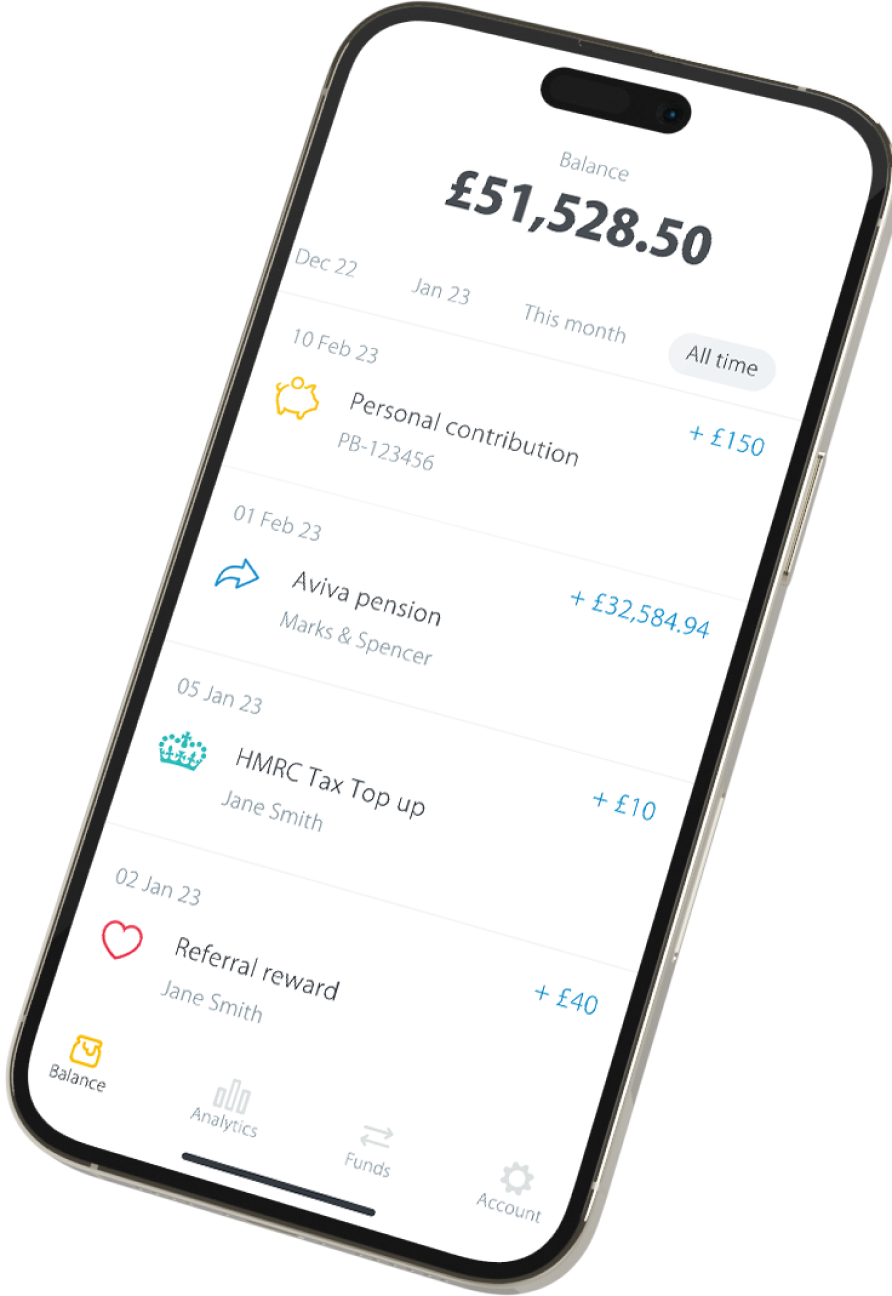
Thank you! Your submission has been received!
Oops! Something went wrong while submitting the form.

Our pension plans

02
Apr 2025

This article was last updated on 08/10/2025

At PensionBee we’ve carefully curated a range of plans to meet different savings needs. Whether you’re looking to invest in line with your values or according to your risk profile, our plans are all diversified. This means they invest across different countries and asset types (such as company shares and bonds).

When you first sign up to PensionBee, you’ll be automatically put into one of our default plans unless you choose a specific plan (more on this below!). But you can easily switch plans at no extra cost any time.

Let’s take a closer look at our pension plans.

Our default plans

When signing up for your PensionBee pension, if you don’t choose a specific plan, you’ll be invested in one of our default plans based on your age. If you’re under 50 and are still saving for retirement, you’ll be invested in the Global Leaders Plan. If you’re 50 or over when you sign up, you’ll be invested in the 4Plus Plan.

Global Leaders Plan

The Global Leaders Plan invests in approximately 1,000 of the world’s largest and most recognised public companies. This approach offers customers a greater opportunity to grow their pension savings before they retire.

It’s a higher-risk plan. This means most of your money will be invested into equities (company shares that are traded on stock markets) or corporate bonds (a type of loan guaranteed by a company). Equities have higher growth potential than other types of assets, but can also fall in value if the company or market performs poorly.

To find out more about the Global Leaders Plan, watch the plan video.

4Plus Plan

The 4Plus Plan aims to grow your pension savings by 4% per year above the Bank of England’s base rate over a minimum five-year time period. Its holdings may be adjusted weekly depending on market developments, as it seeks to balance growth and stability.

This is a medium-risk plan, with a balanced approach to growth. It’ll invest your money into a mix of assets, including equities (company shares that are traded on stock markets) and bonds (a type of loan guaranteed by a company or government). Equities have higher growth potential but are more susceptible to market volatility. Whereas bonds offer more modest but more stable returns.

To find out more about the 4Plus Plan, watch the plan video.

Our responsible plans

If you’re keen to invest in line with your values, PensionBee offers both a Shariah Plan - for those that want to invest according to their faith - and a Climate Plan - which invests in companies that are actively reducing their carbon emissions.

Shariah Plan

PensionBee’s Shariah Plan invests exclusively in Shariah-compliant companies. It’s suitable for anyone looking to invest responsibly or according to their faith.

The plan is composed entirely of equities and invests in the HSBC Islamic Global Equity Index Fund, managed by HSBC Global Asset Management and State Street.

To maintain Shariah compliance, all investments in the fund are approved by an independent Shariah committee. The process is transparent to ensure that investors can be confident that their fund aligns with Islamic principles.

Regular reviews of the fund and ongoing compliance, including purification of non-compliant revenue, are an integral part of the process of maintaining Shariah compliance.

To find out more about the Shariah Plan, watch the plan video.

Climate Plan

Investing in a sustainable pension plan, like our Climate Plan, puts you at the forefront of the transition to a low carbon economy. The plan invests in more than 800 publicly listed companies globally. These are actively reducing their carbon emissions and leading the transition to a low-carbon economy.

The Climate Plan is designed to achieve net zero emissions by 2050 through an accelerated decarbonisation strategy. The plan’s objective is to align with the goals of the Paris Agreement to keep the rise in global surface temperature well below 2°C above pre-industrial levels. It does this by continually reducing the total intensity of the greenhouse gas (GHG) emissions produced by companies in the plan by at least 10% each year. So even if the global economy uses more carbon over time, the Climate Plan will move in the opposite direction.

To find out more about the Climate Plan, watch the plan video.

Our other plans

Tracker Plan

The Tracker Plan invests your money in global shares and bonds and follows the world’s markets as they move.

It’s a medium-risk plan, with a balanced approach to growth. It’ll invest your money into a mix of assets, including equities (company shares that are traded on stock markets) and bonds (a type of loan guaranteed by a company or government). Equities have higher growth potential but are more susceptible to market volatility.

To find out more about the Tracker Plan, watch the plan video.

Preserve Plan

The Preserve Plan makes short-term investments into creditworthy companies. This reduces risk and preserves your money.

It’s a lower-risk plan that’ll invest more of your funds into assets which typically experience smaller fluctuations in their value, such as bonds, relative to the assets in our higher-risk plans, such as equity. However, the value of your savings may still go down as well as up, especially during market volatility. The potential for returns on your investment will likely be more modest over the long-term compared to our higher-risk plans.

To find out more about the Preserve Plan, watch the plan video.

Have a question? Get in touch!

It’s important that your investment option aligns with your goals, values, and circumstances. You may wish to consider switching if it doesn’t. If you’re uncertain about investment options or risk, you can seek guidance or advice from a qualified Independent Financial Adviser (IFA).

You can check out our Plans page to learn how your money is invested in different assets and locations - or log in to your BeeHive to see your specific plan. You can always send comments and questions about our plans to our team via engagement@pensionbee.com.

Risk warning

As always with investments, your capital is at risk. The value of your investment can go down as well as up, and you may get back less than you invest. This information should not be regarded as financial advice.

Period
Market Event
FTSE World TR GBP (%)
4Plus Plan (%)
4Plus Plan’s inception – 6 Sept 2013
QE Tapering, China Interbank Crisis and its aftermath
-5.44
-2.41
3 Oct 2014 – 15 May 2015
Oil price drop, Eurozone deflation fears & Greek election outcome
-5.87
-1.77
7 Jan 2016 – 14 Mar 2016
China’s currency policy turmoil, collapse in oil prices and weak US activity
-7.26
-1.54
15 June 2016 – 30 June 2016
BREXIT referendum
-2.05
-1.07
Period
Market Event
FTSE World TR GBP (%)
4Plus Plan (%)
4Plus Plan’s inception – 6 Sept 2013
QE Tapering, China Interbank Crisis and its aftermath
-5.44
-2.41
3 Oct 2014 – 15 May 2015
Oil price drop, Eurozone deflation fears & Greek election outcome
-5.87
-1.77
7 Jan 2016 – 14 Mar 2016
China’s currency policy turmoil, collapse in oil prices and weak US activity
-7.26
-1.54
15 June 2016 – 30 June 2016
BREXIT referendum
-2.05
-1.07
Popular

Ready to boost your retirement savings?

Ready to boost your retirement savings?

Every contribution counts towards a more comfortable retirement. When your pension is in a good place, you’re in a good place.
Combine your old pensions into one simple plan
Invest with one of the world’s largest money managers
Make paper-free online withdrawals from the age of 55
Pay just one simple annual fee
  • Sign up in minutes
  • Transfer your old pensions into one new online plan
  • Invest with one of the world’s largest money managers
  • Pay just one simple annual fee
Capital at risk
Button with Google Play logo and text 'Get it on Google Play' on a black background.
No items found.
Capital at risk

Choose a self-employed pension that puts you in the driving seat

Sign up to our flexible pension plan for the self-employed and contribute as much or as little as you like, as often as you like.
Get started
When investing, your capital is at risk