



This blog is part of our quarterly plan performance series. Catch up on last quarter’s summary here: How PensionBee’s plans are performing as at Q3 2025.
2025 was a busy, noisy and, at times, exhausting year for investors. But it was not without opportunity, as the US trade war, booming AI investments and changing central bank rate cut expectations repeatedly moved markets.
The final quarter of 2025 delivered steady gains across global equity markets, led primarily by Asia and Europe, including strong performances in Japan, South Korea and the UK, while US markets posted more modest gains. In fixed income, UK government bonds stood out with a strong quarter, outperforming US bonds and many global peers. They also delivered better returns than corporate bonds for the first time since the 2009 global financial crisis.
The performance data covers both Q4 (1 October to 31 December 2025) and year-to-date (1 January - 31 December 2025) and is sourced from our money managers. Figures are before fees and past performance is not a guarantee of future performance.
Keep reading this article for the Q4 market update and performance in your PensionBee Plan and its key asset classes. For the December market update, see our latest blog.
PensionBee’s default plans
4Plus Plan
The 4Plus Plan is managed by State Street with an equity proportion of 81.7%^. It’s the default plan for our customers over 50 years of age. The plan is actively managed for volatility in times of market turbulence, whilst targeting an annualised 4% return above the Bank of England base rate over a minimum five-year period. It aims to balance certainty with stability for those approaching retirement or making regular withdrawals.

Global Leaders Plan
The Global Leaders Plan is managed by BlackRock with an equity proportion of 100%. It’s the default plan for our customers aged under 50. The plan invests in around 1,000 of the largest public companies globally. It aims to maximise the growth of pension savings in the years before retirement.

PensionBee’s specialist plans
Climate Plan
The Climate Plan is managed by State Street with an equity proportion of 100%. The plan follows a Paris-Aligned Benchmark and aims to reduce the total carbon emissions produced by the plan’s companies by at least 10% each year.

Shariah Plan
The Shariah Plan is managed by HSBC and traded by State Street with an equity proportion of 100%. The plan invests in the 100 largest stocks traded globally that also comply with Shariah investment guidelines, as set by an independent Shariah Committee.

PensionBee’s other plans
Tracker Plan
The Tracker Plan is managed by State Street with an equity proportion of 80%. The remaining 20% is allocated to fixed income. The plan offers a cost effective way to follow global markets as they move.

Preserve Plan
The Preserve Plan is a money market fund managed by State Street. The plan makes short-term investments in highly creditworthy companies to preserve money.

Learn more about how your pension is invested
Your pension is invested in a range of assets like company shares (equities), bonds, property and cash. Your pension balance fluctuates depending on how these assets perform. See below for a summary of global markets and the performance of key asset classes in Q4 2025.
Global market summary in Q4 2025
The final quarter of 2025 saw mixed investor sentiments, with strong corporate earnings in November offset by growing scepticism and fear around the AI bubble. Despite this, global markets continued to rise, though at a slower pace than earlier in the year.
October began with a record 43-day US government shutdown, halting key economic data releases such as jobs and CPI reports (which are key indicators of US economic health). Despite heightened uncertainty, market impact was limited, with US equities posting modest gains as investors looked past short-term disruption and focused on long-term economic fundamentals.
Meanwhile, Japanese equities surged to record highs in 2025 following the appointment of the country’s first female Prime Minister, Sanae Takaichi of the Liberal Democratic Party. Her pro-growth agenda includes fiscal policy, higher defence spending, energy stability and keeping the Bank of Japan (‘BoJ’) rate at 0.50%, significantly fueling optimism towards international investors.
In the UK, following Chancellor Rachel Reeves’ Autumn Budget, the FTSE 100 closed higher as improved fiscal forecasts for 2026 and the Budget report showed that Reeves was meeting her main fiscal target with some headroom, supporting investor sentiment.
How did global stock markets perform in Q4 2025?
Japanese equities led the quarter, with the Nikkei 225 rising 12.2%, attracting renewed interest from global investors. The rally was driven by a combination of Prime Minister Takaichi’s pro-growth agenda, supportive fiscal policy and corporate governance push. At the same time, growing caution around potential bubbles in the US tech sector encouraged investors to shift away from US equities in search of alternative growth opportunities.
This shift in sentiment also boosted South Korean markets, where the KOSPI (an index that tracks South Korea’s large to mid cap companies) surged at 21.9% in the final quarter. Gains were driven by major semiconductor companies, alongside strong performances from defence and nuclear firms. Power transformer manufacturers further benefited from rising investment in AI infrastructure, reinforcing the market’s momentum.
The UK also enjoyed a strong quarter, with the FTSE 350 (an index that tracks the UK’s 350 large to mid cap companies) gaining 6.4%. The UK equity market rallied as banks and other financial institutions benefited from elevated interest rates and solid capital positions. Mining stocks also surged, supported by higher commodity prices, including precious metals such as gold and silver.
The US market slowed down during the quarter, with the S&P 500 (an index that tracks the US 500 large cap companies) posting 2.7%, a rare muted performance amongst major global stock indices. Slower momentum reflected a late November pullback linked to the government shutdown and delayed economic data. Concerns about a potential market bubble also cooled enthusiasm for AI and tech stocks. Despite these challenges, the outlook remained positive, supported by strong corporate results in Q3, with 81% of S&P 500 companies beating earnings expectations in November, and renewed confidence following the Federal Reserve’s December rate cuts.

Please note that the performance figures above are reported in local currencies, except for the MSCI Asia ex-Japan, which is reported in USD due to the use of multiple currencies among its constituents.
Short-term fluctuations don’t reflect the full picture of overall performance
The graph below shows the monthly performance of major global stock indices, including those of the US, UK, Japan, Europe, and Asia, throughout 2025. When viewed on a monthly basis, performance appears volatile, reflecting the impact of short-term factors like global political events and changes in central bank interest rate policies.
However, when viewed over the full year (shown in the second bar chart), all indices are posting robust positive year-to-date returns with broad-based strength.

As of 31 December 2025, the geographic allocation for PensionBee equity and multi-asset funds is as follows. Global Leaders: (US: 67%, UK: 3%. Japan: 4%); 4Plus: (US: 52%, UK: 4%, Japan: 5%); Tracker: (US: 49%, UK: 28%, Japan: 5%); and Climate: (US: 66%, UK: 2%, Japan: 3%); Shariah: (US: 82%, UK: 2%, Japan: 3%).

This highlights one of the most important lessons for retirement investing: short-term market movements shouldn’t influence long-term decisions. For retirement portfolios, which are designed for growth over decades, staying focused on long-term goals and maintaining a diversified portfolio is far more effective than reacting to monthly performance swings.
How did UK bond markets perform in Q4 2025?
UK bonds ended Q4 2025 strongly, with both government bonds (gilts) and high-quality corporate bonds posting solid gains. Gilts returned around 3.3%, as markets grew more confident that inflation was easing, interest rates had likely peaked (and expected further cuts), and the government’s Autumn Budget held in November showed a larger-than-expected fiscal headroom, which helped ease concerns about the UK’s financial stability. Additionally, the Bank of England’s (BoE) decision to cut interest rates by 0.25% in December also boosted market confidence.
High-quality corporate bonds also rose by 2.7%, as gilt yields declined and investor confidence in UK companies and the economy was restored, leading to narrower gaps between government and corporate bond yields.

How the BoE policy change influenced 10-year UK gilt yields
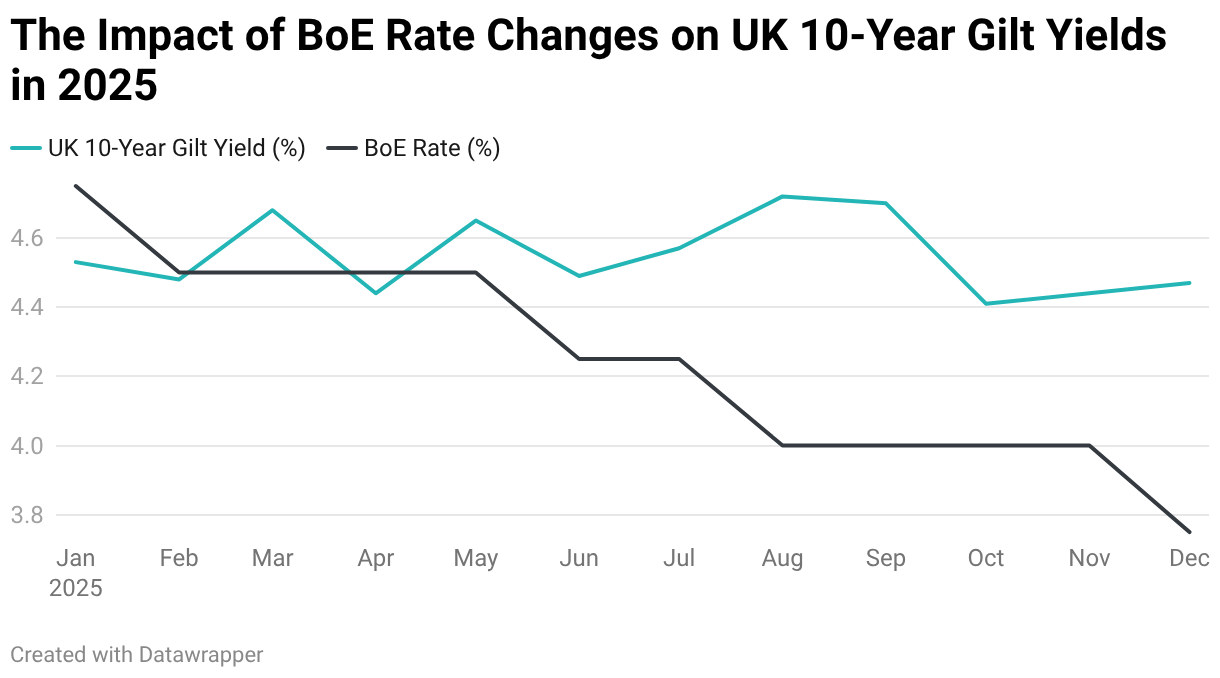
The chart below shows the monthly changes in UK 10-year gilt yields and BoE rate movements in 2025. As UK inflation dropped, investors began to expect that the BoE would halt rate hikes and might even cut rates. This led to a gradual decline in gilt yields throughout the year, as optimism about the UK economy grew.
The expectation of rate cuts helped push UK government bond prices up in September and October, resulting in strong returns. In December, the BoE’s 0.25% rate cut, as anticipated, strengthened market confidence and reaffirmed that inflation was slowing.
As of December 31, 2025, PensionBee’s Tracker Plan allocates 5% of its funds to 10-year gilts and 5% to 10-year index linked gilts.
Conclusion: Staying the course for stable growth
Overall, 2025 was full of political events and surprises for both equity and bond investors. Yet, despite all the volatility, markets still found a way to deliver strong returns. Central banks played their part with rate cuts, and global equities, especially in Asia, powered ahead. It wasn’t just the tech sector leading the charge either. Financials, defence, energy and commodities (including precious metals) all had their gains, and in some cases, all-time highs.
The UK bond market also saw strong returns, buoyed by investor optimism following the UK Autumn Budget. Increased fiscal headroom, along with the BoE’s easing monetary policy, helped to support UK bond prices and further delivered the return to investors.
2025 served as a reminder that while markets may be shaped by uncertainty and short-term volatility, maintaining a disciplined, long-term approach and staying the course remains important for stable and longer term returns.
Have a question? Get in touch!
Do you want to know more about your pension plan with PensionBee? Learn more about the top 10 holdings in your pension fund on our blog, which is regularly updated. You can also look at our Plans page to learn how your money is invested in different assets and locations, or log in to your BeeHive to see your specific plan. You can always send comments and questions to our team via engagement@pensionbee.com.
Risk warning
As always with investments, your capital is at risk. The value of your investment can go down as well as up, and you may get back less than you invested. This information should not be regarded as financial advice.
Period | Market Event | FTSE World TR GBP (%) | 4Plus Plan (%) |
|---|---|---|---|
4Plus Plan’s inception – 6 Sept 2013 | QE Tapering, China Interbank Crisis and its aftermath | -5.44 | -2.41 |
3 Oct 2014 – 15 May 2015 | Oil price drop, Eurozone deflation fears & Greek election outcome | -5.87 | -1.77 |
7 Jan 2016 – 14 Mar 2016 | China’s currency policy turmoil, collapse in oil prices and weak US activity | -7.26 | -1.54 |
15 June 2016 – 30 June 2016 | BREXIT referendum | -2.05 | -1.07 |