
Blog
What happened at PensionBee in August 2022?
From how financial markets have performed in August to our PensionBee roadshow - get all the latest news from PensionBee HQ.

Have you spotted our bee buzzing on your TV yet? Our new TV ad is premiering in full during Channel 4’s Great British Bake Off on Tuesday 20 September at 9.15pm. Let us know what you think using ‘#BelieveInTheBee’ on social media.

Keep reading to find out how financial markets have performed this month and what’s new in PensionBee HQ.

How did financial markets perform in August 2022?

August market performance

August saw many of the world’s stock markets tell a similar story of share prices rallying upwards before falling down again. In the US, the S&P 500 fell by 2.28%, and in the UK, the FTSE 250 fell by 4.16% last month. Compared to some of the double digit swings we’ve seen this year, this smaller margin of market movement could be comforting to some investors.

It’s important to remember that while major stocks are still witnessing negative returns for 2022, bear markets aren’t permanent. Undoubtedly, stock markets will need more time to fully recover from the three economic shocks: the war in Ukraine, the UK’s rising inflation rate, and China’s supply chain disruptions. Despite this recent economic dip, the gains in July have outweighed the losses in August for many investors.

For a more in-depth look at current market performances, read What happened to pensions in August 2022? And for a breakdown of which companies your pension’s invested in, read Top 10 holdings in your pension.

Remember that your pension is a long-term investment when considering short-term performance. Past performance is not a guide to future performance. As with all investments, capital is at risk.

_pensionbee_author join the London to Brighton cycle ride

PensionBee team ride

On 11 September, _pensionbee_author took part in the epic, 54-mile cycle ride from London to Brighton to raise money for the Great Ormond Street Hospital children’s charity. We’re proud to say the team have so far raised over £2,500 for the charity! You can still donate to this fantastic cause via JustGiving.

What else is new?

Fancy meeting the team behind PensionBee? We’re excited to announce that we’ll be travelling to various cities around the UK to see you, our incredible customers! Our first stop will be London on 26 October where we’ll be joined by Financial Journalist; Laura Miller, Founders of The Humble Penny; Ken and Mary Okoroafor, Founder of Money to the Masses; Damien Fahy, and Founder of online platform My Bump Pay; Tobi Asare. They’ll be discussing how much you might need to save for a happy retirement, and how to get there.

This is a great opportunity for you to meet our CEO, Romi Savova, as well as speak to your personal BeeKeeper one-to-one about your pension. So if you’re looking for a free night of pension knowledge, some delicious food and drinks in central London, keep an eye on your inbox to register your interest soon. More dates and locations to be revealed in 2023.

We’re hiring for a Head of UX, as well as Mid-level and Senior Software Engineers. If you’d like to join _pensionbee_author and help us revolutionise the pensions industry, we’d love to hear from you! To view our vacancies, please visit the PensionBee page on Workable.

The Mrs Mummypenny Talks Podcast is back, and we’re sponsoring season five. Tune in as Personal Finance Expert, Founder of Mrs Mummypenny, and Author of ‘The Money Guide to Transform Your Life‘ Lynn Beattie teams up with Founder of Much More With Less, Faith Archer to discuss the cost of living crisis. This season launched on 13 September and is packed full of practical tips on key money topics including food, energy, debt and saving for the future.

Keep an eye out for our next update on our blog. We’re always working on new features to make our customers happy so if you have any ideas or suggestions, please email feedback@pensionbee.com or let us know on social media.

What happened at PensionBee in September 2022?
From how financial markets have performed to behind-the-scenes news from PensionBee HQ.

On 23 September, Chancellor Kwasi Kwarteng made big waves with the ‘Mini-Budget‘. His economic plans sent the pound spiralling to a record low as global markets rejected the government’s proposed new approach to economic growth measures. 10 days later, the government decided to do a U-turn, cancelling the proposed additional rate tax cut for the highest earners.

An unexpected casualty from the ‘Mini-Budget’ announcement was defined benefit pension schemes, which depend on pound stability and were at risk of going underwater without a lifeline. So, the Bank of England bought up government bonds to keep the price stable. As PensionBee offers defined contribution pensions, our plans weren’t impacted by this, however they’re still weathering 2022’s ongoing global market volatility.

Keep reading to find out how financial markets have performed this month and behind-the-scenes news from PensionBee.

How are financial markets performing?

September market performance

In UK stock markets, the FTSE 250 Index fell by over 1_personal_allowance_rate, and in US stock markets, the S&P 500 Index fell by almost 8% last month. Uncertainty over measures taken by central banks to combat inflation (interest rate rises), along with the energy crisis, has clouded any optimism for an imminent recovery.

While we’re currently in a bear market, the good news is global markets have recovered from every bear market in history. Even the biggest market crash since the Great Depression, the 2008 global financial crisis, was followed by the longest period of sustained growth in market history, until the coronavirus pandemic struck markets in 2020.

For a more in-depth look at current market performances, read What happened to pensions in September 2022? And for a breakdown of how exchange rates work, read The pound and its impact on pensions.

Remember that your pension is a long-term investment when considering short-term performance. Past performance is not a guide to future performance. As with all investments, capital is at risk.

The Pension Confident Podcast

Pension Confident Podcast

Research from The Money and Mental Health Policy Institute revealed 46% of people who’re struggling with household debts also suffer from a mental health problem. Our latest episode of The Pension Confident Podcast discusses how to reduce the risk of money worries affecting your mental health.

This month our host, Philippa Lamb, is joined by the CCO of the Financial Services Compensation Scheme (FSCS); Lila Pleban, Founder and Managing Director of Psychreg; Dennis Relojo-Howell, and PensionBee’s COO and Mental Health First Aider; Tess Nicholson. Read the transcript of the latest podcast episode or watch it on YouTube.

Behind-the-scenes at PensionBee

Trophies

If you’ve seen our new ‘Believe in the Bee’ TV ad you’ll have noticed our new distinctive brand asset - the PensionBee bee. Find out why Fablefx animation studio’s ‘digital zoo’ made them the perfect partner for the creation of our beloved honey bee, and learn about the painstaking process of animating it from scratch in our behind-the-scenes blog.

We’re delighted to have recently won ‘DC Innovation of the Year’ at the UK Pensions Awards, and ‘Pensions Innovation’ at the Finder Investing & Savings Innovation Awards. We also received Good With Money’s ‘Good Egg’ accreditation, which recognises financial providers that are committed to improving outcomes for both consumers and the planet.

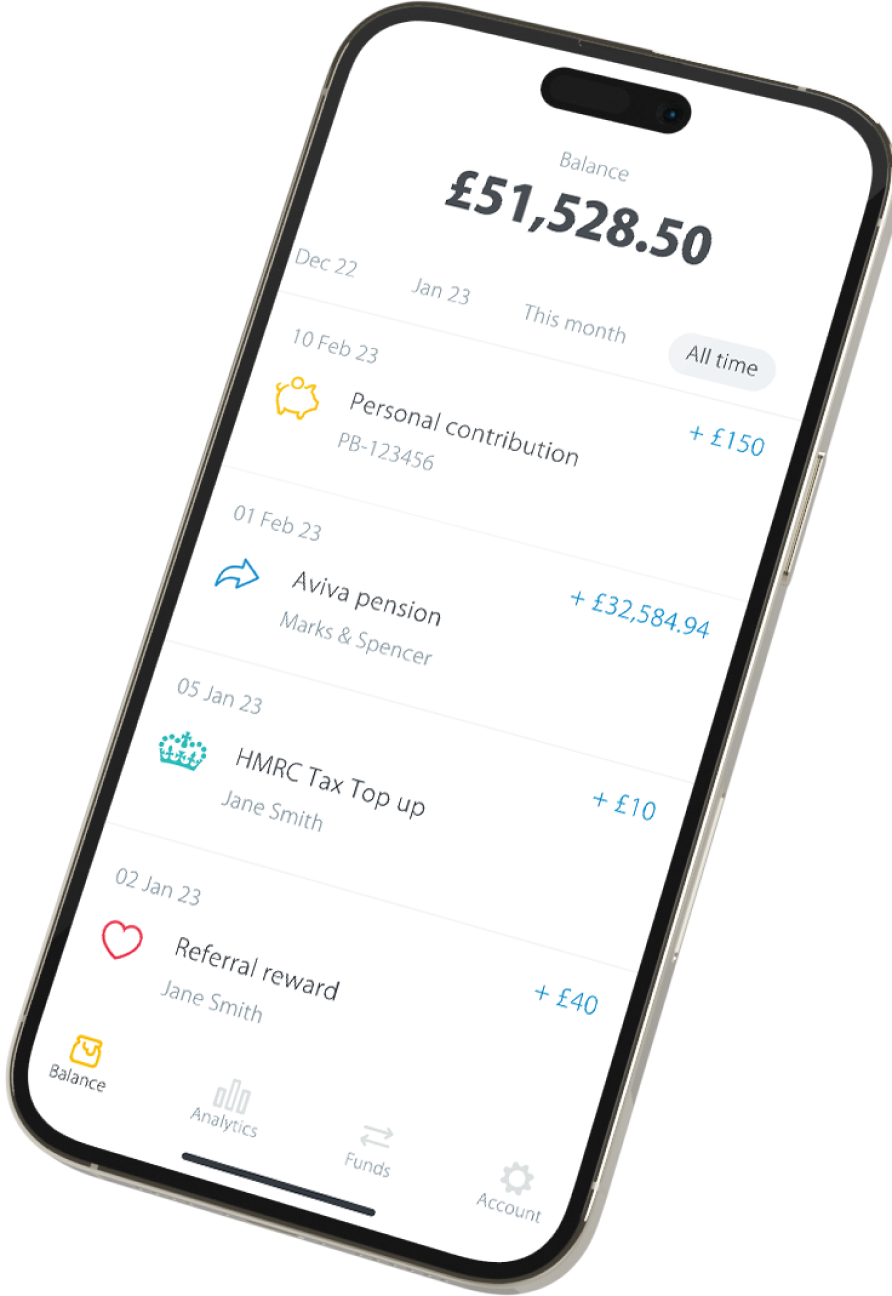
At PensionBee HQ we’re constantly innovating to help make managing your pension simple. We’ve now launched a new way to contribute to your pension, called ‘Easy bank transfer‘. You’re now able to make safe and easy payments to your pension, without having to enter your bank details, by using your PensionBee app, or via the web, whatever you prefer! You can set-up both regular and one-off payments, to suit you.

Keep an eye out for our next update on our blog. We’re always working on new features to make our customers happy so if you have any ideas or suggestions, please email feedback@pensionbee.com or let us know on social media.

In your 40s and panicking about your pension? Here’s what to do.
From finding dormant pensions to keeping an eye on your contributions, some small changes can make a big difference.

Let’s not kid ourselves, long-term saving really isn’t exciting. You won’t find much fun in squirreling money away (unless you’re Martin Lewis) so it’s forgivable if you’ve reached your 40s and a pension has only just become a priority. After all, some even say 40 is the new 20.

Nonetheless, it’s probably time to get your pension affairs in order. So, without further ado, here’s some tips to help you get on top of things…

Step one: ensure you’re automatically enrolled

Seen a big blue monster advertising workplace pensions recently? Don’t worry, us and thousands of others didn’t get it either…

The monster in the workplace pension advert is cute, but what does it mean? Why is the work place pension a monster? #bigquestions
— Abigail O'Reilly (@AbigailOReilly)

But we did get the government’s drive to get people saving. The state pension is unlikely to be enough to support you in your later life, so it’s vital that you take up a workplace pension if you’re employed.

What you can do

The new auto-enrolment rules compel your workplace to contribute towards your pension, as long as you’re paying into the scheme. The employer minimum contribution is currently 1% of your annual salary, but many workplaces offer ‘contribution matching’, which means they’ll increase their contributions if you increase yours. Ensure your employer’s got you enrolled and up your own contribution if you can afford it.

Step two: locate and transfer your old pensions

Chances are you’ve worked in quite a few places by now, so you’re likely to have a few pensions dotted around. This could have a real impact on your savings, so it’s wise to find out where they all are.

Let it stay where it is and you could be damaging your pension prospects.

This is because this dormant cash could be sitting in a poorly-performing fund or in a scheme with horrendously high fees. Let it stay where it is and you could be damaging your pension prospects, and shortchanging yourself needlessly.

What you can do

At PensionBee we put your old pensions all into one place, our Tracker, Tailored and Future World plans are managed by three of the largest money managers in the world. Don’t know where your old pensions are? Check out our page on finding and transferring pensions.

{{main-cta}}

Step three: get an online account

Clarity is key when it comes to saving, so it’s important to check your pension as much as possible so you know where you stand. You need to know which funds are performing, but it’s often easier said than done - many pension providers have a preference for posting docs that are tricky to decipher.

What you can do

If you pick a PensionBee plan, you’ll have 24/7 online access to your pension, so you can easily check how much money is in your pension pot, how your funds are performing, and how much you’re likely to receive on retirement.

Step four: keep on top of your contributions

What you’re putting into your pension now will shape your later life drastically, so it’s important to find the right level of contributions and keep them up every month. Around _ni_rate of salary is a good idea, but ultimately there’s or no right or wrong sum - what suits best will depend upon your own circumstances and how much you want in your pension pot.

What you can do

Consider at least the following when coming to your contribution level:

  • The balance of your existing pension(s) (should you have some pension pots from previous jobs)
  • Your planned retirement age
  • Your ideal retirement income

This should then give you a ballpark figure to start aiming at. Our pension calculator can also give you a better idea about what to save.

As always with investments, your capital might be at risk.

9 shocking pension provider stories
Britain's pension providers have been behaving badly.

Ever wondered who tracks down all your old pensions when you become a PensionBee customer? Well, the answer is our dedicated BeeKeepers; Tess, Priyal and Emily.

PensionBee BeeKeepers

They spend hours dealing with dusty companies - some still struggling along on Internet Explorer - and they’re the ones who’ll bring your pensions into the 21st century. Actually getting to the transfer stage isn’t always easy, however, as some of your old pension providers like to make life pretty tricky. So much so in fact, we’ve been tracking the biggest offenders.

The office is alive with the sound of hold music and the place can sound like a classical concert, but it gets much worse than that. Much, much worse. Straight from the mouths of our BeeKeepers, here’s nine nonscensical tales...

1. Computer says no

“A woman at one big provider (who’ll go unnamed for her own sake) told me that she didn’t receive my letter of authority and informed me that I’d have to send it in again (an up to 3-week process).

When I got off the phone I double-checked our email tracking system and shockingly, it revealed that she had the letter of authority open in front of her whilst we were talking! Needless to say I phoned in again, made an official complaint, and got all the information I needed straight away.”

A legal declaration from a customer that allows us to start tracking down their old pensions

2. Contribution chaos

“Incredibly, one provider likes to create a new policy every time a customer makes a pension contribution. As a result, a customer may end up with 11 different pensions, making it impossible to track fees and performance.”

3. The mysterious case of the disappearing pensions

“Providers often tell me that they’re unable to locate customer pensions on their system. In fact just the other day I received a series of emails telling me exactly this. Eventually, after 40 minutes spent on the phone I was told that they had finally found them! I dread to think where these pensions keep disappearing to.”

4. If a tree falls in the woods, your pension provider will probably be the one to blame

“On occasion, one provider will send duplicate information with 10 page documents. I’m convinced they’ve got a vendetta against the rainforest.”

{{main-cta}}

5. T minus ten seconds to transfer your pension

“Some providers set deadlines on pension transfers, and this can have really painful repercussions. One poor guy we were working with saw his workplace pension refunded to his old employer, after he missed the provider’s transfer deadline. He insisted he’d received no correspondence about it, but the provider disputed it. Just like that his savings were gone and he had no way of getting them back!”.

6. Database disarray

“Many of the providers I deal with have several different databases that aren’t connected. Logistically this makes things a complete nightmare… and makes for hours spent on hold”.

7. I just met you, and this is crazy, but here’s my number\… call me again please.

“One provider has a system whereby you can only call about a single customer at a time - you have to call back each time!”.

8. Calamitous customer management

“On occasion I’ve had a provider send information about one customer, in response to an information request about a totally different customer.”

9. Sixteen reasons to shift your pension

“Staggeringly, one provider lost customer documentation on 16 information requests. Clumsy doesn’t even begin to describe it.”

Incredible, isn’t it? If you want to learn more about how your provider is performing check out our Robin Hood Index.

5 pension innovations that prove digital progress is possible
While many still rely on post and paper, these pension providers are breaking the mould.

The pensions industry isn’t famed for being the most forward thinking. Despite the fact our entire job is based around building a better future, many providers shy away from change (despite what they claim) and stay resolutely stuck in their ways.

That said, there’s a cluster of companies that are on a mission to modernise. Driven by disappointed customers a number of us are challenging the inertia, and coming up with innovative ways to engage Britain’s savers.

Intrigued? Read on for five of the best...

Smart Pension’s auto enrolment solution

If you run your own business you’ll know all too well the challenges auto enrolment can bring. Co-founded by two finance veterans - Andrew Evans and William Wynne - Smart Pension aims to simplify things, through their innovative, all-in-one online platform.

So far they’ve picked up impressive reviews, significant investment and industry accolades. In short, if you’re worried about auto enrolling your staff then Smart Pension could be worth exploring. Find out more about the service on the Smart Pension website .

The People’s Pension affordable advice

According to Unbiased an initial review with an IFA costs _higher_rate_personal_savings_allowance on average, with those looking for pension advice at retirement facing a fee of _basic_rate_personal_savings_allowance for help investing a _high_income_child_benefit fund. Such fees are likely to send shivers down the spines of many savers, so The People’s Pension have harnessed technology and come up with an affordable alternative.

In combination with LV they’re offering savers online guidance and advice. Thousands of savers have taken up the service already, proving there’s plenty of appetite for digital guidance.

{{main-cta}}

Aviva’s Digital Garage

Aviva are one of the titans of the pension industry. But unlike their rivals they don’t see this dominance as an excuse to stand still, and they’re one of the few that’s actively embracing technology.

A clear example of this is their recent investment in the Aviva Digital Garage - a new co-working space designed specifically for technical specialists, creative designers, and commercial teams within their company.

Time will tell whether this new work environment increases creativity, but you can’t dispute it’s a step away from the dour offices home to much of the industry. Ultimately, its goal is ‘explore and develop’ all things digital - so where better for that than a trendy co-working space in the heart of London’s Tech City?

The pensions dashboard

We haven’t been shy of criticising the pensions dashboard here on this blog, but we still believe that if delivered correctly it could fundamentally change the industry.

The government-backed dashboard will allow customers to see all of their pensions in one place online, creating a mobile-friendly way of viewing your savings. As our growth at PensionBee has shown the public are craving a simpler way to save, so the sooner we see this live the better - as things stand a prototype is expected in 2019.

The PensionBee Future World Plan

And finally, we thought we’d finish with a cheeky nudge to our new plan. Months after launching PensionBee we discovered an appetite for this, with increasing numbers of customers asking for an eco-friendly online plan…

@pensionbee any progress on getting an ethical fund going? I’d transfer over straight away if you had one... :)
— James Smith 💾 (@Floppy)

Off the back of this we got in touch with Legal & General - who had only just launched an eco-friendly plan - and took steps to team up to offer PensionBee customers the Future World Plan. In contrast to other plans it only invests in companies generating revenue through low-carbon activities, with a special focus put on businesses that are environmentally friendly.

We’ll be introducing new plans as and when you request them, so either tweet us or shoot an email to our product team at feedback@pensionbee.com. Watch out for our app in the coming months, plus plenty more innovations in 2018...

Have we missed any pension innovations? Let us know in the comments!

PensionBee meets the Minister for Pensions and Financial Inclusion
We welcomed Guy Opperman into the PensionBee offices recently. Here's some of the biggest takeaways from our meeting.

Yesterday, the Minister for Pensions and Financial Inclusion, Guy Opperman, visited PensionBee HQ.

We introduced him to our robots, our human staff, and a PensionBee selfie.

But we know it’s rare to get a politician’s ear for an hour, so we soon moved on to talking about problems facing the industry - including questions sourced directly from you.

Here’s some of the biggest takeaways.

An end to paper signatures?

Up for discussion were the 21 providers still refusing to accept digital signatures, making life difficult for thousands of PensionBee customers. We’re happy to report that he’s promised to follow up with each of them individually, in fact he’s already penned an article on the topic!

Pension Switch Guarantee?

While our robots and automations have drastically sped up the transfer process for some paper providers, many administrators still take 2 - 3 months to release your funds. We recently wrote to the Minister requesting a consultation on a Pension Switch Guarantee, and it’s something we raised again. Thankfully, the Minister promised that he’ll take our concerns away and come back to us on the issue.

More support for the self-employed?

The self-employed make up _ni_rate of our customers, and the Minister was particularly interested in this statistic. With more and more of us shifting into self-employment there’s a risk that people might slip through the cracks, so it’s positive to see that the government shares our passion to get the self-employed saving. We’ll be doing all we can to support them.

All in all it was positive morning and we hope it’s the first of many. Collaboration between government and pension companies is key to building a better industry.

We’ll keep you updated as things progress!

Why do women save rather than invest?
Learn about why 74% of women are more inclined to save their money, whilst only 12% attempt to invest.

Despite their growing financial independence, 74% of women are more inclined to save their money, whilst only 12% attempt to invest. Investing your money has the potential to elevate your wealth and bring your financial goals into fruition, although this isn’t guaranteed. The difference between women and men’s inclination to invest translates to a huge gap with Boring Money reporting that men have £1.01 trillion invested compared to £450 billion for women.

So, why do women save rather than invest? Well, a combination of historical, psychological, and societal factors are at play. Traditional roles, risk aversion, confidence gaps, and lower financial literacy contribute to this trend. But now could be the time to reverse it. Because the good news is, when women do invest, they actually outperform men’s returns.

So let’s break down some of the main reasons women decide to save, rather than invest, their money.

Psychological factors

Psychological factors significantly influence why women often save rather than invest.

1. Risk aversion

It’s a common misconception that women are ‘frivolous’ and want to splash their money on clothes and handbags. In fact, according to HMRC figures, women hold more in Cash ISAs than men. This indicates that they tend to prioritise the safety of saving over investing which have the potential to grow or fall in value over time.

2. Confidence gap

Despite being equally competent to men, a confidence gap exists. According to HSBC, only 31% of women feel confident about investing compared to 44% of men. Women therefore doubt their own capabilities, which unsurprisingly sparks hesitation when it comes to making investment decisions.

3. Financial literacy

Across the world, women also report lower levels of financial literacy, leaving them feeling more cautious about engaging with the stock market.

Societal and cultural influences

Societal and cultural influences deeply impact women’s preference for saving over investing.

1. Gender norms

The truth is, societal norms continue to dictate traditional gender roles. Men are often positioned as the primary financial decision-makers and women as the caregivers and savers. These deep-rooted expectations shape financial behaviours too. PensionBee highlights how these gender norms create a wealth gap in their Carer’s Pension Gap. The research shows a 13% difference in pension pots for those who take time out of paid work to care for loved ones.

2. Media representation

Cast your mind back to the famous movie, The Wolf of Wall Street: a chaotic room full of men running around to beat the stock market. That’s just one example of how the media frequently depicts men as the more keen investors.

3. Peer influence

Social circles often perpetuate these norms. Think about it: do you and your girlfriends talk about money? These cultural narratives and taboos around money contribute to a lack of knowledge about investing. So this is your cue to start talking!

{{main-cta}}

Economic factors

Economic barriers significantly impact women’s propensity to save rather than invest.

1. Income disparity

Women are automatically placed at a disadvantage due to the gender pay gap and underrepresentation in high-paying industries. Why? It’s simple: lower pay translates to less disposable income available for investing.

2. Job stability

Additionally, women are more likely to experience career interruptions. Taking time off for looking after children or caregiving can often lead to reduced lifetime earnings and savings. Women also often occupy roles with less job security, so it’s no wonder they’re often more cautious about investing.

3. Wealth accumulation

In turn, the cumulative effect of these economic disparities means that women accumulate less wealth over time. This could mean they tend to favour simple saving measures over potentially lucrative investment opportunities.

Practical barriers

1. Accessibility

Investment platforms can be tricky to navigate and many women find them challenging to access. Often built with men in mind, many platforms can deter women from exploring investment opportunities. Thankfully, we’re seeing the rise of female financial education platforms geared towards women’s needs, such as Female Invest, rainchq, Vestpod and Propelle.

2. Time constraints

Women are the unsung heroes. They’re often spinning multiple plates, including careers and family care. Let’s give you some context. In the UK alone, 76.3% of women aged 16-64 are in employment, compared to 52.7% of women back in 1971. On top of that, 81% of caregivers are female, leaving many with little time for financial planning and investment research.

3. Male-dominated industry

Additionally, the investment industry has traditionally been male-dominated. This makes it harder for women to find relatable role models and mentors, and it’s this lack of representation that alienates women when it comes to the stock market.

Understanding the investing barriers to break them down

When you look at these societal and cultural barriers, it’s no surprise many women opt for saving over investing. But when investing is a lucrative wealth generator, being aware of these barriers is the first step to take before breaking them down.

We can find solace in knowing that more women are showing an interest in the stock market and that they’re more than capable of making informed investment decisions that can boost their wealth. Here’s three things you can do today to improve your financial health:

  • seek financial education through platforms like Female Invest, rainchq, Vestpod and Propelle;
  • leverage supportive networks whether that’s your friends, family or colleagues; and
  • embrace tailored investment opportunities.

Interested in learning more? Listen to episode 21 of The Pension Confident Podcast. You can also watch the episode on YouTube or read the transcript.

Maria is a Freelance Editor and Writer who previously worked as Global Editor at Female Invest. Her writing focuses on gender equality in finance. She’s also written for a variety of other publications including Harper’s Bazaar, The Telegraph, inews, Metro, Glamour and more.

Risk warning

As always with investments, your capital is at risk. The value of your investment can go down as well as up, and you may get back less than you invest. This information should not be regarded as financial advice.

How to talk to your partner about money
Whatever your relationship looks like, the coming together of two people is the coming together of two financial worlds. Read more about how to talk to your partner about money.

This article was last updated on 24/07/2025

Many people fall in love, move in together and get married, while other couples live apart or choose to remain legally single. Some might decide to start a family or buy a property. Whatever your relationship looks like, the coming together of two people is the coming together of two financial worlds.

So it’s no surprise that money can often be a catalyst for relationship breakdown. 22% of Brits say they find it awkward to talk to their partner about money and one third of couples divorce due to financial disagreements.

The good news is that you can avoid such a breakdown by doing one simple thing with your partner - talking about money. It might not be the most romantic discussion to have on date night, but it could be one of the most important ones.

Why talking about money is essential in a relationship

Talking about money is essential in all relationships, particularly romantic ones as it fosters trust and mutual understanding. Without talking about money, misunderstandings could lead to stress, resentment, and even conflict.

Financial discussions allow couples to align their life goals. Whether that involves saving for a home, planning that summer holiday to Italy, or preparing for the later chapter of life - retirement. It’s therefore essential both partners feel heard in those big (and expensive) life decisions.

Common barriers to discussing money

Fear of conflict

Couples may worry that discussing finances will lead to arguments or put a strain on the relationship. That’s because differences in financial attitudes and habits - such as one partner being a spender and the other a saver - can lead to conflict. But avoiding the topic can create unresolved financial issues that snowball over time.

Different upbringings and beliefs

It’s no surprise that childhood experiences shape financial views, which infiltrate into our adult life. Many couples may therefore fear that their divergent views on spending and saving could make their partner feel uncomfortable.

Lack of financial knowledge

A lack of financial know-how and understanding of financial terms can prevent couples from discussing money because they may feel intimidated or unsure of how to communicate effectively. So it’s just as important to have confidence in your financial knowledge as it is to talk about money.

{{main-cta}}

Seven ways to start talking about money

So we know we should talk, but it can be tricky to get started. Here are seven tips for a constructive money conversation.

1. Set a time and place

Scheduling a talk into your calendar is the first step. It’s important to choose a neutral and comfortable setting free from distractions so you can give the discussion the attention it deserves.

2. Assess your own finances

Having a 360 degree view of your own finances can help you understand your personal financial habits. Take time to review your ingoings and outgoings, and identify any financial goals or concerns you have that need to be discussed. A good way to start is by compiling a list of your assets, including bank accounts, savings, investments, and property. Be sure to also document your liabilities, such as credit card debt, loans, and mortgages.

3. Be honest and transparent

Share your financial situation openly, even if you’re embarrassed about your savings, debts or financial goals. Putting all the cards on the table helps to build trust and prevents misunderstandings later down the line.

4. Focus on shared goals

This isn’t about you or them, it’s about the two of you as a team. Prepare to frame the conversation around your shared goals and values, whether it’s short-term or long-term goals. This could help to ensure the conversation is seen as a collaborative effort rather than a confrontational attack.

5. Listen and be empathetic

Money can be an emotional topic, so it’s important to listen to your partner’s concerns and feelings without fear or judgement. Put yourself in their shoes and be empathetic towards any worries they may have.

6. Agree on a plan and revisit regularly

Once you’ve discussed your financial situation, work together on a plan that suits both of your shared goals. This might include budgeting, saving, or investing strategies. Revisit your plan regularly to ensure you’re on track, and adjust if your financial situation or goals change.

7. Dealing with disagreements

If the disagreement becomes heated, take a break and revisit the conversation when emotions have cooled down. In the meantime, reflect on your different stances and be willing to adjust your own to find a middle ground. Some more serious disputes could benefit from having a neutral third party to mediate.

It’s time to get talking

It’s easy to see why so many couples avoid the conversation of money - it can be confronting, intimidating and frankly unromantic. But talking about finances and having regular check-ins can help you to align your financial goals and spending habits. By openly discussing money regularly, couples can better adapt to changing circumstances, celebrate achievements, and make informed decisions to secure a healthier financial future.

Maria is a Freelance Editor and Writer who previously worked as Global Editor at Female Invest. Her writing focuses on gender equality in finance. She’s also written for a variety of other publications including Harper’s Bazaar, The Telegraph, inews, Metro, Glamour and more.

Risk warning

As always with investments, your capital is at risk. The value of your investment can go down as well as up, and you may get back less than you invest. This information should not be regarded as financial advice.

How does financial planning change over the course of life?
From navigating student loans in your 20s to working out how your pension will support your dream retirement in your 60s and 70s, your financial needs and strategies shift at each stage of life.

Financial planning is a bit like life itself - it’s constantly evolving and can occasionally give you sleepless nights. What you need to focus on when you’re young might not be the same when you’ve got a mortgage, are midway through your career, have started a family, or are approaching your retirement. From navigating student loans in your 20s to working out how your pension will support your dream retirement in your 60s and 70s, your financial needs and strategies shift at each stage of life.

The roaring 20s (ages 20-30)

At this stage, you’re likely starting your career and enjoying the freedom of adulthood. Maybe you’re starting to think about expanding any financial education you were taught at school. So this phase of life is key to setting those financial foundations.

  1. Learn to budget - boring? Yes. Optional? No. Whether it’s cutting down on your Friday night takeaway, or cancelling that gym membership you rarely use, setting up a budget (and sticking to it) will help you stay afloat.
  2. Start an emergency fund - picture this: your car breaks down, or your boiler gives up. Having an emergency fund - around three-to-six months of expenses - will give you peace of mind and can prevent you from having to ask your family for a helping hand.
  3. Avoid high-interest debt - student loans, credit cards, and that overdraft you may have forgotten about after University. Focus on paying off any high-interest debts first. It’ll save you money and help you avoid that sinking feeling when checking your bank account.
  4. Start a pension - it might feel like you have decades of time to spare, but if you start contributing to a pension now, your future self will thank you. Compound interest is magical, even if it sounds boring, as it gives your investments the opportunity to grow over time when left untouched. This is because you earn interest both on your initial amount and accumulated interest you’ve already earned.

Establishing roots (ages 30-40)

When you hit the 30s mark, life can become busier with more responsibilities to juggle. You might have a bigger salary than the decade before. But with that, comes more expenses - housing costs, dependents such as children or even looking after your parents. It also comes with big occasions, such as attending loved ones’ weddings. Many might decide to take a sabbatical from work. Here are some goals to consider.

  1. Increase pension contributions - a rough rule of thumb is to try and pay _ni_rate of your annual salary into your pension if you can. If you have more stability and a higher salary, you could consider putting more into your retirement fund.
  2. Buying a home (or paying it off faster) - if you aren’t a homeowner, you might be thinking of buying a property which will require a down payment. If you’re already a homeowner, consider reducing the mortgage as quickly as possible by refinancing to a lower interest rate, increasing your down payment, or choosing a shorter loan term.
  3. Consider life insurance and write a will - if you’ve got a family depending on you, life insurance is essential. This could also be a wise time to write a will to avoid any complications later on.
  4. Plan for the kids’ future - if you’ve got kids, consider saving for them - whether that be for their education, their future home or even retirement. A Junior ISA (JISA) is an easy and tax-efficient way to save.


{{main-cta}}

The peak-earning years (ages 40-50)

Once you hit your 40s, you’re more likely to be in your peak earning years. Now is a good time to make sure you’re on track for the retirement you want.

  1. Maximise pension contributions - you can’t rely solely on the State Pension for your retirement. The type of lifestyle you want to live when you stop working will determine how much you’ll need to save, so consider taking stock of all your long-term savings. This could include pensions, ISAs and other long-term savings pots. You might want to consider consolidating your pension pots as having them all together can simplify management and potentially even reduce fees.
  2. Reassess investments - in your 40s, it’s time to make sure any investments you have are working for you. Too risky? Too conservative? Now’s a good time to tweak things.
  3. Pay off large debts - clearing off your mortgage or large personal loans should be a priority. The fewer debts you carry into your later years, the less money you’ll be paying on interest and the less stress you’ll endure.

Pre-retirement (ages 50-60)

Retirement is now closer than it is far off, and it’s time to ensure your nest egg can actually support you through those blissful, work-free years.

  1. Finalise retirement plans - if you’ve not had a good look at your retirement plan, now’s the time. Do you have enough money? Will it last? Booking a free Pension Wise appointment, a free government-backed service from MoneyHelper or speaking with an Independent Financial Adviser (IFA) might be a sensible move at this point.
  2. Downsize or declutter - this might be the perfect time to consider downsizing your home to reduce your housing costs, leaving you more money to save for your retirement years.
  3. Review estate planning - make sure your will, power of attorney, and any trusts are up to date. The last thing you want is your assets to go somewhere unintended. It’s key to remember that your pension isn’t technically part of your estate. So while you can include it in your will, it’s crucial to let your pension provider know who your beneficiaries are. If you’re a PensionBee customer, you can do this in your online account, known as your BeeHive.
  4. Consider long-term care insurance - health costs tend to go up as you age. While no one likes to think about it, planning ahead can save your family a financial headache.

Retirement (ages 60+)

You’ve made it! However, retirement doesn’t mean you stop planning. Now, it’s all about managing your savings and making sure you’re financially comfortable for the long-term.

  1. Manage withdrawals - depending on the type of pension you have, there will be different access rules depending on your age. If you’re eligible, you’ll be able to take the State Pension at _pension_age_from_2028 (rising to 68 in 2028) whereas with workplace and personal pensions, the access age is 55 (rising to 57 in 2028). There are also rules when it comes to tax-free withdrawals. For example, only _corporation_tax of your pension can be withdrawn tax-free – and the rest gets taxed as income. To ensure your money lasts, try to pace your spending during retirement. A good rule of thumb is to withdraw 4% of your savings annually whilst the rest remains invested and will allow it to still potentially grow.
  2. Plan for healthcare - while you can use the NHS should you need it, additional healthcare needs might arise. Keep some savings for private care, just in case.
  3. Consider inheritance plans - if you’re feeling generous, think about how you want to leave a legacy. Whether that’s helping out the grandkids or leaving a donation to your favourite charity, make sure your financial plans are clear. Remember, leaving money in your pension can save your loved ones Inheritance Tax (IHT) so it’s definitely worth considering where your money and assets are. For more information, read PensionBee’s IHT guide.

While it’s easy to save into a pension, it can be more complicated when it comes to withdrawing. If you aren’t sure what your options are, PensionBee has a blog all about accessing and withdrawing your pension.

Maria is a Freelance Editor and Writer who previously worked as Global Editor at Female Invest. Her writing focuses on gender equality in finance. She’s also written for a variety of other publications including Harper’s Bazaar, The Telegraph, inews, Metro, Glamour and more.

Risk warning

As always with investments, your capital is at risk. The value of your investment can go down as well as up, and you may get back less than you invest. This information should not be regarded as financial advice.

5 things every woman should know to take control of her finances
From the motherhood penalty to gender pension gap, women face unique financial challenges that impact their earning potential and long-term wealth.

What’s one of the biggest influences on the decisions we make every day? Money. It shapes the opportunities we have and the choices we make throughout our lives. So, this International Women’s Day, let’s talk about it.

Women in the UK save 35% less than men over their lifetimes. This disparity is reflected in the gender pension gap, which stands at 38%. In simple terms, women retire with over a third less savings than men. Sure, the persistent gender pay gap plays a role, but this issue is far more layered than women’s take home pay.

Women face many economic barriers due to societal expectations. This year’s International Women’s Day theme, ‘Accelerate Action‘, inspires us to break down these barriers and share simple tips to help women take control of their financial futures.

1. The gender pay gap and early careers

On average women earn 13% less than men, with the full-time employee pay gap firmly standing at 7% according to the Office for National Statistics (ONS). By the time women reach 40 - an age often associated with greater confidence and wisdom - the gender pay gap widens to 9%.

One of the biggest factors impacting the gender pay gap is salary negotiations - or the lack of them. Research shows that 83% of men are likely to negotiate their salary compared to only 73% of women. That’s because women often hesitate due to fears of being perceived as ‘bossy’ or disagreeable by their employer. A Harvard Business School study revealed that when women do pluck up the courage to negotiate, their requests are often met with resistance.

This could help explain why men are 41% more likely to move into management roles and nearly twice as likely to hold executive positions later in their careers. Not only does this deteriorate women’s confidence to get ahead, but it puts a dent in their financial wellbeing too.

What you can do:

  • research average pay to figure out industry averages;
  • seek mentors and get sound advice without the fear of having awkward conversations with colleagues; and
  • if you feel comfortable enough, speak to colleagues about your salary - there’s no legislation stopping you from doing so.

If you’re looking for extra resources, listen to episode 25 of The Pension Confident Podcast and hear from our panel of expert financial guests as they discuss their experiences of negotiating pay, as both an employee and employer. You can also watch the episode on YouTube or read the transcript.

2. Marriage, divorce, and financial independence

Marriage can be a financial fairytale, but only if both partners have an equal footing. Too often women focus on short-term budgeting and saving; while men are more willing to invest in the stock market. While practical, this approach can create financial blind spots - especially if the relationship sadly ends.

Relying solely on one partner to be financially savvy or to save for the long-term can be risky, as it leaves the other partner vulnerable in the face of unexpected life changes. For example, studies show that women’s household incomes drop by 33% after divorce, compared to an 18% dip for men. Then come the legal fees, asset division, and childcare costs - together, these can significantly lower a woman’s standard of living.

What you can do:

  • maintain some personal financial accounts and savings; and
  • plan for financial independence, regardless of your relationship status.

3. The ‘motherhood penalty’ and career breaks

The ‘motherhood penalty’ is real and accounts for 80% of the gender wage gap. Stepping into the world of motherhood has a high price tag, stemming from essential career breaks that can snowball into stalled career progression and paused salary increases. With childcare averaging £14,000 per year for full-time care in the UK, many women are forced out of the workplace altogether.

When women do re-enter the workforce after parental leave, they may face the impossible job of balancing expensive childcare and lower incomes, which are more common due to the flexibility often required for caregiving responsibilities. In fact, each child under five years old is projected to reduce the earnings of a typical mother by 15% in the US. Meanwhile, men see a ‘fatherhood bonus‘ in wages.

This financial impact extends into retirement. Women who take career breaks to care for children or other dependents often face a significant Carer’s Pension Gap, with many missing out on vital pension contributions during these periods. According to PensionBee, two-thirds of people are likely to take time out of work to provide unpaid care, which can lead to poorer retirement outcomes.

What you can do:

  • negotiate flexible working to balance family and maintain career growth;
  • upskill during career breaks with online courses or volunteering; and
  • advocate for affordable childcare, Shared Parental Leave, and flexible work policies.

4. Caring responsibilities and the ‘sandwich generation’

The ‘sandwich generation’ - those juggling care for both young children and elderly parents - is overwhelmingly made up of women. The financial toll? Staggering. It’s no wonder women’s earning potential and pension pots are slashed significantly when they’re twice as likely than men to reduce their working hours or leave their job altogether to prioritise a full-time schedule of caregiving. The cost of care for children and older family members often drives this decision.

What you can do:

  • explore whether financial aid is available for caregivers;
  • continue topping up your pension (because future you also needs some support); and
  • have honest conversations with family members about how to delegate caring responsibilities.

5. Retirement and the pension gap

Where does the domino effect of a gender pay gap, reduced lifetime earnings, career breaks and caregiving responsibilities lead us? A gender pension gap that leaves women with 38% less in their pot than men.

Later in life, this can leave women in a challenging position, with fewer options and less freedom as they navigate the gap between their retirement goals and financial circumstances. The good news? By making smart choices now, you can build towards the happy retirement you deserve - and your ‘future self‘ will thank you!

What you can do:

  • start pension contributions early to benefit from compounding returns and review them regularly to see if you can increase them;
  • understand your employer pension scheme and ask your employer about contribution matching; and
  • consider consolidating old pension pots if you’ve moved jobs to take control of your financial future.

Summary

If we want to achieve gender equality this International Women’s Day and beyond, financial inequality is the harsh reality we need to confront ourselves with.

So, if there’s one thing you can take away from this International Women’s Day, it’s to:

  • seek financial education;
  • take steps to master your finances;
  • look at ways to boost your pension pots; and
  • advocate for policy changes in the workplace and beyond.

Why? Because every woman deserves an equal opportunity in life - and that equal opportunity starts with your finances.

Maria is a Freelance Editor and Writer who previously worked as Global Editor at Female Invest. Her writing focuses on gender equality in finance. She’s also written for a variety of other publications including Harper’s Bazaar, The Telegraph, i news, Metro, Glamour and more.

Risk warning

As always with investments, your capital is at risk. The value of your investment can go down as well as up, and you may get back less than you invest. This information should not be regarded as financial advice.

Why women's investment goals look different – and why that’s a strength
Women's investing habits reflect real-life priorities like longer lives, smaller pensions, and care responsibilities. Here's what we can learn.

Between 2018 and 2023, the amount of wealth controlled by women grew by an impressive 51%. Yet when it comes to investing, women often play a different game. A recent McKinsey study found that in 2023, _additional_rate of European women were considered risk-averse, compared to just 38% of men. While this has sparked concern about the gender investment gap, the full picture is far more nuanced.

When women do invest, those investments outperformed their male counterparts by 1.8%. This creates a compelling story - one that’s strategic, values-led, and consistently effective. So rather than asking why women invest differently, we should be asking what we can learn.

The life context behind women’s investing goals

Women and men typically follow different structured realities and circumstances. This has a direct impact on how and why they invest their money. On average, women in the UK live nearly four years longer than men, so their retirement savings need to stretch further. Yet they typically earn less. In 2024, the gender pay gap stood firmly at 13.1% for both part-time and full-time employees, while there’s a 38% gap between male and female pension pots.

Many women also take career breaks or work part-time to provide care. This can result in:

These factors create a sharper focus on long-term financial stability over short-term gains. Rather than chasing high-risk returns, women are more likely to invest with security and future-proofing in mind. This aligns their financial goals with the realities of longer lives, career breaks and less predictable income over time. Risk aware is what women are, because throughout their lives, they’re exposed to more of it.

{{main-cta}}

Women invest with purpose and values

For many, financial success isn’t only measured by returns, but by impact. As more women take an active role in their finances, more are making sustainable investing decisions. This is true for 52% of women, compared with 44% of men. Because it turns out, money really does talk. It’s no wonder we’re witnessing a booming ESG investment trend. By 2025, global sustainable fund assets reached approximately $3.2 trillion - nearly double from 2020 levels.

This values-driven approach doesn’t just feel good. It challenges the widely-held assumption that sustainable investments means compromising returns. In fact, some studies show the opposite to be true. Sustainable funds outperformed their traditional peers in 2023 with a median return of 12.6% compared to 8.6%.

Increasingly, women are choosing pensions or ISAs that exclude fossil fuels. Or, those that invest in gender-diverse companies. Because for them, it’s about more than just pounds and pence. They want their money to reflect their values and investing becomes a tool for both financial growth and positive change.

Women favour a long-term approach

When it comes to investing, women are prone to taking a steadier, more thoughtful approach - and it’s working. A study by Warwick Business School revealed women traded only nine times a year vs.13 for men. And their portfolios outperformed their counterparts by approximately 1.8 % annually.

While both women and men tend to stick to their investment plan during turbulent times, men are more prone to act. For example, by increasing or selling their investments altogether. Whereas women don’t make impulsive knee-jerk reactions when volatility hits.

It therefore becomes clear that women aren’t risk averse, they’re risk aware. Women prefer a long-term approach and invest in companies with steadier long-term performance. They’re more likely to ask questions, vet what they’re buying, and stay invested through ups and downs - which could result in better outcomes.

A strength that shouldn’t be ignored

Women’s investing habits reflect real-life priorities like longer lives, smaller pensions, and care responsibilities. But this is paired with a strong focus on values. These aren’t limitations, but rather a strategic edge. As women take greater financial control in the UK and beyond, perhaps they might be shaping the future of investing. Whether through ISAs, pensions, or ethical funds, the message is clear. You can invest on your own terms - with purpose, patience, and impact.

Learn more about the way women invest in episode 21 of The Pension Confident Podcast. Listen to the episode, watch on YouTube or read the transcript.

Maria Collinge is a Freelance Editor and Writer who previously worked as Global Editor at Female Invest. Her writing focuses on gender equality in finance. She’s also written for a variety of other publications including Harper’s Bazaar, The Telegraph, iNews, Metro, Glamour and more.

Risk warning

As always with investments, your capital is at risk. The value of your investment can go down as well as up, and you may get back less than you invest. This information should not be regarded as financial advice.

5 things I spent money on in my 20s and 30s that cost me greatly
PensionBee customer and Founder of Mrs Mummypenny, Lynn Beattie, shares some of her biggest financial regrets.

I am 42 and have _threshold_income (or around _higher_rate debt) left on my mortgage. I wonder if I could have paid this off by now, if I had made a few different choices in life? Maybe. Here are some of the big financial decisions I took that have impacted on my mortgage balance. Were they worth it?

Redundancy cheques

I have been made redundant four times in my life! Back in 1999, aged 22, M&S made me redundant before I even had the chance to start my graduate job, £1,500 received. I signed a compromise agreement with Tesco in 2007, £30,000 received.

Threshers/Wine Rack went into administration in 2009 and eventually I received £4,000 in notice pay owed (30p on the pound owed, I was not happy). And then finally in 2015 I took redundancy from EE after relocation and received £40,000.

I make that £75,000 in redundancy payments over the past twenty years.

Not a penny of it went towards mortgage overpayments. The Tesco money paid for a wedding, a nice honeymoon and being able to take a year off work after my first son was born. The EE money paid for two very nice holidays and paid the actual mortgage whilst I grew Mrs Mummypenny to a sustainable earnings level.

Do I regret any of these decisions? Not in the slightest.

Taking a mortgage holiday

After leaving Tesco and on my extended maternity break, I also decided to take a mortgage holiday. Six months of no payments - this was £6,000 of mortgage repayments not made - whilst the monthly interest was still accruing. This added on around £3,000 to our mortgage and of course, six months of payments were missed.

Do I regret this decision? Yes. Mortgage holidays are a bad idea and cost so much in the long run. I would never do that again. But my thinking at the time was that I needed to conserve money, so I could stay at home with my baby for longer.

An addiction to designer handbags

This one was not just restricted to my 20s it carried on into my 30s as well. My first purchase was a cute Louis Vuitton shoulder bag from Selfridges for £224 (yes, I remember the exact amount!). I still have that bag and it still looks as fresh as the day I bought it. I have since then bought three Louis Vuitton bags, one Gucci, one Dior bag and two Prada bags. At an estimated cost of £3,500.

I have since sold two of the Louis Vuitton bags, but everything else I still own. A few of the bags are rarely used and I have investigated selling them, but despite original receipts and packaging they are worth such a small amount compared to what I paid for them. I cannot bear to sell a _basic_rate_personal_savings_allowance bag for £100. They will be saved for my grandchildren or goddaughter.

A spend that I regret? Partly. I saw these bags as a status symbol and thought it would impress others. Yes, I just admitted that. That first Selfridges purchase gave me such a buzz; the customer service, the packaging, the luxury. A new bag became a promotion present. Every time I got a new job, I bought a new bag as a celebration, before I had even earned the money. I totally did not need the eight designer bags I have bought so far in life.

This in no doubt added to my credit card problem that I have had all my adult life, until 2019 when I finally paid it off.

Eating at the best restaurants

Like the designer bags I got a taste for amazing food and restaurants in my early 20s. I was dating an older guy who came from a well-off family. It was a new experience to me, and I loved it. One of our first dates was dinner at a Conran restaurant.

When I met my husband back in 2004, we would do the same. A special night out would be dinner at La Gavroche or anniversary lunch at Royal Hospital Road. I have eaten at many of the Michelin starred restaurants in London, plus a few in Italy, Spain and many in Las Vegas.

I would estimate maybe three meals per year over 15 years at an average of £300 each. That comes to £13,500. Okay that’s a lot of money. That is really a lot of money. On food.

Regrets? Actually no, not on this one. I have had some incredible eating experiences. The Fat Duck was amazing, all my senses were blown. Michel Roux Jr is the loveliest man and his food is just so good - I remember the double baked cheese souffle to this day.

Perhaps one regret was the 16-course taster menu at Joel Robuchon in Las Vegas. That bill came to more than $1,000. That was an expensive dinner. It probably included real gold and diamonds at that price.

Holidays To Las Vegas

2019 was my tenth time of visiting Las Vegas. I love the place and thoroughly enjoy my holidays there. I have been with many different friends and enjoyed every holiday again and again. I don’t hold back when I go, we eat at nice restaurants, we go to the big shows. I have experienced the wonders of helicopter trips to the Grand Canyon, horse riding at Red Rock Canyon and ridiculously extravagant spa days.

I love my Las Vegas holidays and fully intend to continue returning. And I don’t regret the holidays. Although this probably accounts for another £30,000 of money spent on Vegas and not my mortgage.

Adding these Spends together

I make that around £130,000 of money received and spent on launching a business, buying things, experiences, a wedding, extending a maternity leave. This indeed does mean that I would be nearly mortgage free or at least with a much smaller mortgage. Or maybe more money in my investments or a bigger pension pot.

Ah well. There is little point regretting what you have done in the past, you or I cannot change it. But we can impact the future, by making changes to provide for a better financial future.

Ultimately it’s all about achieving a balance

You can take the steps and make the plans towards paying off that credit debt you have. You could increase your mortgage payments by £50 a month to move closer towards owning your house outright. You could increase your pension contributions by just 1% to ensure that more is put aside for the future.

In my opinion, life is for living as it can be cruelly snatched away. Travel the world and eat the best food, but only if you can afford it. Ultimately it’s all about acheiving a balance. Don’t neglect living in the moment, but don’t forget to put some money aside for the future!

Lynn Beattie is a PensionBee customer and CEO/Founder of Mrs Mummypenny, a personal finance website. She is also an ACMA management Accountant, previously working in commercial finance for Tesco, EE & HSBC. Lynn is a single mum to three boys, living in Hertfordshire, and is the author of ‘The Money Guide to Transform Your Life‘ published in September 2020.

Mrs Mummypenny book launch: The Money Guide to Transform Your Life
PensionBee customer and Founder of Mrs Mummypenny, Lynn Beattie, has written a book called The Money Guide to Transform Your Life.

The Money Guide to Transform Your Life is my first book, which was published on 1 September. It’s been a labour of love over the past few months but I’m confident it’s going to help a lot of people. And, with the economy as it is, it couldn’t have come at a better time. 2020 has been tough, especially when it comes to our finances, and I suspect unfortunately it’s going to get worse. I wanted to write something meaningful to reassure people with clear ways to save money now and how to prepare for financial freedom.

I’m in my eighth year of writing my personal finance website, Mrs Mummypenny and it was about time that I wrote a book! Over the past few years, I’ve had the same questions asked of me time and time again: “How do I read more about your guidance?” and “Where can I go for information apart from reading through hundreds of blog posts on your website?”. I’ve cherry-picked the best of my knowledge and guidance and have created The Money Guide to Transform Your Life.

My goal with The Money Guide to Transform Your Life

Today is the day!! THE MONEY GUIDE TO TRANSFORM YOUR LIFE is published. The perfect book to help save money now and inspire financial freedom in the future. Part memoir, part money guide, a book that you won't want to put down. Please retweet 😍https://t.co/MZ6DdhvVhJ
— Lynn Beattie (@MrsMummypennyUK)

My goal is for everyone, in particular women, to have financial understanding and freedom. This book gives you access to the tools and the confidence you need to manage your money now and in the future. What could be more transformative?

My book is handily split into two parts with lots of chapters that make it easy to pick up and down, easily finding what you need. Part one starts with the financial story of my life, revealing how several massive events have shaped my relationship with money in different ways - some good, some bad. I do this to show the extent to which our relationship with money is emotional, it’s part of who we are and not something rational and objective.

Reading through the lens of my story will hopefully help you to see your own relationship with money in a new and potentially revolutionary light. Part one goes on to cover short-term personal finance, everyday management that many women must do and figure out for themselves. I talk budgeting, money saving on household bills, food, family time, healthy body and mind. I also talk about more taboo subjects such as debt repayment and making money.

Thanks Faith 🥰 And for being a first reader with £50 going to your amazing ration challenge. 🙌🙌 https://t.co/tzNRmgxDYh — Lynn Beattie (@MrsMummypennyUK)

Part two is about medium to long-term finance. Once you’ve championed part one making savings, paying off debt and having created your emergency fund, you can move towards your future financial freedom. There are chapters on wills, insurance, savings, investing, pensions(of course!) and setting up your own business.

I’ve made LOTS of mistakes through life with these finance areas, and I don’t hold back in revealing some of the messy places I’ve landed, my pensions mess being one these mistakes. I’m too scared to work out the impact on my pension of opting out of my pension during my 20s.

We’re all human. If there’s a better place to learn from than mistakes, I don’t know about it. Though if by sharing mine, I can save you from making the same ones that would be a real success in my mind!

Foreword by Romi Savova, Founder & CEO of PensionBee

I was incredibly honoured to have Romi be the first reader of the book and to write my foreword. I cried the first time I read it! It meant a huge amount to have such incredible words from Romi, a businesswoman who I’m hugely inspired by. She’s shaken up an old-school industry in the most incredible way and I’m so proud to not only work with PensionBee, but also that my pension future is secured by PensionBee.

The Money Guide to Transform Your Life offers a blueprint for managing money effectively and with intent. The book is chock full with practical, first-hand and hard-learned tips. It’s an engaging and devourable explanation of how to budget, how to do the weekly shop and how to enjoy holidays without the subsequent guilt trip. The Money Guide to Transform Your Life will demystify savings, including the all-necessary emergency fund, and of course the long-term benefits of pensions, the topic closest to my own heart. With a little effort, this book can save you money right now, help you get out of debt, build up a nest egg for retirement and get you in control of your finances.” - Romi Savova, CEO at PensionBee.

You can buy the book directly from my website and get a signed copy.

Lynn Beattie is a PensionBee customer and CEO/Founder of Mrs Mummypenny, a personal finance website. She is also an ACMA management Accountant, previously working in commercial finance for Tesco, EE & HSBC. Lynn is a single mum to three boys, living in Hertfordshire, and is the author of ‘The Money Guide to Transform Your Life‘ published in September 2020.

Mrs Mummypenny: My lockdown spending diary 2021
PensionBee customer and Founder of Mrs Mummypenny, Lynn Beattie, compares her spending diary with Faith Archer, of Much More With Less, over the past three months of lockdown.

I love a spending diary and always recommend it as the first place to start when you’re looking to understand and/or get in control of your finances. I have been keeping a weekly spending diary for around a year of EVERYTHING I spend money on to help me keep in check with budgets, savings and pension contributions. It helps me to feel in control and save more money in the short and long-term.

Faith Archer (from Much More With Less) and I love to compare our spending diaries on a regular basis, in fact this is the fourth time we have done it. I find it hugely impactful to look at other families spending to get ideas on extra savings, or maybe to realise where I have been a bit tough on myself! It’s reassuring to realise that you are not the only person feeling this way or behaving this way about spending.

We thought now in April 2021, after three months of total lockdown would be a great time to reflect on our spending habits and share what we have achieved and learnt over this time.

Faith and I have comparable lives. We both live in four-bedroom houses, me in Hertfordshire and Faith in Suffolk. The main difference in lifestyles is that Faith lives with her husband and two children. I am now divorced and have my three boys with me 5_personal_allowance_rate of the week. Faith has a dog and I have a cat. We both run our own businesses and websites as personal finance experts/journalists. And we are both PensionBee ambassadors.

Overall summary of our spending

Looking at our spending in isolation we have spent similar amounts from 1 Jan to 31 March. Faith spending £9,950 and me spending £9,382. There are some big variances within this spending though. The standout being that I have a mortgage at £1,236 per month, and Faith is mortgage free. More on this one later. This means that I have spent less on most spending categories, particularly on fun spending categories, making me think that maybe I have been a bit of a scrooge over the past three months! My spending is half of Faiths when it comes to family leisure fun money, £586 vs. £1,175. Not only have I spent less on family fun, but I have also spent very little on ME fun money. In normal times I would be spending money on things like getting my nails done, or maybe a relaxing massage. Obviously, none of these were happening during lockdown! Just the gin spending continues as normal.

Lynn’s spending pie chart

I have hefty car costs with monthly payments on a soon to finish car lease, meaning that I will have £175 extra each month. Faith counters my extra car costs with extra pet costs for her dog. Our food spends (when you total up groceries and takeaways) were exactly the same, with both of us spending £109 per week. While Faith spent more on groceries, I spent much more on takeaways, £397 more in total. Faith is getting better value for money with her food spend, and mine ‘should’ be considerably less considering it’s just me here for 5_personal_allowance_rate of the time! But it’s not really an area that I’m prepared to save money on. In our household we like our weekly treat takeaway and I like to have a break from cooking!

Faith’s spending pie chart

A time for lower spending and more savings

The standout comparison for both of us was that we were both able to save much more money during this time of no social life, limited travelling and relative isolation. For the short to medium-term savings, we have both put money aside into auto-saving apps, round-up investments and Stocks & Shares ISAs, £470 for me and £1,754 for Faith.

We’ve prioritised our pension savings, with different timings and thought patterns for each of us. Our businesses are structured slightly differently with Faith being a sole-trader and me running a limited company. Faith has done what I did last December at the end of my financial year. She has moved a significant amount, _money_purchase_annual_allowance, of what were savings from lockdown into her pension. She has moved into the higher tax rate earning bracket so now benefits from higher rate tax relief on her pension contributions, which can be claimed via her Self-Assessment tax return.

I have saved _tax_free_childcare into my pension during this period. For me, the decision to put more money into my pension is based on tax savings. A contribution to my pension from my company is a business expense and reduces my Corporation Tax bill. Every _basic_rate_personal_savings_allowance that goes into my pension reduces my tax bill by £190 or _corporation_tax_small_profits.

There’s also another tax saving of moving money into my pension compared to saving money into my cash savings, investments or even overpaying my mortgage. I firstly must take money from my business as my salary/dividend, and pay another tax on that, only then can it make its way into my other types of savings. I feel like the double hit of tax isn’t worth it and would rather put more savings into my pension. I’m also confident that I won’t need the money in the short-term, as private pension money cannot be accessed until age 55 until 2028, and then age 57 afterwards.

I’m unlikely to overpay my mortgage

Quite the statement to make but I can’t see myself ever doing this! I just can’t get the maths to work.

Faith is in the fortunate position of owning her house. I am nowhere near that position. I live in an expensive part of the country as a single adult with a large mortgage. But I have a great mortgage rate of just 1.39% and affordable monthly mortgage payments stretched over the next 26 years. I recognise that this might not always be the situation for the longer-term, but also, I plan to downsize and relocate in the not-too-distant future.

I recently investigated the impact of overpaying the mortgage. If I overpaid my mortgage by £100 every month, I would be saving £6,000 in interest and reducing my 26-year term by 27 months. This would mean overpayments of £100 for 24 years or paying an extra £28,800. If I saved this money into my pension would I get more than £6,000 as a return in the long-term? I would guess more than likely.

The facts that I do know are that I’ve had my pension with PensionBee since Jan 2017 and so far, the growth has been 26.1% (taken from my dashboard on 12 April 2021). By no means is this a guarantee of what might happen in the future but, in my view, I’m better off putting the money into my pension for a better return and the tax benefits.

Lockdown starts to ease

I anticipate spending to change as lockdown starts to ease. My spending on fun money for the family and myself will go up. Eating out will also no doubt see a rise, something I’m very excited about. What I intend to maintain are my pension contributions, at least matching what I put into my pension in 2021 with what I did in 2020, and I’m well on the way.

You can read Faith’s account of her spending on Much More With Less.

{{main-cta}}


Risk warning

As always with investments, your capital is at risk. The value of your investment can go down as well as up, and you may get back less than you invest. This information should not be regarded as financial advice.

Lynn Beattie is a PensionBee customer and CEO/Founder of Mrs Mummypenny, a personal finance website. She is also an ACMA management Accountant, previously working in commercial finance for Tesco, EE & HSBC. Lynn is a single mum to three boys, living in Hertfordshire, and is the author of ‘The Money Guide to Transform Your Life‘ published in September 2020.

How much money is enough? Pension tips and guidance
PensionBee customer and Founder of Mrs Mummypenny, Lynn Beattie, asked six savers aged in their 20s through to their 60s, how much is enough when saving for retirement.

This article was last updated on 20/07/2023

‘How much is enough?’ is one of the ultimate questions we can explore about pensions. Also it’s potentially a huge unknown for most people. How much do you have in your pension pot/s now, how much are you contributing on a monthly/annual basis and how much is your employer contributing? What might this be worth in retirement to ensure that you have enough money for the rest of your life? I recently explored this topic with a wide range of financially savvy friends.

I chose people of different ages, backgrounds and, therefore, life stages. There was a person in their 20s all the way through to a person in their 70s. It was fascinating insight into the financial details of people’s lives. And demonstrated perfectly that no individual is the same, with attitudes to how much is enough varying hugely in terms of value and expectation.

As well as asking each case study ‘how much is enough?’, I also asked them if they had any tips for people reading their stories. Tips on how to build a pension, how to keep track of it, and how to get to a position where you’ll have enough along with knowing when you have enough. I want to share these tips with you here, with a reminder of each person I spoke with.

Age 20s

I spoke to Jordon, founder of money saving website Jordon Cox. Jordon says:

“It’s a good idea to keep tabs of how much you have in your pension every once in a while. It’s good to know you’re on track and this can help you decide whether you need to put more or less into your pension to reach your retirement goals.”

Jordon’s right, keep an eye on your pension balance and how it’s growing over time, but maybe don’t check it too often as pension pot values can go up and down with the movement of the markets. I’d suggest comparing your current pension value to what it might be worth in the future when you might be thinking of accessing the money (this is currently age 55, rising to 57 from 2028). This can easily be done using the PensionBee pension calculator. When fully informed you can take action if you need to be adding more to your pot.

Age 30s

Nicola is the founder of Frugal Cottage, a teacher and advocate of FIRE (Financial Independence, Retire Early). Nicola says:

“The best tip I can give is to get started! It can be quite daunting to be planning for a long time in the future, but time will play in your favour. Then, get used to tracking income and expenses; really know where your money goes month to month. Then, start to look at what you want to achieve; I use monthly goals to keep me on track.”

I love this approach and guidance from Nicola who is well on her journey towards financial independence. The tracking of income and expenses is a really important point to make about building up savings for the future. Once you know exactly what you’re spending you can address any overspend with budgeting. And when you have a difference between income and expenditure this money can be directed into short, medium and long-term savings.

Age 40s

Pete is the founder of the Meaningful Money podcast and website. Pete says:

“The question of how much is enough is unique to each individual. Ultimately, it comes down to money in versus money out. If you have more going out than is coming in - as is the case for most of us in retirement - you’ll need to make up the difference by drawing off savings, be that pensions or investments. ‘Enough’, then, means having an amount that you can draw from to fill that gap indefinitely.”

Beware of the Danger Zone (this is the term Pete uses to describe the early retirement years) because this is when savings tend to get most ravaged. The combination of free time, good health and accessible wealth means that this is when the most amount of money gets spent, and if it isn’t managed carefully this can do irreparable damage.

This is essential guidance from Pete for the early years when you might start to access your retirement savings. As already mentioned, this is from age 55, or 57 from 2028 for private pensions and most workplace pensions, however you should check your pension paperwork for more information. If you’re planning to access your pension money earlier you’re likely to use a lot more in your 50s and 60s than later in your 70s, 80s and 90s. You can use a drawdown calculator to help with these calculations.

Age 50s

Faith is a fellow PensionBee ambassador and is the founder of Much More with Less. Faith says:

“Despite being in my 50s I’m still putting lots into my pension, as it gets topped up with free money in tax relief from the government, cuts my income tax bills, and I can get my hands on it if needed in just five years’ time. (Faith can access her private pension at 55 in 2026)

My main tip for retirement saving is to start early and keep plugging away, because those early contributions will be turbo-charged by time.”

Sound guidance here from Faith; the best time to start saving into your pension is as young as possible, the second-best time is now. The benefits of saving in a pension from your 20s will include investment growth over many many years and the benefits of compounding.

Age 60s

Nick is a 65-year-old semi-retired freelance writer. He’s the founder of Pounds and Sense. Nick says:

“If you’re aged 50 or over, you can book a free Pension Wise appointment to discuss your pension options with a trained adviser. Pension Wise is a government service that offers free, impartial guidance about your defined contribution pension options.

Whatever your age, it’s important to think about how much income you will need in retirement and plan accordingly. A recent survey by Which? magazine found that for a comfortable retirement (by no means a luxurious one) couples typically need £28,000 a year and single people _isa_allowance. Your State Pension will only cover part of this, so it’s essential to ensure you have a large enough pension pot to bring your income up to the required level when the time comes.


My thoughts as a self-employed person in my 40s

I’ll end this article with a few tips from me, based on experience and learnings with my own pension. I didn’t start saving money into my pension until I was 32. I was a late starter, a huge financial regret. The consequence of this is that I’ve missed out on contributions from myself and my employers for 10 years of my early career, plus the compounding effect of these contributions increasing in value.

Alas, this is the past and there’s nothing I can do to change this. All I can impact is the future! Good life lesson in general is that. I did start to contribute to a workplace pension from age 32 to 37 and built an OK sized pot. I became self-employed aged 37 and consolidated my pots with PensionBee and now add pension contributions on an adhoc basis.

I’ve set up a pot within my Starling business banking for pension contributions. Every time I receive invoice income, I go to my pots section of my app and allocate money across them. Some money goes to the monthly bills/spending pot, some goes to tax, some goes to the holiday pot, and some goes to my pension pot. I then transfer this money over to my pension every few months. I only transfer money into my pension when I’m confident that cash flow is good, for now and for the future. Also when my emergency fund is fully topped up with three to six months of essential expenses.

I’ve created a pension pot goal, calculated using PensionBee’s pension calculator. I know my current pension value and roughly what that could be worth at my proposed retirement age of 60. I’ve also calculated how much I need to add on an annual basis between now (aged 44) and then (aged 60) to reach my goal.

This all helps me to feel in control and stay on track with my savings and pensions goals. And hopefully I can retire a bit earlier than 60, ha-ha. Wishful thinking!

Risk warning

As always with investments, your capital is at risk. The value of your investment can go down as well as up, and you may get back less than you invest. This information should not be regarded as financial advice.

Lynn Beattie is a PensionBee customer and CEO/Founder of Mrs Mummypenny, a personal finance website. She is also an ACMA management Accountant, previously working in commercial finance for Tesco, EE & HSBC. Lynn is a single mum to three boys, living in Hertfordshire, and is the author of ‘The Money Guide to Transform Your Life‘ published in September 2020.

Renting in retirement: 3 things to consider for a secure future when you don’t own your home
Renting in retirement? Discover three crucial factors to help you financially succeed in your golden years without the safety net of homeownership.

This article was updated on 06/04/2025

Many people assume that by the time they hit retirement, they’ll own a home and no longer have a mortgage. This isn’t always the case. According to the Centre for Ageing Better, the number of older private renters is at an all-time high. Their report found more retirees are having to cover the cost of rent while living on fixed retirement incomes.

You could be renting a property in retirement for a number of reasons. You may have needed to sell your home earlier in life or you may be choosing to privately rent to enjoy more flexibility over where and how you’d like to live. Whatever your circumstances, here are three ways to navigate renting in retirement.

1. Financial planning

While it might be stating the obvious, the key to a happy retirement is making sure you have sufficient savings. This is even more important for renters who don’t have the option of selling a property to help fund their retirement. Maximising pension contributions during your working years can make a huge difference.

One example of this is consolidating any old pensions into a single plan. This could help reduce the fees you’re paying and improve any investment growth potential as well as opportunity to compound.

If you’re employed, it’s likely you’ll be enrolled into your workplace pension scheme and benefit from employer contributions. Under Auto-Enrolment rules, your employer must pay a minimum of 3% of your qualifying earnings into your pension whilst you must pay 5%. However, some companies have more generous policies and may offer employer matched contributions. If you increase the percentage you’re paying in, some employers will match your contributions (up to a certain limit).

Both full-time and part-time employees can benefit from Auto-Enrolment, but you must:

  • work in the UK;
  • be at least 22 years old (and not yet State Pension age);
  • earn more than _money_purchase_annual_allowance per year;
  • not already be a member of a suitable workplace pension scheme.

If your annual salary is between _lower_earnings and _money_purchase_annual_allowance (£833 per month or £192 per week) your employer doesn’t legally have to enrol you (_current_tax_year_yyyy_yy). However, if you ask to join, your employer can’t refuse - and you’ll qualify for the minimum level of employer contributions. So it’s worth discussing with your HR department.

Make sure you’re taking advantage of tax relief on your private and workplace pension savings. Most UK taxpayers usually get tax relief on their annual contributions up to _annual_allowance (_current_tax_year_yyyy_yy) or 10_personal_allowance_rate of your salary, whichever is lower. How much tax relief you get, depends on your earnings. If you’re a basic rate taxpayer it’s a _corporation_tax top up, so HMRC adds £25 for every £100 you pay into your pension making it _lower_earnings_limit. However, higher and additional rate taxpayers can claim further tax relief through their Self-Assessment.

You may also be able to take advantage of the carry forward rule. This allows you to carry forward any unused allowances from the previous three tax years. Before doing so, make sure you understand all the rules around carry forward.]


Budgeting is another essential for managing rental costs in retirement. You could start by estimating your future rental expenses, taking into account your desired location and type of housing. Remember to also factor in inflation and any potential rent increases over time. Then create a detailed budget that includes all your living expenses from utilities and groceries to healthcare. This will help you understand how much you need to save.

2. Consider your housing options

Private renting during retirement offers you flexibility without the long-term commitment of homeownership. And, in some cases, maintenance and repairs are the landlord’s responsibility, which can mean less hassle and cost for renters over time. However, there can be downsides to private renting, especially when it comes to long-term security. For example, if your rent increases over time it could outpace your pension income.

One way to counteract any worries of long-term security in private renting is by securing a long-term lease. Alternatively, you could look for properties that specialise in renting to retirees. These properties can offer a more stable and accommodating rental contract.

Exploring social housing and retirement communities can also be beneficial. Social housing can often be more affordable and often comes with support tailored to retirees. While retirement communities can provide a good sense of community, security, and amenities.

{{main-cta}}

3. Don’t forget about benefits and support

If your pension doesn’t quite cover your living costs as a renter, it’s worth looking into any government benefits you might be eligible for. This could be:

It’s important to note there are two parts to Pension Credit. The first is Guarantee Credit, which tops up your weekly income. The second is Savings Credit, which is an extra payment for people who have saved some money towards their retirement. These payments can make a massive difference to your financial stability during retirement. Make sure you visit gov.uk to understand the criteria before applying.

It’s also worth speaking to your local council, some of which offer support to retirees seeking suitable housing in the UK. This can include financial assistance, housing advice and emergency housing options. Many local councils also offer specific programs aimed at older adults. For example, grants for home modifications to improve accessibility or energy efficiency.

And finally, consider reaching out to charities and non-profit organisations. Charities like Age UK can offer support by finding suitable accommodation or helping you to understand your rights as a tenant. These resources can be invaluable for navigating the rental market as a retiree.


Renting isn’t a compromise

While there are a number of considerations, there are also several benefits to choosing to rent in retirement. From allowing you more freedom and flexibility to providing a like-minded community and support.

While renting doesn’t mean compromising on security or quality of life, it’s crucial to plan ahead to allow you the financial freedom to make the most of your retirement years. Make sure you do your research and understand what support is available to you.

Lee Bell is a freelance Journalist and Copywriter specialising in B2B/consumer technology, specifically AI, health and lifestyle. Sponsored by the Journalism Diversity Fund in 2009 to complete an NCTJ diploma, Lee has over 15 years of writing and editing experience. You’ll find his words in the likes of The Metro, The Sun, Men’s Fitness, Stuff Magazine and T3.

Risk warning

As always with investments, your capital is at risk. The value of your investment can go down as well as up, and you may get back less than you invest. This information should not be regarded as financial advice.

Flexible retirement planning: How to beat the collapse of best laid plans
Any financial hits to pension savings as we get older mean less time for fund values to grow, so flexible planning is key. Freelance financial journalist, Laura Miller, explains more.

We all know what they say about best laid plans going awry, but for maybe the first time we’re seeing the life designs of millions of people being disrupted at the same time due to COVID-19. Retirement goals are no exception.

Scant consolation right now, but the young at least have time on their side. Older workers, who thought those last few years before retirement would give a big boost to their pension pots, are fast approaching trouble - forced to retire later and poorer because of coronavirus.

1/8 older workers have already pushed back their planned retirement age as a result of the pandemic, the Institute of Fiscal Studies (IFS) found 1/3 reported a worsened financial situation.

Older adults are more exposed to financial hits to their pension saving because, being closer to retirement, there is less time for fund values to recover before they might want to start drawing on their wealth.

Most of us have defined contribution pensions that are invested in the stock markets, which fell heavily at the start of the year as the enormity of the pandemic became clear. The UK’s FTSE 100 index, in which many British savers’ pensions are heavily invested, is worth approximately _basic_rate less today than on 2nd January.

Postponing retirement was more common among older workers with a pension fund that has fallen in value, the IFS found, pointing to their need to work longer to make up the shortfall.

When you have an end goal for your retirement planned years in advance, it can be a huge wrench to know that will no longer be possible and you’ll have to keep on working.

{{main-cta}}

What does this tell us?

It’s an important warning for savers not to leave their biggest pension contributions to the last minute. We tend to put more into our pots the older we get, mainly because we’re earning more later in life so can afford to.

But by then we’re also closer to retirement, meaning there’s less time to benefit from the power of compounding that does so much to make our savings grow, or make up a shortfall if, like we have seen recently, markets fall heavily.

Other issues may also get in the way of large late contributions, like unemployment; 4.8 million workers over 50 are concerned about job security due to COVID-19 pressures. 1/3 are worried about finding new employment in the event of losing their job.

Pension plans should not be built around a level of job security that for most people is far from guaranteed. A good financial plan should focus on starting retirement planning as early as possible, not relying on the later stages of working life to fund a pension.

Experts often recommend a multi-asset investment approach to building a pension pot, to help to smooth out short-term shocks in the economy. Annual reviews are important to make sure your plan is on track, and to make adjustments, like reducing the riskiness of your investments as retirement gets closer.

Separate rainy day savings are also lifesavers right now. Older workers with emergency funds can dip into that when times get tough, rather than taking their pension earlier than they may otherwise have done.

Take your pension early (from age 55) and it may have to last you as long as three decades or more. Most of us don’t have big enough pots for that, not if we want a comfortable retirement, and wealth will be permanently reduced if you draw on it before asset prices recover.

Working longer may not be all bad, however. The IFS found postponing retirement was also prevalent among those working from home, suggesting changes to employment structures as a result of the pandemic are making it more attractive for some people to carry on in their jobs.

Risk warning
This information should not be regarded as financial advice.

Retirement shortfall looms due to pandemic effects
Savers preparing to retire may feel they have to delay their plans, while younger workers are coming under pressure to save more.

Savers preparing to retire may feel they have to delay their plans, while younger cash-strapped workers are coming under pressure to save more, due to the influence of the coronavirus pandemic.

Analysis from Moneyfacts has revealed savers are likely to be disappointed by their pension fund’s growth in 2020. At the same time, annual annuity income is continuing to fall.

The average pension fund grew by 4.9% in 2020, despite a tumultuous year for financial markets as businesses were forced to shutter. But this was down significantly from the 14.4% growth seen in 2019.

As pension funds returned less, HMRC data shows savers drew £2.3bn out of their pots under pension freedoms during Q3 2020, a rise from Q2 that may well be attributed to the pandemic putting savers’ finances under pressure.

For pensioners who wanted to use their nest egg for a guaranteed income, Moneyfacts found on average the amount someone aged 65 could get by buying a standard annuity was down 6.3% in 2020. This follows an 8.5% fall in 2019.

With low interest rates set to be a feature of the economy for longer and with national lockdown delaying any recovery in corporate profits, retirees are being urged to lower their income withdrawal rate to avoid running out of money - to no more than 4% a year.

Those still building their pension funds may need to review how much of today’s income is set aside for their future retirement. Unless the economy rebounds quickly and inflation takes off, it’s likely a bigger fund will be needed.

The worrying state of UK savers’ retirement plans has been highlighted by social think tank the Resolution Foundation, which found half of workers have less than £2,300 in their pensions.

Among the lowest paid savers, those aged 25-34 had just £319 in a pension, those from 35-44 had £1,562, and those nearest to retirement, aged 45-54, had just £2,391. This is just a tiny fraction of what’s required.

The Resolution Foundation calculated a single homeowner in retirement needs a weekly income of at least £209, and £445 for a couple in private rented accommodation. This would require a final pension pot of around £70,000.

The report argued the current 8% Auto-Enrolment minimum pension contribution falls very short. It wants employers to contribute more to staff pensions, similar to the campaign for a national Living Wage, which promotes paying wages above the national minimum wage.

{{main-cta}}

A worker aged 25 today needs to be contributing a total (employer and employee contributions, plus tax relief) of 11.2% to their pension, according to the Resolution Foundation. Someone aged 35 today would need to be putting in 15.1%.

With the youngest and oldest workers among the hardest hit by coronavirus-related job losses and redundancies, many will struggle to improve their pension contributions without employers shouldering more of the burden.

For many there will be no easy financial choices over the coming months. But staying in a company pension (benefiting from ‘free money’ towards your retirement from your employer), is really worthwhile in the long run.

No workplace scheme? If you’re self-employed it’s even more important to save into a pension as you won’t benefit from employer pension contributions as part of Auto-Enrolment. With PensionBee’s flexible self-employed pension, for example, you can save as much or as little as want, whenever your business allows.

Retirement can seem like a long way off (for many it is), but last year’s big fall in pension growth shows how vital building a pot up over decades really is. It leaves you more able to weather ups and downs in the financial markets – without them completely derailing your future plans.

Laura Miller is a freelance financial journalist.

Risk warning: As always with investments, your capital is at risk. The value of your investment can go down as well as up, and you may get back less than you invest. This information should not be regarded as financial advice.

Should I teach my children about money?
With research indicating how early in a child's life money habits are set its important that we teach kids about money in schools and at home from a young age. Laura Miller discusses what tools are available for parents and caregivers to use.

This article was last updated on 15/07/2024

Research shows that money habits are set by the time children are just nine years old, and while this might seem a little too early to start having conversations about finance, it’s becoming increasingly important that we do.

A recent study from the Money and Pensions Service found that only _scot_top_rate of children in the UK receive a meaningful financial education. So, whether at school or at home, it’s clear that more needs to be done to ensure children learn how to manage their money in preparation for adulthood.

While as parents or carers, you have a primary role during your child’s formative years, is there more to it than using the likes of pocket money as a way of introducing financial education? And what part can schools play?

The school holidays are coming up and with that in mind, the latest episode of The Pension Confident Podcast delves into the topic of kids and money.

Available to listen to now, it features me, Laura Miller, as host, and guests Emma Maslin, a certified Money Coach and Founder of The Money Whisperer, an award-winning website that attempts to equip its readers with the right money mindset, and Will Carmichael, Co-Founder and Chief Executive Officer of NatWest Rooster Money, which uses digital tech to empower kids with an understanding of money.

For Money Coach Emma, while ‘education settings have a role to play in financial education’, parents should definitely get involved too.

Emma Maslin, certified Money Coach and Founder of The Money Whisperer says: “We live in a society where we’re encouraged to consume and not leave our money in the bank. But we should be encouraging children to leave money in the bank.”.

Why should I teach my children about money?

Learning about money from a young age gives children the skills and confidence to make good financial decisions in adulthood. Speaking about the issue on the podcast, Emma said: ‘If we can teach children the basic building blocks of good money habits and money management, we’re enabling that financial resilience in them as adults.’

It’s an issue the Centre for Financial Capability has agreed on. Jane Goodland, Trustee of the Centre, said: ‘Without a high-quality and effective financial education, young people lack financial capability and a thorough understanding of money skills, and are at risk of facing financial difficulties in later life.’

Research by charity MyBnk and the Centre for Financial Capability surveyed over 4,000 children from over 50 schools and found that children with low financial understanding scores tend to come from lower-income areas.

  • 76% of schools with children most in need of financial education were in more deprived areas
  • _pension_age_from_2028% of schools with children most in need of financial education had above the national average of pupils on free school meals

All children benefit from financial education, but children from lower-income families more than most – their financial knowledge, skills and savings rose by 56% compared to an average of 7% nationwide.

Money Coach Emma made the link between learning about money when young and avoiding financial mistakes as adults.

She said: ‘Children get taught the basics at school and then at 18 they’re faced with letters from the bank offering credit cards, with no teaching around what it actually means for them to take on that credit card, and what the potential life implications are if they get it wrong.’

When should I teach my children about money?

On when to begin money education with kids, Natwest Rooster Money’s Will believes that talking about money’s “the biggest lesson of all”.

Will Carmichael, Co-founder and Chief Executive Officer of Natwest Rooster Money says: “A lot of people’s first conversations about money are negative ones. So, starting early and talking about it with your kids is the best start.”.

With research citing that money forming habits and behaviours begin at the age of nine, it’s vital that financial literacy and capability is included at primary level. The Centre for Financial Capability is working with primary schools to give every primary aged child ‘an effective and high-quality’ financial education by 2030. Topics include saving and budgeting, but the core is to build the confidence, resilience and skills underlying positive money attitudes and behaviours.

Natwest Rooster’s Will pointed out to the podcast ‘only 8% of financial education is delivered within schools’. All the more important then, he added, that, ‘financial education is a joint relationship between teachers, parents and many more touch points’.

How should I teach my children about money?

Young children of primary school age learn by talking, watching and doing. To teach young children about money, it’s easy enough to use real life examples in day-to-day life.

Money coach Emma, who’s a parent herself, highlighted that, ‘Children are like little sponges and [they] are building those habits and behaviours early.’

Natwest Rooster Money’s Will added: ‘Money needs to be taught contextually - much like you stand by the side of the road to teach your kids road safety.’

The government’s MoneyHelper website recommends some examples, here are some of my favourites:

Shopping trip lessons

  • Talk about the money choices you’re making. For example when it can be cheaper to buy loose vegetables rather than those in pre-packed bags.
  • Look and compare prices of products with your children.
  • Ensure they pay attention at the checkout, and invite them to help you complete the purchase whether paying by cash or card.
  • Look at the receipt together, going through how much each item cost.
  • Ask them to spot the ways you use money when shopping, from using a £1 coin to release a trolley, to tapping your debit card at the till.

Talk about ‘pester power’

  • Pull out all of the items your children have pestered you for over the last fews years.
  • For each item, ask why they wanted it and how often they’ve used it.
  • Talk about how much each item cost.
  • Discuss the difference between wanting what their friends have, and really desiring something.

Counting out pennies

  • Take a mix of 1p, 2p, 5p, 10p, 20p, 50p and £1 coins on a table.
  • Use the 1p coins to build a pile of equal amounts next to each of the higher value coins.
  • Take down the piles and ask your child to recreate them.


{{main-cta}}

Digital money

While counting pennies can work well with younger children, both Emma and Will highlighted the need to introduce digital money early on as well.

Money Coach Emma said: ‘Younger children are still learning how to count coins and manage change which is really important, but also they’re going to grow up into a world where they probably won’t interact with cash as much as adults. So, we have to be teaching them how to interact [with money] in a digital way.’

Will added that while technology makes it easier for us to spend, ‘it’s also an opportunity for us to learn and teach’. The Natwest Rooster Money app has a big supply of teaching tools for kids of all ages.

With children embedding their money education in primary school, Emma encouraged parents and carers to get them involved in digital learning from home too. She said: ‘You can’t set up a bank account with your own debit card until you’re 11 years old, but a lot of these apps allow children to get involved from about age six.’

Should I give my children pocket money?

According to the MyBnk survey, children with higher financial literacy were more likely to receive pocket money.

Pocket money introduces the ideas of:

  • Saving
  • What things are worth
  • Exchanging work for money
  • Being responsible for your own wealth.

On the flipside, of those children with less of an understanding about money, only one third received regular pocket money. A primary school teacher interviewed by the Centre for Financial Capability said: ‘These are children that don’t have practical lived experience of money because they aren’t able to, or it’s just not part of their normal family routine’.

Pocket money gives children the opportunity to think about saving for their immediate future i.e. saving up several weeks’ money to buy something bigger, rather than getting whatever a single week’s pocket money will buy. This can encourage conversations about the value of having rainy day savings, the need for saving for a deposit for a home, and investing in a pension.

Emma told the podcast the importance of building healthy money habits: ‘When I work with adults that have financial anxiety, a lot traces back to experiences from when they were younger.’

Key action points

Act early

Children’s money habits are formed by nine years old. Money Coach Emma warned: ‘Be cognisant, as an adult, of the language you use around money around little ears.’

Break the link

Financial education bridges the knowledge gap for children from low-income families. Will recommends: ‘Initiating positive conversations about money.’

Make learning fun

Teach children about money in everyday tasks like shopping. Emma said: ‘Children are interested, and we shouldn’t be squashing that enthusiasm for learning about money.’

Give pocket money

However much you can afford, it’s proven to help children’s financial education. Will advised: ‘Help them build habits and learn to build wealth slowly.’

Laura Miller is a freelance financial journalist.

Risk warning

As always with investments, your capital is at risk. The value of your investment can go down as well as up, and you may get back less than you invest. This information should not be regarded as financial advice.

Can I retire early?
Early retirement is a dream for many - the key is to structure your finances in the smartest way possible. Find out more.

This article was last updated on 20/06/2025

Early retirement is a dream for many. But the key to enjoying a long and happy second act of life is to structure your finances in the smartest way possible. It could be easier than you think - and the earlier you start planning the better.

Multiple sources of income

We’ve all heard the phrase ‘don’t put all your eggs in one basket’, and this is genuinely true for retirement savings. One way to pay for your lifestyle in retirement - and to live that life as early as possible - is to ensure you have income from multiple sources.

You might have some income from long-term savings such as investments, property income or ISAs. Then, there’s pension savings including any private or workplace pensions you have. If you’re eligible for the State Pension, you can also factor that in. Although you won’t be able to access it till you’re 66 (rising to 67 from 2028). Other sources could include any ongoing earnings if you aren’t ready to give up work completely, or you shift into a new type of work.

Having a portfolio of different assets can help you pay for your lifestyle for the next 20, 30 or more years. You’ll need to carefully consider how you can switch incomes from each source at just the right time depending on how and when you can access them.

Spend tax-free ISA income first

Using up tax-free ISA income first is a good idea in those initial 10 years of early retirement when you’re likely to be most active. Often called the ‘golden decade’, this might be when your spending is higher as you indulge in new hobbies, trips and experiences.

Enjoying your golden decade entirely tax-free is a real possibility for people who plan their finances well. For example, by investing the full £20,000 (2025/26) ISA allowance each year for tax-free income later on. When you come to spending this money it’s worth speaking to a qualified Independent Financial Adviser (IFA). They can help you plan by using ‘cashflow modelling’, essentially calculating how long each income stream you have will last.

{{main-cta}}

Tax treatment of buy-to-let properties

If you own property you let out for rental income, you should look at these buy-to-lets next. Rental income will be taxed at your marginal rate after your tax-free personal allowance of £12,570 (2025/26). But as you progress through retirement you may want to consider selling your buy-to-let properties to help fund your lifestyle. Importantly, this can also help avoid your family having to eventually pay Inheritance Tax (IHT) on them.

Buy-to-let properties are subject to capital gains tax (CGT) when you sell them. CGT is 18% for basic rate taxpayers, and 28% for higher rate and additional rate taxpayers. It’s worth bearing in mind that only the profit you make from the sale is subject to CGT. However, you do get a yearly capital gain tax-free allowance of £3,000 (2025/26). Married couples and civil partners who jointly share an asset can combine their allowances, making their total tax-free allowance £6,000 (2025/26). So if you have several properties, selling them gradually over time during your retirement will keep your CGT bill as low as possible, as well as avoiding IHT.

Pension tax-free lump sum from age 55

For most pensions, once you reach the age of 55 (rising to 57 in 2028), up to 25% can be taken tax-free. But you don’t have to take it as early as that, or even all in one go. Thinking carefully about your tax-free pension lump sum can make it last longer.

For example, if you take your tax-free cash and leave it in your current account, over the long-term its value could be eroded away by inflation. But if you keep the money in your pension for longer, it has more opportunity to grow tax-free.

Someone with a £100,000 pension who needs £5,000 of tax-free cash, for example, rather than taking their entire 25% (£25,000) entitlement, could just take 5% (£5,000) of the tax-free cash they need. The remaining £80,000 of their pension pot could continue to grow tax-free over time. Leaving it invested also means it’s shielded from IHT - should they pass away - as the money in your pension doesn’t form part of your estate.

Last but not least - the State Pension and remaining private pension

You might be eligible to begin receiving the State Pension from 66 (rising to 67 from 2028). For the full new State Pension that’s up to another £11,973 a year or £230.25 a week (2025/26) you could add to your retirement income. Use PensionBee’s calculator to check your State Pension age and gov.uk to check your eligibility.

Now, onto any remaining private or personal pensions. Accessing these last could be a good idea if you can, because withdrawals after the initial 25% are taxed. Additionally, leaving your pension invested also means your beneficiaries usually won’t pay IHT. They’ll also not pay income tax on it if you pass away before you’re 75. Beneficiaries will have to pay their normal income tax rate if you’re 75 or over when you pass away. However the government announced in the Autumn Budget that the rules around IHT and pensions will be changing from 2027, so it’s worth keeping an eye out for further announcements as to how this will play out.

Finally, waiting until you’re further into retirement before you draw down the taxable income from your pension means you’re more likely to be able to keep your income below the £12,570 tax-free personal allowance (2025/26).

Summary

While you may be keen on the idea to retire early and finally get your hands on your pension, planning ahead is key. It’s important to keep up to date with the rules around pension saving and withdrawing as they can change. The new Labour government recently announced the rules around IHT and pensions will be changing from 2027, so it’s worth keeping an eye out for further announcements as to how this will play out. Consider making a financial plan ahead of time, understand where your sources of income are coming from and regularly check what the rules and tax implications are. Speak to an IFA if you aren’t sure - you can use the Financial Conduct Authority’s register to find one. They can help you understand what to access first and what will keep your personal tax bill as low as possible, while also saving your loved ones from a big IHT bill.

Laura Miller is a freelance financial journalist.

Risk warning

As always with investments, your capital is at risk. The value of your investment can go down as well as up, and you may get back less than you invest. This information should not be regarded as financial advice.

Thank you! Your submission has been received!
Oops! Something went wrong while submitting the form.

E29: Pensions vs. cash - which is best? With Holly Mackay and Martin Parzonka

01
Jul 2024

The following is a transcript of our monthly podcast, The Pension Confident Podcast. Listen to episode 29, watch on YouTube, or scroll on to read the conversation.

PHILIPPA: Hello and welcome back to The Pension Confident Podcast. My name is Philippa Lamb. Now, last year we discussed the pros and cons of Pensions vs. ISAs and which was the smartest place to put your savings. Today we’ve got another head-to-head: pensions vs. cash. Since the start of 2022, the Bank of England has raised the base interest rate 13 times! It’s no surprise then that savers are reconsidering where to put their money. But you know where you are with cash, right? Put it in a savings account in your bank and it’s there when you want it. But if the interest rate you’re getting doesn’t keep pace with inflation, those savings could actually lose purchasing power over time. With your pension, you’d usually expect your money to benefit from long-term growth. But you can’t get at your cash - it’s locked away til you reach your retirement age. And of course, that could be decades away. So, what matters most to you? Easy access to your money or making it work harder? And how can you make the most of both?

Today’s guests are trying to get their teeth into those questions. Holly Mackay is the Founder and CEO of Boring Money, a financial website designed to help ‘normal people’ cut through the jargon and better understand their savings, investments and pensions. Hello Holly.

HOLLY: Hi, Philippa.

PHILIPPA: From PensionBee, we’re joined again by Martin Parzonka, he’s their VP Product, and we’ve had him on the podcast before. Welcome back.

MARTIN: Thank you. Happy to be here.

PHILIPPA: The usual disclaimer before we start, please remember that anything discussed on this podcast shouldn’t be regarded as financial advice or legal advice. And when investing, your capital is at risk.

How does inflation eat away at our money?

PHILIPPA: Now, you two are going to hate me now, because I’ve got a little maths question for you.

MARTIN: Morning maths!

PHILIPPA: I thought we’d start with the tough ones. OK, imagine it’s five years ago, it’s 2019. You go shopping, you spend £100, and you come home with big bags full of shopping. Here’s the question: if you went out today and bought the exact same items, how much do you think you’d have to spend?

HOLLY: Five years? Well, we know inflation has been pretty ugly.

PHILIPPA: Yeah.

HOLLY: And we know it got to over a high, at one point of 11%. So, I’m going to guess about, I’m going to guess about _lower_earnings_limit because I know you get [less]... Well, everyone knows that, right? You just go to your local supermarket; you don’t get as much for that same £100. So, _lower_earnings_limit.

PHILIPPA: _lower_earnings_limit from Holly. Martin?

MARTIN: I think inflation has been, as you say, running about 11% recently. I think the stats I saw were that the basket of goods [is] probably about 3_personal_allowance_rate higher, depending on what it is.

PHILIPPA: So, you’re saying £130?

MARTIN: Yeah, £130.

PHILIPPA: Holly wins!

HOLLY: Yes!

PHILIPPA: £123.38. But pretty good, both of you, I’ve got to say.

HOLLY: In five years.

PHILIPPA: I know, it’s a lot.

HOLLY: That’s hardcore.

Shopping around for the best rate

PHILIPPA: That’s inflation in a nutshell. Just one of the things we need to balance when we’re thinking about where to keep our savings. Let’s start with the obvious question on that. Why wouldn’t you keep all your money at your bank, in a current account or a savings account? It’s simple, it’s safe - why not?

HOLLY: I mean, I might jump in there. The first thing I’ll say, possibly controversially, is if people have any form of cash savings, your bank is... It’s highly likely that’s the worst place on Earth you could leave your money in your bank’s current account. Because one thing with, particularly the high street banks, is loyalty simply doesn’t pay. So, if you’re banking with any of the big names out there, don’t assume that they’ll look after you. Because the reality is they don’t. So, we have to shop around, we have to look at other options for our money. And it’s easy, isn’t it? Life’s busy, there’s three million things to do on that to-do list. But if you have any sizable chunk of cash savings and it’s in your current account, honestly, you may as well finish listening to this podcast and go and throw some money out of the window, because you’re not getting what you should be.

PHILIPPA: OK, what about bank savings rates? I mean, is that better if you put it in a savings account?

MARTIN: I think they pray on inertia as well. So, they know that you’re in a current account. And like Holly’s saying, they’re not going to do much for you because you’re there already, right? People don’t like to switch.

PHILIPPA: They’ve captured you already.

MARTIN: They’ve captured you. And so, they’ll push savings accounts at you, but they’re actually not that much better because they just rely on you to go for the easy option. “I already know this bank. I’m just going to open that savings account”. And oftentimes, they’re also not that great. A little bit better than the current account, but they lock you in and you could get better rates elsewhere.

PHILIPPA: Because they do play on the idea that we think it’s quite hard to move accounts as well, don’t they? Which now it really isn’t, is it?

HOLLY: No, it’s really much easier than it used to be. And the new bank you move to will quite often do a lot of the heavy lifting for you. And just to give people a sense, I mean, in my particular bank, the current account, the attached savings account there currently offers around about, it’s under 2%.

PHILIPPA: Really?

HOLLY: But it’s not hard to go out there and find rates that are double that! So, I think shopping around is a really good idea. There’s not just one pot of money. This is what we tend to think about: “what shall I do with any spare cash I have?” There are lots of different pots that we can use. And so, I think it’s really important to think about, “what do I actually need that money to do for me?” And it might be that you have some money in an easy-access savings account. There might be some you can set aside for a year, say, and then you’ll get more interest on that. So, I think the first exercise is mentally think about the jam jars and what are you going to put in each of them? What do you need your savings to do for you?

PHILIPPA: Yeah, so stop thinking about it as just a pot of cash.

MARTIN: Yeah, for sure. I like the jam jars concept. There’s also, to remove some inertia, there’s products out there that, not offered by high street banks necessarily, but that roll up cash. I’m someone that I don’t really like cash, whether it’s controversial or not. My risk profile is different, [I’m] a bit younger, so I like to make my money work for me. That said, you still want to have some cash on hand for bills. Obviously, you need to operate money to do stuff, to buy groceries. What you want to be able to do is take the thought out of saving that. So, there are some products out there that’ll just roll up (or round up) money that you’ve got that you spend, put it somewhere else, and they generally have a higher interest rate than a high street bank. So that’s something to consider as well.

PHILIPPA: In fairness to bank accounts, I suppose we should say, there are no complex investment rules here. You’re saving, you’re not investing really. I guess you can think of that as a plus point. I think a lot of people do, don’t they? They think, I understand this. I put the money in the bank. There’s nothing complex here for me to understand. If I want it, I can get it. But we shouldn’t be thinking that.

HOLLY: You’re absolutely right. With cash, you know the deal. The deal is pretty clear. But I think we’re just saying, make sure you get the best deal out there. Actually, there are quite often, it’s the challenger banks. We’ve talked about some of the newer brands out there, they’re hungry for new customers. Yeah, they work hard for you. They’re the ones with the good rates. Actually, they’re the ones with the better mobile experience as well. It can be super easy to set up an account. You could do it within 10 minutes on a commute, really.

Building an emergency fund

PHILIPPA: So, as you say, ideally, we want to keep some cash handy. I think everyone feels that if you can, just in case. It’s that ‘just in case’ feeling, isn’t it? If we’re thinking about that jam jar, the cash I like to keep where I can get it whenever I want it, how much should we set aside? I’m not talking about a figure here; I’m talking about a proportion.

MARTIN: I think the rule of thumb is three months of expenses. I think it’s important, again, where you are in your life stage and your risk profile to make your money work for you. But you’ve got to just look at what you can do without. If expenses do come and there’s something unexpected, make sure you can at least draw down from your investments. What I mean by that is if you’re putting money into something that’s not cash, can you still access it? So, stocks and shares, for example, can you sell them if you need to?

PHILIPPA: Immediately.

MARTIN: Immediately, right? And oftentimes it’s pretty liquid, which means you can get the cash out of that quite quickly. There’s obviously a risk with that. If markets have gone down, you might be selling at a loss, which you need to be ready for.

PHILIPPA: Yeah. I mean, if we’re thinking I’ve always thought three months sounds like a lot. I understand it’s a nice idea, but if you add it all up, it’s a lot. Can we maybe drill down into the actual bits of that expenditure that you really do need to save for? Because we all spend a lot of money over the course of three months, and some of it we probably don’t need to spend, do we? So, is it about actually picking the bones out of that? It’s the rent or the mortgage payment. What do you think, Holly?

HOLLY: Perhaps controversially, no. I’m not sure that I think three months is a lot to have in cash. I think if you talk to financial planners, they’ll typically say it’s between three and six months. Now, I know that sounds huge, but then you think, OK, we’re not in the most certain environment at the moment. What would happen, say, if you lost your job? What would that mean for your rent payments? So, it’s just that comfort blanket around us. Of course, if you’ve got kids, the never-ending voracious cheeping beaks that need to be fed, you might factor that in. So, it does depend, I think, if you’ve got dependents or not. For me, it’s three months as a minimum, as a starting point for our financial plan.

PHILIPPA: So, if we’re thinking about that as one of your jam jars, and I really love this jam jar idea, is that a savings goal in itself? If people are listening to this thinking, “there’s no way I could set aside, right now, three months money, let alone six months money”. Is that the first thing you should be saving for, actually, your emergency cash jam jar?

HOLLY: Absolutely. That for me, is the... I think we all have steps on our financial journey, and there’s an order we should do things in. The first, actually, even before that, would be to pay off any expensive debt. So once that’s done, then absolutely, I think people’s first goal is to get to that three months of outgoings.

PHILIPPA: And just to spell out the reasons for that, if you’ve got debt like that, you’re paying far more in interest, then you’ll gain wherever you put it in savings.

HOLLY: Absolutely. In savings, in an ISA, in whatever it might be, is getting rid of that debt is the very first starting point.

MARTIN: Actually, with the base rate increasing, I think credit cards now are like 3_personal_allowance_rate. It’s insane!

PHILIPPA: Insane. So, if you’re not paying that off every month, that’s a huge bill, isn’t it?

State benefits that are impacted by savings

PHILIPPA: Just sticking with cash, are there any downsides to holding a lot of cash in savings? I’m thinking about state benefits here. Do you risk losing access to state benefits if you’ve got quite a lot of cash saved?

MARTIN: Yeah. If you carry too much cash, too much in inverted commas, it can affect your Pension Credit. If you have _money_purchase_annual_allowance or less in savings, it won’t affect your Pension Credit.

PHILIPPA: Just remind people what Pension Credit is.

MARTIN: So, it’s the amount of extra money that the government will give you if you’re on a low income and you’re of State Pension age.

PHILIPPA: OK. Other benefits that you might risk if you’re holding too much cash?

MARTIN: Yeah, cash can also impact your Universal Credit, which is a payment to help with living costs if you’re on a low income. So, £16,000 is the cut-off point of savings you can have before Universal Credit is impacted.

PHILIPPA: OK. So just to be clear, if you, and it’s your cohabiting partner as well, isn’t it? If you’ve got £16,000 or less in savings, investments, that’s not a problem for Universal Credit. I’m assuming here that pension savings, we’re going to get on to pensions later, they don’t count towards this? That’s not a problem for benefits.

MARTIN: No, that doesn’t affect your Pension Credit.

What are the rules on cash savings?

PHILIPPA: OK, that’s great. Shall we move on to the options about where you keep this cash cushion we’ve been talking about? Best places?

HOLLY: I think we have to not just chase headline rates. For me, it’s about what institution is looking after my money. I have to say I’m a big fan of NS&I, that’s backed by the government. So, for me...

PHILIPPA: This is National Savings?

HOLLY: That’s exactly right. NS&I is backed by the government. They’re the last man standing, effectively. If everything goes to pot, everything goes to seed, NS&I should be the last financial institution still there. They won’t always pay the best, but they’re typically pretty competitive. I feel very secure having my money there. That, for me, is a consideration when we’re looking at financial institutions. Typically, some of the ‘sexier’ brands out there are some of the newer ones, and I do worry a bit about how they’re funded, who’s behind them. Of course, money is protected for us by the government. If a bank or a financial institution signs up to what you’ll see online as FSCS, the Financial Services Compensation Scheme, then anything up to £85,000 is typically safe with that institution.

MARTIN: Well, yeah, on the topic of FSCS, I guess shameless plug, at PensionBee, the way we structure our investments, they’re life-wrapped policies, and so they benefit from 10_personal_allowance_rate protection. If the financial institution that holds an investment, so with us, it’s either BlackRock, State Street, or Legal & General. Honestly, if one of those goes under, there are big problems in the world.

PHILIPPA: Yes, globally.

MARTIN: That said, customers’ funds are protected up to 10_personal_allowance_rate. Now, it’s important to note that when we say safe in inverted commas or safer, it doesn’t mean that money can’t fluctuate. And if markets do drop, the money will drop. So, customers aren’t protected from that, but they’re protected from those institutions defaulting or going bankrupt.

PHILIPPA: Yeah. So, these are all significant. I mean, it takes a while to save the money. You don’t want to lose it, do you? If things go badly. What about Cash ISAs?

HOLLY: That’s the whole point of a Cash ISA, I think, is - I love ISAs. They’re like Tupperware pots. You stick your money in, and the taxman can’t get his hands on what’s inside that pot.

PHILIPPA: So, this isn’t a jam jar?

HOLLY: It’s not a jam jar. God, you can [with] tell my food analogies [that] I’m feeling a bit greedy today! They’re in that pot. This is really important because the tax take for all of us is going up and up and up - and is just going to keep going up. So, ISAs are awesome. But, spoiler alert, we also get a certain amount of money every year we can earn in interest and not pay tax on, whether it’s in an ISA or not.

PHILIPPA: And that’s currently?

HOLLY: That’s the Personal Savings Allowance. It depends on how much tax you pay. If you’re a higher rate taxpayer, you can earn _higher_rate_personal_savings_allowance a year in interest before you pay any tax on it. If you’re a basic rate taxpayer -

PHILIPPA: Which is most of us.

HOLLY: Yeah, you can earn _basic_rate_personal_savings_allowance a year in interest. For me, the smart move, I think, is to look at your first lump sum of money, any cash savings, and go for the good rates. And quite often, those are not in Cash ISAs. But just make sure that the interest you earn on that every year isn’t going to go above that Personal Savings Allowance. So, _higher_rate_personal_savings_allowance if you’re a higher rate taxpayer or _basic_rate_personal_savings_allowance if you’re a basic rate taxpayer.

PHILIPPA: That’s a lot of interest, isn’t it? Most people aren’t going to be getting that much interest on their savings. So, they’re not going to be paying any tax regardless.

HOLLY: And with current interest rates as they are, to give you an idea, if you’re a basic rate taxpayer, that would be about _isa_allowance in a savings account. That would generate about _basic_rate_personal_savings_allowance a year. So, it’s quite generous. So, for me, Cash ISAs aren’t quite as shiny as they once were because we’ve got that Personal Savings Allowance.

PHILIPPA: Interesting. What’s your take on that?

MARTIN: Yeah, I agree. I think if you’re going to take advantage of ISA allowances and the benefits that come with them, Stocks and Shares ISA, because that way you’ve got risk on. You’ve got your money working for you. Investing in stocks and shares in that ISA, generally speaking, markets will outpace inflation and interest.

PHILIPPA: Over the long-term.

MARTIN: Over the long-term. Then the benefits of not paying tax on that gain is better than not paying tax on the interest gain. Like you say, Holly, you could save that money somewhere else in a savings account that’s not in an ISA and still get the benefits of not having to pay tax on it.

Small steps to save for your future

PHILIPPA: We’re back to the jam jar idea. But this is starting to sound like a plan, isn’t it? However small the sums are, and it’s important to say that, I think, because we’ve [had] these conversations. I think a lot of people listen to it and think, all I’m talking about is maybe I could save it would be £50 a month. Why are we even having this conversation? But actually, it’s still worth thinking about that.

HOLLY: £50 a month? Yeah, it can be huge. I started working in finance in Australia, ages ago, aeons ago, and pensions were compulsory, and my employer set it up for me and they paid in, it was probably about $40 a month. And I remember at the time going, “well, that’ll buy me loads, won’t it?” And then I moved back over to the UK, forgot it was there and then tidied it up a few years ago to bring it over. And I was like, “oh my God”. Because we talk about compounding quite a lot. Here’s another analogy for me. I think it’s like building a snowman. And you start off with a tiny little ball of snow and you roll it around your garden forever, and you think, blimey, I’m going to be here all day. And then just towards the end, the bigger the snowball gets, the quicker it grows. And the same is true of our money. So, I’d say to people, even if you start a pension and you put in £10 a month, it doesn’t matter. It’s just the first step is getting started. And it does grow, that snowman does kick in.

PHILIPPA: See, I’m worried about the snowman idea, because my idea of a snowman is that you build this snowman - and then it melts!

HOLLY: I guess the melting is maybe you spending your pension in retirement, swanning around the world having a laugh!

Are pensions ‘hot’?

PHILIPPA: But what you say is absolutely right. I think this is a good moment. Let’s leave cash behind for a moment. Talk about pensions. The basics, they can be hard to understand. I think there’s no denying it. They can feel very complicated to ordinary people.

HOLLY: I wish I was in charge of marketing for the government because I’d run a really good pension [campaign]. Pensions are hot!

PHILIPPA: Go on then. Give us your elevator pitch.

HOLLY: You get ‘free money’. I mean, if you’re a basic rate taxpayer and you put £80... Let’s forget the word pension. You just put it into this ‘account thing’. You put £80 into this ‘account thing’. The government wave their fairy wand and that pops another £20 in that pension account, so that £80 becomes £100. Just like that, you don’t have to do anything other than put that money in. I think that’s really poorly understood as still we don’t explain that core benefit to people very well. Now, why does that happen? It’s basically bribery from the government. They’re patting you on the head, Philippa, and saying: “Philippa, we’d really rather not have to pay for everything you need when you’re really old”.

PHILIPPA: When you’re old and needy.

HOLLY: “So please, Philippa, be a good girl, put £80 in a pension, and to encourage you, we’ll give you back all the tax you paid on that money”. Roll it all up. So, bingo, you’ve got £100. And that’s such a fundamental benefit. It gets even hotter, Philippa, for higher rate taxpayers, because not only does that happen for them, but when they come to do an annual tax return, they get effectively another £20 on that £80 because you reduce your income in that tax return by another element because you’re a higher rate taxpayer, you’ve paid more tax, so you’re getting more tax back. So, if you pay into a pension, in any one financial year, when you come to do your tax return, you’ll be high fiving yourself because you can reduce that taxable income. And that’s a nice feeling in January.

PHILIPPA: Yeah, absolutely. At any time of the year, I think, isn’t it? And as you say, the chunks of ‘free money’ here, they’re substantial as a proportion of what you’re saving. They really are. I think it’s worth talking about workplace pensions here as well, because as you mentioned, Holly, your employer back in Australia, lobbed this what seemed like a very small amount of money into your pension pot at that time, years ago. And then it just rolled up and rolled up. This is ‘free money’ from your employer, isn’t it? And Auto-Enrolment, the government’s bid to make us all jump into that method of saving. That’s been very effective, hasn’t it?

MARTIN: It has, yeah. So, there’s a couple of things also to consider is that a lot of employers will match the contributions you’re making into a pension as well. And so, if you don’t contribute yourself, they also won’t contribute. And so, you’re losing out twice.

PHILIPPA: Yeah, that’s a good point.

HOLLY: I think everyone listening, it’s really worth it if you don’t know. This particularly happens with larger companies, bigger brands. If you don’t know, get on the phone to HR, look on the intranet, whatever, find out about this matching. If your employer matches your workplace pension, then that’s what I’d call a no-brainer, right? Because if you put in, as Martin has just said, another 1%, they’ll give you another 1%. That’s like getting a 1% pay rise.

PHILIPPA: Yeah, right there, isn’t it? They put ceilings on this, don’t they? There’s a limit to how much they’ll let you pay in because there’s a limit to how much they want to match. But well worth doing.

HOLLY: For most of us, we won’t reach that, sort of, limit. So, it’s really worth investigating. And if they do match and there are those extra contributions, there’ll be very few other places where you can get such a good return on your money.

MARTIN: Just on the point about a few places you can get that return on your money, just going back to the tax relief point that Holly was talking about earlier, it’s yeah, you’re so right. It should be shouted from the rooftops. Where else in the world will you get _corporation_tax instantly on the money you put away? That’s an amazing return.

PHILIPPA: Unless it was some crazy scheme where your money would be very much at risk.

MARTIN: Yeah, exactly right.

HOLLY: And blow up horribly!

PHILIPPA: Exactly. Terribly bad idea if someone’s offering you _corporation_tax, I’d think largely, you have to be asking some questions about that, don’t you?

The case for personal pension saving

PHILIPPA: OK, if you’ve signed up for your or you’ve been signed up for your workplace scheme, what are the arguments for setting up a personal pension as well?

MARTIN: Yeah, really good question. The benefits could be that you may want to diversify, not have all your eggs in one basket. Although that said, most plans that you’d invest into in a pension are diversified anyway. You put money...

PHILIPPA: When you say diversified, you mean?

MARTIN: Having money in the US markets, having money in UK markets, in emerging markets, Asian countries, African countries. It’s good to have that spread.

PHILIPPA: Pension funds don’t just invest in stocks and shares, do they?

MARTIN: That’s right. It’ll also be bonds. There’ll be some money held in cash as well. Commodities, property, pretty much anything you can put money into.

PHILIPPA: Commodities being things you make stuff out of, copper, gold, that sort of thing?

MARTIN: Oil.

PHILIPPA: Yeah, all that sort of thing. They have this very diverse, to use your word, range of investments. That essentially is all about insulating you from risk, isn’t it?

MARTIN: That’s right.

PHILIPPA: If something goes badly, hopefully something else is going well.

MARTIN: Yeah. It’s important also to have a look at the type of investment plan you’re putting your money into. So not all plans are like that. Some will just be 10_personal_allowance_rate company stocks, and that’s OK, depending on your risk profile. If you want that, you can have that. Some people don’t want that risk. They want it 10_personal_allowance_rate in bonds. That’s OK. Maybe two years ago it wasn’t OK. Bond markets were interesting.

PHILIPPA: Personal choice.

MARTIN: Yeah, personal choice. Exactly. That’s the point of diversification. So, we got into this point also from your question about why would you set one up?

PHILIPPA: Yes, why would you have one as well as a workplace pension? It’s all money out of your spending pot every month, isn’t it?

MARTIN: Yeah, that’s right. So, one of the things you can do by having a personal pension on the side is that if you do move employers, you can just have that with you all the time. So, roll that employer pension into your personal pension. Next employer, go to their scheme, leave them, roll it into your personal pension again.

PHILIPPA: And this brings us to a point we make so many times on the podcast, but it’s worth saying, again, you need to understand what your pension is all about. Ask your employer, don’t you? Get them to tell you because they hand you a bunch of stuff on day one. You don’t read it; you forget about it. Most people have no idea what their workplace pension is investing in or what they’re getting or what it’s worth. But your employer has to tell you all this stuff, don’t they?

HOLLY: And it’ll be, there’ll be a website. I mean, I can’t... Some of the websites will be pretty dodgy. You’ll be looking at it thinking -

PHILIPPA: “What does this mean?”

HOLLY: “This was built in 1994”, but there’ll be a number there. It’ll tell you how much you’ve got in it. It’ll tell you what the fees and charges are, and it’ll tell you where your money is invested.

PHILIPPA: So that’s definitely worth doing. We always want to know where our money is and what it’s doing. I think that’s the lesson here, isn’t it?

HOLLY: And how much it is. Just getting that number is vital. It’s a first step, really, in sorting it out. We talked about jam jars earlier. It’s just working out what you’ve got in every jam jar before you work out what to do with it.

PHILIPPA: So, we’ve said lots of great things about pensions, but I’m going to say, tell me about the downsides. The first one that comes to my mind is you can’t get the money, can you? Not until you retire.

HOLLY: It’s locked away.

MARTIN: That’s true. But it’s actually not locked away that long. It’s 55 right now before you can draw down from a pension, but 57 in a couple of years’ time. And it’ll keep increasing, likely. People are living longer, so it makes sense that you can’t access your pension for a little bit of time. Interestingly though, [in] the UK, 57 is actually quite young. In Australia, it’s _pension_age_from_2028 before you can access.

PHILIPPA: Is that right?

MARTIN: Yeah. There are benefits here to putting your money into a pension scheme. The other benefit is that the first _corporation_tax that you do draw down is tax-free [capped at £268,275]. That’s pretty cool.

PHILIPPA: When you say draw down, you mean take out?

MARTIN: Take money out of the pension. The main downside is locking it away for a while. But honestly, like I said, it’s quite young still. If that’s the only downside and you get _corporation_tax free money instantly.

HOLLY: Hang on, Martin, I’m going to cut in. 57, there’ll be -

PHILIPPA: OK, Holly, go for it.

HOLLY: Well, to me, it might not have seen that long away. She blushed! Thank God this is a podcast, not telly.

PHILIPPA: Full disclosure, Martin is the youngest person in the room.

HOLLY: Philippa, how do you know? But I think for people, particularly people in their 20s, 30s who are thinking about buying a property, you’re cautious about locking your money away into a pension. And this is where I think for people under 40, an alternative is the Lifetime ISA. This is a vehicle where you can pay in up to £4,000 a year if you’re under 40, and the government will match that with up to _basic_rate_personal_savings_allowance every year. So that’s a total of _starting_rates_for_savings_income, you could save there. There are catches with that. You have to spend that money either on buying a first property, or if you change your mind and decide not to, you can then use that for retirement. If you change your mind and take the money out sooner, you get clobbered with punitive rates. So, you have to be pretty damn sure that you’re either going to buy a property or use it for retirement. But that’s a vehicle that does give people who are saving for a property a bit of flex. It’s an alternative to a pension. There are pros and cons to both. But particularly, I think for self-employed people who don’t have those workplace contributions it’s an interesting tax wrapper to have a look at.

PHILIPPA: Yeah, it’s a fair point about the employer’s contributions. If you’re not getting those, it’s a bit of a more of a straight question where you want to put your own money, isn’t it, Martin?

MARTIN: Holly’s right. Lifetime ISAs are quite beneficial because you do have that option to either take it for retirement or for a first property. But I think there’s caps as well to that. So, it could make sense to have both.

PHILIPPA: Yeah, we’re back to the both, aren’t we? We’re back to the do it all.

HOLLY: More jam jars.

PHILIPPA: More jam jars.

HOLLY: Kitchen’s getting very busy, Philippa.

Final thoughts

PHILIPPA: I know, but I’m thinking, is this the lesson from this podcast? That’s what it is. However much you’ve got or however little you have, don’t imagine that it just needs to go in one place.

HOLLY: And I think that’s really key. And it’s that visual, what do I want this money to do for me? And there’ll be different things, different time frames. We’ve talked about the three to six months of disposable income. That’s one jam jar.

PHILIPPA: The safety cushion.

HOLLY: Then the furthest, longest one down the track is the pension. But there’s other pots to it. And an important message is they can all be quite small because I think for younger listeners in particular, it’s as important to get started and to set the habit as it is to think that you’re having an enormous financial impact.

PHILIPPA: Particularly with a pension, I suppose. Would we add to that, don’t ignore your jam jars, because if you’re paying tiny amounts in when you’re 22, when you’re 32, all being well, if you’re earning a bit more, you should be ramping up your jam jars and making your jam jars bigger. You can’t just keep on paying a tiny amount into your jam jars.

HOLLY: Nice tip there, pay yourself first. So, whenever you get a future pay rise, you can’t miss money you’ve never had. So, the first thing you do is set up a Direct Debit to come out on pay day so you can’t spend it and just hike it up, do it every, hopefully, year and align it to a pay rise.

PHILIPPA: So, the wealthier you get, the more you should be saving?

HOLLY: In theory. Sounds crazy, doesn’t it? But it’s true.

MARTIN: Avoid lifestyle creep. Just, I can get a nice flat white, I can go and get a better flat white, or I could just put that money away, right?

HOLLY: They’d all cost £4 in London anyway!

PHILIPPA: I think we’re going to wrap it up there. There was always so much more in these things, isn’t there, than you think about, but really helpful tips. Thank you very much.

HOLLY: Thank you for having me.

PHILIPPA: We’ll be back next month exploring the question: can money buy you happiness? I’d like to find out. Seriously, though, there’s a lot to talk about in this one. We’re really going to try and get a solid answer on it, so it’s going to be well worth listening to. Meanwhile, please leave us a rating. Write us a quick review in your podcast app. You know we love to hear what you think about every single episode. Remember, you can find us on YouTube and in the PensionBee app, too. Just before we go, always remember, anything discussed on the podcast shouldn’t be regarded as financial advice or legal advice. When investing, your capital is at risk. Thanks for being with us.

Risk warning

As always with investments, your capital is at risk. The value of your investment can go down as well as up, and you may get back less than you invest. This information should not be regarded as financial advice.

Period
Market Event
FTSE World TR GBP (%)
4Plus Plan (%)
4Plus Plan’s inception – 6 Sept 2013
QE Tapering, China Interbank Crisis and its aftermath
-5.44
-2.41
3 Oct 2014 – 15 May 2015
Oil price drop, Eurozone deflation fears & Greek election outcome
-5.87
-1.77
7 Jan 2016 – 14 Mar 2016
China’s currency policy turmoil, collapse in oil prices and weak US activity
-7.26
-1.54
15 June 2016 – 30 June 2016
BREXIT referendum
-2.05
-1.07
Period
Market Event
FTSE World TR GBP (%)
4Plus Plan (%)
4Plus Plan’s inception – 6 Sept 2013
QE Tapering, China Interbank Crisis and its aftermath
-5.44
-2.41
3 Oct 2014 – 15 May 2015
Oil price drop, Eurozone deflation fears & Greek election outcome
-5.87
-1.77
7 Jan 2016 – 14 Mar 2016
China’s currency policy turmoil, collapse in oil prices and weak US activity
-7.26
-1.54
15 June 2016 – 30 June 2016
BREXIT referendum
-2.05
-1.07
Popular

Ready to boost your retirement savings?

Ready to boost your retirement savings?

Every contribution counts towards a more comfortable retirement. When your pension is in a good place, you’re in a good place.
Combine your old pensions into one simple plan
Invest with one of the world’s largest money managers
Make paper-free online withdrawals from the age of 55
Pay just one simple annual fee
  • Sign up in minutes
  • Transfer your old pensions into one new online plan
  • Invest with one of the world’s largest money managers
  • Pay just one simple annual fee
Capital at risk
Button with Google Play logo and text 'Get it on Google Play' on a black background.
No items found.
Capital at risk

Choose a self-employed pension that puts you in the driving seat

Sign up to our flexible pension plan for the self-employed and contribute as much or as little as you like, as often as you like.
Get started
When investing, your capital is at risk