Blog
E1: Making a positive impact with your pension - with Clare Reilly, and Damien Fahy
In this episode Clare Reilly, Chief Engagement Officer at PensionBee, and Damien Fahy, founder of Money to the Masses, discuss sustainable investing.

The following is a transcript of our monthly podcast, The Pension Confident Podcast. Listen to Episode 1, or scroll on to read the conversation.

Music kicks in

Hello, I’m Peter Komolafe; presenter of PensionBee’s Pension Confident Podcast. Every month I’ll be talking to members of the PensionBee team and some of the brightest minds in personal finance to discuss the biggest topics impacting your pension. Just as a precursor, anything discussed on this podcast should not be taken as financial advice and as always with investments, your capital is at risk.

But remember, a happy retirement is a journey, not a destination and the Pension Confident Podcast is here to help you get there. I’m really excited, so let’s get started!

Expert advice on sustainable investing

PETER: Firstly, I’d like to thank you so much for downloading this podcast. We get it, pensions are complicated but both myself and the team at PensionBee are on a mission to make things simple. Whether you’re just starting out on your retirement journey, you’re near retirement, or somewhere in between, this podcast is here to help you get the best out of your pension - and we want you to help us shape it.

That’s why every month we’re going to be kicking off the episode with a Q&A with a PensionBee expert, digging into the biggest questions from PensionBee customers and some of the latest pension news out there. In this episode I’ll be putting your questions to Clare Reilly, Chief Engagement Officer at PensionBee, to address some of the questions customers have been asking about sustainable investing - can we really help tackle climate change with our pension’s investment choices?

Then, later in the show, I’ll be joined by Damien Fahy, founder of popular personal finance website Money to the Masses, to discuss how he believes you can get the equivalent of £30,000 a year in annual pension income by investing as little as £55 a month. That’s right, just £55 a month. We’re going to go through all of the numbers for you.

But first, let’s bring in Clare Reilly, Chief Engagement Officer at PensionBee, to talk about the topic of sustainable investing. Clare, welcome and could you please introduce yourself to everyone?

CLARE: Hi, everyone. So, I’m Clare Reilly. As Pete said, I’m Chief Engagement Officer here at PensionBee. What I do is, I lead on all of our customer engagement work. So, what that means is making sure constantly that our plans meet the changing needs of our customer base. But it also means doing a lot of work directly with customers through focus groups, surveys, case studies to get their voices out into national media. And we do that because PensionBee exists to make pensions simple for everyone in the UK, and so that we can all look forward to happy retirement. And so that means we have to offer our customers an easy way to combine all their pensions together. They can manage that pension online, view their balance, make contributions and withdrawals and actually use some tools to understand how much they should be saving to have the retirement they want.

PETER: I want to start with some basics to get those covered, because we’re not all experts in pensions. In fact, a lot of the time many of us get very, very confused about pensions. So, you know, when we talk about contributions into a pension, number one, how does the pension work? Where do the contributions go? And what’s the point of saving into a pension as opposed to, say, stuffing it in a safe or underneath the mattress or in a bank account somewhere?

CLARE: Right? So, first thing to say is that pensions are actually very simple. They’ve just been saddled with loads of complicated jargon and regulation over the years, which makes them seem a bit inaccessible. In the simplest sense, a pension is your income when you can no longer work, right? You put aside money during your working life, you invest it in the stock market or another type of investment to help it grow and then when you come to retire, and you stop working, and you stop having income from work, you have this pot of money, a pension that will help you see you through to the end of your life. Right? Quite simple, right? But it seems inaccessible, but it really isn’t. And the government is really supportive, obviously, of this behaviour and so they offer a great tax advantage to doing it. So that’s the pension. It’s a tax efficient wrapper and what it means is that for every £100 you put in your pension, the government rewards this behaviour, and they add another £25 pounds on top. So that’s if you’re a basic rate taxpayer, and of course, a little bit more if you’re a higher additional rate taxpayer. And if you’re a PensionBee customer, what you’ll see is every time you make a contribution, you’re gonna see a HMRC tax top up will be added to your account on top and that’s basically free money from the government. And that doesn’t happen very often so that’s a good thing. I mean, look, there’s two types of pensions in the UK, right? There’s defined benefit pensions and there’s defined contribution pensions.

PETER: Can you just give us a brief explanation of how they differ from one another?

CLARE: Defined benefit pensions, they’re the ones that you’ll usually read about in the news, and they paid you a set income for the rest of your life, right? That’s the defined benefit bit. They’re very valuable and they’re pretty rare now. By far the most common type of pension in the UK and the one that we offer at Pension Bee and mostly what you’ll get in the workplace now is a defined contribution pension. So, this is where you and your employer make defined or set contributions over time to grow your pension fund so that in retirement, you have this pot to support you. So, you’re responsible for growing that, you’re responsible for taking care of it and you’re responsible for making it last through all the years of your retirement, which is very different to that defined benefit type. I told you your employer is going to take care of everything and pay you that set amount in retirement. So, you need to understand how much you should be saving and to be honest, most people are currently not saving enough to give them the retirement that they deserve. That’s mainly because they’ve got pensions scattered all over the place from different jobs, they don’t know what their balance is, and they often just don’t know how much they should be saving. And so that’s where PensionBee comes in.

And I just want to answer your one about under the bed, right? So, if you decided to not put any money in a pension, and you wanted to put it under your bed instead, the first practical problem, you’re going to have this that Bank of England keeps withdrawing and issuing new banknotes, right? So, you’d have to be pretty careful that your whole stash wasn’t worthless. More importantly, your savings will actually - they’re going to decrease rather than increase over time if you keep money in cash long enough. And that’s because of inflation. So, if inflation is, say, 2% a year, and that’s the price of household goods, like food, and clothing and fuel, it means there’ll be rising at a rate of 2% a year. So, if your savings are not earning at least 2% a year, the effect of inflation would mean that your money would buy less in a year’s time again and again. And so, the simple rule is that if you don’t want your money to shrink over time, you need to place it in an account that’s paying more in returns than inflation and that would be a pension. So, the average pension, I think, if you look at history, is returned around 5% to 7% each year, so it’s a lot better to have your money in a pension than under the bed.

PETER: Most of the new pensions are defined contributions. Where does the money actually typically go? Where does it end up going?

CLARE: Yeah, so the strategy of those pensions is to invest in a really wide range of assets, and geographies. And what that will do is it will give you a more consistent performance over time. So, what it means is ultimately, most pensions will be invested in thousands of different companies all around the world. So, there’ll be companies of different sizes across different sectors and in different countries. So, if one region or country does badly in any given year, then that will balance out. As I said, that’s diversification. So, pensions can be something as well called multi asset. So that means they invest in a mix of stocks or companies, then also maybe bonds, listed property, gilts, commodities, or similar.

The default plan we have at PensionBee is called Tailored and the way that the Tailored plan works is that it de-risks as you approach retirement and so it gives you the right mix of different types of investments for your age. So basically, if you’re 30 years away from retirement, you should be investing for growth, because you’ve got this really long-time horizon, to be able to take on more risk, because these are your kind of go for growth years. But as you start getting older, and you start getting close to retirement, you should be investing for stability, and you should be investing in the safer asset classes. So those are like bonds and gilts and they’re going to be less susceptible to market fluctuations in those years as you approach retirement.

PETER: So essentially, what you’re describing there is that it’s kind of protecting your journey towards retirement?

CLARE: Yeah, no, that’s exactly it. And so, lots of people don’t want to spend their weekends like following...

PETER: People have better things to do.

CLARE: Every region and every industry, they’d much rather just get some comfort from the fact that all that’s kind of being magically done in the background by a team of experts.

PETER: So, let’s move on to sustainable investing. So how does sustainable investing differ to the investment approach that you’ve just described there?

CLARE: Well, I mean, sustainable investing is about investing in progressive companies that are trying to take into account some or all of the problems this world is facing, and that’s companies that are going to help with the transition to a low carbon economy, or it’s companies that are really embedded in the communities that they’re operating in, or values driven companies with kind of a clear social purpose. So for some, that’s the right thing to do, but for more and more people, it’s because there’s this huge body of evidence that says long term, those companies are going to be more financially successful What was that David Attenborough, quote recently about how illogical it is for your pension to kind of seek short term profit from companies that are simultaneously destroying the world you plan to retire into?

PETER: So, for customers who choose to invest on a sustainable basis, don’t necessarily have to be worried about potentially taking a hit?

CLARE: Yeah, I mean, sustainable investing is redirecting money into the type of companies that are mindful and committed to making the world better around them and not destroying it with their business activity.

PETER: I know that recently there has been a lot of stuff in the news around sustainable investing and people’s views on that. In particular Extinction Rebellion, and what they’re trying to do is they’re trying to enforce, I guess, the investment landscape into coming out of things like fossil fuels. What’s the PensionBee position on that? Do you agree with the sentiment and agree with some of the protests that they have?

CLARE: I mean, why do people protest? People protest, because they don’t feel heard. So, I think when it comes to the planet, and the fact that the planet is dying, because of the human exploitation and people, obviously, understandably, very angry. They’re only getting angrier, aren’t they, when they see executives at these large corporations that are exploiting the planet’s resources and getting paid millions in bonuses for doing so. So, I think the other thing to say as well, it’s so hard, isn’t it, every day to be making the right decisions, to be acting in a sustainable way. That often means buying more expensive products, not eating meat, or dairy as much as you might like to, but all grappling with these decisions, and it can be really exhausting and expensive, I think, to always constantly be trying to do the right thing, when we know actually, in the back of our minds, individuals alone are not going to be able to stop the terrifying demise of the planet, right? We need to get world leaders and politicians and big business and those big decision makers to come together. Because without them, we’re not going to be able to do it. That personally makes me very angry and upset and not listened to. So, I fully understand why people are on the streets protesting about that.

PETER: I understand that PensionBee have been supporters of Make My Money Matter, that’s a recent movement has gained a lot of traction. Tell us a little bit more about the involvement in that.

CLARE: Yeah. So, when it comes to the Make My Money Matter campaign, we were one of the founding pledge partners of that campaign. And I think that we support all these campaigns that are raising awareness of the issue, particularly new voices, and particularly to new audiences, which I believe that campaign is doing through Richard Curtis, who I don’t think most people a couple of years ago would have associated with pensions, let alone be someone telling you that it’s 21 times more effective to move your money to a green pension than it is to stop flying and go vegetarian and switch energy provider. And that’s kind of staggering to think about, so I think that the problem we have is that trillions of pounds of money is invested in all these companies around the world. And we do need to use that money more effectively, to drive positive change in those companies and we fully support that the more campaigns that are out there to deliver that message to new groups of people, obviously, the big debate is whether we should be selling our shares in fossil fuel companies, or whether we should be staying invested. But I actually think we need a mix of approaches because one size doesn’t fit all and I think for maximum appeal, we need that range of options and that range of voices and that’s, I think, we’re really pleased to see all of these awareness raising campaigns.

PETER: But focusing on your fossil fuel free plans specifically, can you expand a little bit more on how that’s actually invested, and how customers can be sure that it’s not going to be greenwashed?

CLARE: Yeah. So, in 2020, we started to get customers telling us again, and again and again, that they didn’t want to be engaging with oil companies any longer, they just didn’t believe the spin. So, we launched a big public campaign, actually in 2020 to try and get this new type of fund launched. The plan is still quite innovative, because firstly, it excludes all fossil fuel companies and also all companies that provide services to the fossil fuel industry. But it also excludes tobacco companies, because that’s another sector that our customers said that they didn’t want to engage with. And it also removes a couple of other kind of problematic sectors. So that’s weapons and violators of the UN Global Compact. So once those companies have been excluded, at the outset, it then invests in this new type of index. So, this is, it’s called a Paris Aligned Index. What the index is doing is it’s taking thousands of global companies. And then it assesses them for how well prepared their businesses are for climate transition, over weights or invests slightly more in the companies that are better prepared, and it invests slightly less money or underweights companies that are not. And so, it’s a kind of a more sophisticated approach to traditional indexes where a traditional index will just track like FTSE 100, which is the 100 biggest listed companies in the UK, even though that might sound a bit complex. It is sophisticated, actually, but the plan is quite simple to understand. We publish the full list of companies on our website every month of more than 1000 companies that invest in any one time you could. You can look closely at that. Because obviously green washing is a really important topic.

We do feel very strongly about that, and we felt really strongly about it when we were looking at the market to see what was on offer back in 2020. And there were just so many complicated plans there with complicated secret data and ratings and which you suspect are sometimes being a bit gamed by different companies. We wanted to give people the confidence that they know what they can expect this pension to invest in and a kind of clean way to look at the ingredients list for the allergens that you don’t want.

PETER: So on that point on exclusion, Clare, there has been a lot of change, I would say, and a shift in sentiment around this topic of climate change. There’s been a lot of really weird weather, droughts, floods, all kinds of stuff going on. We’ve had Cop 26 as well. I wonder if you see that reflected in your customer surveys and what your customers are telling you at this point in time. I know you did one recently. Could you tell us a little bit more about that?

CLARE: Yeah, we conduct a lot surveys, actually working on another one right now. So, we surveyed the same group of customers twice, in 2020 and 2021. And in 2020, we found that only 34% of them wanted to remove oil complete from their pensions. But we found that had gone up to 56% by 2021. We also asked question around - I mentioned the UN Global Compact. So that’s a set of principles around trying to encourage responsible business practices. So, it focuses on corruption and human rights abuses in supply chains and labour issues. 90% said that they did not want to be invested.

PETER: Wow. So, for customers who do want to go further, what PensionBee plans are there at the moment that you have to cater to those customers?

CLARE: Yeah, so there was a group of customers who were kind of really speaking loudly saying that they want to go further, and they want to go faster. So, we are now looking to bring on a new plan next year, it will cater for that group, and it will be more concentrated in its approach. So, it will only probably invest in companies that are having proven impact.

PETER: Do you think that with recent campaigns, like Make Your Money Matter and Extinction Rebellion, that sustainable investing is here for the long term? It’s here to stay.

CLARE: Oh, absolutely. I mean, the government is making changes at the moment to the way that pension schemes and companies are run in the UK. And so all big companies will need to report on climate related financial disclosures, and on the impact that their pension scheme or their company is having on the planet. So, this is called TCFD. It’s called the Task Force on Climate Related Financial Disclosures. It means that all companies in the future will need to demonstrate that they have a strategy to survive in a world that is changing as a result of the climate change, and they need to do that by data reporting on certain kind of climate related metrics. You can pretty much work out which companies are not going to survive in the future based on their inability to adjust. So, I think the short answer is yes, sustainable investing is definitely here to stay. I think the bigger question really is around the pace of change.

PETER: That’s great. Thank you so much, Clare, and thank you for your time today. Really appreciate you spending this first episode with us.

So, we’d love to hear from you, the listeners. If you have any questions that are pension saving or retirement related, please send them to podcast@pensionbee.com. That’s podcast@pensionbee.com. If you prefer, you could Tweet us @PensionBee and we’ll do our best to answer them in our next episode.

£30,000 a year in retirement income from contributing just £55 a month

PETER: Now, one big problem that many people have is knowing exactly how much they need to put into their pension pot. There are a lot of really big numbers that are often bandied out there and it can make it feel impossible if you’re just a normal person, especially if you have financial commitments in the here and now. If that sounds familiar, then our next guest, Damien Fahy might be able to help you feel a little bit more hopeful. He’s the founder of popular personal finance website Money to the Masses. Damien and his team help over 3 million people through the minefield of personal finances every single year. Welcome to the show, Damien. Could you tell us a bit about your background in the financial space? And what prompted you to create Money to the Masses?

DAMIEN: Yeah, Money to the Masses is an interesting story. My background is in finance. So, I used to work in the city of London and worked for a firm that gave financial advice to magic circle law firms, which is basically the people who earn a lot of money. So, they were earning sort of seven figure salaries a year and I got to the point where it wasn’t always fulfilling. I liked the problem-solving aspect of it, but I wasn’t changing the world. And I had bit of an epiphany, really, my first daughter was born and the day I went back from the paternity leave, I met my brother. I’ve got a twin and we had lunch and I was sitting there thinking like “Look, is it worthwhile? Is it changing people’s lives?’ and I didn’t really feel I was. I just making rich people richer. Then the idea of just writing came to life. Money to the Mass was born as a blog. That day, I went back home, started writing and what I was doing essentially was giving the information that would cost hundreds of pounds an hour that I was being charged out for by my company. I couldn’t even afford that, I lived in a terraced house. I mean, this shows you sort of how crazy the world of finance is, you can work in it, but can’t afford the knowledge that you have if you wanted to pay for it. And so, I decided to start putting that information online for free and then fast forward 4 years from then, I quit my job.

I always tell the story, the most popular email I ever sent had the title, “I quit”. I think that everybody thought I was quitting Money to the Masses, but I was quitting my job to do it full time. And that was a moment where you have to just go for it. I mean, you’ve had similar experience yourself and here we are 11 years later and we’re now, as you described, used by 3 to 4 million people a year. We have podcasts, we do live shows, there’s a whole host of things that we do.

PETER: Yeah, you’re right, I did leave a really secure job to do what I do now and the comfort of having auto-enrolments and defined contribution payments into a pension. But I love what I do now in the education space, and that leads us on to a recent episode of your Money to the Masses podcast where you explored the idea of being able to generate the equivalent of £30,000 a year in retirement income by contributing as little as £55 a month. This sounds incredible, and maybe a little bit too good to be true for the listeners. Could you explain a little bit more how you got to those numbers and how it’s actually possible?

DAMIEN: Yeah, what happens is, people have a retirement plan. And they think, “How much money do I need?” and then the numbers are incredibly large. So, you just present them with an Everest that they’ve got to climb. If you want people to take action, you need to be able to give them a motivation, that the problem is surmountable. It’s that old proverb, isn’t it? The Chinese proverb: A journey of one thousand miles begins with a single step. It’s why you wanted to do - was to say to somebody, “Look, you have this dream of a £30,000 a year retirement income”, and that was based upon the average wage in the UK. And let’s reverse engineer it. It sounds like a lot of money when you’re aged 65. But the reality is are, your circumstances are gonna be very different to what they are today. So firstly, you probably won’t have a mortgage. That’s your biggest bill for most people. So actually, to live a lifestyle with an equivalent salary of £30,000 a year in retirement, you actually need two thirds of that, it works out to be £20,000 because history suggests that two thirds of what your salary you wanted at retirement, your final salary would give you the same lifestyle you had just before retirement.

So now we’re already on £20,000. If I go back one step, if you were trying to produce a £30,000 a year income at retirement age 65, then you would need a pot of around £900,000 or something like that. Now, if you’re 30 years old, it would mean you’d have to put £1500 a month away in a pension to achieve that. Now, who’s going to do that at 30 years old? As you get older, that number gets bigger and bigger and bigger. So, you can see, the first thing I did was go, “Well, look, you don’t need £30,000, let’s go back to the £20,000, because that’s gonna give you the equivalent. But then there are lots of levers you can pull in pension planning. It’s not just about how much you put in. For example, when you get to retirement, you have options, you’ve got this pot of money. Now you have a choice that you can take your 25% tax free cash from it. And then you can use the rest if you want to, to go into drawdown, producing the income, whatever you want, you don’t have to do that. Because you could instead choose to use the whole pot to provide your income stream. And if you’ve paid off your mortgage, then you might be okay not having that tax free cash amount.

The other thing people overlook is that you do get a State Pension. You will have a State Pension of around, at the moment, about £9,339 a year. So already I said you’ve got to get a £20,000 a year income. I’ve already now knocked that down to actually you’ve got £9,000 coming from the state. So now you’ve only got to get about £10,000 It’s actually £10,651. Now I won’t bog people down with too many numbers but that already brings the pension pot you need to generate that £10,000 a year, just over £10,000. The pot you need at 65 has now dropped down to £213,000, around that number. That’s a long way off the £900,000 we started at the beginning this conversation.

And so, it’s now starting to become a bit more achievable. Now what does that mean in terms of contributions? If you were 30, you’d have to put in £400 a month, if you’re 40, because you started later, less compounding - you’re £600 a month. If you’re 50, then of course you’re leaving it later, that’s about £1,100 a month.

Now some of those numbers still seem a little bit high. But the thing is, when you have a pension, you’ve got to engage with the plan itself. You can’t just think it’s this mysterious pot your money goes into. You’ve got to look at charges. Now if you look at the average across the industry, it’s at least 1.5% per annum you’re going to be paying probably more than that a year. Now, if you can reduce that down, which you can do by looking around. You could bring that down way below 1% per annum because they compound too. You might have the magical compound on your contributions but charges work - it works in the same way for them so it’s a negative.

So, by reducing that down, that has a big impact on the fund size that you need. You need a smaller fund size. Now, if you then also increase your investment risk. Now if you’re 30, you’re going to have huge economics, bust and boom stock market crashes, you can afford to take more risks. Now, this isn’t advice. This is just historical fact. So, you can take more risk. So, what happens with a lot of people’s pensions, they end up in a default fund of some kind, which is just some sort of middle of the road risk level fund that everybody will end up in. What you need to do is engage with the funds that are underlying and choose one that you like and by doing that, you will end up increasing the eventual pot size you’ll have because you’ll get a bigger return. Now, if you look at the facts and figures out there, broadly speaking, equities give you about a 5% return on top of inflation every year. That’s the historical average. There’ll be years they fall 20%, 30%. There’ll be years they rise 20-30%, but on average it’s about 5%. If you took a bit more risk in your portfolio, you could maybe knock that up by 5, 6, 7, 8% on average per annum on top of inflation. It sounds punchy, but you’ve got a long timeframe if you’re young.

Now if you do that, then that starts to bring down the amount of money you need to invest in your pension a month. The last number I threw out here about a month, we said £400 a month for a 30-year-old, £600 a month for a 40-year-old and £1100 for a 50-year-old. By doing those levers, pulling them I’ve just mentioned, we’ve now got down to £110 a month for a 30-year-old, £250 a month for 40-year-old and £650 a month for 50-year-old. They’re much more achievable, and the thing is we don’t have to stop there because that’s the gross contribution. But the tax relief you get - because this is a wonderful world of pensions - that you get a Brucey bonus from the government. Yes, free money. So, if you ensure that you claim back the tax relief that you’re owed, then you will actually reduce the amount it’s costing you out of your net pay. That’s your take home pay, that’s what most people are concerned about.

And, of course, then when you throw in the idea of auto-enrolment, then there’s some real magic happening now, because auto-enrolment, if people don’t know, it’s basically the scheme that when you join a job and you’re employed, then your employer has to pay 3% of your qualifying earnings. And you have to pay 5% of yours into this pension. You can opt out, but the advice is you wouldn’t want to. I mean, I can’t give financial advice, but I think you’d be mad if you opted out of auto-enrolment. It’s free money, isn’t it? Again, it’s free money, you should stop thinking of it as like money that you haven’t got. Do you know what I mean? Money that’s coming out, because that should be part of your negotiation when you go in there. Yeah, okay, that’s auto-enrolment “Yeah, I’m gonna get that. this is the amount I’ll get put in my pension”. And there’s some great books out there. If you ever read a book called, “The Richest Man in Babylon”, I only throw that one out there because it’s, have you read it?

PETER: I have, yeah.

DAMIEN: What did you think of it?

PETER: It’s a brilliant book, very fundamental things that we just don’t think about too often. And I think whilst they’re very, very simple and basic concepts, you don’t know what you don’t know until you know, you don’t know it.

DAMIEN: Yeah. And for people listening who haven’t read “Richest Man in Babylon”, it’s almost biblical, isn’t it to the narrative? It’s sort of parables, isn’t it? And fundamentally, there are money lessons in there. For people who don’t want to read money books, this is one to start with. But the reason I bring it up, because one of the key messages in there is people should be putting away 10% of their wealth, if they want to be able to get rich, and be the richest man in Babylon effectively. Well, if you look at auto-enrolment, the magic numbers are occurring. It’s 5 there and you can get your employer to put in 5, you will be getting 10% of your money put away for the future, which you can’t touch. And of course, what happens when you pull that together, then you can get to a stage where you can get the equivalent and you add in the State Pension.

So, you get back to the equivalent of a £30,000 a year’s retirement income, then it’s only costing you £55 a month because when you add in the contribution from the employer, this is if you’re age 30, which is £41.25 a month and then the tax leave you also get which is £15.75, then that’s where the magic happens. So, all it is, is you’re pulling certain levers, but what I’m trying to demonstrate to people is that the Everest of the £30,000 a year retirement income. If you gave that to me, I’d be sitting there thinking “I’m never gonna do that”. But if you make some smart choices, you look at what it’s invested in, you look at how much you’re being charged, you join your auto-enrolment scheme at work if you are employed and you’re eligible, and you make sure you put in as much as you can as well. And the other thing to do, ask your employer to match your contribution, all they could say is no. So those sorts of things suddenly make it much more accessible, and I hope people can get a bit more excited about it.

PETER: I think there’s a really good point there. And I think ultimately what I’m hearing is that for listeners, never to assume that it’s too late. Funnily enough, I actually showed the numbers to my partner, and she was like, “How can I get that?” And it’s that interest in actually engaging in the numbers, because I think you’re right. Small, small steps get you a very, very long way over time. But you have also mentioned things like the auto-enrolment, I just want to talk a little bit about that. Do you think that auto-enrolment is something that people kind of either don’t understand or completely miss the impact of when we talk about retirement and pensions?

DAMIEN: I think there’s a danger that employers feel it as a bit of a burden. So therefore, they’re not engaging with their employees about that. “This is amazing, this thing I’ve got to do for you, because I really care about you. I want you to be around working here to retirement”. But this isn’t the answer on its own. And you need to be putting more yourself, don’t forget going back to what I was talking about. I was basing it on the assumption you’re going to get a State Pension. And I think that is an assumption that you can’t, if you’re young, I think that’s one that is questionable.

PETER: Do you think it will be around long term for maybe younger listeners?

DAMIEN: Debatable, I think not in its current form. I think it will end up being means tested, just to get people who are young, who might not understand how it works. The State Pension, when you pay National Insurance contributions, they’re not going into a pot, with your name on. It’s just going into a big fund. Imagine a cash machine where there are people who are retired, withdrawing money from the cash machine, and everyone who’s paying National Insurance contributions are still working, and they’re the people who are filling up that cash machine.

There’s two queues, and what happens when you reach retirement age, state retirement age, you go from filling up the cash machine, and then you go and join the line where you’re withdrawing it. Now, if you think about that, that line is being skewed because more people are joining to withdraw the money from the cash machine and there are less and less people who are actually paying tax because our population isn’t expanding that quickly. If you’re going to make the system work, then something’s got to give. And that’s either you stop giving people as generous a pension. I’m not saying it’s particularly generous, but you don’t give them the increases. But that’s not going to go down very well, because the people in the front of the queue drawing the money are the majority and they will vote. And of course, the people who are paying National Insurance contributions currently that are funding the State Pensions of today, they will have to be probably charged more. And that is again, not going to go down too well. So, I think what will happen is you’ll probably get some kind of means testing at some point. So, I don’t think it will exist in its current form.

PETER: And last but not least, in each episode, we’re going to be asking our special guest to give our listeners their top three pension saving tips, what would be yours Damien?

DAMIEN: Okay, first of all, I would say engage with auto-enrolment, because, as you said, it’s free money. And I think you need to start now is the other tip. So, it isn’t about how much you put in, it’s the impact of starting to put into it. So, it’s just the start, don’t think that’s too little. So, I think that’s the second one. And the third one is to engage with it, manage it, look where your pension is invested, and make life choices about it, whether it’s about the risk, or that you want to make a difference with your pension. So don’t just ignore it and think that it’s something that someone else will look after for you. That’s not the case if you’ve not got a financial advisor, which most people don’t. I think if you do all three of those, you’re probably going to be in a good place.

PETER: Perfect. Thank you so much, Damien, for coming on to the show. If you’re not a reader or listener already, I would strongly encourage you to head over to moneytothemasses.com to get the latest personal tips from Damien and his team. Please remember anything that we discussed here in this podcast should not be regarded as financial advice. As always, when you’re investing, your capital is at risk.

So that’s it for the first episode of the Pension Confident podcast. Thank you so much for listening. And again, we really like to hear from you so please get in touch with us by emailing podcast@pensionbee.com. That’s podcast@pensionbee.com or on Twitter @PensionBee. We’ll be back in the new year with an episode every single month and it’s your questions and feedback that will drive what we discuss moving forward. This is your platform to put those perplexing pension questions straight to the experts. Until next time, keep saving and stay pension confident.

Closing music

Risk warning

As always with investments, your capital is at risk. The value of your investment can go down as well as up, and you may get back less than you invest. This information should not be regarded as financial advice.


What is the FIRE movement and how could it improve your life?
Ken Okoroafor, founder of The Humble Penny, shares his journey to Financial Independence in his mid-30s.

The goal of mortgage freedom and Financial Independence is one that so many people dream of, and wish they could achieve one day. I achieved Financial Independence (including mortgage freedom) in my mid 30s, and today I run a blog and YouTube Channel called The Humble Penny with my wife, to share our journey and with the mission of helping others Create Financial Joy in their lives.

In order to understand the reason why mortgage freedom and Financial Independence was so important to me, I’d like to take you on a journey of seeing life through my eyes. I started the second stage of my life in this country in the Summer of 1998 when my family emigrated to the UK with not very much. I was 14 years old.

20 years later, I became Financially Independent and began what I can only describe as my next life adventure of intentional living and doing family life how I had always desired it. To give you an idea of how things were when I moved to this country, I was on free school meals and thought that was the norm here.

We were relatively poor and, in practical terms, lived beneath the standards of most Brits because we could not claim benefits or use the NHS, as we just didn’t have the rights to do so back then. Life was very difficult but felt hopeful because this country offered so much possibility. Simple things like seeing a bus show up according to a timetable were signs of an organised country where I could thrive one day.

As a young black boy with a strong Nigerian accent, I was often picked on by other boys. So I chose not to say very much most of the time and focused my energy on learning to speak in a way so that I might be understood. I’d watch the BBC and repeat sentences as a way to gradually change my accent. Even then, this presented a challenge for a 14-year-old in East London. This was not how young black boys in that area spoke back then.

Ken Okoroafor

Beyond learning to be understood, one other focus as time passed was on my personal education and growth. I took my school work seriously and also took alternative education seriously. This alternative education (via self-help books) eventually led me to read the book called ‘Rich Dad Poor Dad‘.

This book opened my eyes to a different way of thinking about success. It felt like it offered me a blueprint in what would become my initial toolset for the journey ahead. It helped me to imagine a world where I played the game of life differently and created my own possibilities. It changed my mindset around money and helped me to see that money was not the destination, but the vehicle. I needed to use money differently to get somewhere, a stage of the money journey that I now refer to as a stage of Financial Joy.

About a year after reading the book, Rich Dad Poor Dad, I was on a train journey home in London after a break-up with my then girlfriend, and I saw an ad in the free newspaper that I picked up. It was an invitation to a weekend of learning property investing in London Victoria for beginners seeking Financial Freedom. I thought it was a great opportunity, so I took the Friday off work and attended the weekend seminar where my life would change forever.

Ken and Mary Okoroafor

At this event, I met a beautiful young lady called Mary, who would eventually become my wife. This year makes it 10 years that we’ve been married! Mary too had immigrant roots and at that event as complete strangers, we both wrote on the board our visions for the future. We both wanted to change the game for our families and one day become financially independent. We both wanted to have a family and choose the alternative path to life compared to the path that our parents had followed.

They’d spent many years of their lives working in low-income jobs and when they eventually got on the property ladder in their late 40s and 50s, they spent the rest of their working lives paying a mortgage. This one thing had put so much strain on our families financially. Mary and I wanted to change this for ourselves. It was October 2009 and this became the beginning of our journey together to our own Financial Independence and it was also the beginning of my exploration of some international travel. In January 2011 whilst sitting on a beautiful beach in Zanzibar, Tanzania and planning our wedding, we wrote down our 10-year vision for the future.

That vision included our goal to one day own our own home that we could walk up to and open its door without climbing any stairs. We wanted to become 10_personal_allowance_rate debt-free and mortgage-free, and to actually become financially independent and make working for money optional without having to work until we’re 65. In particular, we hoped to one day be able to explore our passion projects and travel around the world without the restriction of work or money.

We had a strong “why“ for Financial Independence and this goal felt so desirable to us. Thinking about it, this was a crazy ambition to have, particularly as we knew no one else who had done it (apart from the crazy people of the internet). We had no clue how we’d get there but we knew that it was out there waiting for us one day.

Something about that time was special. Dreaming together made this feel like a possibility.

Our approach to Financial Independence

Today, when we teach our approach, we use a memorable acronym (P.O.S.T) to help others remember things:

P - Purpose i.e. Why aim for Financial Independence?

O - Objectives i.e. What is your goal in numbers?

S - Strategy i.e. How will you achieve this goal?

T - Tactics i.e. Which day to day steps will you take?

This P.O.S.T acronym falls under a broader set of tools for the journey:

  1. Skillset
  2. Toolset
  3. Mindset

Ongoing growth and improvements in all three areas are required for the journey and the P.O.S.T acronym falls within the “Toolset”. Things like reading books regularly, getting a coach or mentor, doing specialist courses and hanging around with the right people improve your “mindset” and “skillset” over time.

With our “why“ (i.e. Purpose) for Financial Independence quite clear, next we needed to be clear on the “what“ (i.e. Objectives): clarity on that number we were aiming for and what our version of Financial Independence would look like. This stage is different for everyone because we all have different lifestyles and expectations for the future.

A rough calculation for this is to take your current monthly expenses, multiply it by 12 (for an annual figure) and divide it by 4%.

E.g. If you spend _tax_free_childcare per month, then an annual figure would be £24,000 and your estimated Financial Independence pot would be £600,000 (i.e. £24,000 divided by 4%).

The above is just a guide and this number would change depending on the strategy that you take. For example, if you paid off your mortgage early, then the amount you need for the future would be lower as your future expenses would be lower too.

Then there are other elements to factor in such as access to your personal pension and State Pension. Plus the cost of having kids if you plan to have any, your health, and future work issues, which you can prepare for partly via insurance policies.

Now that we were clear on the “why” and the “what”, we needed a “how“ (i.e. Strategy).

We identified five paths to achieving this goal:

  1. Property Investing
  2. Stock market investing (ISA and pensions)
  3. 10_personal_allowance_rate debt freedom (including mortgage)
  4. Career maximisation
  5. Creating an online business or side hustle

What we needed to do was choose one path to start with and then tweak as we went along. Our first leap was to get rid of all debts except our mortgage. Then we got into property investing, followed by a combo of stock market investing and mortgage freedom.

Parallel to the above, we focused strongly on our personal development and career maximisation. For example, I went from a trainee accountant in 2006 to qualifying as a Chartered Accountant and worked my way up, through various finance roles, to become a Chief Financial Officer for a London investment business in 2017.

I even managed to bluff my way into getting part sponsorship for an Executive MBA at the Judge Business School, University of Cambridge and managed to graduate in the Summer of 2016 after two years of study, a challenging full-time job and two kids under 3-years-old.

With this rise in my career came significant pay rises and other benefits such as bonuses, pension contributions and equity. My wife was also making leaps in her career and took some time off to have our children before returning back to work. In all this, we also started exploring various side hustles to make money here and there, with all these different economic efforts focused on one ultimate goal: Financial Independence.

It’s worth noting that as we learnt and worked hard over all those years, our lifestyles became simpler over time too. This meant that our savings rate as a family kept rising even with periods where we relied on just my income when Mary was off work for some time to have children. Our Savings Rate (proportion of net income saved and invested) reached around 65% in some months.

This money was invested in three main pots: pension, ISA, and mortgage overpayments. The pension and ISA investments were investments in globally diversified index funds and a selection of tech stocks over the years. One important part to our approach was that Mary and I saw every penny that we made as a family as coming into one pot, and out of that pot we made investments into various areas.

This helped to encourage us to be on the same page about our goals and it also helped us to have fun on the journey and celebrate small milestones by either going on a weekend away or just having dinner out. The having fun part is one that many people leave out of their journey towards Financial Independence. It’s absolutely important to see this as a marathon (with various pitstops for fun) and not a sprint. Especially in a situation where you might be going on this journey with someone else. Don’t be so frugal that you don’t enjoy life too.

Given all the above, we automated a lot of our investing, however, the one element of our strategy that took more willpower than all the others was paying off our mortgage early.

Our journey to becoming mortgage-free

For some context, we bought our semi-detached 1930s home just outside London in 2012 and paid it off in a little over seven years! In all, we paid off about £390,000 (including about _annual_allowance interest) without a penny of inheritance or anything like that.

Note that this payoff wasn’t done in a straight line. The largest proportion was paid off in the last three years as things gathered momentum. This journey felt like an impossible journey to be honest and the fact that we did it in many ways is a miracle to us but has also proved to us what is possible.

We started off with a 25 year mortgage like most people in 2012, and our main approach here was to overpay our mortgage each month at least once. This is one of the “Tactics” from the P.O.S.T acronym. This overpaying tactic saved us many tens of thousands of pounds in interest payments because overpaying our mortgage meant that the debt was paid off faster and had less time to compound and accrue interest.

One of my most memorable phone calls was remortgaging one afternoon and getting nine years knocked off our mortgage on that one call simply by remortgaging to a lower rate combined with an increased monthly overpayment of around _higher_rate_personal_savings_allowance per month. The nine years shaved off the mortgage gave us a huge buzz! We’d literally just bought back nine years of our lives by making one phone call and shifting around our finances. With our mortgage on around 15 years left, the next goal was to get it to 10 years, and then below 10 years.

It helped us a lot that we understood how debt works. Another tactic was that we focused on flexible mortgage deals that allowed us in the latter years to pay beyond the 1_personal_allowance_rate limit without an Early Repayment Charge. With our lifestyles kept at the same level for years, most extra cash (e.g. pay rise, bonus, side hustle) went towards the mortgage overpayment.

Note that we also carried on investing in our pensions and ISAs each year but prioritised our mortgage more in the last three years of those seven years. In short, Mary and I did everything possible to live on just one income at most, and then threw everything else at investments.

It was a very difficult journey to pay off the mortgage and many times we’d ask ourselves, why? We’d remember our 10 year plan and it would keep us motivated. We didn’t share our plans with most of our friends and family because they just didn’t quite understand. Our parents, siblings and a handful of friends knew what we were trying to achieve and that was what mattered.

I will never forget the day we made our last mortgage payment. Mary and I called the bank together and on that sunny afternoon in 2019, we were about to achieve something unimaginable in our 30s. It was incredible to see our mortgage balance drop to that zero balance and we took screenshots to remind ourselves of that moment. We popped a bottle of Rosé and that was the beginning of a new life adventure.

Our monthly expenses immediately dropped massively which meant that all we had to pay each month was our council tax, utilities and food costs. Everything else now goes to our other investments such as investing more into our ISAs and pensions each month, with a larger proportion into our pensions as it offers more from a tax efficiency perspective, particularly as we now run a limited company.

The biggest benefit for us of being mortgage-free today is the mental freedom that it gives us. There’s no morning that we wake up in fear or worry about anything financially now because our cost of living is so low that income from our investments can easily cover it without the need to dip into our savings. And where necessary, we can use income generated from our business too.

2020 was a huge challenge for most people globally due to the pandemic and it affected millions of people financially. Being mortgage-free meant that although 2020 challenged us in so many other ways (such as from a mental health perspective), we were blessed to be able to get by because of the financial decisions that we had made over the last decade. This isn’t something that Mary and I could not have foreseen when we created our 10 year plan.

For this reason and many others, this is why we’re now fully committed to helping others create Financial Joy in their lives too. We want to help people design a life that truly works for them too. Financial Independence is a super power and changes your life, not just in this generation but the generation to come. It creates options and generational wealth.

In addition to the above, it gave me the opportunity to quit my job (and Retire Early from my career) in April 2020 to focus on running The Humble Penny and sister platform Financial Joy Academy full time with Mary from what was just a passion project. Our mission now is to help at least 10,000 families achieve Financial Independence this decade using our various platforms.

It is a tall order but we know that if we achieve even a fraction of what we’re aiming for, the snowball effect of that will be life changing for so many people for generations to come. The adventure continues and we look forward to the opportunity to travel more as a family around the world as things start to open up again.

I hope that my story (so far) has given you the motivation to seek to optimise your life for freedom starting with the money that you make today. The future is made up of so many possibilities and you have the power to choose today which path you want to follow and what type of life you truly want. It’s not too late!

Feel free to reach out to us via our blog, YouTube channel, or say hello on Instagram @thehumblepenny. As ever, in all things, be thankful and seek joy!

{{main-cta}}

Risk warning

As always with investments, your capital is at risk. The value of your investment can go down as well as up, and you may get back less than you invest. This information should not be regarded as financial advice.

How much money is enough to save in your pension for your future retirement?
PensionBee customer and Founder of Mrs Mummypenny, Lynn Beattie, asked seven savers aged in their 20s through to their 70s, how much is enough when it comes to saving for retirement.

This article was last updated on 20/07/2023

This question is commonly asked about pensions. How much should we save for our golden years when retire? And there isn’t a simple answer. It depends on several variables and is incredibly personal. Each of us will want a different lifestyle and will need different sized pots to match the requirements of our later years.

But one thing is certain, the State Pension is NOT enough. Without any private or workplace pension savings you’ll be living in relative poverty, even if you qualify for the full State Pension of £203.85 per week (2023/24), which you can receive from the age of _state_pension_age (increasing to _pension_age_from_2028 by 2028). Having your own private pension is a necessary savings pot for the future you, to spend when you no longer want to rely on a working income.

As part of my research into the question - How much is enough? - I’ve spoken to seven people at different stages of the savings journey to understand their thoughts and feelings on the debate. They’re aged from 20s through to 70s, and it’s fascinating to understand their views which demonstrate exactly how personal the subject is.

The maths of calculating how much is enough

PensionBee has a great calculator that can help you set your pension goal. Think about the following questions and input your answers to work out how much is enough. Just use the very simple sliders to select your answers and see what number pops out.

  • The age that you want to retire

The earlier you stop working the more money you are going to need. And the younger you start saving the bigger your pot is likely to be by retirement.

  • The income you want/need at retirement

A realistic estimate for your retirement goal is often suggested to be around two thirds of what you earn now.

  • Pension Level and contributions

Add in your current pension pot size, your proposed contributions and your employer’s contributions, if you’re enrolled in a workplace pension scheme.

Using myself as an example

I’m 44 and would like to retire by the age of 60. I would like a private pension income of _isa_allowance per year. This is based on just me and having no mortgage by then.

I have a current pension pot of £70,000 and intend to put in _basic_rate_personal_savings_allowance per month until retirement age. There won’t be any one-off contributions or employer contributions as I’m self-employed. My projected annual income, including the State Pension (you can switch this on or off) will be £24,440. More than I need, perfect.

Taking it a step further, there are some great analytical tools once I log into my PensionBee account that help me to calculate a target savings amount. This number is £380,000 and with my current assumptions this will be enough to get me through to the age of 95 (the death age used in the calculator assumption). The age of retirement has a big impact on these numbers: if I make my age 65 rather than 60, my required pot size reduces to £307,000.

Have a go and try it yourself!

Back to my case studies of different generations

Age 20s

20s

Jordon Cox is the founder of the Jordon Cox website.

  • What are his pension thoughts and what is his target?

Honestly, I don’t have a target. I’ve only started thinking about pensions in the last year, so it’s all still very new. I think my main target before properly looking into pensions, is to get on the property ladder, and have that help with retirement in later life.

One thing that people of my generation have to think about, is net assets when they get to retirement age. As it’s much harder to get onto the property ladder and have assets behind you to help with retiring, we may need to think about putting more into that.

Age 30s

30s

Nicola is the founder of the Frugal Cottage website and is a teacher and advocate of FIRE (Financial Independence, Retire Early).

  • How much is enough?

This can be a tricky one to answer - the fear of not quite having enough is very real! Plus working for one more year can be a tempting thought when facing retirement. But realistically, it depends on what you want to do in your retirement. If you want to be travelling to exotic places and spending a fortune every year, then you’ll obviously need more. If you want a more simple, quieter lifestyle then your pot will stretch a lot further. My husband and I are aiming for a simple retirement so our needs will be much less.

  • What’s your target for a retirement pot?

Our target is slightly different! We’re aiming for FIRE - retiring early and creating our own financial freedom along the way. So, our target for this is to reach £18,000 a year in dividend income and capital growth, by the age of 50. If just using cash numbers alone, we need to save around £306,000 by then. This will bridge the gap between retiring early and then our teacher workplace pensions and State Pensions kicking in at _pension_age_from_2028. Then we’ll have more income streams than just the investments alone.

Age 40s

40s

Martin Bamford is a Small Business Owner and Founder of Bear Content.

  • How much is enough?

The ‘right’ amount to save for retirement will vary depending on age, income needs and investment risk appetite. It’s seriously hard to settle on a figure that’s enough, as society has conditioned us to always want more. Regardless of the numbers involved, it makes real sense to build financial provision for the future, because we never know when circumstances might change and force us into an earlier than planned retirement.

  • What’s your target for a retirement pot?

I’m 41 and my Financial Plan shows me I need a pension and investment pot of £1.3m for my family to achieve financial freedom and retirement. As a limited company owner, I tend to max out my pension contributions each year with employer contributions, as well as making regular ISA contributions. My main wealth-building strategy is growing the value of my businesses, either for eventual sale or to continue producing dividends while being managed by others. I’m a big believer in diversifying income streams, as those clients I’ve worked with who have the most successful retirement plans do not rely on one source of income in later life, but enjoy a mix of pension, investment, rental and business income.

Pete is the founder of the Meaningful Money Podcast and website.

  • How much is enough?

The question of how much is enough is unique to each individual. Ultimately, it comes down to money in versus money out. If you have more going out than coming in - as is the case for most of us in retirement - you’ll need to make up the difference by drawing off capital. ‘Enough’, then, means having an amount that you can draw from to fill that gap indefinitely

  • What’s your target for a retirement pot?

My personal goal for pensions and investments - combined between my wife and I - is about £750,000. The useful (but not gospel) 4% rule, allows for about £30,000 per year to be withdrawn, on top of State Pensions. It’s my goal to retire at 60 though, so there’ll be seven years after that before my State Pension kicks in. I call this the Danger Zone because these early years are when portfolios get most ravaged. The combination of free time, good health and accessible wealth means that this is when the most amount of money gets spent, and if it isn’t managed carefully this can do irreparable damage to a portfolio.

Age 50s

50s

Faith Archer is a fellow PensionBee ambassador and is the founder of website Much More with Less.

  • How much is enough?

How much you need to retire depends on how much you want to spend. I don’t fancy shivering in a corner, eating baked beans, but I’m not aiming for back-to-back cruises and champagne either. Currently, I don’t think our living costs will change much. We might save a bit when the kids leave home, and hopefully spend a bit more on travel, but we’re lucky enough to have cleared our mortgage already.

  • What’s your target for a retirement pot?

One of my targets this year is to come up with a target for my retirement pot! The traditional maths for Financial independence, Retire Early (FIRE) reckons you need to put away 25 times your annual living expenses to avoid running out of money (as suggested by Pete Matthew and his 4% statement). For example, for _isa_allowance a year you’d need _higher_rate_personal_savings_allowance,000 and for £40,000 you’d need a cool million.

It sounds simple, but actually our income will come from different directions at different times: a buy-to-let, work pensions kicking in at different ages and then our State Pensions. We also have money in ISAs that could potentially tide us over before some of the pensions start.

Now I’ve turned 50, I’d like to work out exactly when my husband and I can afford to retire. On my side, I’ve got just shy of £250,000 in my pension pots, and if I make National Insurance Contributions for another six years (you need 35 years of full National Insurance Contributions to qualify for the full State Pension) I should get the full State Pension from the age of _pension_age_from_2028.

I’m comfortable we have enough to retire at State Pension age, it’s just about working out how much earlier we could quit. I need to grapple with some cashflow modelling!

Age 60s

60s

Nick is 65 and is a semi-retired freelance writer. He is the Founder of Website Pounds and Sense.

  • How much is enough?

In general terms, I think ‘enough’ means having sufficient funds to cover your basic outgoings, a few luxuries such as holidays and meals out, and a bit left over for ‘contingencies’. What that will amount to in practice depends on the individual. If you want me to give you a ballpark figure, I’d say that in my case £1,500 a month should cover it. But I have fairly modest tastes and no dependants. Obviously if that wasn’t the case, the amount would be more.

  • What’s your target for a retirement pot?

Currently I’m semi-retired and living partly off my private pension. I’m just six months from receiving the State Pension, so I’m not really trying to build my pension pot now. I have a pot of around £170,000 in total. Of that, £50,000 is in my SIPP (personal pension) and the rest is in ISAs and other investments. I have a personal financial adviser who assists me with some of my investments and he’s told me I will have more than enough to fund my retirement once my full State Pension kicks in on my _state_pension_ageth birthday.

Age 70s

70s

Gill is now retired and lives with her husband by the sea.

  • How did you plan for your retirement?

We didn’t start with a specific pension fund target. In 1972 we started an insurance broking business which became our main source of income and ultimately capital growth. Residential and Commercial property investment became an adjacent interest in 1988 and progressed until 2003 when we completed the building of our current home. Over the years payments were made into pension funds although the payments were relatively low compared to the property investments. In 2001 we sold the insurance brokerage.

We retired in 2003 (in our 50s) and in the years that followed some properties were sold, the money going into a balanced investment of ISAs, pensions and Premium Bonds. We retained one residential property which still provides us with a regular income.

I think that our way might not work as well now as property has become so expensive to use as a “pension pot” but luckily it worked well for us. Early investment into a pension is much more important in today’s financial climate.

Ultimately, everyone’s situation is different

These stories demonstrate perfectly how retirement planning has changed so dramatically over the past 40/50 years. In a perfect world, as Martin suggested and as Gill has done, a saver would have a balanced portfolio of property, pension and investments. But this isn’t as possible for future generations or even for someone like Jordon just starting on his financial journey.

There’s also huge variety in everyone’s personal situations with each case study having very different plans for their retirement in terms of financial requirements. This serves to highlight the importance of understanding your goals and knowing what you should be aiming for with your pension pot. I know I feel reassured knowing my pension savings goals and that I’m currently on track to hit them.

{{main-cta}}

Risk warning

As always with investments, your capital is at risk. The value of your investment can go down as well as up, and you may get back less than you invest. This information should not be regarded as financial advice.

Lynn Beattie is a PensionBee customer and CEO/Founder of Mrs Mummypenny, a personal finance website. She is also an ACMA management Accountant, previously working in commercial finance for Tesco, EE & HSBC. Lynn is a single mum to three boys, living in Hertfordshire, and is the author of ‘The Money Guide to Transform Your Life‘ published in September 2020.

Self-employed face pension long COVID: 3 ways to rebuild
Many self-employed pension savers have paused or reduced pension contributions due to the pandemic, putting their retirement plans as risk.

Self-employed pension savers have traditionally been a rarer bunch than their auto-enrolled employed peers and coronavirus has widened the gulf, a trend that risks leaving permanent scarring on entrepreneurs retirement plans. But there are ways to fight back.

Coronavirus has not affected everyone’s finances equally. Wealthier households have been able to save an astonishing _lower_earnings_limitbn during lockdowns, according to the Bank of England, while the poorest have seen incomes tumble and costs soar amid calls for the £20 Universal Credit uplift to be made permanent.

The self-employed are a microcosm of these extremes; businesses able to take advantage of pandemic trends like video sessions on cake making to origami and the demand for subscription boxes, have thrived. But many small firms are reliant on face-to-face interactions for business and have disproportionately suffered, showing up now in the finances of their owners.

More than half of all self-employed pension savers - around 1 million people - have paused or reduced pension contributions due to the pandemic, according to new research by Unbiased, a web directory of financial advisers. Typically this is due to a loss of income.

Only 49% of self-employed people have any pension savings at all, it found, and most expect to work beyond age _state_pension_age. The average self-employed pension contribution was 4.1% - compared to 8% of qualifying earnings for employees who are auto-enrolled into workplace pension schemes. Overall Unbiased found 8_personal_allowance_rate of self-employed people are putting their retirement incomes in jeopardy either by reducing their rate of pension saving, or by not saving into pensions at all.

Often entrepreneurs fall back on the old adage ‘my house is my pension’, or ‘my business is my pension’ - but this really is putting all your eggs in one basket. The risk is you are left relying on the State Pension, which in 2020/21 pays up to just £175.20 per week (rising to £179.60 in 2021/22).

A big problem for self-employed people trying to save is their income tends to go up and down a lot which can make regular contributions of a fixed amount tricky - but there are simple ways around this.

How can I save into a pension when self-employed?

1) Save into a SIPP

Saving into a self-invested personal pension (SIPP), with contributions usually benefitting from basic-rate tax relief up front, is a good option. Higher or additional-rate taxpayers can claim back an extra tax relief from HMRC as well. SIPP costs can vary. Picking a simple, low-cost SIPP allows you to keep more of your pot for retirement.

2) Open a Lifetime ISA

Anyone aged 18-39 can open a Lifetime ISA to save up to £4,000 a year and the Government will top it up by _corporation_tax (the same as basic-rate pension tax relief) up to a maximum of _basic_rate_personal_savings_allowance. Access the money tax-free from your 60th birthday, or earlier for a deposit for a first home worth £450,000 or less. Unlike a pension, early withdrawals for other reasons are possible, but you’ll be hit with a penalty on the money you take out. This is _basic_rate for 2020/21 and will be _corporation_tax for 2021/22.

3) Set up a self-employed pension with PensionBee

PensionBee has launched a flexible pension for the self-employed. Savers can pay in according to their current income, with no minimum saving amounts. One-off or regular contributions via bank transfer or direct debit can be easily set up online or via the PensionBee app, and made from personal or business bank accounts, as a sole trader or a limited company respectively.

{{dark-cta}}

Risk warning: As always with investments, your capital is at risk. The value of your investment can go down as well as up, and you may get back less than you invest. This information should not be regarded as financial advice.

How the 2021 Budget changes affect your money and pension
In the Spring Budget the Chancellor announced important changes to our finances, including taxes and how much we can save for a pension.

In the Spring Budget the Chancellor announced some important changes to our finances. These include differences in the taxes we pay, how much we can save for a pension, the minimum we can earn, and how we buy a home.

Here are all the Budget changes you need to know to plan the best for your money.

Lifetime pension allowance

The limit on how much in pension savings (at least ones that benefit from tax relief) an individual can build over their lifetime has been frozen. It will now stay at its current level of _lump_sum_death_benefits_allowance until _current_tax_year_yyyy_yy. It had been expected to rise by £5,800 this year in line with inflation. Breaching the lifetime allowance (LTA) triggers a penalty of up to _pension_release_tax_amount.

Anyone worried they might reach the lifetime allowance in the next five years may wish to keep a close eye on their contributions and consider reducing the amount they save or taking their pension earlier than planned.

Pots are tested by HMRC for lifetime allowance purposes at the point you first start taking from your pension, and again at age 75. How you manage your pot in the intervening years will be important to make sure it does not trigger a charge when the LTA is tested again at 75. Pensioners can manage this by taking taxed income and not paying in contributions.

There is also another way around the LTA limit. ISAs can be used as an addition to retirement income. That is an extra _isa_allowance a year to invest tax-free, with no limits above which charges will apply.

Inheritance tax threshold

The inheritance tax threshold has been frozen at _iht_threshold until _current_tax_year_yyyy_yy, meaning that it will have been kept at the same rate for 17 years. If the threshold had kept up with inflation it should now stand at £446,000 - this is only set to get worse between now and 2026.

Increasing asset values, coupled with inflation, will mean thousands more estates will likely be liable to pay the tax over the coming years.

Capital gains tax allowance

The capital gains tax allowance has been frozen at £12,300 until _current_tax_year_yyyy_yy. If you’re married or in a civil partnership there’s a way around the limit, however. You can transfer assets between you and your partner without incurring a charge, which can allow you to use two lots of the £12,300 capital gains tax allowance if you have a large gain.

Personal income tax allowance

Technically the government kept its promise not to increase the rates of income tax, national insurance or VAT. However the tax-free personal allowance will be frozen at £12,570, and the higher rate threshold, from which tax is charged at _higher_rate, will be frozen at £50,270, from April 2021-2026.

A freeze on income tax thresholds effectively equates to a pay cut as the personal allowance of tax-free earnings will not rise with inflation for five years.

Universal Credit uplift

The £20 weekly uplift in Universal Credit worth _basic_rate_personal_savings_allowance a year will be extended for another six months. Also Working Tax Credit claimants will get a _higher_rate_personal_savings_allowance one-off payment.

Minimum wage increase

Anyone earning the National Living Wage will see an increase from 1 April to £8.91 an hour, which will for the first time also include those aged 23 and over. This means 23 and 24-year-olds who are currently on £8.20 an hour will see their pay jump by 71p an hour. Basic rate workers will get a 2.2% increase of just 19p an hour.

Furlough extension

Furlough will be extended until the end of September. The government will continue paying 8_personal_allowance_rate of employees’ wages for hours they cannot work because of coronavirus. From July employers will be asked to contribute 1_personal_allowance_rate, and _basic_rate in August and September.

Self-employed support scheme

Grants, under the self-employed support scheme, for those who work for themselves and have lost out because of coronavirus have been extended until September. Also 600,000 more self-employed people will be eligible for help under the scheme as access to grants has widened to include those who filed a tax return in the year 2019/20.

Stamp duty holiday

The stamp duty holiday on the first _higher_rate_personal_savings_allowance,000 of a house purchase price has been extended for a further three months until 30 June. After that the nil rate band will be set at £250,000 - double its standard level - until the end of September.

However mortgage brokers have warned a backlog due to the stamp duty holiday is causing long delays for homemovers, so only those who have already agreed to buy or sell may benefit from the extension. Last year saw a six-year high for home price growth at 7%, partly driven by the first stamp duty holiday.

Mortgages

The government is to offer homebuyers with small deposits a helping hand with a new _rate mortgage guarantee scheme for properties worth up to £600,000. Lloyds, NatWest, Santander, Barclays and HSBC will offer these mortgages from next month, with Virgin Money to follow shortly after. Unlike other iterations of Help to Buy schemes, the mortgage guarantee scheme is open to everyone, not just first-time buyers.

Corporation tax

In 2023 the rate of corporation tax will rise to _corporation_tax, but not for all companies. Firms with profits of £50,000 or less will continue to pay corporation tax at the current rate of _corporation_tax_small_profits. This will be around 7_personal_allowance_rate of companies, 1.4 million businesses, according to the Chancellor.

Businesses with profits of £250,000 or more will be taxed at the full _corporation_tax rate, around 1_personal_allowance_rate of firms. There will be a tapered corporation tax rise for businesses with profits between £50,000 and £250,000.

{{main-cta}}

Risk warning

As always with investments, your capital is at risk. The value of your investment can go down as well as up, and you may get back less than you invest. This information should not be regarded as financial advice.

How COVID has hammered women’s financial health
Coronavirus has had a disproportionate effect on women, especially working mothers, but there are ways to lessen the financial damage.

Coronavirus has had a disproportionate effect on women, especially working mothers – but there are ways to lessen the financial damage.

For International Women’s Day, I wanted to highlight how the pandemic has dug the existing gender pay and pensions gaps even deeper. When it comes to money and careers, we’re not all in this together. Far from it. School closures, job losses, furlough and the move to working from home have all combined to hit women hard, widening existing inequalities.

A spokesperson for equality campaigners the Fawcett Society said: “We know more women have been furloughed, have lost their jobs, have had their hours cut, and have had greater disruption due to homeschooling than men. And we know that the impact on disabled women, black women, and other minority groups has been even worse.”

The net result? Coronavirus has slashed income and the potential to save, condemning many women to poverty now and in old age.

Disappearing jobs

First, job losses. Women are more likely to be employed in the worst-affected sectors such as retail and hospitality. So although women make up 39% of global employment, they account for 54% of overall job losses, according to research by management consultants McKinsey.

Similarly, think tank the Institute for Fiscal Studies (IFS) found after the first lockdown that mothers were 23% more likely than fathers to have lost their jobs (temporarily or permanently). Of those who were in paid work prior to the lockdown, mothers are 47% more likely than fathers to have permanently lost their job or quit, and they are 14% more likely to have been furloughed.

Forced to quit

Even if their jobs didn’t disappear, working mothers faced hideous decisions when childcare was swept away, whether due to schools and nurseries closing, or grandparents being unable to look after children during lockdown.

Women are over-represented in front line roles working outside the home, such as nursing and caring, which can be impossible to continue without childcare. Sure, parents can request furlough to help cope, but employers are not required to agree.

In fact nearly three-quarters (71%) of working mums who applied for furlough during the latest school closures had their requests turned down, according to a survey by the Trades Union Congress (TUC). Many women have therefore been forced to quit, cut hours or take unpaid leave.

Tricky juggling while working from home

Even mothers who can work from home faced problems juggling work and childcare. As a mother of two, I know only too well that it’s just not possible to work productively and supervise schoolwork at the same time.

Like many women, I chose to work part-time after my kids were born. I shifted to self-employment for more flexibility around school hours. My husband and I are incredibly lucky that our work continued despite coronavirus. I work from home anyway, so that wasn’t an issue.

However, during the day I normally work alone in glorious peace. Successive lockdowns meant suddenly I was joined 24/7 by my husband and two children, while simultaneously supervising home learning. It’s not that my husband doesn’t pull his weight. But he is employed full-time, so it was easier for me, being self-employed, to dial down work so I could cope with childcare.

Combined impact of individual decisions

Similar decisions by individual families have been repeated up and down the country. When it’s a choice between a full-time role that pays the mortgage, and part-time or lower paid work, it’s more likely the lower income goes by the wayside.

And the lower income is more frequently female, partly due to the gender pay gap, and partly because women are more likely than men to work part-time, be on temporary contracts, be on zero-hours contracts and earn minimum wage. For single parents, or households where one parent leaves the house for work, for example as a key worker or builder, there may be no choice about which partner shoulders remote learning.

The TUC survey found that a quarter (_corporation_tax) of mothers were using annual leave to manage their childcare – but nearly 1 in 5 (18%) had been forced to reduce their working hours, and around 1 in 14 (7%) were taking unpaid leave from work and receiving no income. The IFS also found that mothers still being paid to work reduced their hours substantially, and by more than men.

COVID can also stitch up future career prospects. Women experienced more interruptions than men, according to the IFS, which will affect performance at work and promotions. Many older women have seen coronavirus rip up their retirement plans, either forced to retire earlier than expected, or forced to continue working for longer before they can afford to quit.

Financial impact for women

Job losses, furlough, reduced working hours and time off all lead to less money coming in, and therefore less to set aside in savings or pensions. Government schemes designed to provide financial support overlooked the labour market and caring inequalities faced by women, according to parliament’s Women and Equalities Committee.

For example, even those who qualified for the self-employment income support scheme (SEISS) may have received less due to motherhood. Grants were based on the average of self-employed earnings over a three-year period – with no allowance for lower or no income during maternity leave. Also, although the government extended statutory sick pay, women are less likely to qualify for this safety net, due to low or intermittent pay, zero-hours contracts or low earnings and hours.

No wonder almost half of mothers (44%) told the TUC they were worried about the impact of taking time off work on their household finances. Women have paid the price for the pandemic in soaring debts, smaller savings and squeezed pensions.

{{main-cta}}

Worse pension prospects

On average, women live longer than men, so need more money to cover retirement. However, due to the prevalence of lower pay, career breaks and part-time working, women consistently reach retirement age with smaller pension pots than men.

Pensions belonging to women are around _higher_rate less than those belonging to men, according to PensionBee customer data. The gender pension gap increases by age, so that by the time they reach their 50s, men have a pot that’s almost twice the size as women.

Right now, women over 65 are twice as likely as men to say the State Pension is their main source of income, according to the Financial Lives Survey conducted by the Financial Conduct Authority. Paying even a small amount into a pension every month could therefore make a big difference, come retirement.

How to turn your financial position around

The pandemic may have set back pay equality by decades, but there are ways to improve your own financial situation:

  • Start by paying down debt at expensive interest rates, such as credit cards, overdrafts, catalogue credit or shopping accounts
  • Build financial resilience by scraping together some emergency savings
  • Improve your financial future by reinstating or increasing pension payments, and grab the free money added in tax relief. If your employer offers a pension, you’ll get employer contributions too.
  • Even if you’re not working, you can pay £2,880 a year into a pension and the government will top it up to £3,600 (thanks to tax relief).
  • Make your money work harder, by switching from saving to investing, once you have amassed some emergency cash
  • See what you’ll get from the State Pension by checking online. If you have gaps in your National Insurance Contributions, normally you can only go back up to six years when making voluntary contributions to fill them.
  • If family income has dropped due to COVID, check if you qualify for anything extra:
  • Get money just for being married or in a civil partnership, where one half is a basic-rate taxpayer and the other doesn’t earn enough to pay income tax. The Marriage Allowance is worth £250 this year, but up to £1,188 when backdated.
  • Claim Child Benefit payments where the highest earner brings in _annual_allowance a year or less.
  • If you’re a low earner or self-employed it’s even more important to put aside some money each month however small, for retirement. The benefits of compounding could help turn a small pot into a sizable amount over the long-term.
  • If you’re just getting started PensionBee has a dedicated self-employed pension that you can contribute to as your income allows, with no minimum saving amounts.

Faith Archer is a Personal Finance Journalist and Money Blogger at Much More With Less. Check out Faith and Lynn’s videos about spending during lockdown and after lockdown.

Risk warning: As always with investments, your capital is at risk. The value of your investment can go down as well as up, and you may get back less than you invest. This information should not be regarded as financial advice.

How will the UK’s economic recovery affect pensions?
As the UK economy returns to growth, what does this mean for pension investments and future retirement plans?

The UK’s forecast to grow at the fastest rate since WW2 this year - but amid stock market volatility and rising inflation, pension investors will need to diversify their investments to maximise their chance of seeing their retirement pot grow too.

How has the economy performed so far this year?

The UK economy is beating predictions so far in 2021, helped by the big rise in COVID-related public spending in the March Budget. “Having suffered the largest economic contraction in modern times, the UK now looks set to grow in a manner this year that will also break records,” is the National Institute of Economic and Social Research (NIESR)’s assessment.

Re-opened restaurants, pubs and non-essential shops are booming; retail sales jumped 9.2% in April (42.4% higher than a year earlier amid the first lockdown). Better sales at company tills and a thriving UK economy should boost pension funds that invest in UK firms, growing your retirement pot and income.

Even if your pension is entirely invested in Britain’s main FTSE 100 index, around 7_personal_allowance_rate of FTSE 100 companies’ income is generated overseas. Luckily, the latest figures from the International Monetary Fund (IMF) estimate that the world economy is also set to perform better than forecast, this year.

Good news for pensions, so far - though the rebound is largely due to trillions in government support, a tap that will eventually have to be turned off.

How have pension funds performed?

More investment risk means a higher chance of better returns – but also losing it all.

The average pension fund grew by 4.9% in 2020, arguably not bad amid a global shutdown. But this compares to 14.4% in 2019. PensionBee’s plans consistently outperformed the FTSE 100 last year, with the majority of funds growing by more than the average rate. Average annual annuity income also fell last year, for the third consecutive year, by 6.3%.

In May, average yearly annuity income rose by £86 to £2,357, according to Moneyfacts. But in May 2019, yearly income was £2,516 - so today, retirees are still getting £159 less on average.

To make up for the shortfalls, pensioners withdrew £2.6 billion from their pensions during Q1 2021, up 6% year-on-year according to HMRC. One in three (35%) 41-54-year-olds plan to delay retirement by 16 months, according to research conducted by the team at PensionBee.

Where’s the economy heading now?

With ongoing government support and the vaccine rollout, the IMF expects the world economy to grow by 6% in 2021 (up from its 5.5% forecast in January) mainly due to a big upgrade for the US economy.

In the UK, NIESR has sharply revised up its forecast for 2021 economic growth to 5.7% (from 3.4%), with 4.5% forecast for 2022. From the worst performer among G7 countries in 2020, “optimism about the UK recovery is broad-based and well-founded”, NIESR says.

But the cost of living is also rising. NIESR expects UK inflation to reach 1.8% this year, and almost 2% after 2023. The Bank of England could react by raising the base rate to keep a lid on inflation. Interest rates and inflation, as well as economic growth and how well individual companies perform, will affect pension funds and any cash held in the bank.

How can you secure your financial future with a pension?

Low interest rates at a time of rising inflation eats into the value of savings sitting in cash or cash-like investments like our Preserve Plan, a problem for cautious retired people looking to avoid stock market losses.

At the same time, some fear that stock markets - which have soared since their March 2020 lows - are overvalued and due a fall. Then there’s inflation, which could slow consumer spending and/or force the Bank of England to raise rates sooner.

For pension investors, higher interest rates can mean:

  • investors dump stocks for less risky, interest-bearing bonds, sending share prices lower, reducing returns for pension funds
  • the value of their pension funds fall - pension schemes are one of the largest investors in bonds, and bond prices tend to fall when interest rates rise
  • transfer values on defined benefit schemes tend to fall when the base rate rises

But it isn’t all doom and gloom, higher interest rates can also mean:

  • buying an annuity gets better value, with higher incomes offered
  • increased opportunities to invest at lower prices

When markets fall, it’s tempting to consider withdrawing your money to protect it or moving it to lower risk investments, however, there’s a risk that investments could be sold at a loss and you may miss out on any increases in value in the future when markets recover.

On the contrary, when markets aren’t doing well, there are more opportunities for investors. If you make regular contributions to your pension, you may wish to increase your contributions as you’ll be able to invest at lower prices.

As ever, it’s important to remember that pensions are a long-term investment and although it can be uncomfortable, short-term fluctuations are unlikely to cause any lasting damage, especially if you have no plans to retire in the next few years. That being said, those in or approaching retirement may wish to only draw down what they need and lower their income withdrawal rate to a maximum of 4% a year to avoid running out of money.

The outlook for the UK and global economy is good but uncertain. Pension funds are likely to perform better than last year during the extended lockdowns. However now could be a good time to review your pension investments and ensure they’re well diversified across different geographies and asset classes, as well as ensuring they meet your long-term investment objectives.

{{main-cta}}

Risk warning:As always with investments, your capital is at risk. The value of your investment can go down as well as up, and you may get back less than you invest. This information should not be regarded as financial advice.

FOMO on Bitcoin for your retirement? Think again!
Cryptocurrencies are the hottest investment in town, but they also carry significant risk. Could a pension prove a less risky long-term investment?

Cryptocurrencies are the hottest investment in town – fast moving, furiously hard to predict, and fun (at least while going up). They’re also very high risk. If you’re ready to take more risk to chase higher returns, changing your pension could be a much easier first step.

Cryptocurrencies: the risks

Bitcoin, Dogecoin, SafeMoon – just a few of the cryptocurrencies to excite investors with recent eye-watering returns that make traditional investments seem less enticing. Younger investors are particular fans of cryptos and other high risk investments, according to research by the Financial Conduct Authority. The thrill of investing and status from ownership fuel their decisions, rather than making their money work harder, or saving for the future.

But risky investments can cost you everything – nearly two thirds (59%) of those polled by the FCA said a significant investment loss would have a “fundamental impact on their current or future lifestyle.”

Investing can be fun, but with highly volatile investments like cryptocurrencies the fun can soon stop when the price falls heavily overnight, and to less than you initially paid for it.

Pensions are much easier to manage as a long-term investment. A globally diversified pension pot should make regular, steady gains over decades, setting you up for a happy retirement.

How can I invest for higher returns?

More investment risk means a higher chance of better returns – but also losing it all.

For example, investing in a company listed on the UK’s main index, the FTSE 100, is riskier than keeping your money in cash in the bank. But investing in Dogecoin (where the price fluctuates wildly from day to day), is much riskier than investing in a well-known and highly regulated FTSE 100 company.

A way to manage risk is to invest for the long-term. You have time to make back short-term losses, and can benefit from compounding (where if you reinvest your returns, they get bigger and bigger over time in a snowball effect).

Because pensions are a long-term investment, in a well diversified portfolio you have the option to invest in some higher-risk investments and have time to weather any short-term fluctuations they experience. So you may improve your chances of making higher returns in the longer-term.

More traditional higher-risk investments include:

  • Emerging market equity funds (that invest in the stock markets of developing economies, like China and Brazil)
  • Property
  • Commodities such as precious metals or coffee
  • Smaller company AIM listed company shares (the Alternative Investment Market is made up of smaller, often newer companies, that are less established and more lightly regulated than those on the Main Market of the London Stock Exchange)
  • Foreign exchange funds
  • Green energy funds (investing in companies developing new ways to harness solar, hydro or wind power, for example)
  • New technology funds (such as artificial intelligence investments, or hydrogen batteries)

Diversification is key – it’s very unlikely you’d want all of your money invested in any one of these assets alone but a mixture, based on how much risk you’re willing to take.

You’d also probably want to have some of your money in lower-risk government bonds and cash – though if you’re in your 30s or 40s, it isn’t outrageous to be fully invested in different types (and risk levels) of company shares.

Workplace pension too low risk?

Many employees are auto-enrolled into their default workplace pension fund. These are designed to be suitable for the largest number of people across the ages of a workforce. For this reason, default workplace pensions have often been split around 6_personal_allowance_rate in higher risk company shares, and _higher_rate in lower risk government bonds and cash.

Younger investors, with decades of investing ahead of them, may want to consider whether that’s the right mix for their long-term savings goals. In this scenario they could miss out on the potentially valuable returns that a higher risk fund might offer (for example, by being invested in 10_personal_allowance_rate company shares).

Even pension savers in their 50s may want to consider waiting before reducing their exposure to riskier assets until eight or so years before they want to retire.

Investors’ risk checklist

The FCA advises investors consider five questions before investing in any type of asset:

  1. Am I comfortable with the level of risk?
  2. Do I fully understand the investment being offered to me?
  3. Am I protected if things go wrong?
  4. Are my investments regulated?
  5. Should I get financial advice?

Taking on a bit more risk with a long-term investment like a pension is one way of potentially improving your chances of higher returns, without taking extreme risks on an asset as volatile as Bitcoin.

{{main-cta}}

Risk warning: As always with investments, your capital is at risk. The value of your investment can go down as well as up, and you may get back less than you invest. This information should not be regarded as financial advice.

Volunteering in retirement
Read our guide on how you can keep active and make a real difference to those in need through volunteering in retirement.

Being older and retired has its perks, like cheaper cinema tickets, free eye tests, and plenty of time to spare. However, one thing that you might find missing without work is a sense of purpose.

One way to regain this sense of purpose is through volunteering, and fortunately there’s a number of options available to retirees. Here’s our guide to giving back - and getting the most out of it.

Becoming a volunteer in retirement

Before you commit to volunteering, consider what you can offer and what causes you care about. To decide which type of volunteering would suit you best, ask yourself the following:

  • Where would I be willing to travel to?
  • How often do I want to volunteer?
  • Who am I hoping to help?

Once you know the answers to these questions you can begin narrowing down your choices. Align your values with your voluntary work to make it meaningful for you.

Where can I volunteer as a retiree?

There’s always a need for more volunteers. From your local school board all the way to charity support abroad. Volunteers are the cornerstone of any community.

Give your expertise through governance

Sharing your skills is a great way of giving back. Through your career you learnt a lot, why let that workplace experience go to waste?

Board roles are available - especially in education - and ideal for people with a background in:

  • Business
  • Charity
  • Education
  • Finance
  • Human Resources

Often advertised as a few hours a month, they offer an opportunity to provide leadership in a learning environment.

Public health and the NHS

Helping out can be more hands-on. After a long period of pressure on the NHS there’s more awareness about how essential these services are. And you don’t need to be a doctor to pitch in - there are plenty of simple but vital tasks you can do.

Your local hospital is likely to have a Volunteer Service Manager, who has oversight on all the volunteering opportunities your nearby NHS organisation offers.

  • Organisations like the National Health Service (NHS) have a broad range of volunteering opportunities calling people that are isolating and alone as a Check In and Chat Plus Volunteer or guiding people at COVID-19 vaccination sites as a Steward Volunteer.

All support is appreciated as these essential services continue to operate under challenging conditions.

Regular routine of local support

High streets are scattered with charity shops for a huge range of causes that rely on rotations of volunteers. Helping out is a great way of getting out into the community and meeting new people in your neighbourhood.

Here’s a list of some of the high streets largest charity shop retailers:

Casual volunteering comes with perks - with less commitment and more cups of tea. You can even have some costs expensed, like parking on days you volunteer!

‘Voluntourism’ where charity meets travel

A retirement of spontaneity and adventure doesn’t work with volunteering, does it? Well not all voluntary roles are on a regular basis.

Combining the community support of volunteering and travelling of tourism, ‘Volunteerism’ is popular with pensioners with cultural curiosity - and generosity of course. It’s an opportunity to learn and teach simultaneously.

Though this may seem out of reach with current coronavirus travel restrictions, there are several programs still taking applicants for this year.

{{main-cta}}

How volunteering helps your health

We all want to age well, right? Really it’s not about living longer, but a better quality of living. And health is at the heart of that. Here’s how volunteering helps your health:

Stay active and strengthen muscles

Most volunteering involves some element of movement - even simply stacking shelves with books - and any increase in movement is good for your muscles.

Advice from Age UK for inactive adults includes:

  • Regular standing
  • Standing without help
  • Gentle stretches
  • Walking between rooms

If you’re making an active effort to keep active, yes, swimming at your local leisure centre or taking yoga lessons is an option. But it’s not free. Volunteering is free, and comes with a complimentary sense of fulfillment.

Avoid isolation and expand your social circle

Feeling fulfilled feels good and does good. Beyond how your body is benefitted by voluntary work, your wellbeing is boosted too. We create a routine of socialising in our working lives, from coffees with colleagues to kitchen catch-ups. Once you’re retired and at home more, you’ll miss out on those little moments. To avoid feeling lonely, you’ll have to be a bit pro-active, and volunteering can help greatly with increasing your social interactions.

5 tips for starting a new job
Starting a new job? Read our top tips and see how you can prepare for a great first day at work, with our handy new job checklist.

As we leave lockdown (again) the labour market is making quite the comeback. This year unemployment dropped from 5._personal_allowance_rate in the first quarter to 4.7% in the second quarter - and hospitality and events haven’t even fully re-opened yet.

This recovery is expected to accelerate throughout the rest of the year. And whilst furlough ending will sadly result in some job losses, there’s hope that this will be offset by increased hiring.

If you’re starting a new job - whether that’s joining the job market for the first time, re-entering after a long absence, or picking up a new role for a change of pace - you might be scratching your head with what to do next.

From what to wear on your first day, to how to spend your first payslip - here are a few things to consider to ensure a successful transition into your new role.

Starting your new job

First of all, congratulations! Somewhere in between anxiety and excitement is that ‘new job feeling’. Maybe this job is just that - a job. Or it could kickstart your career.

Either way, you’ll be wanting to make the best impression possible. So after all the hard work landing your new job, here are some handy tips to make this move as smooth as can be.

1. Research your new company

You might’ve already started snooping for information during your interview - but now your contract is signed and you’re committed to this company - what do you really know about them? Here are some pointers for where to look to learn more:

  • Check their website: make a beeline straight to their ‘About Us’ section and begin browsing. Get a feel for their brand and think about how you’ll fit in.
  • Browse their social profiles: take a peek at their post history and press coverage for the latest news. Note that you can search for your company - and vice versa.
  • Ask your boss: break the barrier and be direct. Better to ask questions in advance, than scramble around when you start. There’s no bad question.

Knowledge is power. Getting to grips with the basics before you walk through the door will set yourself up for success. Prepare to impress your new boss.

One key question: payday? You don’t need to worry about seeming too keen, you’re entitled to this information. Whilst talking about money ask if there is a cycle to work scheme or where your workplace pension contributions will be invested.

2. Know where you work

Where you work will soon become a second home given the hours you’ll spend there. So getting to know the area - unless you’re working from home, in which case you likely already know your way around - is a good idea.

Before your first day, try travelling to your new workplace.

On one hand, this is practical. Giving you time frames for how long it takes you to get from home to work - and back. On the other hand, this is exciting. You can see your new workplace, walk around and explore potential lunch spots.

3. First day fashion tips

Without an assigned uniform you may be wondering how casual or formal to dress up - play it safe. You want to make an impression for your work, not your wardrobe. Here are a few first day fashion tips:

  • Professional and prepared: dressing professionally does affect perceptions of your work. And you can’t go wrong wearing blazers and smart shoes.
  • Bold, block colours: the best part of putting together an outfit with block colours is how effortlessly it coordinates into a bold look.
  • Less is more: assembling a simple look makes getting dressed easier, but also makes your appearance more memorable in its minimalist style.

You can always ask your new boss what the dress code is, or if you attended an interview use what your colleagues wore as a guide.

If you’re missing some staple pieces from your workwear it might be a good excuse to go shopping. Whatever you wear, make sure you feel comfortable and confident.

4. Be an early bird

The trick to arriving early is being organised the night before. Lay out your outfit, pack your keys and essentials, bring along any notebooks you might need – then try your best to beat the butterflies and get a good night’s sleep.

Save your energy for your first day by having a restful evening the night before.

Try starting your first day with a spring in your step. You’ve got the job. They wouldn’t have hired you if you didn’t have what it takes. First impressions matter, being early and eager is a great start.

5. Sort out your finances

You can be forgiven for forgetting to save those first few weeks while you’re settling in and still celebrating the good news. But once you get your first payslip it’s time to buckle down and begin building up your assets. Here are the key areas to keep track of:

  • Clearing any debt: use your new regular income to reduce any outstanding debts or overdraft - and start moving your credit score in the right direction.
  • Rainy day savings: get ahead of the game and start saving with a little and often approach. You can’t see the future, but you can save for it.
  • Combining and keeping track of your old pensions: don’t leave your old workplace pension behind and consider combining it into one simple online plan, then top up your pension pot and enjoy tax relief on personal contributions - as well as compound interest.

Starting a new job is the perfect moment to begin practicing healthy saving habits. Consider which subscriptions are actually value for money, and whether you’re getting a good rate on your personal savings.

With your pensions, check that you’re on top of where they are and how your investments are performing. Keeping your pensions invested in one online platform makes it simpler to see how your retirement funds are doing at any time.

Starting your new job (recap)

There’s a lot to remember and think about ahead of your first day. But to make the best impression possible you’ll need to prepare a few bits in advance.

Try following these tips to improve your chances of having a successful start to your new job:

  1. Research into your new company’s social media and values
  2. Practice your new commute and explore the surrounding area
  3. Assemble a simple, professional outfit for your first day
  4. Have a restful night before and arrive into work early
  5. Start a savings account and consider combining your old pensions into one

{{main-cta}}

Risk warning

As always with investments, your capital is at risk. The value of your investment can go down as well as up, and you may get back less than you invest. This information should not be regarded as financial advice.

How PensionBee’s plans are performing in 2021 (as at Q2)
Find out the performance of the PensionBee plans so far in 2021, when compared to the UK and US stock markets.

This is part of our quarterly plan performance series. Catch up on last quarter’s summary here: How PensionBee’s plans are performing in 2021 (as at Q1).

Two-thirds of UK adults have now received two doses of a COVID-19 vaccine, and the economy has fully re-opened. UK stock markets continue recovering towards pre-pandemic levels, whilst US stock markets continue to reach new highs. Nevertheless, economic fallout from the crisis may persist for some time, and investors could continue to experience some degree of market volatility, no matter where their pension savings are invested.

We began producing these quarterly performance updates last year, in response to feedback that you’d like to see the performance of your plan relative to our other plans. We provide this regular summary so you can do just that, as well as compare the performance of your plan with the major UK and US stock markets. We use these market comparators because they measure the performance of the biggest companies on each side of the Atlantic, and because most of our customers have a significant portion of their pensions invested in shares of UK-based and US-based companies. As the majority of our plans are diversified, most of our customers are invested in a mixture of geographies and asset classes.

As at the end of H1 2021 (the first half of this year), UK and US stock markets returned 11% and _ni_rate respectively. This is significantly higher than performance for the same period last year when both stock markets were down (-17% and -3% respectively), and offers hope that economies are recovering.

Against this backdrop, PensionBee plans have performed well. Plans designed for savers under 50 have a higher level of investment in company shares compared to plans for older savers. These plans have all benefited from economic recovery and have grown between 7% and 12% over the last six months. Most plans for those aged 50 and over have also recorded growth and continue to preserve savings for those who are close to retirement through relatively low exposure to company shares, or none at all.

It’s important to remember that your pension is a long-term investment when considering short-term performance. For example, in the five years to the end of 2020, our plans have experienced average annual growth ranging from 5% to 1_personal_allowance_rate, which should put our customers in good stead to build healthy retirement pots. PensionBee’s proud to offer long-term financial products in partnership with the world’s largest money managers: BlackRock, State Street Global Advisors, HSBC, and Legal & General.

Remember that past performance is not a guide to future performance and this blog has solely been prepared for informational purposes and not with the intent to influence future investment decisions. As with all investments capital is at risk.

Savers under 50

Plan / Index Money manager Performance over H1 2021 (%) Proportion equity content (%)^
UK stock market N/A 11% 10_personal_allowance_rate
US stock market N/A _ni_rate 10_personal_allowance_rate
Future World Legal & General 12% 10_personal_allowance_rate
Tailored (Vintage 2043-2045) BlackRock 12% 89%
Fossil Fuel Free Legal & General 11% 10_personal_allowance_rate
Tailored (Vintage 2037-2039) BlackRock 1_personal_allowance_rate 77%
Shariah HSBC (traded via SSGA) 11% 10_personal_allowance_rate
Tracker State Street Global Advisors 8% 8_personal_allowance_rate
Match BlackRock 7% 71%

Sources: Index factsheets and direct from the money managers. All performance is reported in gross figures. Past performance is not an indicator of future performance. Capital at risk. These tables do not take account of any fees that may be levied for a particular investment. View our full fact sheets on our pension plans page. Plan performance may vary slightly from published factsheets due to timing differences and other negligible methodological differences. ^Equity content refers to the amount of exposure each plan has to global stock markets and other listed risk-on assets, such as property.

Savers over 50

Plan / Index Money manager Performance over H1 2021 (%) Proportion equity content (%)^^
UK stock market N/A 11% 10_personal_allowance_rate
US stock market N/A _ni_rate 10_personal_allowance_rate
4Plus State Street Global Advisors 9% _pension_age_from_2028%
Tailored (Vintage 2025-2027) BlackRock 6% 52%
Preserve State Street Global Advisors _personal_allowance_rate _personal_allowance_rate
Tailored (Vintage 2019-2021) BlackRock 4% _higher_rate
Pre-Annuity State Street Global Advisors -6% _personal_allowance_rate

Sources: Yahoo Finance, Investing.com, Morningstar and Direct from the money managers. The performance of BlackRock plans are reported as net figures, and all others are gross figures. Past performance is not an indicator of future performance. Capital at risk. These tables do not take account of any fees that may be levied for a particular investment. View our full fact sheets on our pension plans page. Plan performance may vary slightly from published factsheets due to timing differences and other negligible methodological differences. ^^Equity content refers to the amount of exposure each plan has to global stock markets and other listed risk-on assets, such as property.

An important note of caution: It’s impossible to forecast what will happen from quarter to quarter, and past performance should never be used to predict future performance.

For our customers who are already in retirement, and are perhaps thinking about withdrawing all of their pension, we hope that you will take comfort in the range of plans we have on offer. You may want to consider only drawing down what you need and keeping a close eye on the markets. Our Investment Pathways can help you select a plan based on your personal retirement aims.

We will continue to keep you regularly updated on what’s happening with your savings and if you have questions about your plan’s performance, or anything else, you’re welcome to get in touch with your BeeKeeper.

This is part of our quarterly plan performance series. Check out the next quarter’s summary here: How PensionBee’s plans are performing in 2021 (as at Q3).

Have a question? Get in touch!

You can check out our Plans page to learn how your money is invested in different assets and locations. You can always send comments and questions to our team via engagement@pensionbee.com.

Risk warning

As always with investments, your capital is at risk. The value of your investment can go down as well as up, and you may get back less than you invest. This information should not be regarded as financial advice.

Is my pension protected by FSCS?
FSCS pensions expert, Andy Dixon, answers five of the most frequently asked questions about FSCS protection and pensions.

You might have seen the ‘FSCS protected‘ badge on your bank statements, or noticed it in the PensionBee app and on the website too. That’s because the Financial Services Compensation Scheme (FSCS) can protect far more than just the cash you’ve got in the bank, including your pension.

Here are five of the most frequently asked questions about FSCS protection and pensions.

1. Does FSCS protect my pension?

Pensions protection is a really broad area, and FSCS can cover personal pension plans like those offered by PensionBee. As pensions can be complicated, we’ve built a Pension Protection Checker so you can check what protection FSCS may be able to offer.

FSCS doesn’t protect all types of pensions. The main exclusion is defined benefit or ‘final salary’ pensions, but the good news is that the Pension Protection Fund (PPF) exists just to protect these.

Last year, to help savers who were concerned about their finances during the pandemic, we worked with the PPF and five other financial organisations to put together a guide to pensions protection which helps explain things too.

2. When does FSCS compensation kick in?

There are many different organisations involved in financial regulation, and it’s not always obvious who to turn to when something goes wrong. FSCS follows rules set for us by the regulators, the Financial Conduct Authority (FCA) and the Prudential Regulation Authority (PRA). FSCS can only step in and look at a claim for compensation if:

  • The provider or adviser you’re claiming against has failed. This means we’ve ‘declared it in default’, a technical term which basically means they’ve gone out of business and have no way of paying any claims themselves.
  • The FCA authorised the provider or adviser at the time you dealt with them, and the product or service you used was a regulated one.
  • You have received bad pension advice from a regulated financial adviser.

With pensions, often customers come to us after they’ve moved their pension and lost money. In those cases, FSCS can usually only step in where a saver has received bad advice to switch, rather than making their own decision.

We can also only pay back money that you’ve lost. We can’t, for example, compensate you for any inconvenience you’ve suffered, or if you’ve made money but not as much as you expected.

It’s always free to claim with FSCS and full details about eligibility can be found on our website.

3. Is there a limit to FSCS compensation?

Yes, and each product is different. For most claims for pensions and advice, the limit is £85,000 per person, per product. Of course, many people have worked hard for a long time and have far more than that in their pensions, which is why it’s so important to be aware of the limits before you invest.

Some pension products, such as those offered by PensionBee, are protected up to 10_personal_allowance_rate of their value. That’s because products of this type are classed as long-term insurance contracts. For example, if you have a PensionBee plan and its money manager fails, we could step in and cover the pension at 10_personal_allowance_rate with no upper cap.

Another example is if you’ve already retired and have an annuity, we can protect those up to 10_personal_allowance_rate of the total value. So if you paid an insurer to give you a guaranteed income of £25,000 per year, and that insurer fails, we could step in and cover that £25,000 each year.

You can find all the details of our compensation limits on our website and it’s always best to check with your provider if you’re unsure about the FSCS protection that could apply if something goes wrong - we’ve put together some questions to help.

4. Why don’t providers like PensionBee have this protection themselves?

FSCS is funded by the financial services industry, so PensionBee and over 45,000 other financial firms in the UK contribute to FSCS’s running costs each year. This is called the ‘FSCS levy’.

It’s important that FSCS is independent, as it means that if a company does go out of business, we’re still here to step in if we can. It also means, where we can pay compensation, that savers usually get their money back sooner, they don’t get caught up in the complexities of a company going through administration, which can take years to resolve.

5. Why do people usually contact FSCS?

Over the past couple of years, we’ve started to get a lot of claims from consumers who unfortunately have lost a lot of their pension savings because of poor advice. Many people are tempted to switch by the potential for high rates of return, but don’t always understand that they have to make all their own investment decisions when they move from a workplace pension, which is managed by their employer, to a personal pension like a Self Invested Personal Pension (SIPP).

Pensions can be confusing and if you’re not sure what to do with your savings there are lots of places you can find help. Free pension guidance is available online via sites like MoneyHelper and, if you’re aged 50 and over, you’ll be eligible for a free pension guidance session from Pension Wise. You can also pay to see an independent financial adviser (IFA), who is authorised to give you pension advice. You can check the FCA’s register of authorised individuals, firms and bodies, while the Money Advice Service has a similar directory for savers seeking independent pensions advice.

Remember, if an opportunity sounds too good to be true, it often is and you should seriously consider the credibility of any offer that promises high growth or guaranteed returns.

Risk warning

As always with investments, your capital is at risk. The value of your investment can go down as well as up, and you may get back less than you invest. This information should not be regarded as financial advice.

How can I get my pension back on track after taking time off to have children?
Freelance financial journalist, Rebecca Goodman, shares her tips to get your retirement savings back on track after having children.

There are lots of reasons why people take time off work after having children but stopping pension contributions at the same time can make a big dent to your overall retirement savings.

However, it is possible to get your pension back on track and to make up for the shortfall, by forward planning, topping up your pension, and making sure you’re receiving tax credits and breaks where you can.

Is my pension on track?

The first thing to do is check if your pension is on track for your retirement.

If it’s your State Pension, you can check via the government website. It will tell you how much you’re expected to get, at what age you’ll receive it, and how to increase it.

For private pension savings, such as one through a work scheme, you can check by contacting your pension provider. You can usually also do this through an online account if you have one or by checking your last pension statement.

Should I top up my pension?

If you’re worried about the amount of money you’ll be retiring on and you want to add to it, you can top up your pension contributions.

But before you start putting away more money it’s worth looking at exactly how much you’re aiming to have in retirement.

Couples need around £26,000 or £13,000 each to cover household essentials, plus extras such as holidays, according to research from Which?). And depending on when you decide to retire this could be quite a sizable sum, as our pension calculator suggests.

This is an average amount but a useful figure to use as a guide to how much you might need when you retire. If gaps in your contributions mean you’re way off your retirement goal, you can top up a private or workplace pension either through regular contributions or a one-off lump sum.

What to consider with regards to pension contributions

Your pension contributions may have changed while taking time off work.

For those with workplace pension schemes, an employer has to continue making payments while employees are receiving maternity or paternity pay for up to 39 weeks, at the level it was paying before you went on leave.

However, your salary may have fallen during this time and you’ll only need to pay a percentage of the lower rate. If you stopped making contributions altogether this affects both your entitlement to the state pension and the overall size of your pension pot.

If you stopped making contributions altogether this affects both your entitlement to the state pension and the overall size of your pension pot.

Therefore it’s important to start putting money away again as soon as you can. Even if your salary has dropped or you’re not working at all it’s still possible to benefit from government tax breaks.

If you earn £3,600 or less, or you’re not earning at all, you’re able to put away a total of £3,600 each year. The government tops up these contributions, so the maximum you can put away is £2,880 and it’ll add the rest up to the limit.

So if you’ve got the cash to spare, either from savings or another source, by adding it to your pension you’re getting a small extra bonus from the government and boosting your retirement income.

How can I boost my State Pension?

To receive the full State Pension, of £179.60 a week or £9,339 a year, you’ll need to have made National Insurance (NI) payments or credits for 35 years.

But if you’ve taken time off to look after children, like many parents do, or you haven’t returned to work, you’re likely to have gaps in your NI contributions.

One way to build up these credits is by claiming child benefit, which is something all parents should do.

Even if you aren’t eligible for the benefit, such as if you or your partner earn more than _annual_allowance, you should still apply as this means you’ll get the NI credit which counts towards your state pension entitlement.

Taking a longer career break to raise children

It’s not always women who take time off to look after babies or young children, or reduce their working hours, but they are more likely to.

Around 28.5 per cent mothers with a child aged 14 or under has reduced their hours because of childcare reasons, compared to 4.8 per cent of fathers, according to the Office for National Statistics.

A major reason is the cost of childcare, with the average cost for sending a child under the age of two to nursery for 25 hours a week coming in at £6,800 a year, according to the Family and Childcare Trust.

However, even if you stopped or reduced your pension contributions over a longer period, it is possible to get your pension back on track.

However, even if you stopped or reduced your pension contributions over a longer period, it is possible to get your pension back on track.

The first thing to do is to increase the amount of money you’re putting away. The amount you can save will depend on your financial circumstances but if you can reduce other costs in any way, and redirect this money to your pension, it will make a big difference to your retirement income.

For example if you’re still paying for childcare costs, there are lots of ways to save money including taking advantage of the government’s tax relief childcare scheme and applying for free nursery hours if you’re eligible for them.

It’s also worth remembering that whatever you’re putting away will help and as soon as you start paying into your pension again your pot will start to rise again.

Rebecca is a freelance personal finance journalist writing stories about how money affects us all and how to make the most of yours. She regularly writes for several national newspapers including the Independent, the Mail on Sunday, the Sun, and the Guardian along with a number of specialist publications. You can find her on twitter @rebeccahgoodman.

Risk warning

As always with investments, your capital is at risk. The value of your investment can go down as well as up, and you may get back less than you invest. This information should not be regarded as financial advice.

How can I get more guaranteed income in retirement?
Freelance financial journalist, Laura Miller, shares five top tips for increasing guaranteed income in later life.

This article was last updated on 22/11/2024

Guarantees are good. You can rely on guarantees and build plans using them as foundations. That’s why guaranteed income in retirement is so important. It provides peace of mind that the essentials will be covered in later life. It isn’t always easy to find, though.

Many more of us used to have defined benefit pensions than we do today. These would pay a fixed sum every month at retirement, based on your final salary and how long you worked for your employer. But hardly any younger pension savers will get one. Instead we’ll retire with defined contribution pensions, and the amount we end up with will be based on how much we’ve paid into our pot and how well our investments perform over time. And as we know, with investing there are no guarantees.

The irony is that we’re living longer, which makes stretching our retirement incomes, maybe across three, even four decades, harder. Pension savers have never needed guaranteed income more.

Until relatively recently, buying an annuity with a pension pot solved many a saver’s guaranteed income needs as an annuity pays a fixed sum every month for life, or a set number of years. But the income you could buy got less and less, so savers argued they weren’t very good value. After pension freedoms were introduced in 2015, no one had to buy an annuity anymore, so many savers chose not to.

Even so, there’s still a strong desire, and need, for a guaranteed income in retirement. So what can you do? Here are five ways to increase your guaranteed income in retirement.

1. Defer your State Pension

For every nine weeks you defer your State Pension the government will increase the amount you receive by 1%. This is around 5.8% for each year. So, if at State Pension age (currently _state_pension_age) you’re due the full State Pension of £221.20 per week but decide to defer it by a year, you would get an extra £12.82 a week. It can make sense to hold off on taking the benefit if you can, so you have that guaranteed income when you need it in later life.

2. Boost your National Insurance Contributions

You need 35 years of National Insurance Contributions to get the full State Pension. But you may have some gaps that mean you miss out, for example if you’ve been unemployed, on a low wage, self-employed, looking after children, or working abroad.

You can usually top your record up though, to get the full amount. Roughly, voluntary contributions can be made for the past six years, and the deadline is 5 April each year. See how many years you have online at gov.uk/check-national-insurance-record.

{{main-cta}}

3. Defer your defined benefit pension

Check your pension paperwork as you may actually be one of the lucky ones who has a defined benefit scheme tucked away. If you do, you may be able to put off taking it, and use up other income first instead so you have a guaranteed income to fall back on when you need it later.

The bonus with deferring a defined benefit pension is that you’ll typically get a guaranteed uplift. This increases your annual income and any entitlement to tax-free cash as a result - something you don’t get with defined contribution schemes.

4. Pay more into your pension

Making additional contributions into your workplace or personal pension won’t guarantee you additional income in retirement, but it will put you in a good position to capitalise on compound interest and investment growth. Plus, if you increase your workplace contributions you may be able to ask your employer to pay more in too via Auto-Enrolment.

If you do have a defined benefit pension, making additional voluntary contributions will get you a higher guaranteed income in retirement. You’ll need to be an active member (i.e. still paying in) in order to take advantage of this, however not all schemes offer it. You’ll also need to weigh up how much you’ll likely get back in income.

5. Don’t discount annuities altogether

Annuities aren’t all bad. You may decide to shun an annuity at the start of your retirement but it could look more appealing later on. Annuity rates increase the older you are when you buy one, and if you find yourself in poor health, with high blood pressure or arthritis, or become seriously ill, you’ll be able to buy an “enhanced annuity” which offers an even better rate.

You can compare pension annuity rates online, or speak to a financial adviser if you’re not sure what to do, in particular if you’ve got a high-value pension pot or you’re looking at more complex annuity options.

Risk warning: As always with investments, your capital is at risk. The value of your investment can go down as well as up, and you may get back less than you invest. This information should not be regarded as financial advice.

Avoid these pension mistakes in your 40s
Put your best foot forward and avoid the most common pension mistakes in your 40s, with these tips to help you towards a happy retirement.

By the time we reach our 40s, we’re supposed to have life figured out. We’re supposed to have a stable job, a long-term partner and kids, and plenty of money invested away for our retirement. Right? Well, perhaps some people do. But the reality for many of us is probably more along the lines of “I’m winging it,” than “I’m winning it.”

We’re not the best place to provide career and relationship advice, but we can certainly help you put your best foot forward when it comes to your pension. So we’ve prepared the following tips to help you towards a happy retirement.

For more tips, you can download our guide: 7 Pension Mistakes To Avoid In Your 40s.

Don’t leave old pensions scattered around

If you’ve had more than one job, you’ve probably paid into more than one pension. While having several pensions may not be bad in and of itself, it does carry the following risks.

  • With more than one pension to manage, you’re more likely to lose track of your pensions and run the risk of completely forgetting about them by the time you retire.
  • Your pensions will use different strategies to invest your money, which will likely lead to inconsistencies and overlaps that could lead to a poorly balanced investment portfolio and reduce overall growth potential.
  • Your pensions will charge different fees, and some might be more expensive than others. This could result in paying more than you need and erode growth potential.

Top tips

  • Consider combining your pensions into one simple plan. You’ll only receive one statement, and it will be much easier to manage.
  • Contact any old employers to check that you’ve got all your pensions accounted for.

{{main-cta}}

Don’t contribute too little, if you can help it

Most workplace pensions are called ‘defined contribution’ plans. This means that the amount of pension income you’ll receive in retirement is influenced by the amount you contribute (pay in). So contributing more now pays off in the long-term.

Of course, not everyone can afford to contribute a large amount into their pension each month. And it might be tempting to think that there’s no reason to pay in more than the default 5% contribution that was probably automatically set up when you joined your workplace pension. But paying in even just a little more can make a big difference to your future retirement income.

Our pension calculator shows that if a 45 year old with £30,000 in their pension contributed £200 a month until they retired at _pension_age_from_2028, their pension pot could be worth around £120,731 at retirement. But if they contributed £250 a month (just £50 more), their pension pot could be worth around £139,810 at retirement (nearly _isa_allowance more). Contributing £300 a month could result in a pension pot worth around £158,887 (nearly _isa_allowance more again).

*Doesn’t include workplace contributions, State Pension or taking a tax-free lump sum at 55.

Top tips

  • Take a look at the value of your current pension pot(s).
  • Use a pension calculator to discover if you’re on track for your desired retirement income.
  • If you’re not on track, make a plan to pay more into your pension. If you’re a member of a workplace pension, you might be able to take advantage of your employer paying in more too.

Don’t forget about lost pensions

As we get older and our list of previous jobs grows longer, the risks of our old pensions becoming misplaced and forgotten increases too. And this is no trivial matter. It’s estimated that more than 1.6 million pension pots worth £19.4 billion are ‘lost’. That’s the equivalent of £13,000 per pension - or a year’s worth of pension drawdowns, to sustain an essential lifestyle.

Fortunately, lost pensions can be rediscovered. And the sooner you act, the quicker you can combine it into your main pension which could make your saving more efficient.

To locate any lost pensions, take the following steps.

  1. Contact your former employers and ask them what pension schemes they might have had set up when you worked there. Provide your employee or payroll number, if you can, to speed up the process.
  2. Contact any pension provider whose name rings a bell, and ask them to check your records. You’ll probably need to provide your National Insurance number and date of birth.
  3. Use the government’s Pension Tracing Service to find the names and contact details of your pension providers.

And if you’re not sure whether you might have a lost pension, you can use our own Do I have a pension? tool to find out.

Top tip

  • Got a ‘lost’ pension that’s on its own? You could consider combining it with your existing pensions. This could mean better returns, lower fees and make saving for retirement much easier.

Interested in four extra pension tips? Give yourself the best chance of a happy retirement and download our free guide: 7 Costly Pension Mistakes To Avoid In Your 40s.

Risk warning

As always with investments, your capital is at risk. The value of your investment can go down as well as up, and you may get back less than you invest. This information should not be regarded as financial advice.

How PensionBee's plans performed in 2020 (as at Q4)
Find out the performance of the PensionBee plans in 2020, when compared to UK and US stock markets.

This is part of our quarterly plan performance series. Catch up on last quarter’s summary here: How PensionBee’s plans are performing in 2020 (as at Q3).

2020 was a challenging year for both public health and the global economy, resulting in widespread changes to lifestyle and employment. Regulatory approval and the subsequent rollout of vaccines at the end of last year gives hope that the end of the pandemic is on the horizon. Nevertheless, economic fallout from the crisis will continue for some time and investors continue to experience some degree of market volatility, no matter where their pension savings are invested.

We began producing quarterly performance updates in response to feedback that you would like to see the performance of your plan relative to our other plans. We provide this regular summary so you can do just that, as well compare the performance of your plan with UK and US stock markets. We use these market comparators because they measure the performance of the biggest companies based in the UK and USA respectively and because most of our customers have a significant portion of their pensions invested in shares of UK and US-based companies. As our plans are diversified, all our customers are invested in a mixture of geographies and asset classes.

In 2020 the UK stock market performed at -12%, whilst the US stock market returned 18%. Against this backdrop all our plans performed well, substantially outperforming the UK stock market thanks to the benefits of diversification. It’s good to remember that your pension is a long-term investment and keep that in mind when considering short-term performance. For example, in the last five years our plans have experienced growth ranging from 5% to 1_personal_allowance_rate, which should put our customers in good stead to build healthy retirement nest eggs. PensionBee is proud to offer long-term financial products in partnership with the world’s largest money managers, BlackRock, State Street Global Advisors, HSBC and Legal & General.

Driving positive change

Throughout 2020, our money managers have been incorporating more analysis of the societal and environmental impact of companies in decisions about how to best invest your money. Your voices and determination have played an important role this year in driving this change. In early 2020 we learnt that the majority of customers who responded to our survey on responsible investing wanted to balance making money with creating positive societal outcomes. These views also reflect the government’s climate-change related amendments to the Pension Schemes Bill, which will soon be law for all workplace schemes.

We took evidence of these views to our money managers and shared our PensionBee vision that everyone should be able to look forward to a happy retirement. Money managers have the power to influence the behaviour of the companies they invest your money in, and affect change by voting with or against management. We believe that responsible corporate behaviour is a key indicator of future profitability of investments.

Your money managers also recognise the long-term financial risk of investing in companies that harm society and the planet. In 2020 State Street Global Advisors added screens to ensure that your money can’t be invested in companies that repeatedly violate the UN Global Compact, or in companies that produce controversial weapons. BlackRock also added these exclusionary screens to the Tailored Plan, as well as screens for companies that sell tobacco, civilian firearms and tar sands / coal.

For customers who want stricter exclusions now we were very proud to announce a new responsible plan in 2020. We worked with Legal & General Investment Management to launch the Fossil Fuel Free Plan, to exclude companies with proven or probable reserves in oil, gas or coal, tobacco companies, manufacturers of controversial weapons and persistent violators of the UN Global Compact. The plan is also designed to invest more of your money in companies that are aligned with the Paris climate agreement. We also now have the Climate Pension Plan which invests exclusively in companies addressing the world’s great social and environmental problems, whilst saving for your retirement.

This is the beginning of our journey, one that will be led by you. We’ll keep listening and influencing the industry to invest your money in building a better world that leads to a more prosperous retirement.

Finally, we also saw another new plan launch in 2020, our Pre-Annuity Plan, as part of the FCA’s Investment Pathways for customers over 55. This plan aims to provide a return that broadly corresponds to the cost of purchasing an annuity. It works by investing your money into a more stable type of asset called bonds. The plan returned 14% in 2020, and 61% since 2016.

Remember that past performance is not a guide to future performance and this blog has solely been prepared for informational purposes and not with the intent to influence future investment decisions. As with all investments capital is at risk.

Savers under 50

Plan / Index Money manager Performance over 2020 (%) 5-year annualised performance (%) Proportion equity content (%)^^
UK stock market^ N/A -12% 5% 10_personal_allowance_rate
US stock market^ N/A 18% _ni_rate 10_personal_allowance_rate
Shariah^^^ HSBC (traded via SSGA) 23% N/A 10_personal_allowance_rate
Tailored (Vintage 2037-2039) BlackRock 9% 1_personal_allowance_rate 78%
Tailored (Vintage 2043-2045) BlackRock 8% 1_personal_allowance_rate 9_personal_allowance_rate
Future World^^^ Legal & General 7% N/A 10_personal_allowance_rate
Match BlackRock 4% 9% 7_personal_allowance_rate
Tracker State Street Global Advisors 2% 9% 8_personal_allowance_rate

Sources: Yahoo Finance, Investing.com and direct from the money managers. The performance of BlackRock plans are reported as net figures, and all others are gross figures. ^Price taken on the first open day of Q1 2020 and 2016. Past performance is not an indicator of future performance. Capital at risk. These tables do not take account of any fees that may be levied for a particular investment. Full fact sheets are available here: www.pensionbee.com/uk/plans. Plan performance may vary slightly from published factsheets due to timing differences and other negligible methodological differences. ^^Equity content refers to the amount of exposure each plan has to global stock markets and other listed risk-on assets, such as property. ^^^The Shariah and Future World Plans were launched in 2016 and 2017 respectively and 5-year performance is not available yet. The Fossil Fuel Free Plan launched in December 2020 and as yet there is no performance data available.

Savers over 50

Plan / Index Money manager Performance over 2020 (%) 5-year annualised performance (%) Proportion equity content (%)^^
UK stock market^ N/A -12% 5% 10_personal_allowance_rate
US stock market^ N/A 18% _ni_rate 10_personal_allowance_rate
Pre-Annuity State Street Global Advisors 14% 1_personal_allowance_rate _personal_allowance_rate
Tailored (Vintage 2019-2021) BlackRock 9% 8% _higher_rate
Tailored (Vintage 2025-2027) BlackRock 9% 8% 53%
4Plus State Street Global Advisors 3% 5% 61%
Preserve State Street Global Advisors _personal_allowance_rate 1% _personal_allowance_rate

Sources: Yahoo Finance, Investing.com and direct from the money managers. The performance of BlackRock plans are reported as net figures, and all others are gross figures. ^Price taken on the first open day of Q1 2020 and 2016. Past performance is not an indicator of future performance. Capital at risk. These tables do not take account of any fees that may be levied for a particular investment. Full fact sheets are available here: www.pensionbee.com/uk/plans. Plan performance may vary slightly from published factsheets due to timing differences and other negligible methodological differences. ^^Equity content refers to the amount of exposure each plan has to global stock markets and other listed risk-on assets, such as property.

An important note of caution: It’s impossible to forecast what will happen from quarter to quarter, and past performance should never be used to predict future performance. However, it’s reasonable to prepare ourselves for further disruption as coronavirus has continued to have an impact on the global economy. When markets fall, it’s tempting to consider withdrawing your money to protect it or moving it to lower risk investments, however, there’s a risk that investments could be sold at a loss and you may miss out on any increases in value in the future when markets recover.

On the contrary, when markets aren’t doing well, there are more opportunities for investors. If you make regular contributions to your pension, you may wish to increase your contributions as you’ll be able to invest at lower prices than before the market downturn.

For our customers who are already in retirement and are perhaps thinking about withdrawing all of their pension as a result of the downturn, we hope that you will take comfort in the range of plans we have on offer. You may want to consider only drawing down what you need and keeping a close eye on the markets. Our Investment Pathway guide can help you select a plan based on your personal retirement aims.

We will continue to keep you regularly updated on what’s happening with your savings and if you have questions about your plan’s performance, or anything else, you’re welcome to get in touch with your BeeKeeper.

This is part of our quarterly plan performance series. Check out the next quarter’s summary here: How PensionBee’s plans are performing in 2021 (as at Q1).

Have a question? Get in touch!

You can check out our Plans page to learn how your money is invested in different assets and locations. You can always send comments and questions to our team via engagement@pensionbee.com.

Risk warning

As always with investments, your capital is at risk. The value of your investment can go down as well as up, and you may get back less than you invest. This information should not be regarded as financial advice.

How to claim small business expenses on taxes
Did you know that you can claim many of the running costs of starting up your own small business? Learn more.

If you’re self-employed, you may be able to reduce your income tax bill by claiming relief on a range of business expenses. Claiming the relief is relatively simple and can be done when submitting your annual Self Assessment tax return.

What kind of expenses can you claim?

Tax relief can be claimed on a range of items and services that contribute to the running costs of your business.

The list is long and specific, but they can broadly be grouped into the following categories:

  • Office costs (eg. furniture)
  • Travel (eg. fuel and bus fares)
  • Clothing (eg. uniforms)
  • Staffing (eg. salaries and contractors)
  • Things you buy to sell on (eg. stock)
  • Financial products (eg. insurance)
  • Business premises costs (eg. heating and business rates)
  • Marketing (eg. website hosting and advertising)
  • Training courses (eg. advanced training)

A full list can be found on the Gov.uk website.

Other business costs like equipment, machinery and vehicles are considered ‘capital allowances’ rather than ‘business expenses’ and need to be claimed a different way (see details).

Are there any exclusions or limitations?

If you’re working from home or use some items for both business and personal use then you’ll need to note the following details.

Working from home

In many cases, a home may be used as an office. In this situation, the government allows expenses to be claimed on the following:

  • Heating
  • Electricity
  • Council Tax
  • Mortgage interest or rent
  • Internet and telephone use

However, as we’ll see in the next section, you can only claim the portion of those expenses that were used for the purpose of running your business.

Mixed-use expenses

You can only claim expenses on products or services that are necessary components of operating your business. However, some expenses - like mobile phones - can be used for work and leisure.

In cases where an expense has a mixed business and personal use, you can only claim the portion of the expense that was used for your business. For example, if half of your mobile phone bill was spent on business-related calls, then you’d only be allowed to claim relief on that portion of your bill.

Trading allowance

In the UK, the government allows you to earn _basic_rate_personal_savings_allowance without paying tax or reporting the income to HMRC. This is called the ‘trading allowance’. If you operate within this allowance then you can’t claim tax relief on expenses.

{{main-cta}}

How to track expenses for a small business

Expenses can be claimed against your taxes only if you have a record to prove the claim is legitimate. You’ll also need to keep track of your income so that the proper amount of tax can be calculated.

Keeping track

You can keep track of your income and expenses by either recording the date that you:

  • sent an invoice or were billed (traditional accounting)
  • received income or paid a bill (cash basis accounting)

Both methods are acceptable, but you shouldn’t mix up the two methods. You can keep these records in a spreadsheet or other accounting software.

Although you won’t need to present your records when submitting your tax return, you’re required to have them so that you can effectively calculate a profit or loss, and present your accounts to HMRC if asked.

Keeping evidence

In the event that HMRC asks you to present your records, you’ll need to show proof that the expenses were legitimate. Accepted methods of evidence include:

  • Receipts
  • Bank statements or chequebook stubs
  • Invoices, till rolls and bank slips

If you use the traditional accounting method, you’ll also need to keep a record of expenses you’ve yet to pay or receive and some additional information.

HMRC requires that you keep these records for at least five years following the submission deadline of the relevant tax year (currently 31st January).

If you lose or can’t find evidence of some expenses then you can estimate their cost if necessary, but you must inform HMRC when submitting your tax return.

How to claim business expenses

The amount of tax you have to pay is calculated by HMRC when you submit your annual tax return, known as Self Assessment.

A Self Assessment can be submitted online via HMRC’s website or by post.

What’s included in a Self Assessment?

Because the Self Assessment is used to calculate the amount of tax due, they’ll ask for the following information for the previous tax year:

  • Total turnover (income)
  • Total expenses (these will need to be itemised if turnover was above £85,000)

This is in addition to the following personal information that’s unrelated to your business:

  • Other income (eg. dividends, rent income, pension)
  • Benefits and allowances (eg. universal credit or Jobseeker’s Allowance)
  • Pension contributions
  • Charitable donations
  • Student loan repayments

Self Assessment deadline

Each tax year starts on 6th April and ends on 5th April the following year.

You’ll need to submit your Self Assessment and pay the required taxes by the following dates:

  • 31st January the year after (if submitting online)
  • 31st October the year after (if submitting by post)

For example, any trading you made between 6th April 2020 and 5th April 2021 would require a Self Assessment submitted by 31st January 2022.

In other words, you’ll have between six and nine months to submit and pay your tax return depending on the submission method you use.

If you miss the deadline, you might have to pay a penalty.

Risk warning:

As always with investments, your capital is at risk. The value of your investment can go down as well as up, and you may get back less than you invest. This information should not be regarded as financial advice.

How pensions can cut your tax bill
Pensions don't just turbocharge your retirement savings, they can also help you cut your tax bill and hang onto Child Benefit.

This article was last updated on 04/09/2024

Pensions don’t just turbocharge your retirement savings – they can also help high earners cut their tax bill and hang onto Child Benefit. Basically, pension contributions get taken off your income before calculating income tax, which shrinks your tax bill. By lowering income, high earners may also be able to keep more Child Benefit.

Plus, money inside a pension doesn’t get hammered by income tax or capital gains tax. This also slashes admin, because you don’t have to declare any pension growth or dividends on your tax return. Tax only hits money inside your pension when you start taking it out.

Retirement may seem a long way away. But bumping up your pension contributions can save loads of time and thousands of pounds right now.

Free money from pensions

One of the big attractions of paying into a pension is the free money added by the government, as pension tax relief. Usually basic rate taxpayers get a _corporation_tax tax top up; meaning HMRC adds £25 for every £100 you pay into your pension making it _lower_earnings_limit.

(Are we having fun yet?)

Pensions work out even better for higher and additional rate taxpayers, because they can get _higher_rate or _additional_rate tax relief respectively.

Limits to the free money

Sadly, there are limits to the government’s generosity! Most people can contribute up to _annual_allowance or 10_personal_allowance_rate of their earnings (whichever is lower) each tax year, and still get tax relief. Even if you don’t earn enough to pay tax, you can pop up to £2,880 a year in a pension and see up to £720 added in tax relief. However, once your income tips over _adjusted_income a year for 2024/25, the tax man starts chipping away at how much you can pay into pensions, while still qualifying for tax relief.

Particularly flush? Under the snappily titled ‘carry forward’ rules, you can lump together up to three previous years’ unused pension allowances and make a potentially mahoosive pension contribution. It just can’t exceed more than you’ve earned in the current tax year, and you must have had a pension during the previous years.

Read our ‘Ultimate Guide to Pensions and Tax‘.

How to avoid paying tax on your pension

Tax relief on pension contributions is the magic wand that can cut tax bills for high earners. Higher and additional rate taxpayers can claim a further _corporation_tax and 31% respectively when completing their tax return.

Some lucky employees don’t have to do anything to get maximum tax relief, if their workplace pension is run through a trust, or through a net pay or salary sacrifice arrangement. However, if your workplace pension isn’t set up that way, or you have a pension outside work, or are self-employed, you’ll need to claim the extra tax relief yourself. You do this by filing a tax return or you can contact HMRC directly for further information.

Read our ‘self-employed tax tips‘ or find out more about the PensionBee Self-employed pension.

If a higher rate taxpayer puts down their total pension contributions (including basic rate relief added automatically), they can then claim their extra _basic_rate tax relief and get it taken off their tax bill. Similarly, an additional rate taxpayer would see their bill shrink by _corporation_tax of their total pension payments.

Example: How pensions can reduce your tax bill

  • if a _higher_rate higher rate taxpayer earned _annual_allowance during the tax year and paid £8,000 into a pension, their total pension contribution would be _money_purchase_annual_allowance including basic rate tax relief.
  • by putting the info on their tax return, they could claim the _tax_free_childcare owed in higher rate tax relief (_basic_rate of their _money_purchase_annual_allowance gross contribution, which works out as _corporation_tax of the £8,000 they actually paid into their pension). If they were to increase their pension contributions by another _money_purchase_annual_allowance it would only actually cost £6,000!
  • similarly, a _additional_rate additional rate taxpayer making the same £8,000 pension contribution, automatically topped up to _money_purchase_annual_allowance with basic rate relief, could receive an extra £2,500 in additional rate relief (_corporation_tax of their _money_purchase_annual_allowance gross contribution, which works out as 31% of the £8,000 they actually paid into their pension). Upping their pension contributions by _money_purchase_annual_allowance would effectively cost just £5,500.
  • in practice, high earners can claim the extra tax relief either as a reduction in the current year’s tax bill, as a tax rebate, or as a change in their tax code, so they pay less tax in the following year. Just remember that tipping into higher rate tax doesn’t flick a switch, so that the whole of your pension contributions automatically get higher rate relief. You only get higher rate tax relief on income over the basic rate threshold.
  • higher rate tax currently kicks in when income tips over £50,270 a year. Say someone earning £54,270 paid an £8,000 contribution into their pension, topped up automatically with _tax_free_childcare in basic rate tax relief to _money_purchase_annual_allowance.
  • only the £4,000 above the threshold for higher rate tax would qualify for higher rate tax relief, reducing their tax bill by £800. The other £6,000 (under the threshold) would just get basic rate relief.

{{main-cta}}

What if you don’t usually file a tax return?

If you’re a higher rate taxpayer who doesn’t normally do a tax return, because PAYE is taken out of your payslips, it’s well worth signing up for Self-Assessment to cash in on the extra tax relief on your pension contributions. Alternatively you can contact HMRC directly. Plus, if you didn’t realise you were entitled to this extra tax relief, you can claim arrears going back up to the four previous tax years. Kerching!

What is salary sacrifice for pensions?

If your boss deducts pension contributions from your salary through a net pay arrangement or salary sacrifice, you don’t have to wrestle with a tax return to max out your tax relief. Instead, with a net pay arrangement, the pension money is taken out of your pay before any tax is taken off. You benefit from tax relief then and there, with nothing else to do. Increasing your pension contributions leaves less of your salary subject to income tax and therefore you should have a smaller tax bill.

One twist on the net pay arrangement is where you agree to reduce the salary on your contract, in return for your employer paying a larger amount into your pension. This is known as ‘salary sacrifice’. In addition to the income tax benefits, it also saves you and your employer some National Insurance contributions. It’s worth asking if your employer will add their 13.8% National Insurance saving to your pension payments. Just be aware that reducing the salary on your contract may also reduce future calculations of for example redundancy pay, pension income, statutory maternity pay and paternity pay.

The Child Benefit Hokey Cokey

The government also doles out free money if you have children – but takes it away again once you earn too much. In, out, in, out, shake it all about!

For the 2024/25 tax year, Child Benefit is paid out at £25.60 a week for the oldest or only child and £16.95 a week for each additional child. Child Benefit will only be chipped away once the highest earner’s income hits _annual_allowance per tax year, at a rate of 1% for every extra £200 in income. Child Benefit payments will therefore only be withdrawn entirely when earning £80,000 a year. This is known as the High Income Child Benefit Tax Charge (HICBTC).

How to hang on to Child Benefit

Here’s how pension contributions can ride to the rescue of your Child Benefit payments. Income, when working out the HICBTC, includes all the stuff like salary from your job, profits from self-employment, any rental income and so on. But – crucially – you can deduct pension contributions, as well as some other things like donations to charity.

So whacking money into your pension brings down your income for the purposes of the HICBTC calculation. From 6 April 2024, bringing your adjusted income below £80,000 will keep more Child Benefit, and below £60,200 you won’t have to give any back.

Example: How pensions can help you hang on to Child Benefit

For 2024/25, if the highest earner in a family with two kids makes £80,000 a year, in theory, that means waving goodbye to all their £2,212.60 in Child Benefit. Ouch! However, if they put £16,000 into a pension, topped up with £4,000 in basic rate tax relief to a total of _isa_allowance, this would bring down their ‘adjusted net income’ for Child Benefit purposes to _annual_allowance.

Suddenly, they don’t have to pay any Child Benefit back, and their pension contribution means they get £4,000 in higher rate tax relief taken off their tax bill.

Diverting £16,000 into a pension means they have gained a chunky £10,212.60, from:

  1. £4,000 in basic rate relief added to their pension pot;
  2. £4,000 in higher rate relief taken off their tax bill; and
  3. £2,212.60 retained in Child Benefit.

Effectively, they are only out of pocket by £5,787.40. Win:win all round for the family finances.

Why Child Benefit is vital for stay-at-home parents

Don’t ignore Child Benefit if you earn over £80,000 but your other half doesn’t! If your family includes a really high earner, they may not want to faff around being paid Child Benefit, putting it on their Self-Assessment tax return and getting it taken away again. If so, they can ask not to be paid Child Benefit at all. If income later dips below £80,000, you can always apply to restart the payments.

However, it can be important to register for Child Benefit in the first place, even if you opt out of the payments afterwards. Child Benefit has a super power for stay-at-home parents or low earners: it protects their entitlement to the State Pension. The person who claims Child Benefit for a child under the age of 12 gets National Insurance credits towards their State Pension, if they’re not working or earn less than £123 a week. You need 35 years of National Insurance Contributions or credits to be able to claim the full State Pension in retirement.

If both parents return to paid work after having children, they may not need National Insurance credits from Child Benefit, if they’re paying National Insurance Contributions on their earnings. But stay-at-home parents could end up with a gaping hole in their State Pension, if they don’t get NI credits from each year they claim Child Benefit. Signing up for Child Benefit also means your child will automatically receive a National Insurance number shortly before they reach 16.

Read more about ‘Child Benefit and the State Pension‘.

Faith Archer is a Personal Finance Journalist and Money Blogger at Much More With Less. Check out Faith and Lynn’s videos about spending during lockdown and after lockdown.

Risk warning: As always with investments, your capital is at risk. The value of your investment can go down as well as up, and you may get back less than you invest. This information should not be regarded as financial advice.

Will taking my pension affect my benefits?
Means tested benefits could be reduced or stopped if you take a lump sum from your pension pot or start drawing down. Learn more.

Some benefits are means-tested which factors in your income and capital (eg. savings). Because drawing down from your pension is considered income, and taking out a lump-sum to put into your savings is considered capital, your pension could affect the amount of benefit you can receive.

How does taking your pension affect applying for benefits?

In order to receive government benefits that are means-tested, you’ll need to meet a set of eligibility criteria. This criteria often considers how much income and capital you have.

In regards to pensions:

  • Income includes any money you regularly draw down from your pension.
  • Capital includes one-off lump sums you take from your pension, whether you spend it immediately or save it.

Your pension should only impact your benefits if you’re over 55, since that’s the earliest you can usually access your pension.

If you’re over the Pension Credit age (equal to the State Pension age), the money left in your pension could be included when your capital is being assessed.

How does taking your pension affect benefits you already receive?

If you already receive means-tested income, you’ll want to consider how drawing down from your pension could impact your income as this could impact the amount of benefit you’re eligible to receive.

Means-tested benefits also usually rely on the individual claimant updating their details once their circumstances change.

For example, if you’re out of work and receive Universal Credit, you’ll need to inform the government if you start working again. In this case, the income from your new job would be added to any pension income you receive, and that could impact the level of benefit you receive.

Means-tested and non means-tested benefits

Means-tested benefits which could be impacted by your pension include:

  • Universal Credit
  • Income Support
  • Pension Credit
  • Tax credits
  • Jobseeker’s Allowance (JSA)
  • Employment & Support Allowance (ESA)
  • Council Tax Support
  • Housing Benefit
  • Social Fund (Cold Weather Payment, Funeral Payment)

Benefits that aren’t means-tested won’t be impacted by your pension.

{{main-cta}}

Will taking my pension affect Universal Credit?

Universal Credit is a benefit for people who are on low incomes, are out of work, or can’t work.

It replaces Child Tax Credit, Housing Benefit, Income Support, income-based Jobseeker’s Allowance (JSA), income-related Employment and Support Allowance (ESA), and Working Tax Credit.

To receive Universal Credit you must:

  • be on a low income or out of work
  • have less than £16,000 in savings between you and your partner
  • be under State Pension age (or your partner must be)

Your pension could influence your eligibility because:

  • any regular income you receive from your pension will contribute to the income that’s assessed
  • any larger lump-sum amount you drawdown may contribute to your savings, whether you spend it immediately or not

For example, if you took out a lump sum of over £16,000 from your pension you’d no longer be eligible to receive Universal Credit as this would tip you over the eligible savings limit.

To see how your income might affect your benefits, use a benefits calculator.

Will taking my pension affect Child Benefit?

Child Benefit is a benefit to help parents or guardians (including other family members and foster carers) with the costs of raising a child.

Any one parent or guardian can claim Child Benefit. However, if your or your partner’s individual income is over £50,000 you may have to pay a High Income Child Benefit Charge.

Your pension could influence whether you’re taxed on the benefit because any income you receive from your pension will contribute to the income that’s assessed.

You can choose to voluntarily stop receiving Child Benefit if you prefer.

Will taking my pension affect Pension Credit?

Pension Credit is a benefit for people who are retired and receive a low income. It can be claimed once you reach the State Pension age, and includes Guarantee Credit and Savings Credit.

To receive Pension Credit you must:

  • have an income below £173.75 (or a joint-income below £265.20 with a partner)

Your pension could influence your eligibility because:

  • any regular income you receive from your pension will contribute to the income that’s assessed

In addition, receiving Pension Credit could impact other means-tested benefits you may receive.

  • If you’re under the Pension Credit qualifying age, only the amount you draw down from your pension will contribute to benefit assessments.
  • If you’re over the Pension Credit qualifying age, both the amount you draw down from your pension and the amount left in your pension pot will contribute to benefit assessments.

Keeping track of income from multiple pensions

If you receive income from more than one pension, it might be harder and more time consuming to calculate exactly how much you receive and how this might impact any benefits you receive.

To simplify things, you might want to transfer your pensions into one easy-to-manage plan.

PensionBee can help by combining your old pensions into a new plan. You’ll then be able to view and adjust the income you receive to match your needs, online or using the secure app.

Risk warning

As always with investments, your capital is at risk. The value of your investment can go down as well as up, and you may get back less than you invest. This information should not be regarded as financial advice.

The pros and cons of self-employment
PensionBee customer and Founder of Mrs Mummypenny, Lynn Beattie, explains the pros and the cons of being self-employed.

As each year passes more and more people in the UK choose to become self-employed. According to the Institute of Fiscal Studies 14% of the UK working population were self-employed in 2019 compared to just 8% in 1975. While there are some clear benefits to being self-employed there are also some disadvantages. In this article I’ll explain the pros and the cons of self-employment. Maybe you’re thinking about taking the leap? This might help you to make that decision.

As the author I must declare some personal experience. As Mrs Mummypenny, a personal finance expert and PensionBee ambassador, I’ve been self-employed since 2015. Before that I spent 16 years employed for large companies earlier in my finance career.

The pros of self-employment

A chance to follow your passion

Everybody has something they’re passionate about, that lights up their life and fills them with joy. Setting up your own business can channel that passion into your everyday allowing you to make an income from it. What could be better than earning money from doing something that you love?

Some of the happiest people have turned their life passion into their business, from writers to cake makers, from fashion designers to therapists. It means every day they wake up motivated and happy to do what they do. The mental health benefits of this alone are huge.

Freedom and flexibility

Self-employment means freedom and flexibility. As a self-employed person you’re the boss, you answer to yourself with no one telling you what to do. Your hours can fit flexibly around your life, if you want to work a four-day week you can, and if you want to work at 2am you can!

The flexibility often means that self-employment suits those with a busy family life, working business hours around the children. It can also mean that you can work from home or from any location, particularly if your work is internet based.

The financial rewards are unlimited

The financial rewards of self-employment are unlimited. Grow your business in the right way, and the turnover will grow and grow. It’s entirely up to you how big your business gets. There comes a point of expansion where outsourcing is required for more growth, but it’s entirely your decision how big or small your business becomes.

Claim for all allowable expenses to reduce your tax bill

Running your own business means that you’re responsible for all of the financial record keeping. Including a vast array of allowable business expenses. These are subtracted from your income to calculate your profit, on which tax is paid. There are many allowable expenses (including your pension contributions if you’ve set up as a limited company!) that can help to reduce your tax bill, full information can be found on the gov.uk website. If you haven’t set up a pension yet PensionBee has just launched a flexible self-employed pension. And if you have other pensions, which you’re no longer contributing to, you can also combine these together in a PensionBee plan.

The cons of self-employment

It’s hard work and takes time to build a successful business

There’s no denying that running your own business is hard work, and you get out what you put in. The first couple of years of any business are especially hard work. The hours of promotion, organisation and dedication feel endless to get your business to a point of financial viability.

Many businesses fail in their first two years, with business owners underestimating the amount of work required to generate cash flow. No business can survive without a positive cash flow.

Having to do everything yourself

As a self-employed person you’re responsible for everything: all of the book-keeping, admin, sales, marketing, legals, design, IT, negotiation. The list goes on and on. Much of this can be outsourced, but only when there’s sufficient income or the desire to do so. It can sometimes feel like there’s a never-ending list of tasks to be completed, many of which can get in the way of the core of your business, but alas must still be done!

No employer pension contributions

One of the biggest benefits of employment is a pension that not only you contribute to but also your employer. The minimum contribution is 5% from you, and your employer will top this up by 3%. Many employers offer more than this and will increase their contribution if you do as well.

As a self-employed person the only contributions to a pension are made by yourself. There’s no extra bonus from an employer. But there are the same tax benefits for the self-employed, a contribution as a lower tax rate paying self-employed person means that your pension provider will claim for the extra _corporation_tax tax top up so for every £100 you save, an extra £25 will be claimed. If you have a limited company the pension contributions from your business bank account are usually treated as an allowable business expense.

No holiday and sick pay

Any time off from your business will be unpaid unless you have an element of passive income generation. This often means that you never switch off and always do that little bit of work, even when away on holiday. The same applies to sick pay, if you’re ill, any time off will be unpaid.

There’s an insurance called ‘income protection insurance’ that will help in the case of long-term sickness for the self-employed. This insurance will cover your essential income if you become so ill that you can’t work. It normally kicks in after a period of time you determine, normally when your emergency money runs out.

Is going self-employed worth taking the risk?

In my humble view, absolutely! I’m beyond grateful for Mrs Mummypenny and the life and opportunities it has given me. How else could I have become a PensionBee billboard model?!

Lynn Beattie is a PensionBee customer and CEO/Founder of Mrs Mummypenny, a personal finance website. She is also an ACMA management Accountant, previously working in commercial finance for Tesco, EE & HSBC. Lynn is a single mum to three boys, living in Hertfordshire, and is the author of ‘The Money Guide to Transform Your Life‘ published in September 2020.

{{dark-cta}}

Risk warning

As always with investments, your capital is at risk. The value of your investment can go down as well as up, and you may get back less than you invest. This information should not be regarded as financial advice.

Thank you! Your submission has been received!
Oops! Something went wrong while submitting the form.

How PensionBee's plans are performing in 2025 (as at Q3)

28
Oct 2025

This is part of our quarterly plan performance series. Catch up on last quarter’s summary here: How PensionBee’s plans are performing as at Q2 2025.

In the third quarter, global stock markets performed well thanks to economic growth and strong company earnings, with many US companies reporting higher profits than expected. UK government bonds faced uncertainty due to potential long-term tariff impacts on inflation, while the Chair of the US Central Bank hinted at lowering interest rates, which positively affected global stock markets. Elsewhere, Europe experienced political instability due to concerns about government debt sustainability in France.

Keep reading this article for the Q3 market update and performance in your PensionBee Plan and its key asset classes. For the September market update, see our latest blog.

The performance data covers both Q3 (1 July to 30 September 2025) and year-to-date (1 January - 30 September 2025) and is sourced from our money managers. Figures are before fees and past performance is not a guarantee of future performance.

PensionBee’s default plans

4Plus Plan

The 4Plus Plan is managed by State Street with an equity proportion of 77.8%^. It’s the default plan for our customers over 50 years of age. The plan is actively managed for volatility in times of market turbulence, whilst targeting an annualised 4% return above the Bank of England base rate over a minimum five-year period. It aims to balance certainty with stability for those approaching retirement or making regular withdrawals.

^Equity % at 30 September 2025, asset allocation can change on a weekly basis due to the plan’s actively managed component.

Global Leaders Plan

The Global Leaders Plan is managed by BlackRock with an equity proportion of 100%. It’s the default plan for our customers aged under 50. The plan invests in around 1,000 of the largest public companies globally. It aims to maximise the growth of pension savings in the years before retirement.

^The plan was launched in February 2025, so the year-to-date figure isn’t available and has been replaced by since inception. Additional performance data for the 3-year and 5-year periods is also unavailable.

PensionBee’s specialist plans

Climate Plan

The Climate Plan is managed by State Street with an equity proportion of 100%. The plan follows a Paris-Aligned Benchmark and aims to reduce the total carbon emissions produced by the plan’s companies by at least 10% each year.

^The new Paris-aligned strategy was launched in September 2024, so performance data for the 3-year and 5-year periods is currently unavailable.

Shariah Plan

The Shariah Plan is managed by HSBC and traded by State Street with an equity proportion of 100%. The plan invests in the 100 largest stocks traded globally that also comply with Shariah investment guidelines, as set by an independent Shariah Committee.

PensionBee’s other plans

Tracker Plan

The Tracker Plan is managed by State Street with an equity proportion of 80%. The remaining 20% is allocated to fixed income. The plan offers a cost effective way to follow global markets as they move.

Pre-Annuity Plan

The Pre-Annuity Plan is managed by State Street with a fixed income proportion of 100%. The plan invests in bonds to provide you with returns that broadly correspond with the cost of purchasing an annuity. PensionBee is retiring this plan in Q4 2025.

Preserve Plan

The Preserve Plan is a money market fund managed by State Street. The plan makes short-term investments in highly creditworthy companies to preserve money.

Learn more about how your pension is invested

Your pension is invested in a range of assets like equities (also known as ‘company shares’ or ‘stocks’), bonds, property and cash. Your pension balance fluctuates depending on how these assets perform. See below for a summary of global markets and the performance of key asset classes in Q3 2025.

Global market summary in Q3 2025

In the third quarter, investors felt positive about global stock markets reaching new highs. This was due to economic growth and companies reporting high earnings. By late July, about 83% of S&P 500 companies reported higher earnings than expected. (The S&P 500 is an index that tracks the performance of 500 of the largest public companies in the US.) This supported market growth throughout the quarter. Meanwhile, UK government bonds (also known as ‘gilts’) posted a cautious outlook. This was due to uncertainty about how US tariffs might affect UK inflation in the long term.

In August, central bankers met in Wyoming, US (known as the Annual Jackson Hole Symposium). Global stock markets, including in the US and China, climbed up again after Jerome Powell (Chair of the US Central Bank) hinted at lowering interest rates in September.

On the other hand, Europe faced political instability. Former French Prime Minister François Bayrou lost a vote of confidence and was replaced by Sébastien Lecornu. This is because François Bayrou suggested spending less and raising taxes in 2026. The French government was worried that France might not be able to pay off its debt in the future.

How did global stock markets perform in Q3 2025?

Asian stock markets led global performance during the quarter, with the MSCI Asia ex-Japan Index (an index that tracks the performance of large and mid-size public companies across Asia, excluding Japan), posting an impressive 11.1% return. The rally was primarily driven by strong gains in tech stocks across the region, supported by surging demand for AI infrastructure and improving trade dynamics that reduced tariff risks. Notably, the weakening US dollar further enhanced the competitiveness and earnings of export-oriented Asian markets, particularly in tech-heavy economies like China, Taiwan and South Korea.

In the US, the S&P 500 delivered strong gains of over 8%, reaching multiple new highs during the quarter. This performance was underpinned by outstanding earnings results from the majority of large-cap companies, particularly from the Information Technology and Communications sectors. A significant contributing factor was again the weakening US dollar, which boosted the overseas earnings of US multinational companies. Additionally, markets priced in a highly anticipated 0.25% Federal Reserve (US Central Bank) interest rate cut at the September meeting, providing further growth to equities.

The UK also delivered a strong performance for the quarter, with the FTSE 100 (an index that tracks the performance of 100 largest UK public companies) up 7.5%, its strongest quarterly gain since 2022. A weaker British pound lifted overseas earnings for global companies in oil, healthcare, and mining. Defence stocks rose due to high demand, with ongoing geopolitical tensions and rising defence budgets. As well as non-essential consumer goods, equities saw solid returns, supported by the Bank of England’s (‘BoE’) interest rate cut, thereby increasing spending with hopes of easing inflation.

In contrast, the MSCI Europe ex-UK (an index that tracks the performance of large and mid-size public companies in Europe, excluding the UK) rose just 2.8%, lagging behind other markets. Sluggish growth in the Eurozone, underwhelming performance in German stocks, and ongoing political uncertainty in France muted investor sentiment and limited gains across the region.

Please note that the performance figures above are reported in local currencies, except for the MSCI Asia ex-Japan, which is reported in USD due to the use of multiple currencies among its constituents.

The bar graph below shows US exposure and quarterly performance for our 100% equity and multi-asset plans. US stocks, largely driven by AI-related gains, boosted returns, especially for equity-heavy plans. However, despite strong quarterly returns for all plans, year-to-date results do differ, highlighting that short-term performance shouldn’t drive long-term investment choices.

^The 4Plus and Tracker Plans are multi-asset funds, and all others are 100% equity funds. The Preserve and Pre-Annuity Plans do not have exposure to US stocks, as they are composed of cash and fixed-income assets, respectively.

Key themes in the stock market over the quarter included AI infrastructure investment, interest rate cuts from central banks, and strong sector performance. While resilient earnings and easing trade tensions lifted sentiment, concerns are rising about the sustainability of AI-driven growth.

How did UK bond markets perform in Q3 2025?

UK bond investors remained cautious despite a 0.25% BoE interest rate cut in August. Gilts fell -0.8%, while corporate bonds rose just 0.8%. The 30-year gilt yields hit their highest levels since 1998, a trend also mirrored in UK investment-grade corporate bonds.

Two main factors driving this underperformance were persistently high inflation, with the August Consumer Price Index (‘CPI’, a metric used to measure the UK inflation) at 3.8% (the highest since January 2024), and increased uncertainty around inflation. Ongoing tariff-related pressures since April have kept inflation elevated, undermining investor confidence in the near-term outlook and limiting the effectiveness of policy easing.

Source: MSCI and Bloomberg

Long-term gilt yields reflect persistent inflation pressure

The graph below shows how UK inflation and long-term gilt yields moved through 2025. Inflation, measured by CPI, has risen since April’s US Liberation Day Tariff announcement. The full impact of these tariffs on prices remains unclear, creating uncertainty for investors.

Bond markets tend to react negatively when the outlook for inflation is uncertain, as it is today, prompting a selloff in long-dated gilts. As a result, 30-year gilt yields climbed to their highest level since 1998, reflecting investors’ caution about persistent inflation and long-term fiscal pressures.

Looking ahead, UK bonds face a cautious outlook. Persistent inflation uncertainty may keep yields elevated despite further interest rate cuts. Additionally, the upcoming Autumn Budget in November will influence market sentiment, especially if fiscal measures add pressure to inflation expectations.

As of 30 September 2025, PensionBee’s Tracker Plan has 4.73% of its funds invested in long-dated gilts (over 10-year maturity).

Have a question? Get in touch!

Do you want to know more about your pension plan with PensionBee? Learn more about the top 10 holdings in your pension fund on our blog, which is regularly updated. You can also look at our Plans page to learn how your money is invested in different assets and locations, or log in to your BeeHive to see your specific plan. You can always send comments and questions to our team via engagement@pensionbee.com.

Risk warning

As always with investments, your capital is at risk. The value of your investment can go down as well as up, and you may get back less than you invested. This information should not be regarded as financial advice.
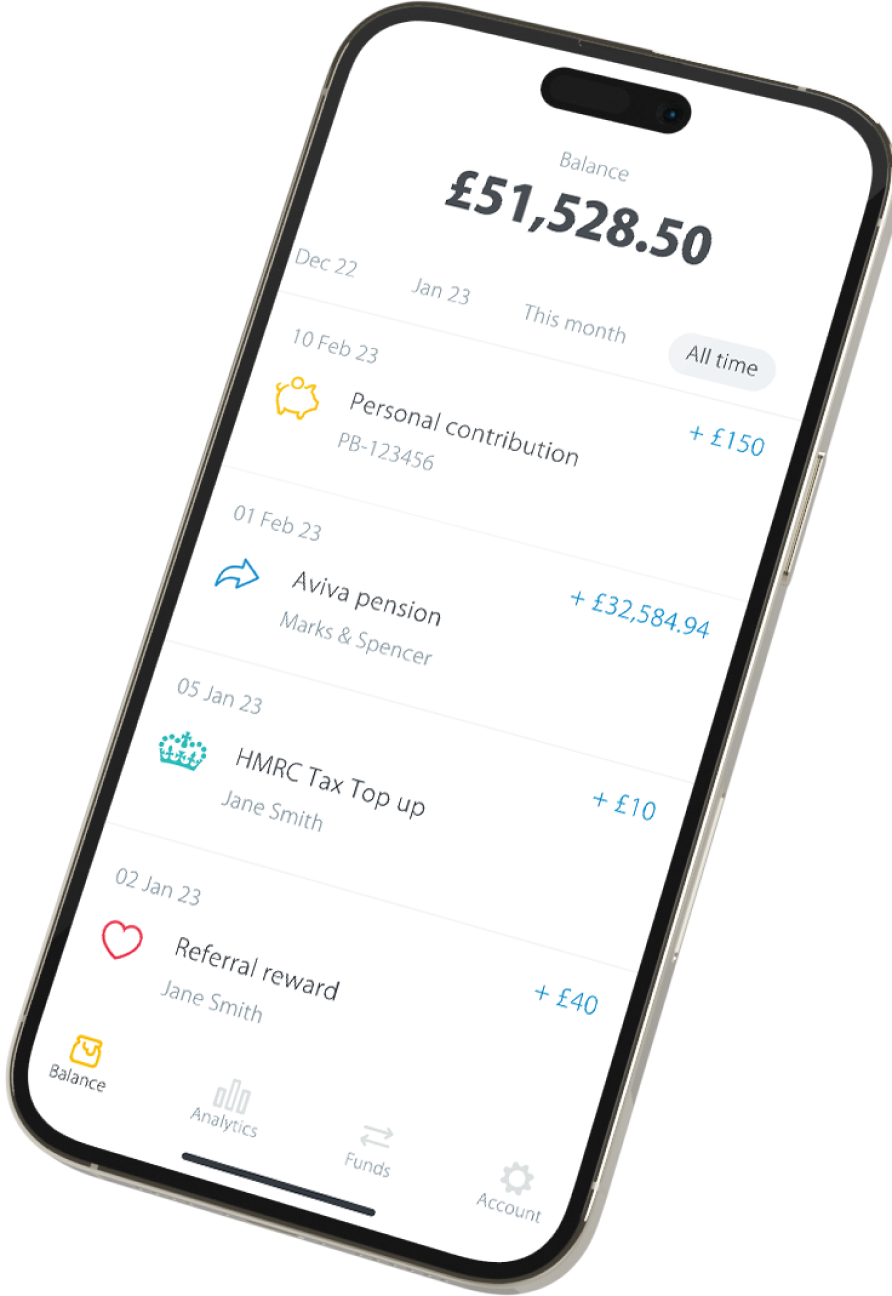
Period
Market Event
FTSE World TR GBP (%)
4Plus Plan (%)
4Plus Plan’s inception – 6 Sept 2013
QE Tapering, China Interbank Crisis and its aftermath
-5.44
-2.41
3 Oct 2014 – 15 May 2015
Oil price drop, Eurozone deflation fears & Greek election outcome
-5.87
-1.77
7 Jan 2016 – 14 Mar 2016
China’s currency policy turmoil, collapse in oil prices and weak US activity
-7.26
-1.54
15 June 2016 – 30 June 2016
BREXIT referendum
-2.05
-1.07
Period
Market Event
FTSE World TR GBP (%)
4Plus Plan (%)
4Plus Plan’s inception – 6 Sept 2013
QE Tapering, China Interbank Crisis and its aftermath
-5.44
-2.41
3 Oct 2014 – 15 May 2015
Oil price drop, Eurozone deflation fears & Greek election outcome
-5.87
-1.77
7 Jan 2016 – 14 Mar 2016
China’s currency policy turmoil, collapse in oil prices and weak US activity
-7.26
-1.54
15 June 2016 – 30 June 2016
BREXIT referendum
-2.05
-1.07
Popular

Ready to boost your retirement savings?

Ready to boost your retirement savings?

Every contribution counts towards a more comfortable retirement. When your pension is in a good place, you’re in a good place.
Combine your old pensions into one simple plan
Invest with one of the world’s largest money managers
Make paper-free online withdrawals from the age of 55
Pay just one simple annual fee
  • Sign up in minutes
  • Transfer your old pensions into one new online plan
  • Invest with one of the world’s largest money managers
  • Pay just one simple annual fee
Capital at risk
Button with Google Play logo and text 'Get it on Google Play' on a black background.
No items found.
Capital at risk

Choose a self-employed pension that puts you in the driving seat

Sign up to our flexible pension plan for the self-employed and contribute as much or as little as you like, as often as you like.
Get started
When investing, your capital is at risk