










.jpg)
Members of Parliament (MPs) are individuals elected by the UK public to represent their interests and concerns in the House of Commons. They play a key role in governing the country, proposing and designing new laws, and raising issues that matter to the public.
But how are the UK’s politicians compensated for governing?
In 2026/27, the Prime Minister of the UK can expect to earn around £169,344, with Cabinet Ministers earning close to £166,104.
But the financial benefits don’t stop there. Like many public sector workers, MPs will also receive a generous defined benefit pension when they retire.
How much do politicians get paid?
There are two parts to consider when looking at how much MPs are paid: their salaries, and their pensions.
MPs’ salaries
MPs’ pay increases annually. That’s based on the changes in average earnings in the public sector, as recorded by the Office for National Statistics (ONS) figures.
As of April 2026, MPs receive a basic annual salary of £98,599.
Ministers in the House of Commons receive an additional ministerial salary.
For example, a Cabinet Minister could receive an extra £72,454. Of this, the claimed amount - that’s the amount ministers actually take - is only £67,505.
That takes their total pay to £171,053, of which they’re claiming £166,104.
This applies to several high-ranking roles in government, including the:
- Chancellor of the Exchequer;
- Secretary of State; and
- Lord Chancellor.
Meanwhile, the Prime Minister (PM) can get a further £80,807. However, they only claim £75,440 of this.
That makes the PM’s salary £174,711, of which they take £169,344.
MPs’ pensions
MPs are enrolled in a defined benefit pension scheme.
That differs to most modern workplace and personal pensions which are defined contribution pensions. In these schemes, what your pension's worth on retirement depends on how much money you’ve contributed and the performance of your investments.
Defined benefit pensions that MPs get work differently.
Employees and employers both still pay in. The difference is that, with defined benefit pensions, you’re guaranteed a set retirement income - typically for life - regardless of how the underlying investments perform.
That income's determined by factors such as how much you earn and how long you work for that employer.
In 2015, alongside other public service pension schemes, the MPs’ Parliamentary Contributory Pension Fund (PCPF) was reformed.
Before this, their defined benefit pensions were based on an MP’s final salary. Now, they’re calculated based on their average salary over their career.
Additionally, the age at which MPs' pensions become payable has been aligned with the State Pension age (66, rising to 67 from 2028). That’s instead of a fixed retirement age of 60 or 65.
What would MPs have in a defined contribution pension?
MPs have the privilege of defined benefit pensions. But if they paid into a defined contribution pension, like lots of workers in the UK, it’d be different.
Most workers these days are auto-enrolled into their workplace pension. Under Auto-Enrolment, employers are legally obliged to enrol eligible employees if they:
- work in the UK;
- are between 22 and State Pension age;
- earn more than £10,000 a year; and
- aren’t already a member of a suitable workplace scheme.
If you earn less than £10,000 but more than £6,240, you can ask to join the scheme and your employer is obligated to enrol you.
When new starters who meet the criteria join a business, they’re automatically enrolled, rather than having to opt in.
Employees then pay a minimum of 8% of their ‘qualifying earnings’ into the pension - that’s between £6,240 and £50,270. Of this, their employer must pay at least 3%.
So what might it look like if MPs had a defined contribution pension instead?
The table below shows what MPs would pay into this type of scheme if they contributed the minimum required under Auto-Enrolment, and how much they might have in their pension as a result.
Figures calculated using the PensionBee Pension Calculator. Assumes politicians enter parliament at 35 with £20,000 already saved, a retirement age of 67, 5% annual investment growth, 2.5% annual inflation, and a 0.7% annual management fee.
PensionBee’s Pension Landscape report found that the average pension pot size at 66 is £88,444. So, MPs would have more than double this if they only contributed the minimum under Auto-Enrolment.
Of course, they could increase their personal contributions, boosting their pot further. And, some employers match pension contributions if you increase yours.
Making bigger contributions outside of Auto-Enrolment can help you build an even bigger pension.
Who decides what MPs get paid?
The Independent Parliamentary Standards Authority (IPSA) is responsible for MPs’ pay and pensions. But this wasn’t always the case.
Parliament used to be in control of their own compensation. MPs would speak to experts, such as the Senior Salaries Review Body, then vote on whether their salaries increased.
But then, in 2005, the Freedom of Information Act 2000 came into effect, leading campaigners to request details of MPs’ expenses. This began the slow unravelling of the 2009 MPs’ expenses scandal.
In response, the government announced the creation of IPSA, which came into effect in 2010. Now, IPSA makes decisions on the pay, pensions, and reasonable expenses of the 650 elected MPs and their staff in the UK.
How to kickstart your pension savings
While we wouldn’t necessarily recommend you become a politician, there are lots of other things you can do to boost your pension savings.
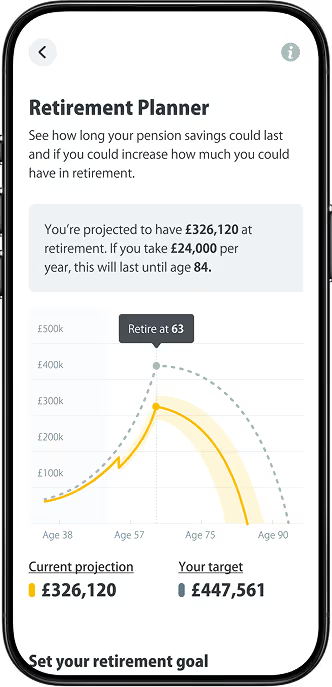
PensionBee’s tools can help you plan ahead for retirement. Use the Pension Calculator to see how long your savings could last, and how adjusting contributions might affect your pot.
If you feel there’s a gap between your projected and desired retirement income, you can consider combining your old pensions and contributing to your pension to boost your savings.
Risk warning
As always with investments, your capital is at risk. The value of your investment can go down as well as up, and you may get back less than you invest. This information should not be regarded as financial advice.
Period | Market Event | FTSE World TR GBP (%) | 4Plus Plan (%) |
|---|---|---|---|
4Plus Plan’s inception – 6 Sept 2013 | QE Tapering, China Interbank Crisis and its aftermath | -5.44 | -2.41 |
3 Oct 2014 – 15 May 2015 | Oil price drop, Eurozone deflation fears & Greek election outcome | -5.87 | -1.77 |
7 Jan 2016 – 14 Mar 2016 | China’s currency policy turmoil, collapse in oil prices and weak US activity | -7.26 | -1.54 |
15 June 2016 – 30 June 2016 | BREXIT referendum | -2.05 | -1.07 |











%201.png)